Entrepreneurship and business planning - ch 9
 Call Kai
 Learn
 Practice Test
 Spaced Repetition
 Match
 Flashcards
 Knowt Play
1/25

There's no tags or description
Looks like no tags are added yet.
26 Terms
What is the liability of newness, and how does the risk of failure change as a venture grows older?
The liability of newness refers to the challenges and higher risk of failure faced by newly established organizations.
New ventures face their highest risk of failure at the very beginning of their life cycle.
This risk decreases significantly as ventures become older.
New organizations lack established routines, relationships, and experience operating together.
The slides refer to Stinchcombe's theory and research by Yang and Aldrich (2017).
According to Yang and Aldrich (2017), what factors influence the survival of new ventures?
Survival depends more on how much entrepreneurs learn during the organizing process than on how much previous experience they have accumulated.
Additional financial capital and experience in the relevant industry, management, and start-ups are also relevant factors.
A venture's history partly shapes its future possibilities.
Important MCQ distinction: Learning during the organizing process is emphasized more strongly than accumulated previous experience.
What is a new-venture team, and what are its main components? 7
A new-venture team is a group of founders, key employees, and advisors who move a new venture from an idea to a fully functioning firm.
According to the diagram on slide 4, its components include:
Founder or founders
Management team
Key employees
Board of directors
Board of advisors
Lenders and investors
Other professionals
What percentage of new ventures are started by more than one person, and why does the quality of the founders matter?
50–70% of new ventures are started by more than one individual.
The characteristics of founders and their early decisions significantly influence how the new-venture team develops.
Both the size and quality of the founding team are important.
What are the three main advantages of starting a venture as a team rather than alone?
More talent, resources, and ideas: Team members bring different abilities and contributions.
Broader and deeper networks: Teams provide more social and professional contacts.
Psychological support: Cofounders can support each other through the difficulties of starting a business.
What are the main disadvantages of starting a venture as a team?
Team members may not get along.
Equal founders may disagree when a formal organizational structure is established and one person must become CEO.
Founders with similar expertise may duplicate rather than complement each other's abilities.
Founders may disagree about work habits, risk tolerance, passion, how the company should be managed, and other important decisions.
What is a dynamic equity split agreement, and why might a founding team use one?
A dynamic equity split agreement allows ownership shares to be adjusted according to founders' contributions over time.
It can help address differences in contributions involving work, resources, responsibilities, or commitment.
The slides mention dynamic equity split agreements as a consideration for founding teams but do not explain their detailed mechanics.
What are the four preferred attributes of sole entrepreneurs and new-venture team members?
Higher education
Prior entrepreneurial experience
Relevant industry experience
Broad social and professional network
How do higher education and prior entrepreneurial experience benefit founders?
Higher education: Enhances entrepreneurial knowledge and skills.
Prior entrepreneurial experience: Helps founders avoid costly mistakes because they have previously experienced the challenges involved in establishing or operating a venture.
Why are relevant industry experience and broad social and professional networks valuable to entrepreneurs?
Relevant industry experience provides better-established professional networks and applicable skills, including marketing and management.
Broad social and professional networks provide potential access to additional know-how, capital, and customer referrals.
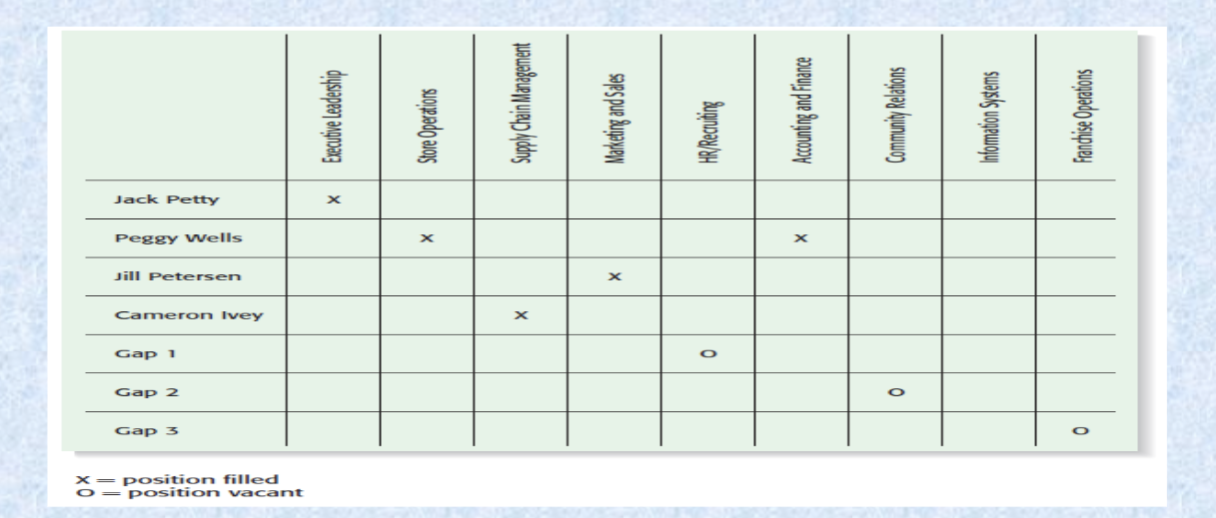
What is a skills profile, and why is it important when building a management team?
A skills profile is a chart showing the most important skills required by a new firm and identifying where skills gaps exist.
It helps entrepreneurs:
Identify skills already available within the team.
Recognize missing expertise.
Determine which positions or capabilities must be added.
What does the skills profile example on slide 8 show, and how are filled and vacant positions indicated?
the chart compares employees with important business functions, including:
Executive leadership
Store operations
Supply chain management
Marketing and sales
HR/recruiting
Accounting and finance
Community relations
Information systems
Facilities operations
X = position filled
O = position vacant
The example identifies vacancies in HR/recruiting, community relations, and facilities operations.
What types of workers can a new venture use to build its team?
Employees
Interns
Freelancers or independent contractors
Virtual assistants
These arrangements give a new venture different ways to obtain the labor and expertise it needs.
What is a board of directors, who elects its members, and what types of directors can it include?
A board of directors is a panel of individuals elected by a corporation's shareholders to oversee the management of the firm.
It can include:
Inside directors: Individuals who are also involved in the company, such as executives.
Outside directors: Individuals who are not part of the company's day-to-day management.
The slides mention Guberna and Women on Board as related organizations.
What are the three general roles of a board of directors?
Formal governance responsibilities:
Appoint the firm's officers.
Oversee the corporation's affairs.
Participate in strategic decision-making and long-term goals.
Provide guidance to the firm's management.
Lend legitimacy to the firm through signaling.
How does a board of directors add value through guidance and legitimacy?
Guidance: Although a board has formal governance responsibilities, one of its most useful functions is providing advice, guidance, and support to management.
Legitimacy: Well-known and respected board members increase a firm's credibility.
This credibility effect is referred to as signaling.
What are the three main categories of professional advisors that help complete a new-venture team?
Board of advisors
Lenders and investors
Other professionals, including attorneys, accountants, and business consultants
They provide expertise, resources, and support beyond those available within the founding team.
What is a board of advisors, and what are its main characteristics?
A board of advisors is a panel of experts invited by a firm's managers to provide counsel and advice on an ongoing basis.
Its characteristics include:
Provides nonbinding advice.
Has no legal responsibility for the firm in its advisory role.
Can be established for general purposes or a specific issue.
Usually requires less time commitment than a board of directors.
Provides guidance and credibility.
What are the main differences between a board of directors and a board of advisors?

Why might an individual prefer serving on a board of advisors instead of a board of directors?
It generally requires less time.
There is no potential legal liability associated with the advisory role described.
Advisors can contribute expertise without assuming formal governance responsibilities.
Why do lenders and investors become involved in new ventures, and what three general roles do they perform?
Lenders and investors have a vested interest in the ventures they finance, motivating them to help those businesses succeed.
They can:
Become actively involved in supporting the firm.
Provide guidance and advice.
Provide financial oversight.
What are the nine ways lenders and investors can add value to a new venture beyond simply providing capital?
Help identify and recruit key management personnel.
Provide insight into markets the venture plans to enter.
Help fine-tune the business model.
Serve as a sounding board for new ideas.
Introduce additional sources of capital.
Serve on the board of directors or board of advisors.
Recruit customers.
Help arrange business partnerships.
Provide a sense of stability and calm.
Why can lenders and investors help improve the credibility and development of a new venture?
Their involvement can provide:
Valuable industry and market knowledge.
Access to professional networks and financing.
Guidance on business models and management decisions.
Help with recruiting, customers, and partnerships.
Financial oversight and organizational stability.
Their value therefore extends beyond financing.
Which other professionals can be part of a new-venture team, and what is a business consultant?
Other professionals include:
Attorneys
Accountants
Business consultants
A business consultant is an individual who provides professional or expert advice to a company.
The slides give examples such as large consulting firms (the Big Four) and freelance consultants.
What are the two main categories of business consultants, and where can new ventures find them?
Paid consultants: Professionals or firms that charge fees for their advice and services.
Free or reduced-cost consultants: Advisors available through nonprofit organizations or government agencies.
The slides mention VLAIO, European Union initiatives, and potentially students as sources of lower-cost assistance.
Why might a new venture use consultants instead of relying entirely on its founding and management team?
Consultants provide professional or expert advice in areas where the venture may need additional knowledge or capabilities.
They can help address specific problems or skills gaps without requiring the company to rely exclusively on its existing team.
Consulting services may be paid or available at reduced cost through support organizations.