MICI 3119 Prokaryotes Midterm 2
 Call Kai
 Learn
 Practice Test
 Spaced Repetition
 Match
 Flashcards
 Knowt Play
1/184

There's no tags or description
Looks like no tags are added yet.
185 Terms
What is a synthetic living cell? What are some examples?
now know how to make genetic code
can build green blocks add them together to make a genome in a synthetic cell
ex:
Taxol: anti-cancer treatment, natural product from a tree, found in amazon and being burnt down, ability to grow this tree to make the precursors for taxol is more difficult but now know the genes needed to make taxol and can clone these genes and make the biosynthetic pathway in E. coli, grow the bacteria in controlled conditions
S-reticuline is a precursor for morphine, comes from poppy seeds, can now make morphine in fermenters from glucose

What is the central dogma of molecular biology?
all organisms have a process where these macromolecules are part of it

What are the general features of bacterial replication?
1. Bacterial genomes are circular
2. DNA synthesis is semi-conservative (only one strand is copied)
3. Meselson and Stahl proved this in “the most beautiful experiment in biology”
bidirectional replication: start at an origin and fork- both have leading and lagging strands moving away from each other

What was Meselson and Stahl’s experiment?
use two types of nitrogen heavy and light
new strand being added in with N14
First is N15 and then replicated and the growth added was the N14

What is fidelity in DNA replication?
if blueprint is damaged→ unreliable mechanism for replication
organism protects blueprint by having error prevention mechanisms
MMR: mismatch repair: cells will repair and fix the mismatch (exonuclease-cut and repair damage)
replication fidelity is 10^-10 = low frequency of error

What are the key points of DNA replication?
1. DNA polymerases add nucleotides to the 3’ end
2. DNA polymerases can only extend existing nucleic acid chains (can’t make new ones)
3. DNA synthesis begins at the origin and proceeds bidirectionally
4. DNA synthesis is continuous on leading strand
5. Lagging strand is made in pieces that are then put back together
What are the important proteins of DNA replication?
Primase (DnaG) RNA polymerase-makes RNA primer
Polymerase III (DNA): The workhorse polymerase, has proofreading activity
DnaA Binds ori begins open complex
SSB Single stranded binding proteins-keep open complex open
Polymerase I Replaces RNA primer ribonucleotides with deoxyribonucleotides
DNA ligase Links Okazaki fragments together
Helicase (DnaB) Unwinds the DNA ahead of the replication fork
Tus Binds Ter. Blocks replisome until the other one shows up
Replisome Complex of proteins that make up the replication fork
HU Histone-like protein that helps DnaA bind the ori
What are the early steps of replication?
Formation of open complex
1. DnaA binds specific sequences in oriC (with help from histone-like protein HU)
2. DNA unwinds (stands separate) in an ATP-dependendent manner
3. SSBs bind to keep open complex open
Prepriming Complex
1. DnaB (helicase) binds to both ends of open complex
2. This gives two replication forks going in opposite directions

What are the features of DNA priming?
1. Primase binds and makes 12 nt piece of RNA
2. Now DNA Polymerase III can initiate DNA synthesis, adding deoxyribonucleic acids one at a time to 3’ end of chain
3. Extension occurs continuously on leading strand
4. Synthesis of lagging strand is made in pieces called Okazaki fragment
helicase unwinds double helix
direction of replication is 5’ to 3’
ligase stitiching okazaki fragments
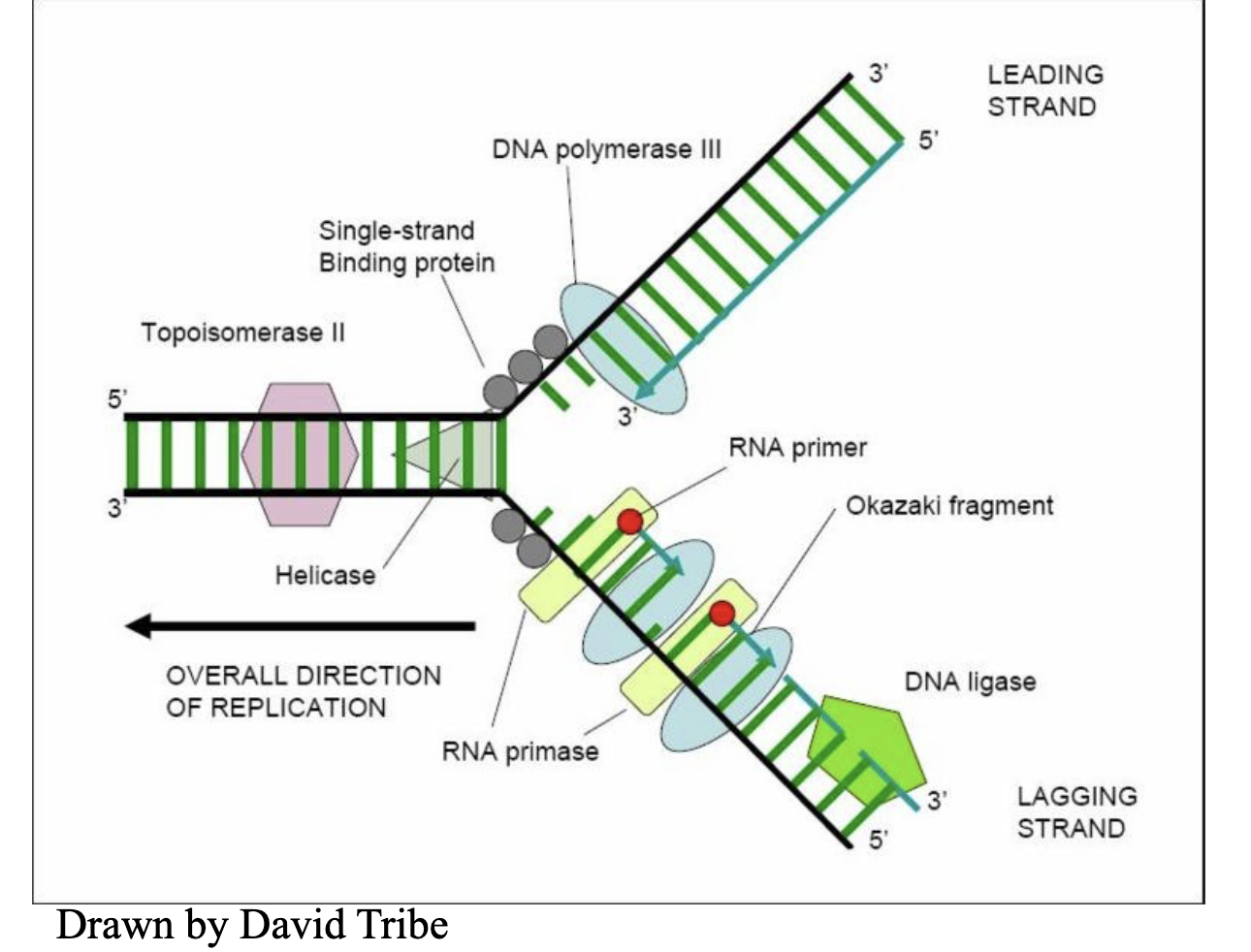
What are the features of Okazaki fragments?
1. Same steps as for synthesis of leading strand: RNA primer, Polymerase III
2. Okazaki fragments are usually about 1000 bp
3. Polymerase III stops when it reaches last RNA primer
4. RNA primer is removed by Polymerase I (5’ to 3’ exonuclease activity)
5. Break is sealed by DNA ligase
exonuclease: needs to remove the RNA because it doesn’t belong with the DNA
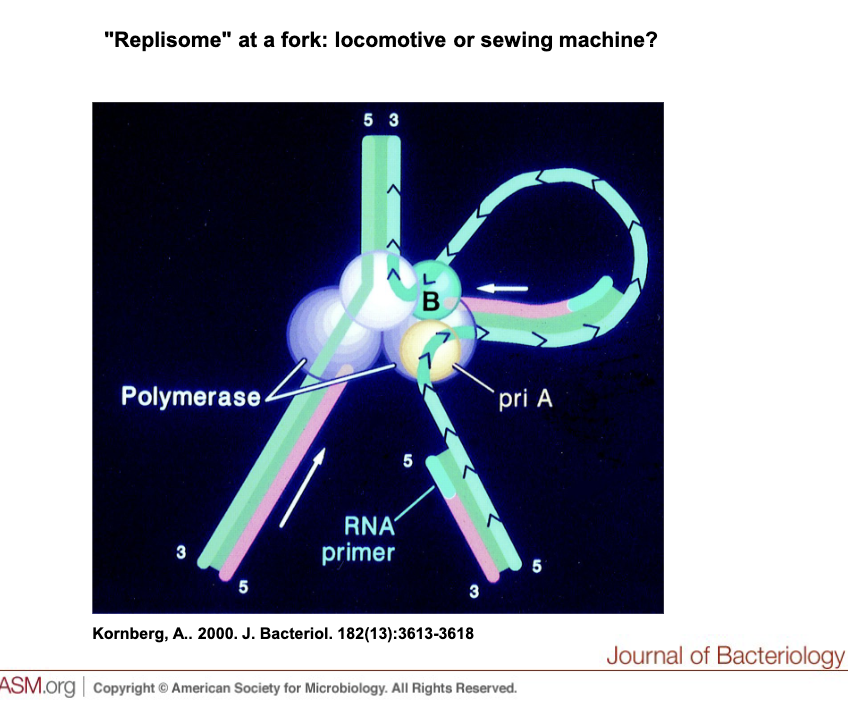
What are the features of the replisome structure?
like a sewing machine
lagging strand in a loop kept near the replication fork and the okazaki fragments are closer to it
What are the features of termination of replication?
Tus binds Ter
Ter allows one-way replication
Ter stops Replisome: it is thought to stop the helicase DnaB
Other replisome shows up and dislodges Tus
Replication is done
Chromosomes end up “tangled”. The 2 chromosomes can be resolved through recombination or by decantenation. Decantenation after replication is resolved by Topo IV.
Tus helps with the collision of machinery on lagging and leading strand
Ter is like a stop sign

What happens when chromosomes get tangled during replication?
During replication the chromosomes can get tangled together and
form dimers.
Dimers are resolved by site specific recombination at dif sites
The dif sites are lined up by FtsK which is localized to the septum
and activate XerC/D
XerC/D are the recombinase that act on dif sites
dif sites are on the chromosome (sequence sites)

What are the features of DNA supercoiling?
1. DNA duplex is a right handed helix
2. 10.5 bases per turn
3. Overwinding = positive supercoiling, underwinding = negative supercoiling
4. DNA gyrase introduces negative supercoils
5. Topoisomerase removes supercoils
6. Supercoiling is energy stored in DNA molecule as “twist” or “writhe”
7. Superhelical tension can be used to aid processes (packaging, open complex formation, etc).
What are the features of topoisomerases?
Enzymes that introduce or relieve supercoils by breaking the phosphate bond of DNA
1. Topoisomerase I removes supercoils
2. Gyrase: introduces supercoils
3. Topoisomerase IV: removes catenations. This is especially important during replication to resolve the replicated chromosomes.
inhibiting DNA gyrase was a good target
bacteria fought back against ciprofloxisin (?)
bacteria underwent mutation gyrase still works but works slowly, doesn’t work well but works enough for the cell to survive

What is Phage vs Anti-Phage biology (also known as) Anti-host defence vs host defence (broadly)?
phages: viruses that infect bacteria
race between phages and hosts fighting back
phages can sometimes cure antibiotic resistant bacteria → phage therapy tailored and bacteria find mechanisms to fight back against the phage
What is the common mechanism of a phage into a cell? What are some host defenses once phage enters cell?
phages usually attach to some molecule on the bacterial surface
ex: LPS (many phages use the sugars on LPS as an exact target for their target they are trying to infect) response →biofilm (hiding and masking LPS), change the O-antigen mutate it (pseudomonas does this smooth and rough LPS -resist phage attachment)
E. coli has restriction enzymes → EcoR1 when phage injected into cell the bacteria will destroy it with EcoR1
restriction enzymes are one of the more common defense mechanisms of bacteria against phages

What are the features of restriction enzyme response to phage?
bacteria have restriction modification systems : yellow nucleic acid degradation (CRISPR-Cas restriction modification system for bacteria- fights against phages this is the bacterias immune system, CRISPR-cas adapts→ adaptable immune system, captures signals of the phage so the immune response has a degradation response against the phage)
Phage anti-defences (many) talk about one today
→phages need host, under selective evolutionary pressure as bacteria try to get rid of the phage, phages try to fight it
(molecular arms race)
phage encoded defenses (evolve over time) target bacterial defenses so the phage can replicate and create cell lysis
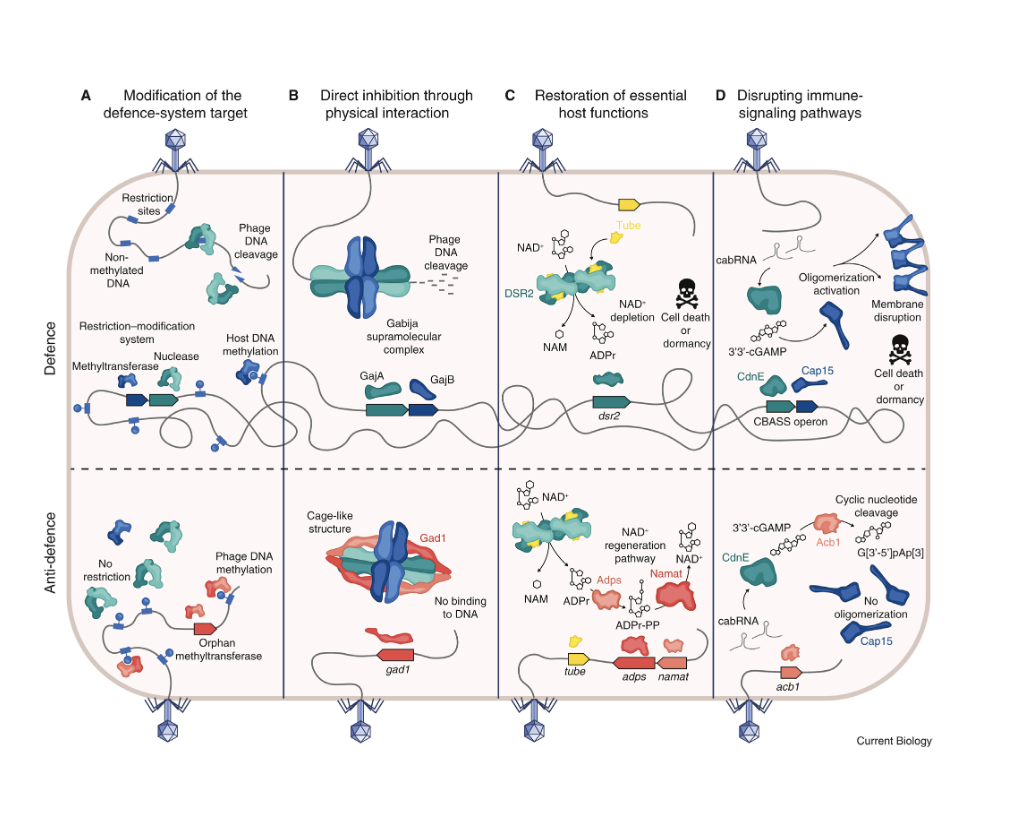
What are four ways a cell defends against a phage?
Modification of the defence-system target
Direct inhibition through physical interaction
Restoration of essential host functions
Disrupting immune-signalling pathways
top= bacterial defense system
bottom is anti-defense
don’t need to memorize just know diversity of systems out there 1. bacteria creates defence 2. phage fights back
What are restriction modification systems?
Bacterial enzymes that recognize a specific sequence and cut the DNA phosphate backbone (polymer)
→EcoRI (GAATTC)
→Sequences are usually palindromic
Host DNA is not cleaved due to methylation at the specific sequence, a process carried out by DNA methylases
→Bacterial DNA is hemi-methylated after replication and is fully methylated afterwards
Consequence is destruction of the invading phage genome
→Only targets dsDNA phages
bacteria replicate DNA→ it is hemi-methylated will be fully methylated upon completion of the chromosome
ECORI does not cleave the sequence that is modified but most phages don’t have methylation and only dsDNA are cleaved
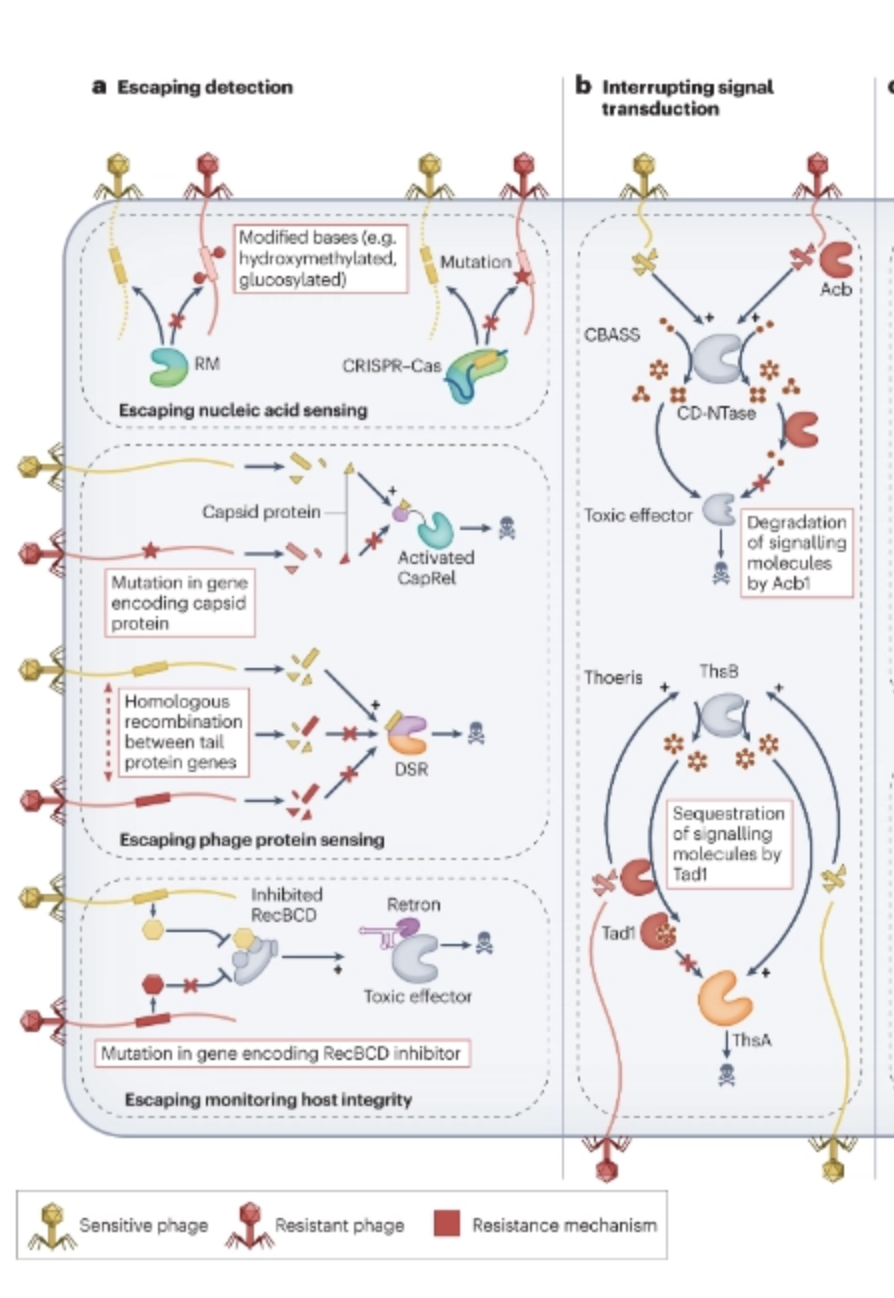
What is CBASS? What does it do?
CBASS, working in signal transduction
Cyclic oligonucleotide-based sensing system (CBASS)
Bacterial enzyme (CD-Ntase) generates cyclic nucleotides such as cGMP-AMP (think multimers)
These cyclic nucleotides activate bacterial enzymes (effectors) that can act as nucleases and phospholipases [?]
Results in bacterial cell death and therefore abortive infection (Altruism)
phospholipases: targets phospholipids (membrane)
image:
b. (top half) degradation of signal molecule phage enters but cannot do its task
→phage evolve, if seen bacterium enough can escape it
Acb promotes survival of the host and escapes the cell altruism
phage escapes detection/ anti-defense
What are the features of altruism in bacteria?
altruism: evolutionary context → loss of one can benefit the greater amount, the cell is dead and the phage can’t replicate
altruistic behaviour tends to occur in clonal populations
What are the features of escaping detection (Anti-defense)?
Some phages encode their own DNA methylases or co-opt bacterial methylases so that the incoming phage DNA is not cleaved
by restriction enzymes
Consequence: phage genome is intact and can perform its normal function leading to phage propagation
Mutated phage DNA sequence (GAATTC to GAATAC)
The target of the restriction enzyme is changed and therefore the phage genome remains intact. Might be at low frequency or stochastic, yet beneficial and selected by survival and phage fitness.
What are the features of Anti-CBASS?
Phage encodes an enzyme that degrades cyclic nucleotides!
This results in limited or greatly reduced signal transduction
Less endonuclease, less phospholipase, therefore reduced activity towards bacterial cell death (delays abortive infection)
Consequence: allows phage genome replication and protein function, towards phage survival
Can phage therapy be a practical solution to the ‘superbug’ problem
(drug resistance)? Yes or no?
phages can resist bacterial defenses
may work may not work, will not work like drugs where target is known and knows how it works
some bacteria can develop resistance to these phages
issue is that it is not as reliable or predictive for therapeutic outcomes
What are the features of transcription?
• Bacteria synthesize mRNA at the level of transcription (as a process)
• mRNA in bacteria is generally unstable
• RNA polymerase can initiate new strand synthesis (DNA polymerase can only copy existing ones).
What is the architecture of a gene?
• Coding strand is the one that looks like the mRNA sequence (it has the codon sequence)
• The template strand is the one that is read
• By convention, we ‘write’ the sequence of the coding sequence (careful here.....)
both strands have genetic information
can have information on other strand

What are the features of initiation of transcription (structurally)?
• Sequences around -10 and -35 are the promoter region
• RNA polymerase (holoenzyme) consists of 5 subunits: a(2), b, b1, w, sigma (6 proteins)
• core polymerase can synthesize RNA
– Core is without sigma factor (4 subunits, or 5 proteins)
• Sigma subunit helps RNA polymerase recognize the promoter (specificity)
+1 is the transcriptional start site
-35 -10 is the promoter region

What are sigma factors?
• Sigma 70 is normal “housekeeping” sigma
• Alternate sigma factors recognize different promoter sequences
• Sigma 54 is slightly different from others
others give specificity for specific genes with certain roles

What are the features of promoter strength?
• Sequences at -10 and -35
– Usually the closer to the consensus sequence, the stronger the promoter
• Spacing between -10 and -35 is important
• Sequence of ‘spacer region’ can be important in some cases.
• e.g. extended -10 elements have a ‘TG’ box (~20% E. coli promoters).
• Taken together, these elements control frequency and strength of RNA polymerase binding.
TTGACA -- 17 – TATAAT consensus promoter
TTGATA -- 16 – TATAAT a strong promoter
CTGACG -- 18 – TACTGT a weak promoter
normally 17
default condition spacing is between the -10 and -35 (still called this name even if they can change a bit ex: -11)
spacing does matter, protein is recognizing landing spot and if the spot is off won’t bind as well weaker interaction
What is the process of initiation of replication?
• Polymerase holoenzyme binds promoter- “closed complex”
• DNA unwinds to form “open complex”
• Holoenzyme can form open complex
– Sigma 54 is a special case
• Ribonucleotides begin to be incorporated
– Uracil instead of thymidine for RNA

What is the process of DNA elongation?
• Sigma subunit dissociates
• There is a DNA-RNA hybrid of 18 nt as polymerase synthesizes the mRNA known as the transcription bubble
• Nucleotides begin to be incorporated

What is the process of DNA replication
replication fork, binding initiation
RNA chain elongating and sigma factor ejected
makes a single stranded RNA chain, will stop at termination factor

What is the process of termination of DNA replication?
• Intrinsic terminators
• Rho-dependent terminators
What are the features of factor independent termination?
– Result in secondary structures in newly made message that result in polymerase dissociation
hairpin allows polymerase to fall off
structure in mRNA itself
hairpin is stabilized by base pairs that are complementary to each other forms bc of the inherent sequence of the mRNA itself (based on inverted repetitions that allow the structure to form)

What are the features of Rho-dependent termination?
– Proteins bind to newly made message and moves up chain towards polymerase-DNA complex.
– Polymerase reaches a Rho-dependent termination sequence and stalls
– Rho catches up and polymerase dissociates
Rho acts together with sequence that stalls the polymerase
(gives Rho the chance to catch it)
What are the features of operons?
Genes encoding for proteins with related functions are often clustered together into operons
One promoter is used to make a mRNA that will be translated into multiple proteins
This type of message is “polycistronic”
only in bacteria and archaea
clusters it under one promoter
advantageous to encode genes in one mRNA (that has a short life) that have the function to ensure all made at the same time
one control switch for multiple
single promoter

What are the key components of transcription?
RNA Polymerase: Consists of 4 subunits: (a)2, b, b1 w
Sigma subunit: Binds polymerase to make “holoenzyme”
+1: Transcription start site-place where the 1st nucleotide is incorporated
-10 and -35 Promoter, where polymerase sits down
Open complex formation: Unwinding of the DNA double helix
Template strand: The DNA strand that is copied (read 3’ to 5’)
Coding strand: The DNA strand that looks like the mRNA that will be made
termination 2 types: rho dependent and factor independent
transcriptional start site is not the same as the translation start site
What are the features of translation?
• Ribosomes assemble on the mRNA
• Ribosomes recruit charged tRNAs and form peptide bonds between the amino acids that the tRNAs bring
• In bacteria transcription and translation are coupled
recruits charged tRNAs (specialized form) they carry the a.a.
Tc and TL coupled: happening at the same time in very close time and space to one another as the mRNA is being made, the ribosome can be bound to the mRNA during its synthesis (same compartment) (most useful for time and space)
key difference bacterial genes do not have introns (non-coding sequences) less editing that needs to happen
polysistronic mRNA multiple ribosomes can bind to one message
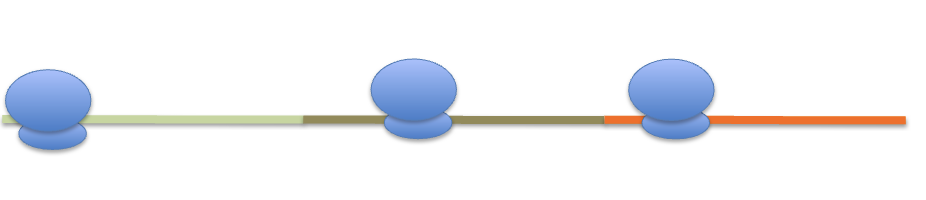
What are the features of ribosomes?
• Made of RNA and proteins
• Small subunit binds mRNA
• Large subunit provides enzymes needed to form peptide bonds
• Binds 5’ end of mRNA and starts to scan until it gets to first AUG “start codon”
• 2 sites for charged tRNAs
– P (peptidyl) site
– A (aminoacyl) site (where the new one comes)
What are the features of translation initation?
• mRNA is decoded in triplets: codons
• Codons pair with anticodons-regions of tRNAs
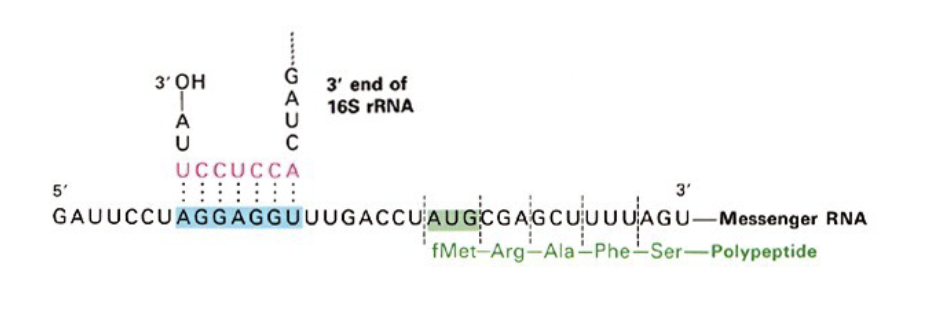
• Shine Delgarno sequence (aka ribosome binding site) is recognized by the 16sRNA in the small subunit of the ribosome (30s)
• Ribosome binds and starts scanning down message until it finds the start codon
• fMet tRNA binds start codon
pink is within the s ribosome
larger unit is 50s
don’t bind at start codon initially bind at ribosome binding sequence → upstream of the start codon
16S rRNA is highly conserved and utilized for phylogenetic trees, 16S cannot change very easily, very important for translation initiation = won’t change
What are the features of the genetic code?
genetic code= degenerate multiple codes = one a.a.
genetic change in 3rd position= no change (wobble position, most likely to switch but not change the a.a.)
change in 2nd position would change a.a

What does aminoacyl-tRNA synthetases (AARSs) do?
• aminoacyl-tRNA synthetases (AARSs) attach the correct amino acid to the tRNA
• the first amino acid is formylated-methionine (f-Met)
tRNAs are charged and couple with amino acid
charged amino acids= come into the ribosome and tRNA binds to mRNA and base pairs to achieve incorporation
a.a. being couple to tRNA

What are the features of translocation?
• Peptide bond is formed between tRNA at A site and peptidyl-tRNA in P site
• Uncharged tRNA leaves the P site
• Ribosome moves to the new A site
transfer reaction polypeptide goes to A site and then shifts along (needs energy) translocation, ribosome moves along mRNA
know A, P sites, can have mismatch or rejections, know it needs energy
ribosome can pause when something is wrong with RNA RNA hybrid
polypeptide chain is being transferred to next adjacent site covalent bonds being formed
E= exit where uncharged tRNA leaves

What is the process of making a protein?
RBS ribosome binding site
30s then 50s comes together
could sequence proteins to determine first a.a. (proof to show there is an alternate start codon- can happen)
ribosome slides along
can have multiple proteins from one mRNA if polysistronic (green and orange)
a.a not added to the stop codon -unmatched sequence no charged tRNA that can add a.a.

What are the features of termination: release factors?
Release factors bind stop codons and dislodge growing polypeptide chain.
The ribosome then disassembles.
RF1: recognizes UAG and UAA
RF2: recognizes UAA and UGA

What are the common themes in macromolecular synthesis?
• Initiation: protein machines are recruited to the correct place by specific sequences in the nucleic acid
• Elongation: the chain grows (polymerization)
• Termination; specific sites on nucleic acids act to disassemble the protein machines
– Often by recruiting specific proteins (Tus, Rho, RF)
What is attenuation?
mechanism to couple transcription to nutrient supply
– Don’t make genes for AA biosynthesis if you already have
plentiful access to the AACommon mode of regulation for amino acid synthesis
– First worked out in trp operon“leader sequence” codes for a peptide that functions as
the “attenuator”
- Lots of Trp: make leader, transcription halted
- Low Trp: do not make leader, transcription goes aheadConceptually similar to transcription termination
-information that alters the polymerase is in the mRNASecondary structure of the mRNA dictates if a ribosome can read the message or if it stalls
concept: don’t make genes for a.a. biosynthesis if already had access to a.a. in question
bacteria can make a.a. from scratch or if present in environment in plentiful amounts no need to make their own. Don’t spend energy on making own a.a. when already present. When not present need a signal to the cell to make the a.a., sensing environment and linking it to transcription process
leader sequence: a lot of Trp make the leader and then Tc is halted if making peptide Tl but operating at the level where Tc is halted.
leader sequence not made if a low Trp and then Trp biosynthesis initiation
secondary structures in mRNA that dictate if ribosome can read the message or stalls
What are the features of gene regulation?
mRNA made first needs to exist before and when being made it can form hairpin structures and base pair with each other
1 and 2 base pair with each other and 3 and 4 this is because regions in red could base pair with a region in yellow
-if not Trp around when trying to couple the Tc to Tl the peptide is made and reaches the Trp codons
to incorporate Trp in the ribosome need a charge tRNA with Trp but there isn’t any=stalls (pauses) now 1 and 2 can’t bind to one another now 2 and 3 bind to each other bc ribosome creates a kink bc it stalled due to lack of Trp= anti-termination structure (this doesn’t terminate Tc)
Tc and Tl are coupled and the presence of the codons causes either fast read through if a lot of them and terminate Tc or pauses bc no Trp around anti-termination and full transcription of operon to make Trp (can only occur is the process of Tc and Tl are coupled)

What is the difference between high Trp levels and low Trp levels?
High Trp levels:
• Message is read quickly
• Favors formation of terminatorLow Trp levels:
• Ribosome stalls
• Favors formation of antiterminator

What are the features of repressors and negative control?
• Proteins that bind DNA
• Bind to specific sequences called operators
• Repressors block binding of RNA polymerase to promoter
• Ability to bind DNA is often regulated by cofactors (such as sugars or other metabolites)
no Tc, protein blocks access to promoter RNA pol can’t work
regulated by cofactors (proteins are able to bind to sugars and bc of that impacts if system is repressed or activated)
What are the components of the lac operon?
LacZ B-galactosidase: cuts disaccharide lactose into glucose and galactose
LacY Permease: lets lactose into the cell
LacA B-galactosidase transacetylase
LacI repressor
P Promoter
Lactose inducer
IPTG artificial induce
lacI = gene name or italicized L (lower case l when writing the gene)
LacI= protein encoded by the lacI

What tools were available for the discovery of the lac operon?
• Mutants
– Constitutive
– Non-inducible
• Construction of “merodiploids”
– Allowed for complementation
• Assay for enzyme activity
– Could tell if gene was being expressed or not
• logic
constitutive: always on or always off
non-inducible: never induced
merodiploids: genetic complementation (when take gene away via mutation can sometimes reintroduce it to complement it back) take it out process doesn’t work add it back process works= gene essential for the process can also add in with slight changes
if damage site protein can perhaps not recognize the site and implicate the site in the process being studied
What are the features of the uninduced state of the lac operon?
• LacI binds operator
• No transcription
when genes not expressed
LacI protein is binding to the operator no Tc bc RNA poly can’t recognize promoter

What are the features of non-inducible mutants in the lac operon?
• lacZ
• LacI^s, repressor, can no longer bind lactose
remove lacZ gene= no way to make beta galactosidase
could also make mutant of LacI protein (use LacIs -modified repressor) can’t bind lactose
superrepressor unable to bind lactose and bc of that it binds to the operator and is stuck there system is repressed
LacI protein normally has lactose bound to it
LacIs superrepressor has mutation and different shape = can’t bind lactose
operator= cis
LacI = trans (can be made from different locus and work at different site)
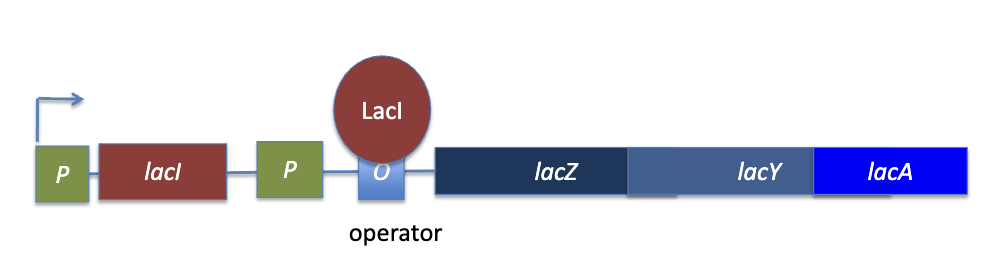
What are the features of the induced state of the lac operon?
• Inducer (lactose or IPTG) binds LacI
• LacI cannot bind operator
• Transcription of operon
induced state lactose is present or IPTG (similar to lactose)
LacI can’t bind to operator
RNA pol can access promoter and operon is transcribed
in presence of lactose the cell has sensed the ability to use this sugar and use it by occupying the repressor
when lactose binds to repressor it changes its conformation of LacI

What are the features of constitutive mutants in the lac operon?
• lacI: no repressor, no repression
• O c: repressor binding site damaged, LacI is made but can’t bind
always on
if mutate lacI gene remove it no longer expressed, no repressor
or
damage the site where LacI protein would bind → mutation on chromosome at operator site= Oc LacI is made but can’t bind
can still get promoter access and Tc can occur and the mRNA can be made

What are cis and trans mutations in relation to the lac operon?
• cis-acting locus - a genetic region affecting the activity of genes on that same DNA molecule
– example: lac operator
• trans-acting locus- encodes for a factor that can act elsewhere.
– example: LacI

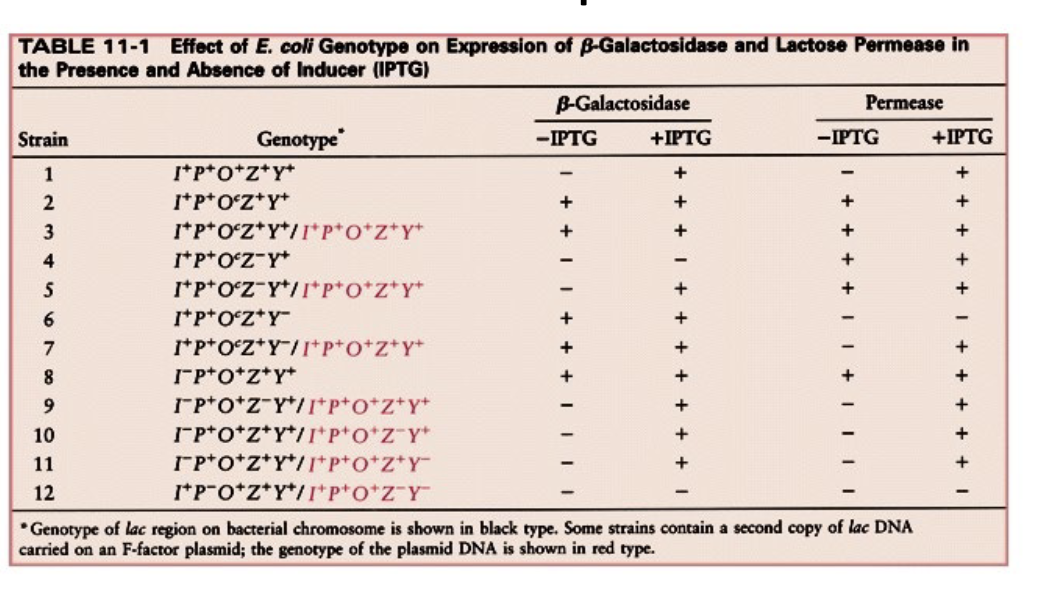
What are the results of lac complementation?
important concept: can take gene away and add it back in with complementation
IPTG= lactose
if it getting metabolized and what is being turned on or off
cannot complement an operator on a plasmid that is cis with a trans element
strain 12 certain conditions couldn’t get expression bc the operator being added in trans is not working (red)
figure out how system is turned on, turned off and what regulates the expression of the Lac operon
sugar binds to the repressor = cell knows when it needs to Tc
What are the features of activators- positive control?
• Proteins that bind specific sequences of DNA
• Make contact with RNA polymerase
• “Recruit” holoenzyme to promoters
• Classified by structure of DNA binding domain
green= ds helix (has a bend to it) conformational changes are occurring upon protein binding
domains in red binding to the major grooves of DNA → conformational change to the DNA
provides access to promoter region for RNA pol
What is the process of the complex made with MarA and DNA?
monomer 2 helices binding to the major groove 6 and 3 → creates bend in the DNA
Tc regulators alter DNA structure leading either to activation or repression event
positive control

What is the diauxic shift and catabolite repression?
• Cells use glucose first
• Presence of glucose represses many genes
• Glucose regulates the activity of adenylate cyclase which makes cAMP
• cAMP binds catabolite activator protein CAP
• CAP is an activator that recruits RNA polymerase to promoters that would not be turned on efficiently otherwise
most systems are primed to metabolize glucose first
will not upregulate every pathway to use the sugars all at the same time
1st prefered sugar then assemble the machinery to change to a different sugar → diauxic shift brought about by catabolite repression
cAMP binds to CAP → activator that recruits RNA poly that would not be turned on efficiently otherwise ex: lactose
Glucose and xylose: two phase to growth curve
lag, log stationary
no more glucose but there is xylose there is a lag and the genes for xylose metabolism are being made and then metabolism occurs = 2nd shift for xylose diauxic shift
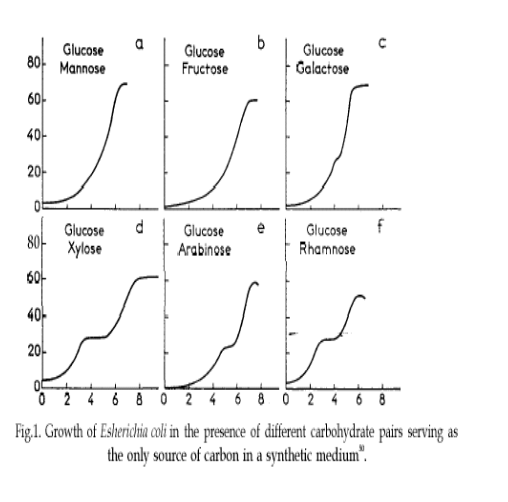
What are the features of positive control in the lac operon?
• Lac operon is subject to catabolite repression
• CAP binding site adjacent to promoter recruits polymerase for efficient transcription

What are the features of negative control: Trp repressor?
Another level of control for the trp operon
Operator region is bound by repressor
Repressor is only able to bind DNA when bound to Trp
Trp has repressor not attenuation
operator bound by repressor
repressor can only bind to DNA whne bound to Trp
sensing molecule as metabolite and then altering the synthesis of MMS

How does sigma 54 work?
• Sigma 54 – RNA Polymerase cannot form open complex on their own
• Need help of NtrC bound at “enhancer” sequences far upstream from promoter
Sigma 54 (spacing is different for this type of promoter -24 -12) cannot form open complex at the promoter needs enhancer sequence: NtrC binds upstream and far away but close in secondary structure
signal is being interpreted upstream and there is DNA looping event, structure of DNA →cis element being brought close to the site of the polymerase and Sigma factor to activate Tc

What are the different mechanisms of gene regulation?
• Positive control
• Negative control
• Attenuation
• Transcription cascades
• Alternate sigma factors
What are the features of plasmids?
• Extrachromosomal elements
– Usually circular
– Can be linear (rare)
• Can encode factors that allow growth in new environments
– Antibiotic resistance
– virulence
• Important because they can be shared among species
extrachromosomal= exists outside the chromosome (has primary content of essential for living cell)
plasmids are outside can sometimes integrate into chromosome
own origin of replication can move into different environments and cells
hard to study linear plasmids
antibiotic resistance tends to come from plasmids (can spread antibiotic resistance from one bacteria to another)
virulence factors that help the bacteria to be more virulent
plasmids move around and the genotype is shared (horizontal gene transfer through a plasmid can pass on antibiotic resistance to other species of bacteria)
What are colicins?
toxins that kill other bacteria that don’t have the plasmid you have
• Colicins are secreted by bacteria and kill other bacteria by forming pores or by entering and acting as nucleases
• Don’t hurt the host because the plasmid that encodes the toxin also makes the “immunity” product that neutralizes the toxin
• Colicin systems are encoded by plasmids
colicins found on plasmids
toxins that kill other bacteria that don’t have the plasmid that matches
pore forming toxins: colicins of Group A and kill other bacteria (competitive environment)
cell devision and plasmid not passed on the cell that doesn’t have plasmid will die bc the plasmid is not expressed
kills competitors and maintains the plasmid at the same time

What are high copy numbers?
• “Relaxed”
• Generally small size <10 kb
• ColE1 plasmid is best studied of this type. ColE1 make colicins that kill species related to E. coli
• Replication is unlinked to cell division
• Random partitioning
What are low copy numbers?
• “Stringent”
• Usually larger (can be up to 300 kb)
• R100 plasmid is model for this type
• Directed partitioning systems
• Often conjugative
– Allows “back up” mechanism for ensuring it is transferred to progeny
during growth of cell high copy can replicate on its own
no dedicated partitioning mechanism for high copy
low copy needs a mechanism to make sure each cell gets one (if there are few in cell and it splits not guaranteed it will end up in both cells)
conjugation
What are the features of Replication and partitioning in high copy plasmids?
• Progeny is assured of inheriting the plasmid because there are many copies
• Since replication is unlinked to cell division, copy number can be amplified by adding drug that inhibits protein synthesis (such as chloramphenicol)
– This is known as plasmid amplification
can stop cell division with chloramphenicol binds to ribosomes→ cell won’t divide bc needs the ribosome to make proteins for division but the plasmids can continue replication

What are the features of Replication and partitioning in low copy plasmids?
• Replication of plasmid linked to chromosome ensures at least 2 copies are present at time of division
• Specialized partitioning mechanisms help ensure plasmid is distributed to daughter cells
need partitioning mechanism to make sure each daughter cell has a copy

What are the features of Regulation of copy number?
• Often controlled by antisense RNA
• High copy number results in the expression of an antisense RNA that interferes with replication
ColE1: More plasmid results in more Rop and RNAI
Rop helps RNAI bind RNAII which is Required for plasmid
replication
done via RNA
Rop protein
if don’t have RNAII and is occupied by RNAI can’t replicate the plasmid anymore use antisense RNA

What are the features of Replication of R100 (more antisense)?
• RepA is required for initiation of replication at oriV
• CopB is a repressor of repA
• copA encodes antisense to 80-90 bp of the repA message
• When a plasmid enters a cell there is no CopB and little copA so you make lots of RepA until you achieve the copy number (C)
• R100 cannot coexist with related plasmids because the copA genes are similar. Therefore they will repress the replication of the related plasmid. This is plasmid incompatibility
What is plasmid incompatibility?
• Plasmids can regulate their own replication.
• The mechanisms by which they control their own replication can also control other plasmids in the same cell.
• In these cases, only one plasmid will be inherited.
• These plasmids are in the same “incompatibility group”
if a plasmid is already in a cell to prevent other plasmids from entering= plasmid incompatibility
plasmids of the same group do not exist together different plasmids with different mechanism can exist together because they are not in competition
What are the features of control of replication by DNA repeats (iterons)?
• “iterons” are repeated sequences (17-22 b)p of DNA
• RepA binds iterons and “handcuffs” 2 plasmids together
• These coupled plasmids cannot replicate again
– Tight control of plasmid copy #
• RepA can also handcuff related plasmids
– Another mechanism of plasmid incompatibility
iterons physical sites on plasmid DNA
RepA can bind to iterons and allows only one copy of replication
when cuffed cannot replicate again

What are the features of the RepA-iterons?
• RepA builds up and binds plasmids together
• “Handcuffed” plasmids do not get replicated
gene for RepA is encoded on plasmid→ expressed→ protein made →binds at cis element (iteron)

What are the features of plasmid stability?
• Naturally occurring plasmids are generally stable (they have been selected for that host)
• Artificial plasmids are often not stable
• 3 general phenomenon associated:
– Plasmid integrity
– Partitioning
– Differential growth rates
selection mechanism is the environment
plasmids can be loss if their environmental necessity is no longer there
keeping the plasmid when no longer needed comes at a cost
stability= has 3 features that contribute
What are the features of plasmid integrity?
• Plasmids often have insertion sequences or other recombination “hotspots” that allow for deletions or inversions
• One gene may be intact while others are lost or in a different orientation
sometimes can incorporate in chromosome
can be replicate into the daughter cell to ensure passed on to next generation
can have recombination and plasmid sequence can change
A→ B deletion ( no longer needed elements are loss)
A→ recombination

What are the features of toxin-antitoxin systems?
• Way to ensure plasmids are inherited
• Toxin can kill its host but doesn’t because of the presence of the antitoxin
• The toxin is usually stable and the antitoxin is less so.
• The result is that the antitoxin needs to be made all the time to keep up, so if the gene encoding it is lost (on the plasmid) the toxin can kill the host.
What are the features of partitioning systems 1?
CcdB-CcdA toxin-antitoxin system
• ccdB and ccdA are encoded on some low copy plasmids
• CcdB inhibits topoisomerase and kills cells
• CcdA binds CcdB and neutralizes it
need daughter cell to receive the plasmid
genes are encoded on low copy plasmid
because they are on plasmid means they need a plasmid to survive
CcdB-CcdA toxin-antitoxin system
• CcdA is less stable than CcdB
• Cells that don’t get plasmid don’t express CcdA and they die

What are the features of partitioning systems 2?
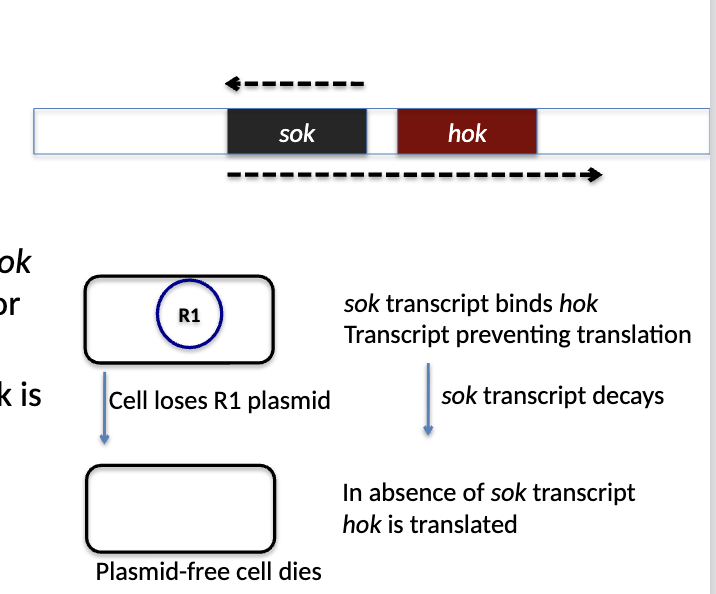
sok and hok
• hok encodes protein that is toxic to host (host killing)
• sok makes antisense RNA that prevents hok translation (supressor of killing)
• If plasmid is lost, Hok is made and cell dies
antisense RNA bind to the hok mRNA and prevents translation
if plasmid is lost hok will kill the cell
need the plasmid for the cell to survive
What are the features of differential growth rates?
• Expression of many genes from a large plasmid is a burden if these genes are not required
• Selection pressure to lose plasmid
• Facultative pathogens are good examples
– Shigella virulence plasmid is 200 kb
– High expression of virulence plasmid genes at 37oC
– Plasmid is lost at high rate if virulence is not required
context matters where it is found if can’t infect it will lose the plasmid
What are the features of Plasmid structure replication, maintenance,
incompatibility?
• Plasmids can be high or low copy number
• Many mechanisms exist to ensure their propagation
– Specialized replication mechanisms
– Partitioning systems that kill host if they do not inherit plasmid
– Ways of getting rid of other plasmids (incompatibility)
• Plasmids do not always get along
• Plasmids in the lab can be unstable
– Plasmids can be lost and plasmids can rearrange in many ways
– Plasmids are very useful in the lab but their peculiarities must be kept in mind to wield their full power
plasmid in lab unstable can add antibiotic to create stress and ensure those with the plasmid will survive and those that don’t won’t
What are the features of plasmid transformation?
• Uptake of naked DNA
• Griffiths experiment used transformation to show DNA was genetic material
• Some strains are naturally “competent” to take up DNA
• In other cases, cells can be made chemically competent
• More desperate ways to transform DNA:
– bolistic transformation: Shoot in DNA on gold particles
– electroporation: Shock in the DNA using a capacitor
another way of how DNA gets around → Transformation
naked DNA= not membrane enclosed outside in the environment
can pass on information from just DNA onto another strand
some DNA strains are naturally competent but can be made competent (some are good at uptaking DNA)
DNA: sugar, carbon, nitrogen, phosphorous, oxygen
some cells import DNA if naturally competent and break it down and assimilate the elements for other purposes
not all DNA is good invading DNA can be dangerous to chromosome some cells have systems that prevent entry of DNA entry into cell (over come this with bolistic transformation or electroporation)
bolistic done with plants bc they have thick cell wall
electroporation shock DNA and force destabilization of membrane to allow DNA entry
What are the features of competence?
• Naturally competent bacteria become competent in response to growth phase (usually late log phase)
• In some cases, competence is linked to diffusible factors (quorum sensing)
• In some cases, cells have proteins that bind preferred DNA sequences (usually from relates or same species). Examples are Neisseria and Haemophilus spp.
• Naturally competent bacteria have dedicated structures and systems to allow for uptake of DNA
• DNA enters as a ssDNA molecule
biological context: the ability to take up DNA
can make them competent by adding salts and competency buffers
not all DNA is desirable phage or transposon can damage cell DNA
What are the types of recombination?
Site specific recombination
Homologous recombination
What are the features of site specific recombination?
occurs at particular DNA sequences recognized by enzymes that
recognize said DNA sequences and catalyze recombination with a specific recipient DNA
What are the features of homologous recombination?
(general recombination) occurs between DNA sequences
that are homologous -- that is, the two DNA sequences are nearly identical. Homologous recombination requires RecA.
What is the difference between reciprocal crossover and non-reciprocal crossover?
on top blue DNA strand will crossover and go to the red (product has some exchange of both strands)
non-reciprocal only one makes a product with gained element from the other not both (information lost from one and given to the other)
walk the line red up to black and then switches again

What are the features of intramolecular recombination?
• Recombination can occur, looping out a piece of DNA
• Results in a circular piece of DNA and a shorter piece
• Common way for plasmids or phage DNA to integrate

What are the features of recombination frequency?
• Probability that recombination will occur at a site of DNA is fairly constant (although “hotspots” do exist).
• Increasing the amount of homology will increase the chances for
recombination
recombination is based on homologies or similarities of sites
amount of similarity in the bases makes it easier for the enzymes and machinery to mediate the cross over event
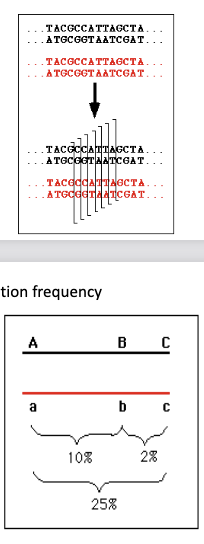
• the further apart two DNA positions are the greater the probability that there will be a recombination event between them.
• DNA sequences that can be distinguished are called "markers”
• recombination frequencies are directly proportional to distance between two markers
hard to bend over short distances
bend over long distance will have more flex
if A B and C are homologous with a b c the distance between the sites is what matters
What is the link between genetic crosses and co-inheritance?
Genetic crosses often use co-inheritance of markers to tell how close genes are to each other
• Co-inheritance frequency is inversely proportional to the distance between two DNA markers
– Recombination at i or ii results in inheritance of A+ (but not B+C+)
– Recombination at i and iii results in coinheritance of A+B+
co-inheritance for larger genomes (eukaryotes)
longer the distance the higher their frequency of co-inheritance

What are the features of RecA?
• Recombination is mediated by RecA
• RecA’s job is to pair homologous DNA segments together so they can exchange strands
• RecA binds DNA (usually single stranded DNA)
• Then more RecA monomers bind cooperatively to make a nucleo-protein filament
• This RecA filament then goes looking for homology to pair with and recombine
yellow= ssBP
RecA added to SSB complex and displaces SSB making nucleole protein filament
RecA coats the strand and then goes on to look for homology

What are different recombination possibilities?
Strand invasion and formation of a D loop
When covered with RecA
D loop top right → strand invasion
ssDNA can have base pairing with homology coated with RecA and then new DNA added
or displacement of DNA

What are the key components of homologous recombination?
1. Homologous recombination requires substantial DNA sequence homology between the donor and recipient DNA.
2. Recombination between any two sequences is a relatively low frequency event. (Therefore, a genetic (or phenotypic) selection is typically required to identify a specific recombination event in vivo)
3. The co-inheritance of two genetic markers is inversely proportional to the distance between them.
4. Homologous recombination can be prevented in a recA mutant.
1 in 10 000 (only one time would a homologous recombination reaction occur)
if there is a phenotype to select for that event can measure it and be that thing selected for
if no recA cannot make the nucleo filament and can’t have homologous recombination
What are the features of F plasmids?
• Conjugative plasmid
• Can integrate into the chromosome
• Cells that have the F plasmid are F +
• Cells that lack the F plasmid are F-
fertility plasmid
conjugative can be shared between bacteria very well
large and holds a lot of info
can integrate into the chromosome using insertion sequence elements (IS)
large and difficult to work with
tra= transfer functions has all the information for transfer on itself (extra chromosomal information encodes the information it needs to propagate itself)
on chromosome is a sequence that is homologous to one of the insertion sequences (IS) on the plasmid
remnants or scars of the broken IS on each side of the insertion

Where can an F plasmid insert itself?
F can insert in many places on the chromosome
multiple IS sequences

What are the feature of a F’ plasmid?
• In some cases, excision can be imprecise and a piece of the chromosome is included in the plasmid
• The plasmid that now carries the extra DNA is F’
• F’ plasmids are useful for constructing partial diploids (merodiploids)
excision or when plasmid crosses out can be imprecise, sometimes extra bits of the chromosome are added into the plasmid on the deintegration event
merodiploids: two copies of the same gene but they can be different

How can an F’ plasmid be used to make partial diploids?
lacO cannot work in trans
constitutive always on or off
inducible can turn on the system
