Atomic Theory/Periodic Table Organization
 Call Kai
 Learn
 Practice Test
 Spaced Repetition
 Match
 Flashcards
 Knowt Play
1/77

There's no tags or description
Looks like no tags are added yet.
78 Terms
WHO proposed the existence of ATOMOS?
Democritus
WHAT was Democritus's theory behind ATOMOS?
Basic elements make up all matter, and after enough breaking down, a point is reached at which no further breaking down is possible.
HOW did Democritus come to his conclusion about ATOMOS?
Qualitative observations about the world and patterns he saw.
What are ATOMOS?
The smallest and simplest forms of elements making up matter.
What do ATOMOS do?
They move around in a void.
What do ATOMOS feature?
Characteristics and properties that correspond to the matter they make up. (Ex: A cactus's atomos would be spiky.)
WHO proposed the 5 Postulates and the BILLIARD BALL/SOLID SPHERE model?
John Dalton
WHAT are Dalton's 5 Postulates?
I) All elements have atoms.
II) Atoms of the same element are identical.
III) Atoms making up different elements are different from one another.
IV) Law of Definite Proportions
V) Law of Conservation of Mass
WHAT is Dalton's Law of Definite Proportions?
Atoms of one element can combine with atoms of other elements to form COMPOUNDS, and these COMPOUNDS will ALWAYS have the same number and type of atoms, in the same ratio. (Ex: H2O will ALWAYS be H combined w/2O)
WHAT is Dalton's Law of Conservation of Mass?
Matter cannot be created or destroyed; it can be subjected to change/transformation.
WHAT is Dalton's Billiard Ball/Solid Sphere atom model like?
A solid sphere, the shape of an atom.
WHO proposed the existence of subatomic particles such as ELECTRONS and proposed the PLUM PUDDING MODEL?
J.J. Thomson
HOW did Thomson come to his conclusion about ELECTRONS?
Cathode Ray Experiment
WHAT is the Cathode Ray Experiment?
A beam of particles, called cathode rays, came from the negatively charged electrode (cathode) to the positively charged one (anode) in a vacuum glass tube.
HOW did Thomson gauge the existence of NEGATIVELY CHARGED ELECTRONS from his Cathode Ray Experiment?
He performed tests on the cathode ray beam:
I) Placing two electrical plates in proximity to the beam on both sides of the glass tube, one positively charged and one negatively charged, the beam bent TOWARD the positive charge/AWAY from the negative charge.
II) Bringing a magnet in proximity to the beam inside the glass tube, the beam bent exactly as current (moving negative electrical charge) is supposed to bend.
HOW did Thomson decide from his Cathode Ray Experiment that these negatively charged subatomic particles exist in ALL FORMS OF MATTER?
He used different kinds of metals for the electrode, and the same cathode ray beam that he had already decided was comprised of negatively charged particles came from each different metal he used.
WHAT is Thomson's Plum Pudding atom model like?
Tiny negatively charged electrons are evenly distributed in a ball of positive charge.
WHO discovered the existence of the NUCLEUS and proposed the PLANETARY MODEL?
Ernest Rutherford
HOW did Rutherford discover the existence of the NUCLEUS?
Gold Foil Test
WHAT is Rutherford's Gold Foil Test?
A test that makes use of radioactive alpha decay. A steel cube has alpha decay occurring inside it, leaving positively charged He to shoot out from a small hole on one of the cube's faces toward a sheet of gold foil. When the He struck the foil, it mostly stayed on its forward course, staining the film in front of the gold sheet; however, sometimes the He rebounded off the gold foil and stained the ends of the film.
HOW does the Gold Foil Test explain the existence of the NUCLEUS?
The fact that MOST of the particles shot through the gold foil undeflected suggested that the atom was MOSTLY empty space rather than a Plum Pudding model.
The fact that SOME particles DRASTICALLY deflected off the gold foil suggested that sometimes the positive particles struck a place of CONCENTRATED POSITIVE CHARGE, repelling the positive He. Because this only happened SOMETIMES, this region of concentrated positive charge must've been SMALL enough to be missed most of the time, but DENSE enough to elicit such a drastic rebound effect when it was struck.
Concentrated with positive charge+very small+very dense=NUCLEUS
WHAT is Rutherford's PLANETARY MODEL like?
Very, very dense nucleus of positive charge at the center of loosely existing electrons of negative charge.
WHO discovered the existence of NEUTRONS, proposing that they, too, have a place in the nucleus of the previously proposed Rutherford PLANETARY model?
Sir James Chadwick
WHY did Chadwick insist that Rutherford's model was incomplete w/o neutrons?
I) He found it hard to believe that protons ALONE were making up something as immensely dense as the nucleus.
II) If protons were the only subatomic particle making up this tiny, dense nucleus, then the nucleus would always be collapsing and coming apart because the tightly packed-together positive charges would be violently repelling each other; therefore, the protons could NOT be alone within the nucleus. Neutrons must exist between protons and must have no charge, as that would explain why they're so difficult to detect.
WHO discovered that light can behave as both a wave and a particle, photons, via the PHOTOELECTRIC EFFECT?
Albert Einstein
WHAT is the photoelectric effect?
When light strikes the surface of a metal, electrons are ejected from the metal only when the frequency of light is high enough; therefore, light can behave like a wave and like a particle, a photon. Photons can interact with electrons.
WHO built off of both Rutherford's PLANETARY MODEL and Chadwick's neutron proposal by suggesting that electrons carried differing levels of energy depending on their different positions orbiting the nucleus?
Neils Bohr
HOW did Bohr come to his conclusion that electrons carried different levels of energy based on their position orbiting the nucleus?
He used light and the color range. As a wave, visible light is the part of the electromagnetic spectrum that humans can see in the form of colors: ROYGBIV. Going down the acronym, the colors' energy levels increase. Electrons with more energy that exist in the FAR-FROM-NUCLEUS orbits help reflect colors like high-energy colors like indigo and violet, while electrons with less energy that exist in the CLOSE-TO-NUCLEUS orbits help reflect low-energy colors like red and orange. Electrons can move from one orbit to another by releasing or absorbing energy. Absorbing energy increases the electron's energy, letting it jump to a farther-from-the-nucleus orbit, while releasing energy releases photon(s) that reflect color(s) before making the electron jump to a closer-to-the-nucleus orbit.
WHAT does Bohr's model look like?
The nucleus core of an atom has BOTH protons and neutrons, while electrons sit in orbits of varying distances from the nucleus.
According to Bohr, do electrons prefer to have the lowest energy or higher energy?
Lowest energy, closest to the nucleus, GROUND STATE
To what state do low-energy, ground-state electrons move to after ABSORBING energy according to Bohr?
To an EXCITED state further from the nucleus with more energy
WHO are the two who brought about the QUANTUM MECHANICAL MODEL?
Erwin Schrödinger and Werner Heisenberg
WHAT'S the difference between Bohr's atom model w/orbits and this dynamic duo's model with ORBITALS?
Electrons don't sit and move between distinct, neat, and predictable orbits as they do in Bohr's model; instead, they exist freely and rather randomly in different regions (probability zones/ORBITALS) because Erwin. S and Heisenberg took into consideration electrons' wave-like behavior, which is more unpredictable and haphazard.
WHAT do orbitals/probability zones look like?
They're 3D bizarre shapes.
WHAT was Erwin Schrödinger's MATHEMATICAL contribution to atomic theory?
He used calculus to determine the likelihood of orbitals existing and electrons residing in them.
WHAT was Werner Heisenberg's MATHEMATICAL contribution to atomic theory?
Principle of Uncertainty
WHAT is Heisenberg's Principle of Uncertainty?
You can't know an electron's speed and position simultaneously.

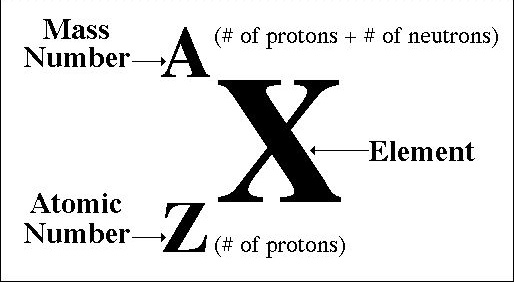
A
MASS NUMBER = Number of protons + Number of neutrons
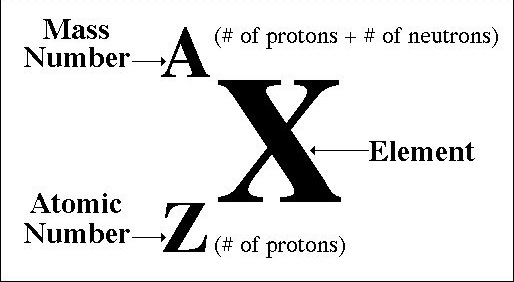
Z
ATOMIC NUMBER = Number of protons
C (imagine it's in the top right corner of the image)
CHARGE = Number of protons - Number of electrons

X
Atomic Symbol of an element
ATOMS are ALWAYS…
… NEUTRAL
1 amu
1 g/mol
Mass of one proton and mass of one neutron
1 amu and 1 amu
Electrons are so, so tiny that they are essentially…
… massless
Who founded the periodic table of elements we use today?
Dimitri Mendeleev
ROWS on Mendeleev's periodic table of elements
Periods/Series
COLUMNS on Mendeleev's periodic table of elements
Groups/Families
Types of Elements
Metals, Metalloids, and Non-Metals
What are the properties all METALS must have?
They must be…
… able to CONDUCT HEAT/ELECTRICITY
… MALLEABLE (able to be hammered into sheets)
… DUCTILE (able to be coiled/pulled into wire)
… LUSTROUS (shiny)
What percentage of all elements are METALS?
80%
At room temperature, what state of matter are ALL METALS EXCEPT FOR ONE?
Solid
What is the SOLE EXCEPTION to the "All METALS are solid at room temperature" statement?
Mercury (Hg)
What are the properties of NON-METALS?
They must be the OPPOSITE OF METALS in ALL respects:
They must be…
… HORRIBLE at conducting heat/electricity
… BRITTLE/fragile (incapable of being hammered into sheets or coiled/pulled into wire)
… DULL/not-shiny
What are the 7 diatomic elements?
Bromine/Br, Iodine/I, Nitrogen/N, Chlorine/Cl, Hydrogen/H, Oxygen/O, Fluorine/F
Diatomic
Describing how 7 NON-METAL elements on Mendeleev's periodic table exist as pairs of the same atom.
What random ahh acronym can you use to remember the 7 diatomic elements?
Brinklehof = Br+I+N+Cl+H+O+F
What are the properties of METALLOIDS/SEMI-METALS?
They must have SOME characteristics/properties of METALS, but not ALL of them.
At room temperature, what state of matter are ALL METALLOIDS?
Solid
What do REPRESENTATIVE ELEMENTS do?
They exhibit the entire range of possible chemical properties.
Characteristics of TRANSITION ELEMENTS
They…
… are metals w/high melting points
… form colored compounds
… are PARAMAGNETIC (attracted to a magnetic field when IN a magnetic field)
… have several OXIDATION STATES
Why did Mendeleev organize groups/families the way he did?
He organized groups/families the way he did because elements in the same family have the same number of electrons, which means they have similar REACTIVITY BEHAVIORS.
Reactivity
HOW EASILY an element will combine w/other substances to form new compounds.
How many elements are there on Mendeleev's periodic table?
118
On Mendeleev's periodic table, what are the REPRESENTATIVE ELEMENTS (Group A)?
Families 1, 2, 13, 14, 15, 16, 17, 18 (everything that's NOT a transition element)
On Mendeleev's periodic table, what are the TRANSITION ELEMENTS (Group B)?
Families 3, 4, 5, 6, 7, 8, 9, 10, 11, 12 (the easy-peasy 10-by-4 smack in the center of the table)
Lanthanide & Actinide Series (the two extra series underneath the main table)
What are the 4 individual families that we learned about thus far that consist of REPRESENTATIVE ELEMENTS?
1A (minus Hydrogen, which is a non-metal gas): Alkali Metals
2A: Alkaline Earth Metals
7A: Halogens
8A: Noble Gases
Characteristics/Properties of 1A Alkali Metals
VERY reactive, never naturally found IN their basic ELEMENT FORM, soft as butter
Characteristics/Properties of 2A Alkaline Earth Metals
Reactive, make up basic solutions, change color w/fire
Characteristics/Properties of 7A Halogens
VERY reactive, poisonous, low melting and boiling points, consists of elements of all three states of matter
Which 7A Halogen elements are SOLIDS?
Iodine (I) and Astatine (At)
Which 7A Halogen element is a LIQUID?
Bromine (Br)
Which 7A Halogen elements are GASES?
Fluorine (F) and Chlorine (Cl)
Characteristics/Properties of 8A Noble Gases
Unreactive, odorless, colorless, MONOATOMIC, all gases
Monoatomic
Elements existing as a SINGLE ATOM, the noble gases of the 8A family
On Mendeleev's periodic table, what are the NON-METALS?
Hydrogen in the very top-left corner + 8A Noble Gases Family + Upside-down staircase part of the 4-by-4
On Mendeleev's periodic table, what are the METALLOIDS?
The diagonal W that fills in the 4-by-4 staircase + one extra element in the top-left and directly diagonal to the bottom-right
On Mendeleev's periodic table, what are the METALS?
Everything (MINUS THAT ONE BOX) that's not a non-metal or a metalloid, the majority of the periodic table