Nutrition Therapy and Pathophysiology (Oct. 2nd)
 Call Kai
 Learn
Learn Practice Test
 Spaced Repetition
 Match
Match Flashcards
 Knowt Play
1/23

Earn XP
Description and Tags
Vocabulary flashcards covering clinical nutrition roles, practice settings, interprofessional collaboration, and clinical decision-making from Chapter 1.
Name | Mastery | Learn | Test | Matching | Spaced | Call with Kai | Chat |
|---|
No analytics yet
Send a link to your students to track their progress
24 Terms
Registered Dietitian Nutritionist (RDN)
Educated and trained health professional who is extensively trained to prescribe and deliver nutrition therapy using the framework of the nutrition care process.
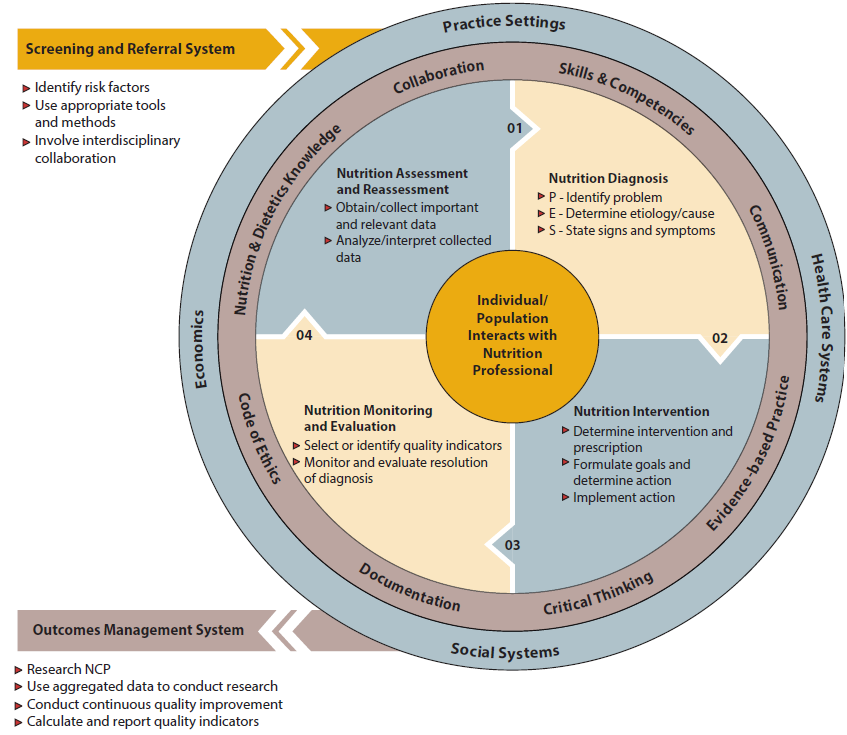
Nutrition Care Process (NCP)
A standardized four-step process that allows for a consistent, evidence-based process for providing nutritional care: Nutrition Assessment, Nutrition Diagnosis, Nutrition Intervention, and Nutrition Monitoring and Evaluation.
Clinical Nutrition Manager
A clinical nutrition team member who directs the activities of RDN, NDTR, and dietetic assistants, with major tasks including hiring, evaluating, and training employees, writing job descriptions, and developing departmental policies and goals.
Dietetic Technician (NDTR)
A clinical nutrition team member who assists the clinical dietitian by gathering data for nutritional screening, assigning malnutrition risk levels, administering supplements, and helping patients select menus.
Dietetic Assistant / Diet Clerk
A clinical nutrition team member who assists the clinical dietitian and/or dietetic technician in routine aspects of nutritional care, such as processing diet orders, checking menus against standards, and collecting patient food records.
Public Not-for-Profit Hospital
An acute care facility often owned and managed by the county or state government.
Private Not-for-Profit Hospital
An acute care facility owned or managed by the community, a religious organization, district health councils, or their own hospital board.
Private For-Profit Hospital
An acute care hospital facility operating as an investor-owned (for-profit) health-care organization.
Veterans and Military Health Facilities
Government-run acute care facilities for veterans of the U.S. military service and active-duty enlisted men and women.
Outpatient Clinic
An acute care clinic facility for preventative, primary health care (such as well-child care or vaccinations) and secondary health care (such as treatment of T2 diabetes mellitus).
Urgent Care Clinic
An acute care clinic facility designed to provide primary care.
Skilled Nursing Facility
A post-acute care facility providing 24/7 nursing care for complex medical needs.
Long-Term Acute Care Hospital
A post-acute care facility providing care for individuals with complex medical needs who have a longer than average hospital admission.
Residential / Assisted Living Facility
A post-acute care facility providing support for activities of daily living, such as bathing.
Continuing Care Retirement Community
A post-acute care facility providing a continuum of care from independent living, assisted living, and skilled nursing on one geographical site.
Rehabilitation / Restorative Facility
A post-acute care facility providing integrated, multidisciplinary assistance for recovery from acute or chronic illness and/or surgical procedures (such as stroke).
Adult Day Care
Facilities offering supervision, social and recreational activities, and meals/snacks while providing daily respite for family members.
Hospice Care
Care or facility focusing on relieving symptoms and supporting individuals with a life expectancy of 6 months or less.
Interprofessional Collaborative Practice
Occurs when two or more professions learn about, from, and with each other to enable effective collaboration and improve health outcomes.
Medical Problem Solving
The ability to identify nutrition-related health problems and make decisions regarding the most appropriate nutrition-related solutions.
Evidence-Based Dietetics Practice (EBP)
The incorporation of systematically reviewed scientific evidence into food and nutrition practice, integrating professional expertise and judgment with client, customer, and community values.
Clinical Practice Guideline
A systematically developed statement based on scientific evidence to assist practitioner and patient decisions about appropriate health care for specific clinical circumstances.
Implementation Science
The study of the process of implementation, outcomes, and strategies to promote effective implementation of evidence-based practice.
Critical Thinking
An evolving skill involving using the mind to organize and integrate information, identify relationships, make inferences, form conclusions, and make decisions.