Workbook Questions & Exercises (6-9)
 Call Kai
 Learn
Learn Practice Test
 Spaced Repetition
 Match
Match Flashcards
 Knowt Play
1/160

There's no tags or description
Looks like no tags are added yet.
Name | Mastery | Learn | Test | Matching | Spaced | Call with Kai | Chat |
|---|
No analytics yet
Send a link to your students to track their progress
161 Terms
Anatomy is the study of
form and structure
Physiology is the study of
function
The imaginary line that divides the body into upper and lower portions is the
horizontal
The imaginary line that divides the body into equal right and left halves is the
midsagittal
_____ is the portion of the cell that carries genetic information.
Nucleus
Body tissues that bind and support other tissues are
connective
The organizational levels of the body are cells, tissues, organs, and
systems
The two major cavities in the body are
dorsal and ventral
The axial portion of the body consists of the
all of the options
The appendicular portion of the body consists of the
arms and legs
What is the simplest organizational level of the human body?
Cells
The federal government’s lead agency for scientific research on oral, dental, and craniofacial disease is the
NIDCR

What cavity is 1?
ventral cavity

What cavity is 2?
abdominopelvic cavity

What cavity is 3?
thoracic cavity

What cavity is 4?
abdominal cavity

What cavity is 5?
pelvic cavity

What cavity is 6?
cranial cavity

What cavity is 7?
spinal cavity

What cavity is 8?
dorsal cavity

What’s the directional term for 1?
superior

What’s the directional term for 2?
posterior

What’s the directional term for 3?
anterior

What’s the directional term for 4?
proximal

What’s the directional term for 5?
distal
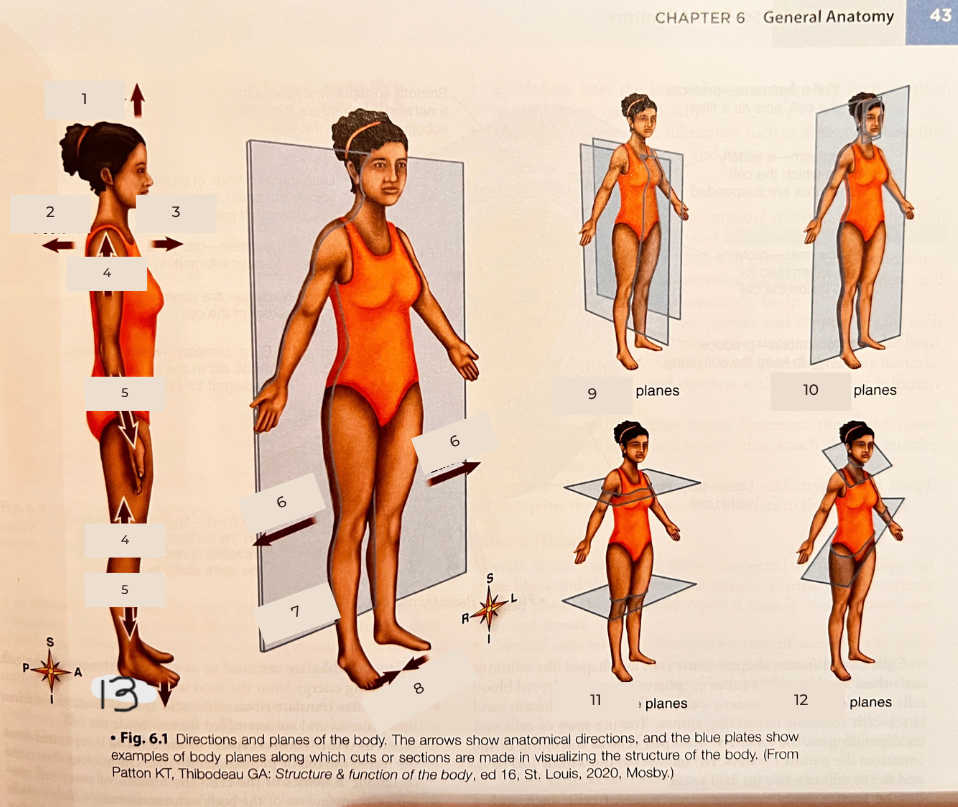
What’s the directional term for 13?
inferior

What’s the directional term for 6?
lateral

What’s the directional term for 8?
medial
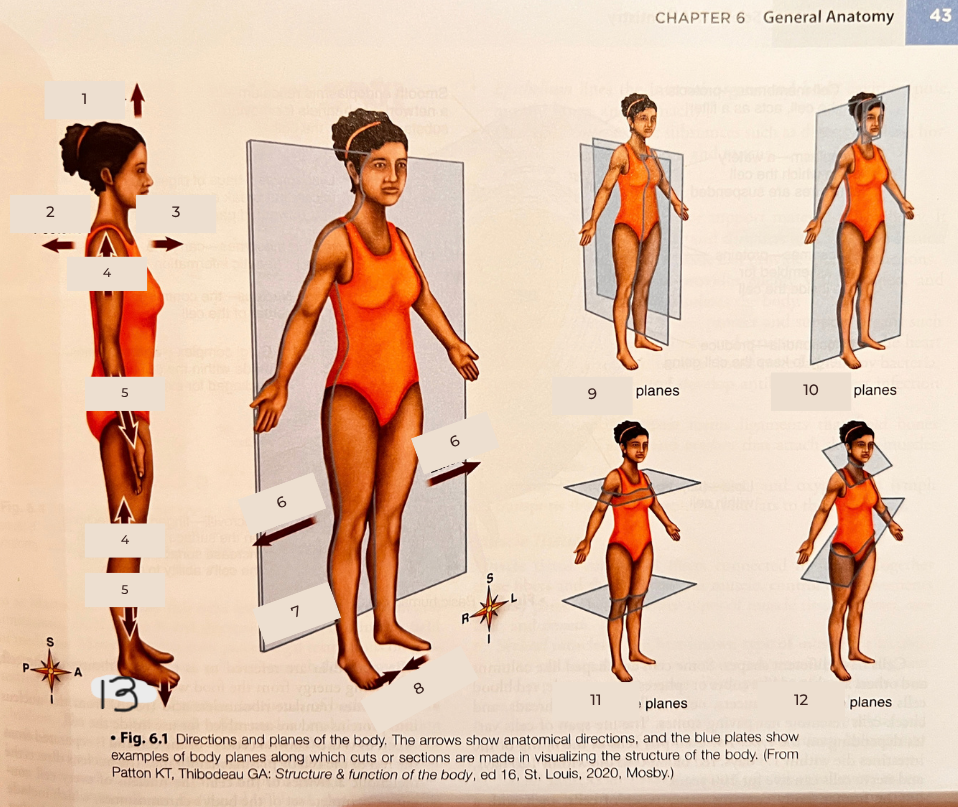
Which numbers are the frontal planes? (___ and ___)
7 and 10

Which number is the sagittal planes?
9

Which number is the transverse planes?
11

Which number is the oblique planes?
12
The skeleton is divided into axial and ___ sections.
appendicular
The connective tissue that covers all bones is the
periosteum
The two types of bone are compact and
cancellous
Cartilage is found
where bones join
Which of the following is/are type(s) of muscle tissue?
all of the options
Which muscle is striated in appearance but resembles smooth muscle in action?
cardiac
Which of the following is a muscular disorder?
contusion
A function of the circulatory system is
to transport nutrients and oxygen to body cells and to regulate body temperature and chemical stability
The heart chambers consist of the atria and
ventricles
Which of the following is/are functions of a blood vessel?
all of the above
The primary function of the lymph system is to
rid body of toxins, waste, and harmful microorganisms
What make(s) up the lymph system?
all of the options
The _____ in the CNS is considered the communication between the brain and the body.
spinal cord
The peripheral nervous system is divided into the autonomic and ____ nervous systems.
somatic
The type of neuron that carries impulses toward the brain and spinal cord is
sensory
The main function of the respiratory system is
to deliver oxygen to the body
What is the role of the digestive system?
It breaks down the food you eat for energy.
Which is not an action of the digestive system?
Sensory function
The primary function of the endocrine system is to
regulate the body’s activities with hormones
The primary function of the urinary system is to
eliminate waste from the body
Which body system includes the skin?
Integumentary
Which of the following is an example of an appendage?
all of the options
Name the first period of prenatal development.
Preimplantation period
Which period of prenatal development is the most critical?
Embryonic period
The embryonic layer that differentiates into skeleton, muscle, and kidneys is
mesoderm
Which branchial arch forms the bones, muscles, and nerves of the face and the lower lip?
First
Which branchial arch forms the sides and front of the neck?
Second
The hard and soft palates are formed by the union of the primary and secondary
palates
When does the development of the human face occur in the prenatal period?
Fifth to eighth week
Which of the following environmental influences during pregnancy may cause anomalies?
all of the options
What factor(s) can have a prenatal influence on dental development?
genetics and environment
Name the processes for the laying down or adding of bone.
deposition
Name the process of bone loss or removal.
resorption
Growth, calcification, and _____ are the three primary periods in tooth formation.
eruption
The final stage in the growth period is the
bell
Dentin that forms before eruption and makes up the bulk of the tooth is ___?
primary dentin
What is the name of the process by which teeth move into a functional position in the oral cavity?
eruption
The portion of a tooth that is visible in the mouth is the ____.
clinical crown
The cementoenamel junction is located
between the cementum and the enamel
____ is the hardest substance in the human body.
Enamel
What is the largest mineral component in enamel?
calcium
Pain is transmitted through dentin by way of
dentinal fibers
They type of dentin that is also known as reparative dentin is
tertiary dentin
The pulp is made up of
blood vessels and nerves
What types of cells form the intercellular substance of the pulp?
fibroblasts
The primary function of the periodontium is
to support, maintain, and retain the tooth
Which type of oral mucosa forms the inside of the cheeks, lips, and soft palate?
lining mucosa

What is A?
Pulp horns

What is B?
Coronal pulp

What is C?
Accessory canal

What is D?
Radicular pulp
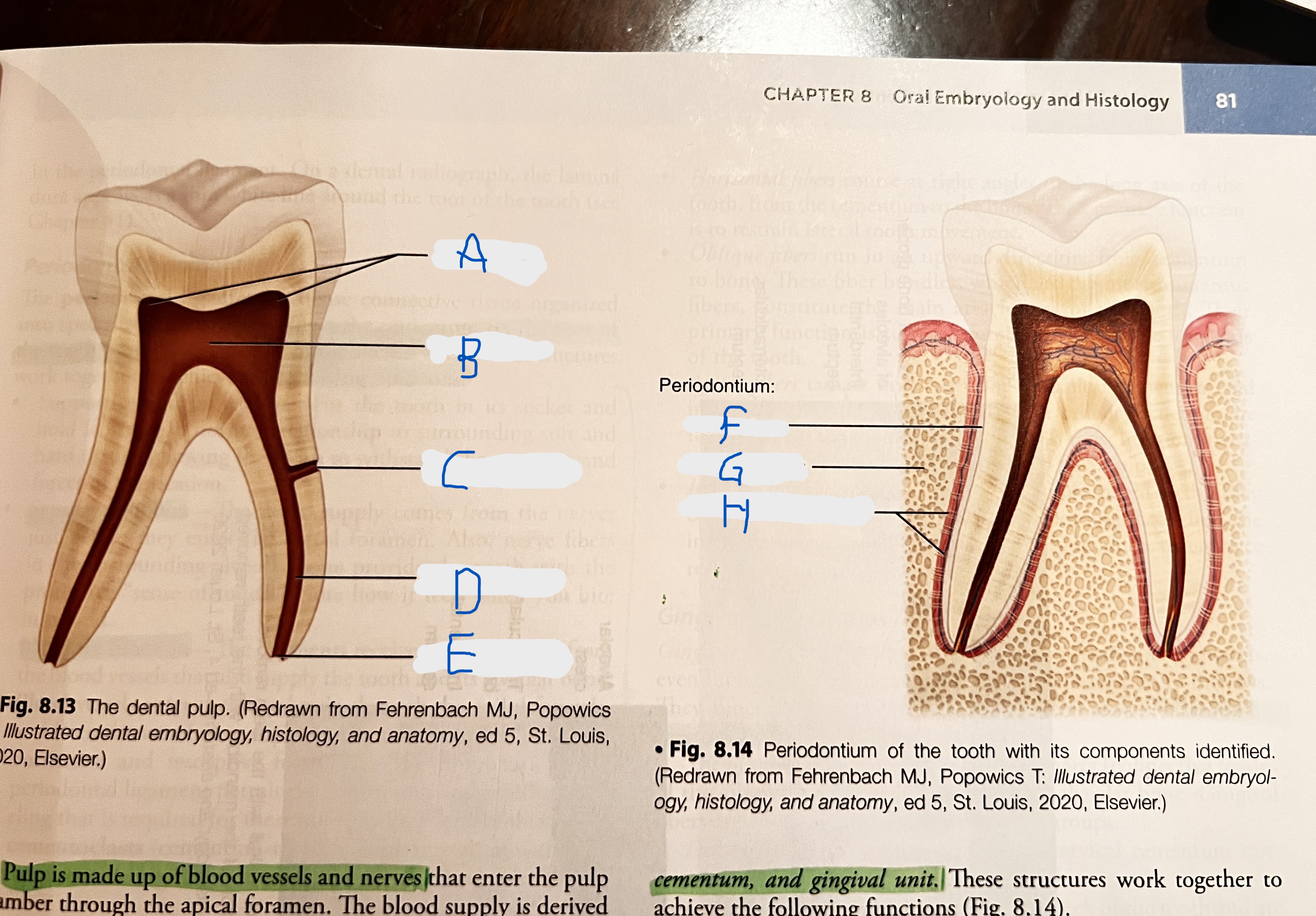
What is E?
Apical foramen

What is F?
Cementum

What is G?
Alveolar bone

What is H?
Periodontal ligament
The regions of the head include the frontal, parietal, occipital, temporal, orbital, nasal, infraorbital, buccal, oral, mental, and ____
zygomatic
What bone forms the forehead?
frontal
What bone forms the back and base of the cranium?
occipital
Which bone forms the cheek?
zygomatic
Which bones form the upper jaw and hard palate?
maxilla
Name the only movable bone of the face.
mandible
Where is the mental foramen located?
mandible
What are the basic types of movement of the TMJ?
hinge and glide
What type of sign or symptom may be a patient who is experiencing TMD exhibit.
pain
Which cranial nerve innervates all muscles of mastication?
fifth
What is the name of the horseshoe-shaped bone where the muscles of the tongue and the floor of the mouth attach?
hyoid
Which of the major salivary glands is the largest?
parotid
Which is another name for the parotid duct?
Stensen’s duct