MAE 381 Test 3
 Call Kai
 Learn
 Practice Test
 Spaced Repetition
 Match
 Flashcards
 Knowt Play
1/70

There's no tags or description
Looks like no tags are added yet.
71 Terms
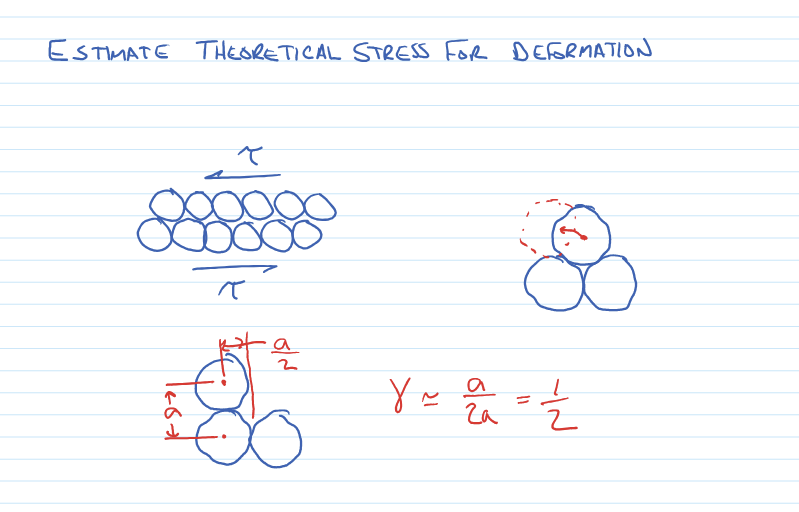
What formula do you use to calculate theoretical stress for deformation?
𝜏 = G( gamma)
gamma = (displacement of top atomic plane from the original plane) / (interplanar spacing between two atoms, h)
What features do real crystals contain?
Defects
What kind of motion does plastic deformation correspond to?
The motion of dislocations
Describe what kind of deformation slip is
Plastic deformation because of dislocations

What direction is dislocation motion for an edge dislocation?
The dislocation motion is parallel to the direction of applied shear stress

What direction is dislocation motion for an screw dislocation?
Dislocation motion is perpendicular to the applied shear stress direction

What makes a specific plane a slip plane for dislocations?
The plane with the highest planar density (plane that can shove the most atoms into crystallographic plane)
What decides the slip direction?
The direction within the slip plane that has the highest linear density (the number of atoms centered along a specific crystallographic direction vector divided by the length of that vector)
What is the combination of a slip plane and a slip direction called?
A slip system
What plane has the highest planar density (close packed plane)?
the ( 1 1 1 ) Plane.
What family does the 111 plane belong to (highest planar density)
the { 1 1 1 } Family
What direction does slip occur along for the FCC Structure
Slip occurs along the < 1 1 0 > direction, having the highest linear density/close packed directions
How many slip systems are in the FCC structure?
12 ; four unique 111 planes, three slip vectors in the < 1 1 0 > direction
How many slip systems are in the BCC structure?
12 slip systems
What are the qualities of FCC and HCP crystal structures?
Closed packed planes
Closed packed directions
High atomic packing factor
What are the characteristics of BCC and Simple Cubic crystal structure?
Closed packed directions
No closed packed planes.
Lower APF than FCC
What does the burgers vector correspond to ?
It corresponds to the dislocations’ slip direction
magnitude is equal to the unit slip distance
What is the relationship between slip distance and atomic density
Slip distance is larger on low atomic density because bigger gap between atoms
slip distance smaller on closed packed planes because less of gap
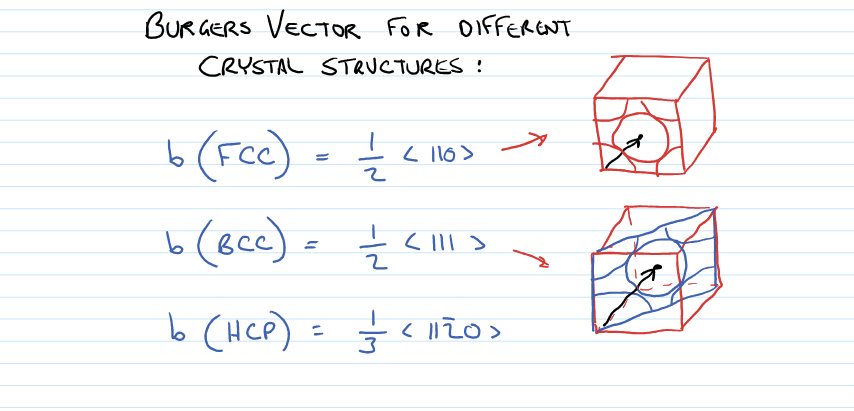
What is the burgers vector for an FCC structure?
½ < 1 1 0 >
What is needed for a lower Peierls-Nabarro Stress?
Lower b - low interatomic spacing (close packed direction)
High d - high interplanar spacing (close packed plane)

Why is the top value of b the lowest and not the bottom?
The atoms are touching shoulder to shoulder , smaller gaps between them
The second option has more gap between each atom along the diagonal
What does a smaller d (interplanar spacing) lead to
more overlap
intense atomic crowding → higher atomic stress

For cubic crystals, what direction is [ h k l ] to the (h k l) plane?
perpendicular

How do you check the angle between the direction and the plane?
Do the dot product, and if perpendicular, the dot product will equal zero

Characteristics of low PN - stress?
closest packed planes (large vertical gap between planes, so when shear occurs, the atoms arent grinidng against each other, low PN stress)
close packed directions
What is the primary slip system for BCC structure?
{ 1 1 0 }< 1 1 1 >
other slip can occur but are material/temp dependent
What is the primary slip system for the HCP structure?
{ 0 0 0 1 } < 1 1 -2 0 >
Why are FCC and BCC more ductile?
Because of large amount of slip systems ; have more ways they can deform.
Why is HCP normally brittle?
Less slip systems available/less ways to deform
What can an applied stress be resolved into?
A shear component along specific plane and direction (breaks down). May be different for each crystal (T_r)
What is the critical resolved shear stress? (T_crss)
The shear stress in a slip plane/direction needed to initiate slip
How is Tau crss differen from T PN?
Tau crss accounts for factors not accounted for in T PN. (temperature, defects)
When does a single crystal plastically deform?
T_resolved (max) >= T_crss
What do single crystals decrease?
Creep, critical at high temps
With no grain boundaries what happens?
Less creep; deformation builds faster
What are the characteristics of a slip system in polycrystalline materials
more complex/slip system changes grain to grain. randomized crystallographic orientations
grain boundaries interfere with slip (make slip harder) → dislocations pile at the GBs
Characteristics of polycrystalline materials compared to single crystal materials
STRONGER- grain boundaries trap/stop incoming dislocations
How do grain shape and material properties change after plastic deformation in a polycrystalline metal?
Grains are first isotropic and equiaxed (same ni all directions)
then become elongated and anisotropic.
the boundaries stay intact, but deform along with the grains . they do not tear
How do you make a material stronger/harder to resist dislocation?
need to restrict/impede dislocation motion
How do you restrict dislocation motion in a material?
reducing grain size generates more grain boundaries that dislocations can pile up against and make the material stronger
Why do grain boundaries act as a barrier in edge dislocations?
dislocation must change slip direction as crosses boundary
atomic disorder causes discontinuity of slip planes
How does angle affect dislocations?
harder for dislocations to cross high angle grain boundaries
Results of high angle grain boundaries?
dislocations pile up at the grain boundaries instead of crossing
causes stress concentration at grain boundary. This generates new dislocations in adjacent grain
What does the hall-petch equation equation relate?
the dependence of yield strength of grain size
sig_o = material starting stress
k_y: hall petch strengthening coeff (material based)
d = avg grain diameter

When is the hall petch equation not applicable?
For very large or very small grains
How can grain size be controlled?
Material processing
slower cooling = larger grains
heat treatment - grains grow at elevated temp
How can you harden and strengthen a metal atomically?
adding impurity atoms
forming an interstitial solid solution
increase grain size
Why does adding impurity atoms change the characteristics of metals?
impurities impose lattice strain, interacting around dislocations

What do impurity atoms tend to do around dislocations?
they tend to segregate around dislocations, reducing overall lattice strain
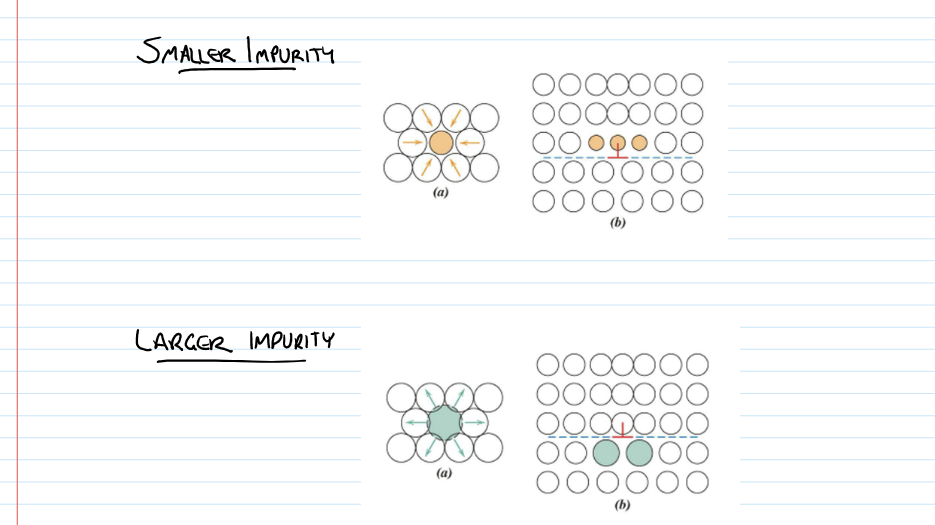
What needs to happen for the dislocation to start moving?
lattice strain needs to increase, which requires more force and energy
results in harder and stronger material

What is the relationship between dislocations and material strength
harder to move dislocations → stronger material
What is the relationship between plastic deformation and dislocation density
plastic deformation increases dislocation density because new dislocations form as deformation occurs
What does a higher number of disolcations imply?
that dislocations are closer/less gaps between
on average, dislocation strain interaction is what?
repulsive ; dislocations harder to move when closer together
What is strain hardening?
Plastic deformation increases hardness and strength by increasing dislocation density
What happens when there are two positive edge dislocations within the same slip plane?
repulsion occurs (pushing away from e/o)

What happens when there is one positive and one negative dislocation within the same slip plane?
attraction occurs ; partial planes join and cause dislocation annihilation
not as common

Why does strain hardening depend on dislocation density?
when there is a large separation/distance, no interaction is able to occur.
dislocations do not want to be close, so more shear needed to move them together

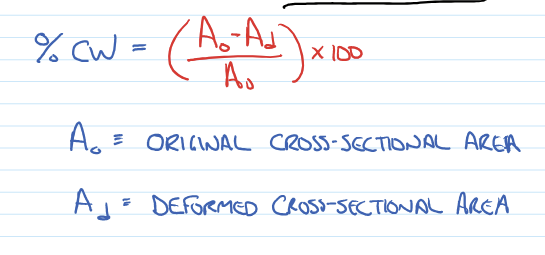
What is the degree of plastic deformation often expressed as?
Percent cold work
What does coldwork sacrifice?
Ductility
How to recover the pre-coldworked condition of a material
heat treatments; can enhance atomic diffusion
What can plastic deformation of a polycrystalline metal result in?
change in grain shape
strain hardening
increased dislocation density
altered physical properties (conductivity, corrosion, resistance)
What does dislocation motion do for recovery?
can reduce total number of dislocations and strain energy between them
can be sufficient in restoring electrical and thermal conductivities to pre-cold worked state
After recovery, what state are grains in?
still in high strain energy state after recovery
still large numbers of dislocations
What is recrystallization?
formation of new set of strain free grains in previously cold worked material
requires annealing heat treatment
What happens during recrystallization?
the metal becomes softer and weaker → more ductile
properties restored to pre cold worked values
What is the minimum temperature at which complete crystallization occurs in 1 hr?
typically 1/2-1/3 of the absolute melting point
Chracteristics of recrystallization for iron
more cold work decreases recrystallization temperature
a certain amount of cold work is needed for recrystallization to occur
What is recrystallization followed by?
Grain growth
high energy grain boundaries
increasing grain size decreases overall energy
grain growth occurs by migration of grain boundaries
What is the burgers vector for BCC?
½ < 1 1 1 >
What is the burgers vector for HCP?
1/3 < 1 1 -2 0 >