Astrophysics - Telescopes
 Call Kai
 Learn
 Practice Test
 Spaced Repetition
 Match
 Flashcards
1/74

There's no tags or description
Looks like no tags are added yet.
75 Terms
What shape is a converging lens?
Convex i.e. thicker in the middle.
What are axial rays?
Rays parallel to the principal axis.
Describe the effect of converging lens on axial rays.
Rays converge at the principal focus.

Describe the effect of converging lenses on parallel non-axial rays.
Rays converge at a point on the focal plane that is not the principal focus.

What is the focal length, f?
Perpendicular distance between lens axis and focal plane.
What is a real image?
An image formed when light rays from a point on an object actually meet. It can be projected onto a screen.

What is a virtual image?
An image formed when light rays from a point on an object appear to have come from another point in space. It cannot be projected onto a screen.

Give the names of the two lenses in a refracting telescope. What type of lenses are they?
Objective lens and eye lens. Both converging (convex) lenses.
Write an expression in terms of focal lengths for the length of the telescope when set up in normal adjustment.
Telescope length = fo +fe
Explain what normal adjustment means in terms of the position of the principal foci.
The principal focus of the objective lens is in the same position as the principal focus of the eye lens.
What can be assumed about the rays coming from one point on an object in space? Explain why.
The rays from one point on the object are parallel. As the object is so far away it can be assumed to be at infinity.
Describe the role of the objective lens.
Converges the parallel rays from the object, to form a real image on its focal plane inside the telescope.
Describe the role of the eye lens.
Acts as a magnifying glass on this real image to form a magnified virtual image, which the observer views.
Explain what normal adjustment means in terms of the final image.
The telescope produces a final magnified virtual image, that appears to be at infinity, as the light rays leave the telescope parallel.
Give the equation for angular magnification (M) in terms of the angles subtended.
M = angle subtended by image at eye / angle subtended by object at unaided eye = θᵢ / θₒ.

Give the equation for angular magnification (M) in terms of focal lengths of the lenses.
M = fₒ / fₑ.
Explain which lens normally has a longer focal length.
fo is typically much greater than fe, to give a large magnification M to view objects in space.
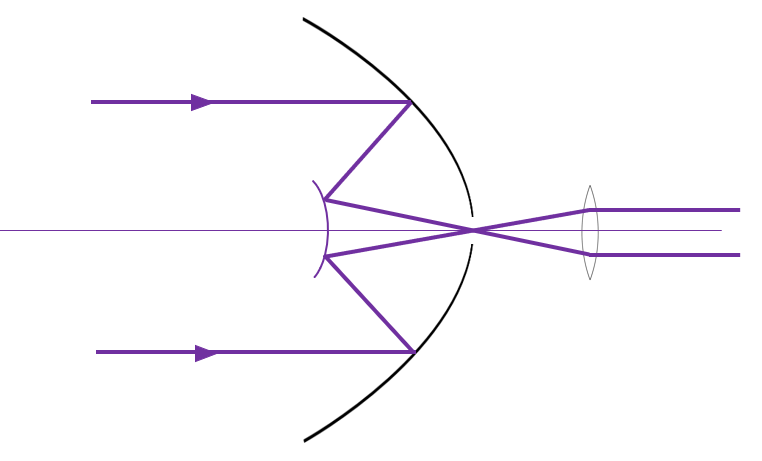
Describe the shape and function of the primary mirror of a Cassegrain telescope.
Parabolic and concave. Reflects axial rays from an object causing them to converge at its principal focus. Forms a real image in front of the mirror.
Describe the shape and function of the secondary mirror of a Cassegrain telescope.
Convex. Reflects light out through a hole in the primary mirror.
Describe how an image is seen using a Cassegrain reflecting telescope.
The light enters the eyepiece lens. A virtual image can be viewed at infinity.
State two advantages of large diameter telescope that give a higher image quality.
Greater collecting power. Greater resolving power.
Is it easier to build large diameter reflectors or refractors? Explain why.
Easier to build large diameter reflectors as mirrors can be supported from behind. Lenses in refractors can only be supported at the edges. Large lenses can distort or break under their own weight.
What effect does chromatic aberration have on images?
Multi-coloured edges. (Edges are most affected as the edges of lenses most closely resemble the shape of a triangular prism.)
What causes chromatic aberration?
Red light is refracted less than blue light. Red light has a longer focal length than blue light.
Does chromatic aberration affect refractors or reflectors?
Only affects refractors as they use refraction and lenses. Does not affect reflectors as they use reflection and mirrors.
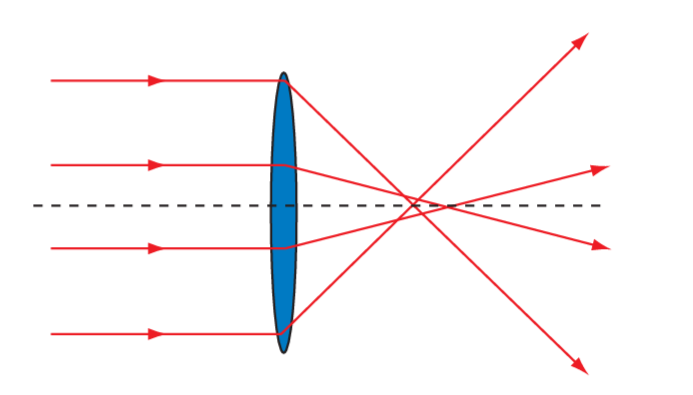
What effect does spherical aberration have on images?
Blurred images.
What causes spherical aberration?
Rays further from the principal axis are brought to a focus closer to the lens/mirror.
What types of mirrors and lenses are affected by spherical aberration?
Spherical mirrors. Spherical lenses (includes convex lenses).
Describe the two problems associated with the secondary mirror of a reflecting telescope.
Causes less light to reach the primary mirror. Light is diffracted as it passes around the secondary mirror and the ‘spider’ (framework) holding it in place.
Explain why reflectors are lighter than refractors and why this is an advantage.
Mirrors are lighter than lenses. Makes reflectors more manoeuvrable for tracking objects.
Name two parts of the EM spectrum that can be detected most easily by ground-based telescopes.
Visible light. Radio waves.
Name the molecule in the Earth’s atmosphere that absorbs U-V rays.
Ozone (O3).
Name the molecule in the Earth’s atmosphere that absorbs I-R rays.
Water (H2O).
Give one advantage of locating a telescope at high altitude on the ground.
Reduce the effects of atmospheric absorption and distortion. (More important for visible light than radio.)
Give one advantage of locating an optical telescope in a dry environment.
Reduces cloud coverage.
Give one advantage of locating an optical telescope away from populated areas.
Reduces light pollution (e.g. from street lights).
Give one advantage of locating a radio telescope away from populated areas.
Reduces radio interference (e.g. from microwave ovens).
Explain why the reflecting dish of a radio telescopes the can be made from a mesh rather than solid metal.
Provided the mesh size is smaller than λ/20, radio waves are reflected by, rather than diffracted through, the mesh. (Radio waves have a long enough wavelength for this.)
Give two advantages of using a mesh dish over a solid dish.
Lower weight so more manoeuvrable and easier to support. Cheaper as requires less material.
Which type of telescope from the list below that requires the most precisely shaped parabolic reflecting dish: I-R, U-V, visible light, radio. Explain your answer.
Reflection of waves is affected by imperfections greater than λ/20. U-V has the shortest wavelength and therefore more likely to be affected by imperfections.
Explain why I-R telescopes need a cooling system.
I-R telescopes need to be kept cool. so that they don’t produce their own I-R radiation, as that would interfere with the I-R they are detecting.
Explain why x-ray telescopes cannot make use of a parabolic reflecting dish.
The x-rays would either pass through or be absorbed.
Explain how the design of x-ray telescopes allows rays to be focused on a point.
Grazing mirrors are used so that the angle of incidence is large enough to cause the rays to be reflected. A series of these mirrors are required to gradually focus the rays.
Describe what collecting power is.
Energy collected per second.
What is collecting power proportional to?
Collecting power ∝ area ∝ diameter2
Why is it an advantage to have a high collecting power?
Gives more intense image. So, the telescope can observe fainter objects and objects at greater distances.
Describe what resolving power is a measure of.
A measure of how much detail you can see. (Higher resolving power = more detail.)
Define minimum angular resolution.
The smallest angular separation at which the instrument can distinguish two points. (Smaller minimum angular resolution = more detail.)
Give the equation for calculating minimum angular resolution.
θ ≈ λ / D, where θ is the minimum angular resolution (radians), λ is the wavelength (m), and D is aperture diameter (m).
Describe what limits the resolution of a telescope.
The diffraction of light as it passes through the opening of the telescope.
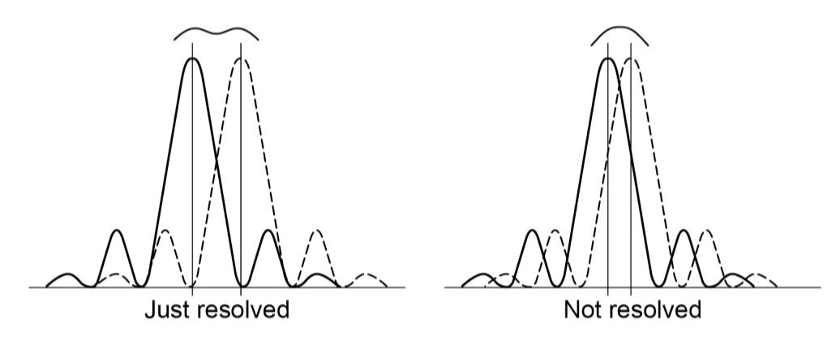
Give the Rayleigh Criterion.
Two objects will be just resolved if the centre of the diffraction pattern (i.e. the centre of the Airy disc) of one image coincides with the first minimum of the other.
For a given wavelength of light, will a smaller or larger diameter telescope produce a more detailed image? Explain why.
Larger diameter will have a smaller minimum angular resolution as θ ≈ λ/D. Higher resolving power – more detailed image.
What factors should you discuss in a telescope comparison question?
collecting power (including calculation) resolving power (including calculation) the shape (link to spherical aberration) the location (does the telescope need to be in space?) reflector or refractor if optical (link to chromatic aberration)
What is a CCD?
A detector used in telescopes. Made of a silicon chip split into pixels.
How does a CCD work?
Incident photons cause electrons to be released from each of the pixels. Number of electrons is proportional to intensity of light. Processed electronically to give a digital image.
What is quantum efficiency?
Percentage of incident photons which cause an electron to be released.

Compare the quantum efficiency of a CCD to the human eye.
CCD = 70-80% Human eye = 4-5% (as low as 1% in low light)
Describe an advantage of a higher quantum efficiency.
Higher intensity image obtained for a given exposure time Allowing dimmer objects to be viewed.
What determines the resolution of a CCD?
Related to the total number of pixels per unit area, and their size. Smaller pixels = better the resolution = clearer image.
What determines the resolution of the human eye?
The spacing between the light-sensitive cells on the eye’s retina.
Compare the resolution of a CCD and the human eye.
If the pixel size is smaller than the retinal size, a CCD will have a better resolution than the human eye.
Give additional advantages of using CCDs as detectors in telescopes over the human eye.
Information is stored and analysed digitally so can be accessed remotely (so telescopes can be located where light pollution / atmospheric absorption is reduced e.g. in space). Can detect a larger range of wavelengths beyond the visible spectrum, so more energy and information collected from the star. Can be exposed for longer times (and more images taken per second), so more light detected, allowing dimmer objects to be observed.
Draw a ray diagram to show a converging lens producing an image from an object beyond 2f. Give three facts about the image.
Image is:
Real
Inverted
Diminished

Draw a ray diagram to show a converging lens producing an image from an object between f and 2f. Give three facts about the image.
Image is:
Real
Inverted
Magnified

Draw a ray diagram to show a converging lens producing an image from an object inside f. Give three facts about the image.
Image is:
Virtual
Upright
Magnified

Draw a simple diagram to show the lenses in a refracting telescope in normal adjustment. Show the focal lengths (fo, fe) and principal foci (Fo, Fe) of the two lenses.

Draw a ray diagram to show a refracting telescope set up in normal adjustment.

Draw a diagram for a Cassegrain reflecting telescope. Start by drawing two axial rays that come from a point on an object that can be assumed to be at infinity.
Draw a diagram to show a lens affected by chromatic aberration. Show rays for red light and blue light.

Draw a diagram to show a concave spherical mirror affected by spherical aberration.

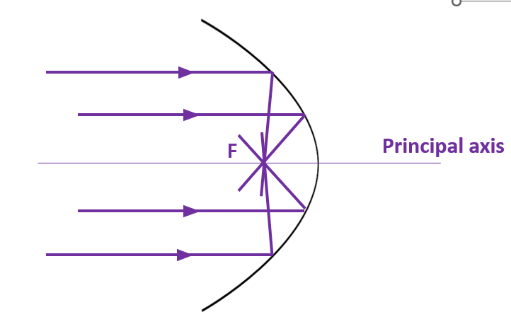
How can spherical aberration be overcome when using a concave mirror? Draw a diagram to show this.
Use a parabolic mirror. All axial rays converge at the same principal focus.
Draw a diagram to show a lens affected by spherical aberration.
Give three ways of putting telescopes in space.
On a satellite in orbit.
On a plane.
On a hot air balloon.
Sketch the diffraction pattern to show what happens to light as it passes through the opening of a telescope. Annotate key features.

Draw a diffraction pattern diagram to show two objects that can just be resolved.