Psychology Exam 3
 Call Kai
 Learn
 Practice Test
 Spaced Repetition
 Match
 Flashcards
 Knowt Play
1/163

There's no tags or description
Looks like no tags are added yet.
164 Terms
What is learning?
Learning is a relatively permanent change in behavior, knowledge, skills, or attitudes that results from experience
What is nonassociative learning?
Simple learning to reduce (habituation) or increase (sensitization) the amount of responding we do to stimuli that innately drive a response
What is habituation?
Reducing your responses to something that:
Repeats in your environment and
Doesn’t predict anything
What is sensitization?
Increasing your response to something that
Repeats in your environment and
Is potentially noxious
What is associative learning?
Linking up stimuli and experiences because something that was previously neutral predicts something important (good or bad)
What is classical conditioning?
An unconscious learning process where an unconditioned response becomes associated with a previously neutral stimulus to trigger an automatic, conditioned response
What is the unconditioned stimulus (sometimes abbreviated as US or UCS) and the unconditioned response (sometimes described as UR or UCR)?
Something that naturally and automatically triggers a reaction without any prior learning
What are the conditioned stimulus (CS) and conditioned response (CR)?
Conditioned stimulus: the former neutral stimulus that, after being repeatedly paired with the unconditioned stimulus, now triggers a reaction
Conditioned response: the learned, automatic reaction to the conditioned stimulus
Are classical conditioning responses voluntary or involuntary?
Involuntary
What is acquisition? What is extinction? What is spontaneous recovery?
Acquisition: the initial period in which a neutral stimulus is repeatedly paired with an unconditioned stimulus until the subject connects the two
Extinction: the gradual weakening and eventual disappearance of the conditioned response
Spontaneous recovery: the unexpected reappearance of an extinguished conditioned response after a period of rest
What is blocking?
A phenomenon where prior conditioning to one stimulus prevents a subject from learning an association with a new stimulus

What is the Garcia effect?
Some associations are evolutionarily advantageous
Nausea associated with bad food
Fear associated with loud noises

What is latent inhibition?
A phenomenon where it takes longer to learn an association with a stimulus if you have already been exposed to it repeatedly without any consequence
Not paying attention to it anymore; not giving attention that it needs, even if it becomes predictive
Which neurotransmitter is essential in making predictions, mainly if the reward is unexpected?
Dopamine
When we experience an unpredicted reward, dopamine neurons fire lots more action potentials
The first few times a cue or an action predicts an outcome, dopamine neurons fire to the reward
But once learning has happened, dopamine neurons now fire to the predictive cue
What is operant conditioning? How is it different from classical conditioning?
Operant conditioning is a method of learning that occurs through rewards and punishments for behavior
Unlike classical conditioning, which deals with automatic, involuntary reflexes, operant conditioning focuses on voluntary actions and how their consequences dictate whether they will happen again in the future
If I do something, something will happen
What is motivation, and how can it be measured?
The internal or external driving force that energizes, directs, and sustains goal-oriented behavior
Psychologists and researchers measure motivation through a combination of behavioral, cognitive, physiological, and self-report methods
What is the optimal amount of motivation? How can low levels and high levels of motivation be problematic?
A middle amount
Too little motivation can make it hard to get anything done
Too much motivation can make it hard to get anything else done
What is operant or instrumental learning? How does operant conditioning involve learning two different associations?
Operant (aka instrumental) means learning two associations:
A cue in the environment triggers an action
An action triggers an outcome
Operant behavior reflects our intentions: we do these things because we desire the outcome
How does dopamine regulate motivation?
High motivation means a willingness to work for a reward
Depleting dopamine seriously decreases work, but only mildly impacts rewards
How can we change an individual’s motivation for behavior?
Changing the frequency or reliability of the outcome to motivate the behavior
Establishing a really strong habit, so the cues trigger behavior even when the outcome isn’t there
What are the four kinds of outcomes?

What are some of the reasons that punishment does not usually work?
Punishers don’t increase good behaviors: they just (maybe) reduce unwanted ones. You can’t punish every single unwanted behavior. It’s better to reinforce wanted behaviors
If the cues associated with punishment go away (like the person who scolds you), then the behavior might come back
If there are mixed signals in the environment, for instance, combined reinforcement and punishment (like a teacher scolding you and peers in class cheering), the punishment is less effective, or ineffective
Punishment only works “well” if it is severe right off the bat. This could be cruel as a deliberate policy
What is more effective for behavioral change than punishment?
Reinforcing desired behavior
What is a habit?
After we learn how our actions influence outcomes, we learn when we are cued to do an action
Doing an action on cue is a habit
Doesn’t involve our deliberate intention
How are habits useful?
Habits free up our cognition for other problems
How do effective habits depend on effective cues?
You can help yourself out by choosing effective, reliable cues for actions you want to do more, making it more automatic
Cues that are specific to the situation
Cues that don’t contradict the desired action and outcome
Repeat, repeat, repeat, - routine
What is a post reinforcement pause?
A temporary break or hesitation in responding that occurs immediately after a learner receives a reward or reinforcer
What are the four partial reinforcement schedules and how do they work?
Variable schedules are more motivating

Why are variable schedules more motivating than fixed schedules?
Unpredictability keeps engagement high, eliminates predictable pauses, and makes behavior hard to stop
We have evolved to survive unpredictable worlds
In what way is dopamine a learning signal but not a pleasure signal?
Dopamine neurons do not fire when you receive a predictable reward; instead, they fire when an outcome is better than expected, drop when an outcome is worse than expected, and flatten when expectations match reality
This discrepancy is called a reward prediction error. It acts as a teaching signal, telling the brain to update its internal models, strengthen neural pathways, and repeat or abandon specific behaviors.
Dopamine signals for gambling are prolonged, increasing motivation
Increased motivation to gamble means spending more money
What did Pavlov show in his classical conditioning experiment? Be sure to be able to identify the US, UR, CS, and CR
Showed that animals can learn to produce an involuntary, reflexive response to a previously neutral stimulus by repeatedly pairing it with a natural, life-sustaining stimulus
Unconditioned Stimulus (US / UCS): A stimulus that naturally and automatically triggers a reaction without any prior training.
Example: Food (meat or meat powder)
Unconditioned Response (UR / UCR): A natural, unlearned, reflexive reaction to the unconditioned stimulus.
Example: Salivation when the dog sees or tastes food
Conditioned Stimulus (CS): A previously neutral stimulus that, after being repeatedly paired with the unconditioned stimulus, triggers a learned response.
Example: The sound of a bell (or metronome)
Conditioned Response (CR): A learned response to a previously neutral stimulus.
Example: Salivation triggered solely by the sound of the bell
What is stimulus generalization?
A behavioral process where a person or animal responds to a new, similar stimulus in the same way they were trained to respond to the original stimulus
What is discrimination?
The ability to tell the difference between a specific stimulus and other similar stimuli, responding only to the target cue
Pavlov's dogs learned to salivate only to a specific tone of a bell that was paired with food, and not to a different bell tone or a trumpet sound that was never paired with food
What do the Little Albert studies show? How can fear be conditioned?
Show that human emotional responses—specifically fear—can be learned through classical conditions — and that these fears can generalize to similar objects
How do advertisers use classical conditioning principles?
Unconditioned Stimulus (US): Something that naturally and automatically triggers a positive feeling or reaction without any training—such as catchy music, humor, breathtaking scenery, or an attractive celebrity
Unconditioned Response (UR): The natural, happy, or excited feeling people get from that music, joke, or person
Conditioned Stimulus (CS): The brand, logo, or product itself, which starts out neutral
Conditioned Response (CR): By repeatedly pairing the product with the pleasant stimulus in commercials, the brand eventually triggers that same positive feeling even when the music or celebrity is gone
What is a conditioned taste aversion?
A learned, long-lasting rejection of a specific food or drink after it is paired with nausea or illness
How is operant conditioning different from classical conditioning?
Classical conditioning pairs two stimuli to create an involuntary, automatic reflex response
Operant conditioning connects a voluntary action to a consequence (a reward or punishment) to change how often that behavior happens
What was Thorndike’s Law of Effect?
It states that behaviors followed by satisfying or rewarding consequences are more likely to be repeated, while behaviors followed by discomfort or unpleasant outcomes are less likely to recur
What are reinforcers? What’s the difference between primary and secondary reinforcers?
Any consequence that strengthens or increases the frequency of a behavior that comes before it
Primary: Innate and biological; they do not require any prior learning or conditioning
Secondary: Learned and culturally conditioned; they have no inherent value on their own
How are positive and negative reinforcements processes similar and different?
Both are operant conditioning processes that increase the future likelihood of a desired behavior, and both use consequences to shape actions rather than punish them
Positive Reinforcement: Adds a desirable or pleasant stimulus.
Negative Reinforcement: Removes an aversive, unpleasant, or uncomfortable stimulus
How are positive and negative punishments similar and different?
Both aim to decrease or stop an unwanted or undesirable behavior from happening again in the future
Positive Punishment: Adds or introduces an aversive (unpleasant) stimulus after the behavior.
Negative Punishment: Removes or takes away a desirable or valued stimulus/privilege after the behavior.
How are reinforcement and punishment different?
Reinforcement increases the likelihood of a behavior happening again, while punishment decreases the likelihood of a behavior happening again
What is reinforcement and what are the different types of reinforcement?
Any consequence that strengthens or increases the likelihood of a target behavior happening again
Positive Reinforcement: Adding a desirable or pleasant stimulus after a behavior to increase its frequency (e.g., giving a child praise or a toy when they finish their homework)
Negative Reinforcement: Removing an unpleasant or aversive stimulus after a behavior to increase its frequency (e.g., turning off a loud seatbelt buzzer once you buckle up)
What is the difference between a continuous schedule of reinforcement and a partial schedule of reinforcement?
A continuous reinforcement schedule rewards a behavior every single time it occurs, while a partial (intermittent) reinforcement schedule rewards the behavior only some of the time
What are the different types of partial schedules of reinforcement? How are the outcomes differ for each?
Fixed Ratio (FR): Reinforcement is given after a set, exact number of responses (e.g., getting a bonus for every 10 items sold)
Produces a high, steady rate of response
Causes a brief post-reinforcement pause right after a reward is received, as the subject rests before starting the next count.
High demands can lead to ratio strain (burnout or a breakdown in responding)
Variable Ratio (VR): Reinforcement is given after an unpredictable, average number of responses (e.g., slot machines or lottery tickets)
Produces the highest and most persistent rate of response of all schedules.
No predictable pauses occur because the person or animal never knows when the next reward is coming.
Extremely resistant to extinction (often underlying compulsive behaviors or gambling)
Fixed Interval (FI): Reinforcement is given for the first response after a fixed, set amount of time has passed (e.g., receiving a paycheck every two weeks, or checking cookies that bake for exactly 20 minutes). [
Produces a "scalloped" response pattern: responding is very slow or non-existent right after the reward, then speeds up rapidly as the end of the time interval approaches.
Overall rate of responding is lower and less consistent compared to ratio schedule
Variable Interval (VI): Reinforcement is given for the first response after an unpredictable, varying amount of time has passed (e.g., pop quizzes in a classroom or checking for a text message when notifications are off).
Produces a slow, steady, and continuous rate of response.
Because the person cannot predict when the time window will close, there is little incentive to pause or burst-respond; persistence is high and steady

What is a Skinner box?
It is a small, enclosed space (often soundproof) that isolates an animal subject—such as a rat or pigeon—from outside distractions
The box typically includes a lever, button, or pecking key, along with a reward dispenser (such as food or water) and cue lights or sounds. In some setups, the floor can deliver a mild electric shock.
When the animal performs a specific action (like pressing the lever), it receives a consequence—either a reward (positive reinforcement) or the removal of an unpleasant stimulus (negative reinforcement). This process teaches the animal to repeat or avoid the behavior.
What is shaping?
A behavior modification method that teaches a complex, non-natural behavior by rewarding small, incremental steps—called successive approximations—that gradually get closer to the final goal
What is insight learning?
The sudden, cognitive realization of a problem's solution, and aha moment
What is observational learning?
The process of acquiring new behaviors, skills, or attitudes by watching and processing the actions of others, rather than through direct trial-and-error experience
What is an emotion?
A relatively brief episode of synchronized physiological, behavioral, and subjective responses
Evident when a situation becomes relevant to our personal goals
What are the three aspects of emotions: “feelings,” autonomic responses, and somatic responses?
Autonomic responses: sympathetic activation, hormonal (physiological component)
“Feelings”: introspection (subjective reaction)
Somatic responses: behavioral tendency to approach or avoid something, facial expressions (behavioral response)
What are the functions of emotions?
Regulate arousal
Direct perception and attention
Influence learning and memory
Motivate behavior
Communicate with others
Smiling, crying, embarrassment
What is the evolutionary view of emotion as originally proposed by Darwin?
Emotions help us survive and thrive & promote survival of our species
Emotions allow us to adapt to different situations and keep us safe from danger
Many emotional responses seem to be instinctive and universal, rather than learned and culture-specific
Why are facial expressions important?
They communicate immediate information about how we are doing
Darwin hypothesized that facial expressions are part of our evolutionary heritage
They do not seem to be simply a product of learning or imitations
What are Ekman’s six (or seven) basic emotions?
Happiness
Sadness
Contempt
Surprise
Fear
Disgust
Anger
How was this research done (on if emotions are instrinsic)?
Went to parts of the world without TV or media, where they had no way to learn emotions from other parts of the world, and asked them to identify the emotions displayed on faces
What evidence suggests that these emotions are innate (inborn)?
People from entirely different cultures—including isolated, pre-literate societies with no exposure to Western media—can reliably recognize and produce the same facial expressions for basic emotions (such as anger, disgust, fear, happiness, sadness, and surprise).
What are display rules?
What emotions is it okay to display to other people?
What is the discrete vs. dimensional approach to emotions?
Discrete emotions approach: an approach to analyzing emotions that focuses on specific emotions such as anger, fear, and pride
Treats each emotion as categorically distinct from others
Examines both primary and secondary emotions
Dimensional approach: an approach to analyzing emotion that focuses on dimensions such as pleasantness and activation
How pleasant or unpleasant the emotion feels
How activated (or aroused) the person feels when in the midst of the emotion
What are the three main contributors to happiness?
Happiness set point: the level of happiness that is characteristic of a given individual
Genetically determined and reflected in stable, early-appearing personality traits such as
High levels of extraversion
Low levels of neuroticism
Account for ~50% of the variation in happiness across individuals
Life circumstances: thought to account for 10% of variation in happiness
Adaptation: a phenomenon whereby an individual stops noticing a stimulus that remains constant over time, resulting in enhanced detection of stimulus changes
Intentional activities: roughly 40% of variation
What can we do to change our happiness?
Cultivating feelings of gratitude
Savoring positive experiences
Using our strengths
Using a dimensional approach, what kind of responses do we show to different kinds of images?

How do psychopaths and individuals with phobias respond to different kinds of images?
People with phobias react the same, except to the thing they have a phobia of
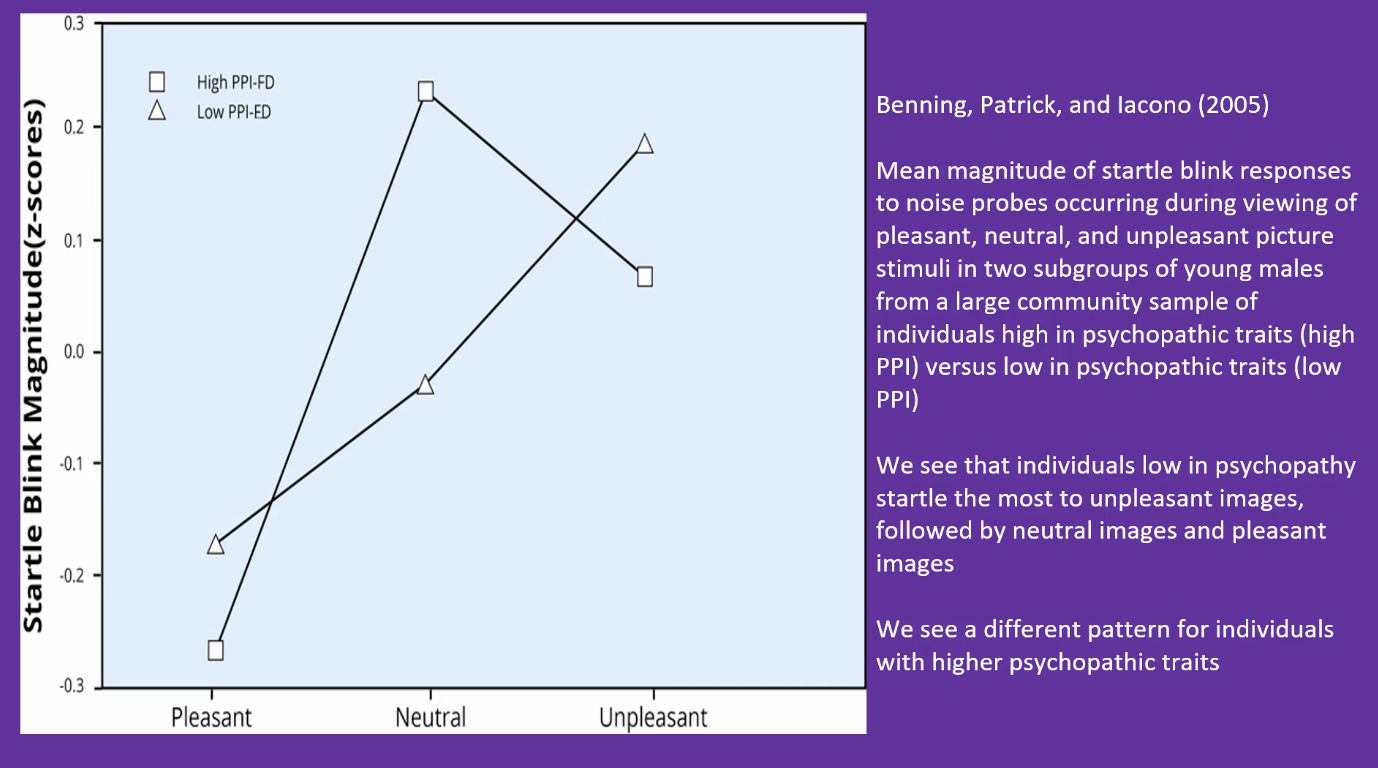
What is the difference between things that are intrinsically vs. extrinsically rewarding?
Intrinsic rewards: Intangible feelings, personal satisfaction, pride, curiosity, or a sense of achievement that come from within you during or after an activity
Extrinsic rewards: Tangible, physical, or social benefits given to you by an outside person, manager, or system
What is performance vs. mastery orientation?
Mastery orientation: Developing competence, learning new skills, and achieving personal or absolute standards of growth (self-improvement)
Performance orientation: Demonstrating competence, validating ability, and comparing oneself to others (winning)
What is a fixed vs. growth mindset?
Growth Mindset: The belief that intelligence, skills, and talents can be developed and improved through effort, strategy, persistence, and learning from mistakes
Fixed Mindset: The belief that basic qualities like intelligence and natural talents are static, innate, and unchangeable traits that you are simply born with or without
How common is it for college students to be stressed?
90% of students at UMN have expressed feeling very overwhelmed
What are the three major sources of stress?
Catastrophic events (eg natural disasters)
Major life events (eg divorce)
Daily hassles (eg forgetting your phone, missing the bus)
What is stress?
A physiological response to some type of environmental event that is subjectively appraised as being taxing or even exceeding one’s ability to adapt
What is a Type A personality?
Competitive
Time-urgent
Hostile and aggressive
What is a Type B personality?
Relaxed
Patient
Easygoing
Which trait is associated with coronary heart disease?
Being hostile and aggressive
How does stress impact physical health?
Don’t memorize, just know that chronic or prolonged periods of stress has effects on our physical health
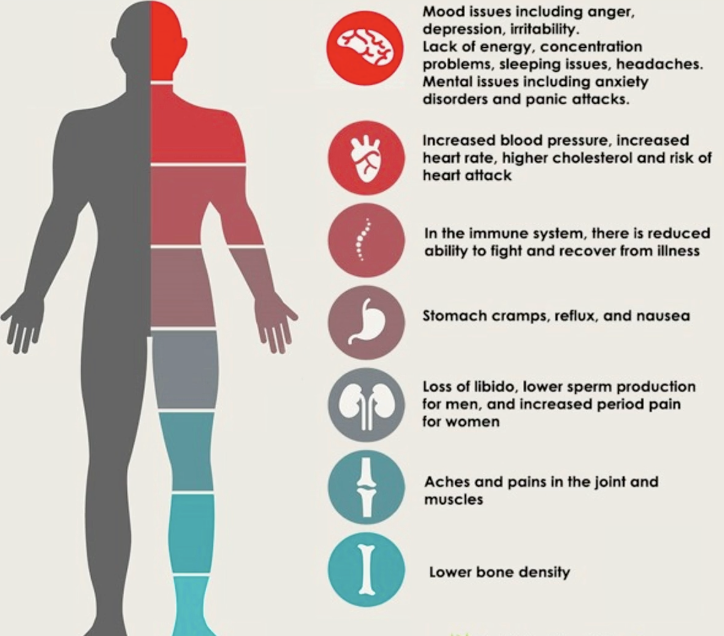
What is the General Adaptation Syndrome, and what happens at each stage?
Stage 1/Alarm: sympathetic nervous system is activated due to threat or danger (eg heart speeds up, blood is diverted to your skeletal muscles)
Stage 2/Resistance: body attempts to cope with stress while you remain on alert (eg adrenal glands pump hormones into your bloodstream)
Stage 3/Exhaustion: body exhausts if the stressor remains intense and ongoing (vulnerable to illness, collapse)
What is the relationship between stress/arousal and performance (Yerkes-Dodson Law)?
Dictates that performance increases with arousal (stress, anxiety, or motivation), but only up to a point. Once arousal or stress crosses that optimal threshold, performance drops sharply
What does it (Yerkes-Dodson law) predict as the optimal conditions for performance?
Medium levels
How can mindset help manage stress?
Positive reappraisal: change how you describe something in a more positive way
Downward comparisons: compare yourself to someone in a worse position
Present control: take control of what you can take control; let go of the things you can’t
Are traumatic events common?
Nearly 90% of individuals have experienced a potentially traumatic event
How is trauma different from stress?
Trauma: a type of stimulus; an event
Deeply distressing or severe stressor
Stress: a response
Tension, discomfort, and physical symptoms
Does the research suggest that PTSD is incurable?
It is not incurable
What types of treatment work for PTSD?
Commonality: all three require you to face what you’re avoiding
Prolonged exposure
Cognitive processing therapy
Eye-movement desensitization and reprocessing
Do we report subjective gains from experiencing a traumatic event? Does our behavior tend to change after a traumatic event?
2/3 to ¾ of people who have experienced a highly stressful event report some degree of posttraumatic growth: the perception of beneficial change or personal transformation in the struggle to overcome adversity
However, many do not show changes in behavior
What is consciousness?
Our awareness of both the external world (the events taking place around us) and the internal world, including awareness of ourselves and our own thoughts, feelings, and behaviors
Stream of inner experience
What makes “you” you
What are the properties and components of consciousness?
Limited and selective
Dynamic
Can change very quickly or dramatically
Can focus on the past or future
Involves both arousal and awareness
Wakefulness or alertness
Ability to recognize something
What are the hard and easy questions that the science of consciousness needs to answer? How can these be studied?
The hard problem: first-person data (ask about subjective experience)
Can make it hard to decode because people can lie, but easier to collect
The easy problem: third-person data (behavioral and brain processes)
Easier because you can quantify it
How can researchers measure the consciousness of an individual in a vegetative state? What are the results of Owen (2006)?
The vegetative state is a chronic state of brain dysfunction in which a person shows no obvious signs of awareness
May open their eyes, regulate breathing, and show evidence of wakefulness
On the surface, these individuals seem to lack awareness; however:
Owen et al. (2006) used functional magnetic resonance imaging to examine the presence of awareness of individuals in a vegetative state
When asked to imagine playing tennis or moving around her home, the patient activated predicted cortical areas in a manner indistinguishable from that of healthy volunteers.
What is blindsight?
The ability of people who are cortically blind due to lesions in the primary visual cortex to respond to visual stimuli that they do not consciously see
Individuals with blindsight subjectively report that they cannot see anything, but their behavior suggests otherwise
What is meant by a split brain? What are some of the effects of a split-brain patient? An object seen in the left visual field will be processed on which side of the brain? How about something seen in the right visual field?
Individuals whose corpus callosum has been severed during brain surgery in order to manage their epilepsy
A group that has existed since the 1960s
Corpus Callosum: bundle of fibers connecting the two sides of the brain
Each hemisphere is responsible for different functions
Left hemisphere = language functions (Broca’s and Wernicke’s areas)
Right hemisphere is associated with more visuospatial functions

What is the circadian rhythm?
Our level of alertness is determined partially by biological factors and partially by environmental factors
Circadian rhythm: a regular, 24-hour pattern of bodily arousal
Diurnal: arousal highest during the day
Nocturnal: arousal highest at night
In general, arousal is the highest in the morning and lowest in the evening
Individuals factors such as age can cause this to vary
How do stages of sleep vary?
Stages vary from short bursts of irregular waves to large, slow brain waves during deep, restful sleep
Brain activity changes with each stage
What is REM sleep?
A stage characterized by rapid eye movements, brain activity similar to wakefulness, faster heart and breathing rates, inability to move the skeletal muscles, and dreams
Sometimes referred to as paradoxical sleep, because despite the heightened activity in the brain’s motor cortex, the muscles of the body are completely relaxed
Brainstem actively blocks signals from the motor cortex to the rest of the body, producing a kind of paralysis
What are the different drug types (depressants, stimulants, psychedelics) and what physical effect does each have?
Depressants: drugs that decrease activity in the central nervous system
Shape consciousness by lowering levels of arousal, making people feel calm and perhaps sleepy
Most common depressant: alcohol
Alcohol decreases control impulses
Blackouts are related to memory regions such as the hippocampus shutting down
Stimulants: psychoactive drugs that excite neural activity and speed up bodily function
Stimulants increase arousal, usually making people feel alert, energetic, and even euphoric
Most common: coffee, nicotine
Leads to high highs and low lows, dopamine
Hallucinogens: psychoactive drugs that change the contents of conscious awareness, distorting perceptions and triggering sensory experiences in the absence of any sensory input
Interferes with serotonin systems of the brain, changes in perception
Less addictive, but can be more disturbing
Marijuana: a mild hallucinogen
Is multitasking effective?
People report subjective benefits of multitasking
Humans are slower to complete tasks and make more errors while multitasking
Distracted drivers looking at their cell phones are more likely to show a sluggish driving style
Taking handwritten notes improves grades in class relative to taking notes on laptops
What is developmental psychology?
The scientific study of how people change physically, cognitively, socially, and emotionally from infancy through old age
What is a point of debate in developmental psychology?
What development happens in stages and what happens continuously?
What is a stage?
Distinct segments of an organism’s life with sharp differences or discontinuities between them
Why study developmental psychology?
Humans are constantly in flux
Describe: what changes occur over time?
Explain: what mechanisms drive the change?
Predict: how do early markers predict later life outcomes?
Intervene: how can we intervene with those who are at risk?
What is meant by cells to society?
Development occurs across multiple levels of change (from cells to society), and thus investigations here are inherently interdisciplinary
Developmental psychology can be thought of as developmental science
What is meant by a qualitative vs. quantitative change?
Qualitative changes: abrupt changes in physiology from one stage to the next (eg crawling to walking)
Quantitative changes: gradual changes in the amount or degree of functioning (eg memory improvement)
What is maturation?
A series of biological growth processes that enable orderly growth, relatively independent of experience
Happens regardless of life inputs