Cellular Respiration & Fermentation 1.0
 Call Kai
 Learn
 Practice Test
 Spaced Repetition
 Match
 Flashcards
 Knowt Play
1/67

Earn XP
Description and Tags
electron
Name | Mastery | Learn | Test | Matching | Spaced | Call with Kai | Chat |
|---|
No analytics yet
Send a link to your students to track their progress
68 Terms
Overall chemical equation for AEROBIC cellular respiration (in symbols)
C6H12O6 + 6O2 —> 6CO2 + Energy (ATP)
Overall chemical equation for AEROBIC cellular respiration (in words)
Glucose + Oxygen —> Carbon Dioxide + Water + Energy (ATP)
Glycolysis
The anaerobic process occurring in the cytoplasm that breaks down one glucose molecule into two molecules of pyruvate, yielding a net gain of 2 ATP and 2 NADH.
Aerobic respiration
A form of cellular energy production that requires oxygen to fully break down organic compounds, generating carbon dioxide, water, and high yields of ATP.
Mitochondrial matrix
The innermost fluid-filled compartment of the mitochondrion where pyruvate oxidation and the Krebs cycle take place.
Krebs cycle
A cyclical series of enzyme-catalyzed reactions in the matrix that oxidizes acetyl groups to produce CO2, 2 ATP, 6 NADH, and 2 FADH2 per glucose molecule.
Electron transport chain
A series of protein complexes in the inner mitochondrial membrane that shuttle electrons, pumping hydrogen ions to create a proton gradient.
Final electron acceptor in aerobic respiration
Oxygen (O2), which accepts low-energy electrons and combines with protons to produce water (H2O).
Cristae
Folds of the inner mitochondrial membrane that expand the available surface area for oxidative phosphorylation.
Fermentation
An anaerobic pathway that allows glycolysis to continue by oxidizing NADH back to NAD+ without an electron transport chain.
Lactic acid fermentation (One of the 2 main types of fermentation)
An anaerobic reaction pathway in animal muscle tissue and certain bacteria that reduces pyruvate to lactate to regenerate NAD+.
Alcoholic fermentation (One of the 2 main types of fermentation)
An anaerobic process carried out by yeasts and some microorganisms that converts pyruvate into ethanol and CO2 to regenerate NAD+.
What is the ultimate goal of cellular respiration and fermentation?
To break down food (glucose) to produce ATP (cellular energy).
What are the biological reactants (inputs) of cellular respiration?
Glucose and Oxygen.
What are the products (outputs) of cellular respiration?
Carbon dioxide, Water, and ATP.
What does "aerobic" mean?
A process that requires oxygen to occur.
What does "anaerobic" mean?
A process that does not require oxygen.
What is the first stage of both cellular respiration and fermentation?
Glycolysis
Where in the cell does Glycolysis take place?
The cytoplasm (the fluid inside the cell, outside the mitochondria).
What is the starting molecule of glycolysis, and what is it broken down into?
One glucose molecule is broken down into two pyruvate (pyruvic acid) molecules.
How many net ATP molecules are produced during Glycolysis?
2 ATP.
Where do the second and third stages of aerobic respiration take place?
Inside the mitochondria.
What is the second stage of cellular respiration called, and what waste gas does it release?
The Krebs Cycle (or Citric Acid Cycle); it releases Carbon Dioxide (CO2).
What is the main job of electron carriers like NADH and FADH2?
They act as "cellular piggy banks" or trucks that carry high-energy electrons to the Electron Transport Chain.
Which stage of cellular respiration produces the most ATP?
The Electron Transport Chain (ETC).
What is oxygen's role at the very end of the Electron Transport Chain?
It is the final electron acceptor, combining with hydrogen to form water (H2O).
What is the total estimated ATP yield from one molecule of glucose via aerobic respiration?
Around 30 to 38 ATP (usually simplified to 36 ATP).
Why does a cell switch to fermentation?
Because oxygen is missing, meaning the cell cannot run the Krebs cycle or ETC.
What type of fermentation occurs in human muscle cells during intense exercise?
Lactic Acid Fermentation.
What are the products of alcoholic fermentation in yeast?
Ethyl alcohol (ethanol) and Carbon Dioxide (CO2).
How much extra ATP does fermentation produce on its own?
0 ATP. It simply recycles molecules so Glycolysis can keep making its basic 2 ATP.
Cellular respiration and fermentation both have one main goal
to make ATP (cellular energy)
Aerobic
means it requires oxygen (like cellular respiration)
Anaerobic
means it does not need oxygen (like fermentation)
The Three Steps of Cellular Respiration: What’s the 1st step?
Step | Where it Happens | Does it Need O2? | ATP Yield | Main Thing to Know |
Glycolysis | Cytoplasm (outside mitochondria) | No (Anaerobic) | 2 ATP | Breaks 1 glucose into 2 pyruvates. |
The Three Steps of Cellular Respiration: What’s the 2nd step?
Step | Where it Happens | Does it Need O2? | ATP Yield | Main Thing to Know |
Krebs Cycle | Mitochondrial Matrix (inside) | Yes (Aerobic) | 2 ATP | Releases CO2 waste; charges up electron carriers (NADH and FADH2). |
The Three Steps of Cellular Respiration: What’s the 3rd step?
Step | Where it Happens | Does it Need O2? | ATP Yield | Main Thing to Know |
Electron Transport Chain (ETC) | Inner Membrane of mitochondria | Yes (Aerobic) | ~32–34 ATP | The Big Jackpot. Uses oxygen to make tons of ATP and water. |
Photosynthesis vs. Respiration
They are exact opposites (AND THEIR EQUATIONS). Photosynthesis makes the food (glucose); respiration breaks the food down to release energy.
What is a product of cellular respiration?
Water
What’s true about cellular respiration?
It occurs in all cells
True or False: Cellular respiration occurs in both animal and plant cells.
True; not false
Unlike photosynthesis, cellular respiration occurs in
All eukaryotic cells.
Fermentation and cellular respiration are both processes that break down glucose and
Release energy from bonds.
Cellular respiration occurs in the cells of both ___ and ___.
Eukaryotes and prokaryotes.
The inputs and outputs of cellular respiration
ATP (No, an output)
Carbon dioxide (No, an output)
Oxygen (Yes, an output)
Sugar (Yes, an output)
Water (No, an output)
Plant cells use photosynthesis to make food. Plant cells also use cellular respiration to get energy from the food they make. How how are 2 ways cellular respiration is different from photosynthesis?
Photosynthesis produces oxygen, and cellular respiration produces carbon dioxide + Photosynthesis produces oxygen, and cellular respiration produces carbon dioxide.
Explain what the outputs of cellular respiration are and how they are produced.
The main outputs of cellular respiration are ATP energy, carbon dioxide, and water, which are produced when cells break down glucose using oxygen.

According to the figure, which cellular process is demonstrated?
Respiration
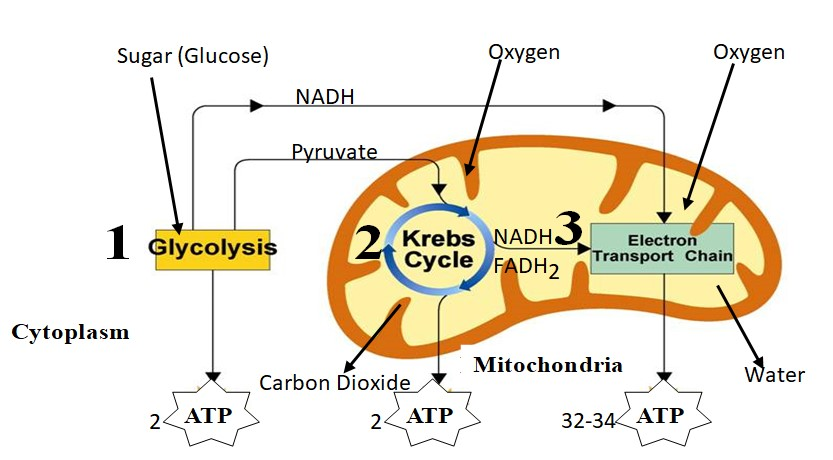
According to the figure, which labeled stage does NOT require oxygen to happen?
Glycolysis (1)

According to the figure, which gas is being RELEASED during stage 2 of the process?
Carbon Dioxide
Plants that can make their own food are known as a/an
Autotroph
Heterotrophs could not live without autotrophs.
True; they can’t live without them
The energy molecule necessary for supplying energy for life is called
Adenosine triphosphate
What parts of the cell are used during the process of cellular respiration?
Cytoplasm & Mitochondria
What are the PRODUCTS of photosynthesis & REACTANTS of respiration?
Sugar + Oxygen
What are the PRODUCTS of respiration?
Carbon dioxide + water + ATP
What are the REACTANTS of photosynthesis?
Carbon dioxide + water
Which of the following is the correct sequence of events in cellular respiration?
Glycolysis ➜ Krebs cycle ➜ electron transport
Cellular respiration is called an aerobic process because it requires
Oxygen
Photosynthesis is to chloroplasts as cellular respiration is to
Mitochondria
In the presence of oxygen, glycolysis is followed by
Krebs cycle
How do ALL organisms get the energy they need?
By breaking down food molecules gradually and capturing their chemical energy
During Cellular Respiration energy is converted from ___ to ___.
Glucose to ATP
Glycolysis occurs in the (1)___. Krebs Cycle occurs in the (2)___. The electron transport chain occurs on the (3)___.
cytoplasm, mitochondria matrix, mitochondria inner membrane
At the end of Krebs Cycle, 1 glucose molecule will produce (a)_ carbon dioxide molecules, (b)_ ATP molecules, (c)_ FADH2 molecules, and (d)_ NADH molecules.
4, 2, 2, 6
Which step of cellular respiration does NOT require oxygen?
Glycolysis; not required
Which stage of cellular respiration converts pyruvate into ATP and other high-energy molecules?
the Krebs cycle
Which of the following is the first stage of cellular respiration?
Glycolysis; first step