Lecture #20 - Isoprenoid Metabolism (IN PROGRESS)
 Call Kai
 Learn
Learn Practice Test
 Spaced Repetition
 Match
Match Flashcards
 Knowt Play
1/11

There's no tags or description
Looks like no tags are added yet.
Name | Mastery | Learn | Test | Matching | Spaced | Call with Kai | Chat |
|---|
No analytics yet
Send a link to your students to track their progress
12 Terms
Isoprenoids
Largest and most chemically-diverse class of natural compounds (~50,000 in plants).
Isoprenoids - Functions
Alkoloids
Bile salts
Chlorophyll
Carotenoids
Coenzyme Q
Cholesterol
Dolichol
Farnesylation
Fat-soluble vitamins
Haem A
Hormones
Juvenile hormones
Peptidoglycan
Plastoquinone
Sterols
Terpenes
Taxol
Natural rubber
Isoprenoids - Synthesis (Overview)
Isoprenoids are synthesized from 2 isomeric hemiterpene precursors:
Isopentenyl Disposphate (IPP)
Dimethylallyl Diphosphate (DMAPP)
Isoprenoids are synthesized from 2 distinct pathways:
Mevalonic Acid (MVA) Pathway – Cytosolic pathway (plants and animals).
Methylerythritol Phosphate (MEP)/Deoxyxylulose (DXP) Pathway – Plastidial pathway (Plants, protozoa, and bacteria).
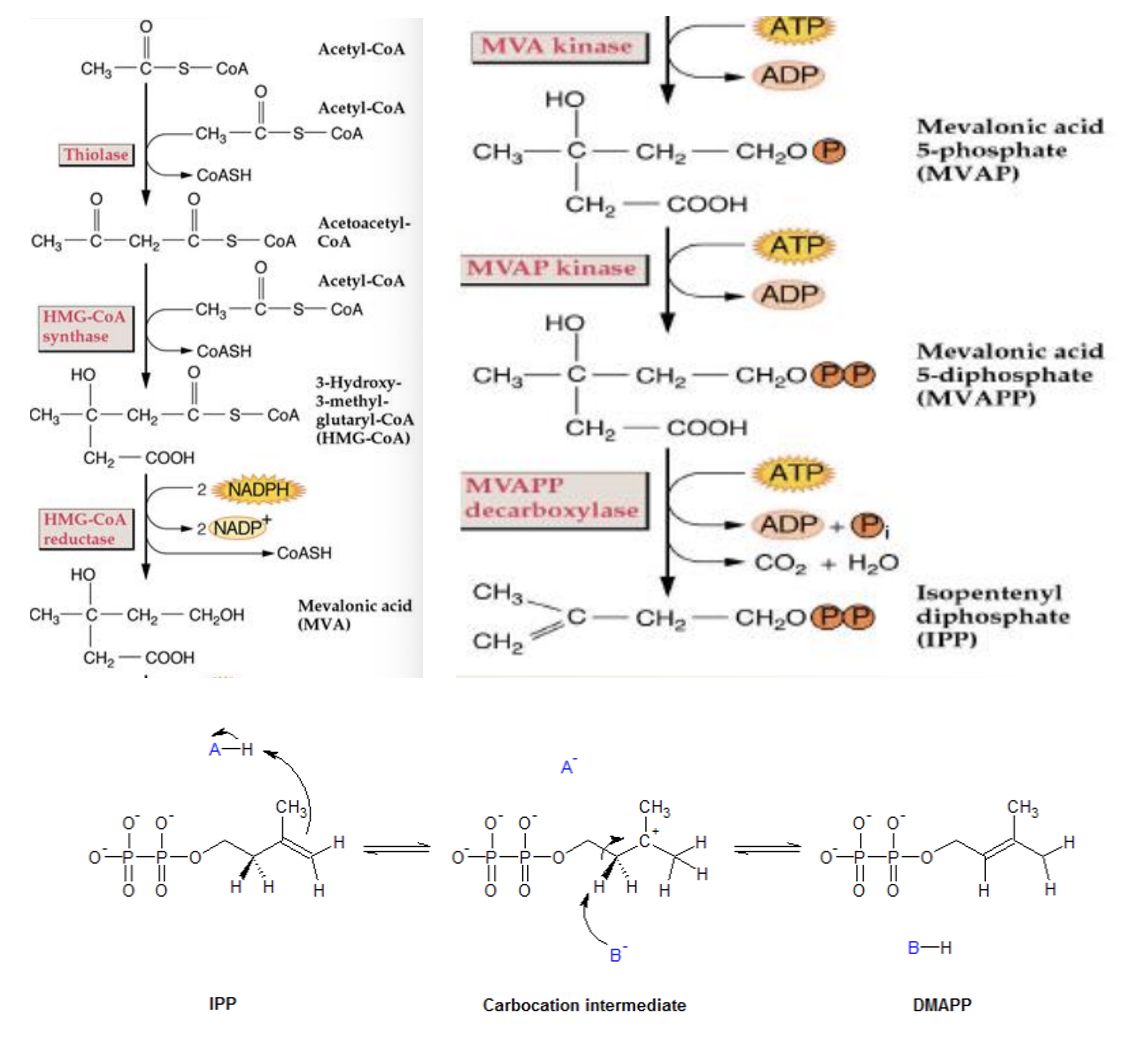
Isoprenoids - Synthesis (MVA Pathway)
Condensation: 2 x Acetyl-CoA → Acetoacetl-CoA + CoASH (via Acetyl-CoA Thiolase 2 (AACT2))
NOTE: AACT identified by functional complementation of yeast Δerg10 mutant, AACT2 identified by biochemical characterization.
Aldol Condensation: Acetoacetyl-CoA → 3-Hydroxyl-3-Methylglutaryl-CoA (HMG-CoA) + CoASH (via HMG-CoA Synthase (HMGS)).
NADH-Dependant Reduction: HMG-CoA + 2 x NADPH → MVA + 2 x NADP+ (via HMG-CoA Reductase (HMGR)).
NOTE:
HMGR Characteristics:
Key enzyme: one of the most regulated enzymes (feedback, transcription, translation, phosphorylation, degradation).
Inhibited by mevinolin (lovastrin) via competitive inhibition: binds to active site of HMGR, inhibiting MVA production and downstream products.
HMGR Structure:
Conserved membrane anchor.
Highly-variable hydrophilic N-terminal sequence.
Differences in sequence and degree of glycosylation affects targeting and activity.
Highly-variable linker sequence.
Highly-conserved, cytosol-exposed C-terminal catalytic domain.
ATP-Dependant Phosphorylation: MVA + ATP → Mevalonic Acid-5-Phosphate (MVAP) + ADP (via Mevalonate Kinase (MVK)).
ATP-Dependant Phosphorylation: MVAP + ATP → Mevalonic Acid-5-Diphosphate/Mevalonate Diphosphate (MVAPP) + ADP (via Phosphomevalonate Kinase (PMK)).
ATP-Dependant Decarboxylation: MVAP + ATP → Isopentenyl Pyrophosphate (IPP) + Pi + CO2 + H2O (via 5-Diphosphomevalonate Decarboxylase (PMD)).
Isomerization: IPP → Dimethylallyl Diphosphate (DMAPP) (via IPP Isomerase (IDI)).
Isoprenoids - Synthesis (MEP Pathway)
PLANTS:
A) Transketolase-Like Decarboxylation: Pyruvate + Glyceraldehyde-3-Phosphate (G3P) → 1-Deoxy-Xylulose-5-Phosphate (DXP) + CO2 (via DXP Synthase (DXS)).
BACTERIA:
A) Transketolase-Like Decarboxylation: Pyruvate + Thiamine Pyrophosphate (TPP) → Hydroxyethyl-TPP + CO2 (via DXS).
B) Condensation: Hydroxyethyl-TPP + G3P → DXP
NOTE:
Similar TPP-mediated 2C transfer in Calvin Cycle.
2 classes of plant DXSs: class 1 found in green (photosynthetic) tissues.
A) Isomerization: DXP → 2-C-Methyl-Erythrose-4-Phosphate (via DXP Reductoisomerase (DXR)).
B) NAPDH-Dependant Reduction: 2-C-Methyl-Erythrose-4-Phosphate + NADPH + Mn+ (cofactor) → 2-C-Methyl-D-Erythrose-4-Phosphate (MEP) + NADP+ (via DXR).
A) CTP-Dependant Cytidyl Trranfer: MEP + Cytidine Triphosphate (CTP) → 4-Diphosphocytidyl-2-C-methyl-D-erythriol (CDP-ME) + PPi (via MEP Cytidyltransferase (MEPC/IspD)).
B) ATP-Dependant Phosphorylation: CDP-ME + ATP → CDP-ME2P + ADP (via CDP-ME Kinase (CMK/IspE)).
C) Cyclization: CDP-ME2P → 2-C-erythriol-2,4-cyclodiphosphate (cMEPP) + CMP (via cMEPP Synthase (MCS/IspF)).
Fd-Dependant Reduction and Linearization: 2 x Ferredoxin (Fd) + cMEPP → 1-hydroxy-1-methyl-2-(E)-butenyl-4-phosphate (HMBPP) + 2 x Fd + H2O (via cMEPP Reductase/HMBPP Synthase (HDS/IspG)).
NADPH-Dependant Reduction: HMBPP + NADPH → IPP + NADP+ + H2O (via HMBPP Reductase (HDR)).
Favours IPP formation (6:1 IPP to DMAPP), as more products require it (IPI used to convert more if needed).
Isoprenoids - Synthesis (Evidence of Plant MVA + MEP Pathways)
Following transformation by glycolytic enzymes and pyruvate dehydrogenase, isotopically-labelled glucose at C1 appears in methyl groups of:
MEP: labelled pyruvate and G3P (C3) → IPP labelled at C1 and C5.
MVA: labelled acetyl-COA → IPP labelled at C2, C4, and C5.
Isoprenoids - Classes and Examples
Prenyl diphosphates.
Short-Chain Prenyl Diphosphates - C10 prenyl diphosphates.
Medium-Chain Prenyl Diphosphates - C15-25 prenul diphosphates.
Long-Chain Prenyl Diphosphates - C30+ prenyl diphosphates.
Terpenes
Hemiterpenes - Most basic isoprenoid unit (EX: Isoprene)
Monoterpenes - C10 isoprenoids.
3 classes:
Acyclic
EX:
Linalool
Citrol
Mycene
Geraniol
Monocyclic
EX:
Limonene
P-cymene
Methol
Thymol
Bicyclic.
EX:
Eucalyptol
Carene
Thujeine
Pinene
Sesquiterpenes - C10 isoprenoids.
3 classes:
Monocyclic (EX: Zingiberene)
Bicyclic (EX: Casbiene)
Tricyclic (EX: Patachoutol)
Diterpenes - C20 isoprenoids (EX: Steviol).
Long-Chain Isoprenoids - C30+ isoprenoids.
Triterpenes - C30 isoprenoids (EX: Digitoxigenin).
Polyisoprenoids - C30+ isoprenoids (EX: Dolichol)
Isprenoids - Prenyl Diphosphates (Prenyltransferases)
Prenyltransferases - Enzymes forming prenyl diphosphates by “head-to-tail” condensation of IPP onto DMAPP, beginning with forming and extending a C10 allylic product.
Classes:
Trans-Prenyltransferases (TPTs) - Add IPP in the trans configuration.
Cis-Prenyltransferases (CPTs) - Add IPP in the cis configuration.
Final chain length determined by prenyltransferase specificity.
Enzyme named after product formed (EX: Geranyl Pyrophosphate Synthase (GPS) forms geranyl pyrophosphate (GPP)).
Isoprenoids - Prenyl Diphosphates (Synthesis - C10 Prenyl Diphosphates)
A) IPP + DMAPP → Geranyl Diphosphate (GPP) + PPi (via GPP Synthase (GPS)).
Enzyme location (GPS): Plastid.
Enzyme type (GPS): TPT.
Product use (GPP): Monoterpenes.
B) IPP + DMAPP → Neryl Diphosphate (NPP) + PPi (via NPP Synthetase (NPS)).
Enzyme location (NPS): Plastid.
Enzyme type (NPS): CPT.
Product use (NPP): Monoterpenes.