History of Western Art, Architecture, and Design: Midterm Terms Complete Review
 Call Kai
 Learn
Learn Practice Test
 Spaced Repetition
 Match
Match Flashcards
 Knowt Play
1/171

There's no tags or description
Looks like no tags are added yet.
Name | Mastery | Learn | Test | Matching | Spaced | Call with Kai | Chat |
|---|
No analytics yet
Send a link to your students to track their progress
172 Terms
Scale
The relative size or proportion of an object in relation to other objects or its environment.
Site
The physical location or setting where an artwork or architectural structure is situated.
Medium
The materials or techniques used to create an artwork, such as oil paint, marble, or bronze.
Petroglyphs
Rock carvings made by removing part of a rock surface to create images or symbols.

Pictographs
Rock paintings created by applying pigments to rock surfaces.

Parietal Art
Art that is created on the walls of caves or rock shelters, including graffiti.

Palimpsest
A manuscript or artwork that has been reused or altered, with remnants of the original still visible.

Paleolithic
(paleo Greek: "old"; lithikos: "of stone") The earliest period of the Stone Age, characterized by the use of chipped stone tools.

Mesolithic
(mesos Greek: "middle, midst") The middle period of the Stone Age, marked by the development of more advanced tools and a shift to a more settled lifestyle.

Neolithic
(néos Greek: "young, fresh, new") The last period of the Stone Age, characterized by the development of agriculture and permanent settlements.

Çatalhöyük
A Neolithic town in modern-day Türkiye that flourished around 7500 BCE.

Henge
A prehistoric monument consisting of a circular area enclosed by a bank and ditch, often with stone or wooden structures.

Post and Lintel Construction
A building method where horizontal beams (lintels) are supported by vertical posts.

Tongue and Groove Joints
A method of joining two pieces of wood or other materials by fitting a protruding tongue on one piece into a groove on the other.

Megalith
A large stone used in prehistoric structures or monuments.

Trilithon
A structure consisting of two large vertical stones supporting a third stone placed horizontally across the top.

Chauvet Cave Paintings
Cave paintings located in Ardèche, France, featuring lions, rhinos, and bears, made with ochre and charcoal, created around 30,000 BCE.

Venus (or Woman) of Willendorf
A limestone statuette tinted with red ochre, dating from 24,000-22,000 BCE, known for its exaggerated female features (11.2cm hight).

Lascaux Cave Paintings
Cave paintings in Dordogne, France: Hall of the Bulls and "Chinese" horse, made with ochre and charcoal, created between 15,000-20,000 BCE.

Stonehenge
A prehistoric monument in England made of bluestone and sarsen stones, constructed around 2000 BCE (97ft diameter, 24 ft high). In Salisbury Plain, Wiltshire England.

Nebra Sky Disk
A bronze and gold artifact dating to 1700 BCE, depicting celestial phenomena, found in Halle, Germany (30cm diameter).

Mesopotamia
(Greek: between the rivers) An ancient region located between the Tigris and Euphrates rivers, known as the cradle of civilization.
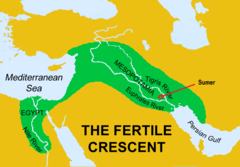
Sumer/Sumerians
First major civilization in Mesopotamia

Akkadian/Assyria/Babylon
Akkadian → early empire; ruler as powerful/divine
Babylonian → law + kingship (Fall of Babylon, 539 BCE)
Assyrian → military power + palace reliefs (war & palaces)

Cuneiform
An ancient writing system developed in Mesopotamia around 3000 BCE, characterized by wedge-shaped marks.

Votive Sculptures
Sculptures created as offerings to deities, often representing worshippers or significant figures.

Registers
Horizontal bands used in art to organize scenes or figures, often seen in ancient reliefs.

Hieratic Scale
A technique in art where the size of figures is determined by their social or spiritual importance.

Relief Carving
A sculptural technique where the sculpted elements remain attached to a solid background of the same material.

Iconoclasm (looting)
The deliberate destruction of religious icons or monuments, often for political or religious reasons.

Stele (marker)
A stone or wooden slab, often used as a monument or marker, inscribed with text or reliefs.

Ziggurat
A massive structure built in ancient Mesopotamia, resembling a terraced pyramid with a temple at the top.

Lamassu
A mythical creature with a human head, the body of a bull or lion, and wings, often serving as a protective figure.

Standing Male Worshipper
A votive figure made of gypsum alabaster, shell, black limestone, and bitumen, dating to 2800 BCE, representing a worshipper. Sumerian, from Square Temple at Eshnunna (Iraq), now in the MET.

Goat in a Thicket
A gold, copper, shell, limestone, and lapis lazuli sculpture found at Ur, dating to around 2600 BCE, representing a goat among vegetation. Now in British Museum & Philadelphia Museum.

Standard of Ur
A decorative box made of shell, limestone, lapis lazuli, and bitumen, dating to 2500 BCE, depicting scenes of war and peace. Now in British Museum.

Victory Stele of Naram-Sim
A sandstone stele dating to 2250 BCE, commemorating the victory of Naram-Sim, a ruler of Akkad. 6'7", in the Louvre.

Head of an Akkadian Ruler
A bronze sculpture from the Akkadian Period, around 2200 BCE, representing Sargon of Akkad, notable for its realistic features. 12in high in Iraq Museum.

The Invisible Energy Should Not Exist
By Michael Rakowitz, recreating Ancient Iraqi artificated that were looted or destroyed after Iraqi War using Middle Eastern recycled food packages; addressing cultural loss, destruction, and displacement.

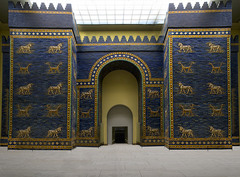
Ishtar Gate
A grand entrance to Babylon, constructed with blue glazed bricks around 570 BCE, commissioned by King Nebuchadnezzar II. In the Pergamon Museum.
Ancient Egyptian Art
Art characterized by its focus on permanence and adherence to established conventions, often serving religious or funerary purposes.

Tombs
Structures built to house the dead, often elaborately decorated and filled with goods for the afterlife.

Necropolis
A large, ancient cemetery with elaborate tomb monuments, often associated with a specific city.
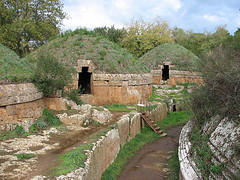
Sarcophagus
A stone coffin, often adorned with inscriptions or sculptures, used for burial.

Old Kingdom, Middle Kingdom, New Kingdom
- Old Kingdom (c. 2686-2181 BCE): Era of the great pyramids and monumental royal tombs, emphasizing the pharaoh's divine power and the afterlife. (PYRAMIDS)
- Middle Kingdom (c. 2055-1650 BCE): Period of political reunification when Egyptian art became more realistic and emotionally expressive, especially in royal portraiture. (REALISM/REUNIFICATION)
- New Kingdom (c. 1550-1070 BCE): Egypt's imperial peak, known for huge temples, elaborate tombs, and powerful pharaohs such as Hatshepsut, Akhenaten, and Tutankhamun. (EMPIRE + TEMPLES)

Hieroglyphs
From 3000 BCE, a system of writing using symbols and pictures, used in ancient Egypt for religious texts and inscriptions.

Pyramid
A stepped and triangular monumental structure with a square or rectangular base and triangular sides, serving as a tomb for pharaohs.

Papyrus
A plant-based material used in ancient Egypt for writing, made from the pith of the papyrus plant.

Mummification
The process of preserving a body for the afterlife, involving embalming and wrapping in linen.

Pharaoh
(God-King in the Bible) The title of ancient Egyptian kings, considered divine rulers and intermediaries between the gods and the people.

Orientalism
A term used to describe the representation of Eastern cultures in Western art, often characterized by stereotypes.

King Djoser
Old Kingdom pharaoh; built the Step Pyramid at Saqqara, the earliest major Egyptian pyramid.

Khufu
Old Kingdom pharaoh; Great Pyramid of Giza, the largest of the three main Giza pyramids.

Khafra
Old Kingdom pharaoh; second Giza pyramid; associated with the Great Sphinx.

Menkaure
Old Kingdom pharaoh; built the smallest of the three main pyramids at Giza.

Imhotep
Architect of Djoser's Step Pyramid at Saqqara; first known architect by name.

Thutmose (sculptor)
Sculptor associated with Akhenaten's court; workshop produced the famous Bust of Nefertiti.

Ra
Egyptian sun god and Chief Deity; pharaoh was considered the son of Ra.

Osiris
God of the dead, resurrection, and afterlife; husband of Isis and father of Horus.

Isis
Goddess and wife of Osiris; mother of Horus, associated with protection and motherhood.

Horus
Falcon-headed god and son of Osiris and Isis; living pharaoh was identified with Horus.

Anubis
Jackal-headed god associated with mummification, embalming, and guiding the dead.

Hatshepsut (c. 1507-1458 BCE)
Powerful female New Kingdom pharaoh; known for her monumental mortuary temple at Deir el-Bahri.

Akhenaten
New Kingdom pharaoh who promoted Aten worship and inspired the distinctive Amarna artistic style.

Nefertiti
Queen and wife of Akhenaten; famous for Thutmose's painted limestone portrait bust.

Tutankhamun (r. 1333-1323 BCE)
New Kingdom pharaoh famous for his nearly intact tomb and its rich funerary objects.

Napoleon Bonaparte - Egypt
Led the 1798 French expedition to Egypt, stimulating European study of ancient Egyptian culture.

Palette of Narmer
An ancient Egyptian ceremonial palette made from siltstone dating to around 3200-3000 BCE, depicting the unification of Upper and Lower Egypt.

The Pyramid of Djoser
The first large-scale stone building in history, made with limestone, designed by architect Imhotep, built around 2650 BCE, in Saqqara (famous step pyramid).

Great Pyramid
The largest of the three pyramids at Giza, made out of limestone and granite, built as tomb for Pharaoh Khufu around 2600 BCE, standing at 146 meters high.

Great Sphinx of Giza
A limestone statue with a lion's body and a human head, built during the reign of Pharaoh Khufu. From 2500 BCE.

King Menkaura and Queen
A greywacke stone sculpture from 2490 BCE, found at Giza, depicting King Menkaura and his queen, housed in the Museum of Fine Arts, Boston.

Standing Hippopotamus aka 'William'
A faience sculpture from around 1900 BCE, measuring 20 cm x 7.5 cm x 11.2 cm, located at The Met.

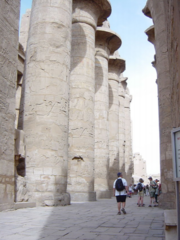
Great Hypostyle Hall
A hall in the Temple of Amun-Ra at Karnak, Luxor, made out of sandstone and mud brick. Built during the Middle-New Kingdom, characterized by papyrus-style capitals and a post-and-lintel structure.
House Altar depicting Akhenaten, Nefertiti and their Daughters
A limestone altar from circa 1350 BCE, located in the Egyptian Museum, Cairo, depicting the royal family.

Funerary Mask of Tutankhamun
A gold mask inlaid with lapis lazuli, carnelian, obsidian, turquoise, and glass paste, created in 1323 BCE, measuring 21.3 x 15.5 x 19.3 inches, housed in the Egyptian Museum, Cairo.

Bust of Nefertiti
A limestone and stucco bust created by Thutmose around 1345 BCE, measuring 19 inches high, located in the Egyptian Museum, Cairo.

Archaic period
A period in Greek art and architecture from the mid-7th century to 480 BCE, characterized by the development of sculpture and pottery styles.

Amphora
Ancient Greek two-handled storage vessel, commonly used for wine or oil and often decorated with painted scenes.

Krater
Large Greek vessel used for mixing wine with water, often decorated with mythological or everyday scenes.

Kouros / Kouroi
Nude male youth statue(s) from Archaic Greece; rigid, frontal, idealized, often used as grave markers or religious offerings.

Kore / Korai
Clothed female youth statue(s) from Archaic Greece; usually religious offerings, characterized by elaborate clothing and the Archaic smile.

Dipylon amphora
A black-figure earthenware amphora from the Late Geometric period, circa 750 BCE, located in the National Archaeological Museum, Athens.

New York kouros
A marble statue from around 580 BCE, representing a youth, located in the Metropolitan Museum of Art, New York.

Achilles and Ajax amphora
By Exekias, a black-figure earthenware amphora created around 540 BCE, housed in the Vatican Museums, Rome.

Classical period
A period in Greek art from 480 to 323 BCE, marked by advancements in sculpture, architecture, and the establishment of artistic canons.

Persian sack of Athens
The event in 480 BCE when the Persian army invaded and looted Athens during the Greco-Persian Wars.

Canon of proportions
A set of rules for ideal human proportions in art, notably used by artists like Polykleitos (1:7) and Lysippos (1:8). Harmony.

Ideal Proportions
Greek belief that beauty comes from mathematically balanced proportions and harmony of the human body or architecture.

Contrapposto
A sculptural technique where the weight of the body is distributed unevenly, creating a more dynamic and relaxed pose.

Relief sculpture
A type of sculpture where the figures are carved into a flat background, as opposed to being fully three-dimensional.

Perikles
Athenian statesman who sponsored the rebuilding of the Acropolis, including the Parthenon, during Athens' Golden Age.

Pheidias
Major Greek sculptor who supervised the Parthenon's sculptural program and created its monumental statue of Athena.

Kallikrates
Greek architect who, with Iktinos, designed the Parthenon.

Iktinos
Greek architect who, with Kallikrates, designed the Parthenon.

Greek architectural orders
The three styles of ancient Greek architecture: Doric, Ionic, and Corinthian, each with distinct features.

Doric Order
Pediment (roof), Frieze (section below roof), Triglyph (motif section), Metope (blank section in between triglyphs), Capital (top of column), Shaft (column section), NO base.

Ionic Order
Pediment (roof), Frieze (section below roof with motif decor), Architrave (below Frieze), Entablature (includes the whole top section), Capital (top of column), Shaft (column section), Base (bottom of column).

Corinthian Order
Cornice (Top flat roof), Frieze (section below roof with motif decor), Architrave (below Frieze, layered section), Capital (top of column), Shaft (column section), Base (bottom of column).

Panathenaic procession
A ceremonial procession held in ancient Athens in honor of the goddess Athena, featuring various cultural and religious activities.
