Unit 3 - Ecology
 Call Kai
 Learn
Learn Practice Test
 Spaced Repetition
 Match
Match Flashcards
 Knowt Play
1/81

There's no tags or description
Looks like no tags are added yet.
Name | Mastery | Learn | Test | Matching | Spaced | Call with Kai | Chat |
|---|
No analytics yet
Send a link to your students to track their progress
82 Terms

Species
A group of organisms that share common characteristics and that can interbreed to produce fertile offspring.
Classifications
The organization of organisms into different taxa or groups.
Binomial name
Has two parts. The first word is the genus such as Camponotus, whereas the second part is the species name like maculatus. This needs to be written in italics or underlined.
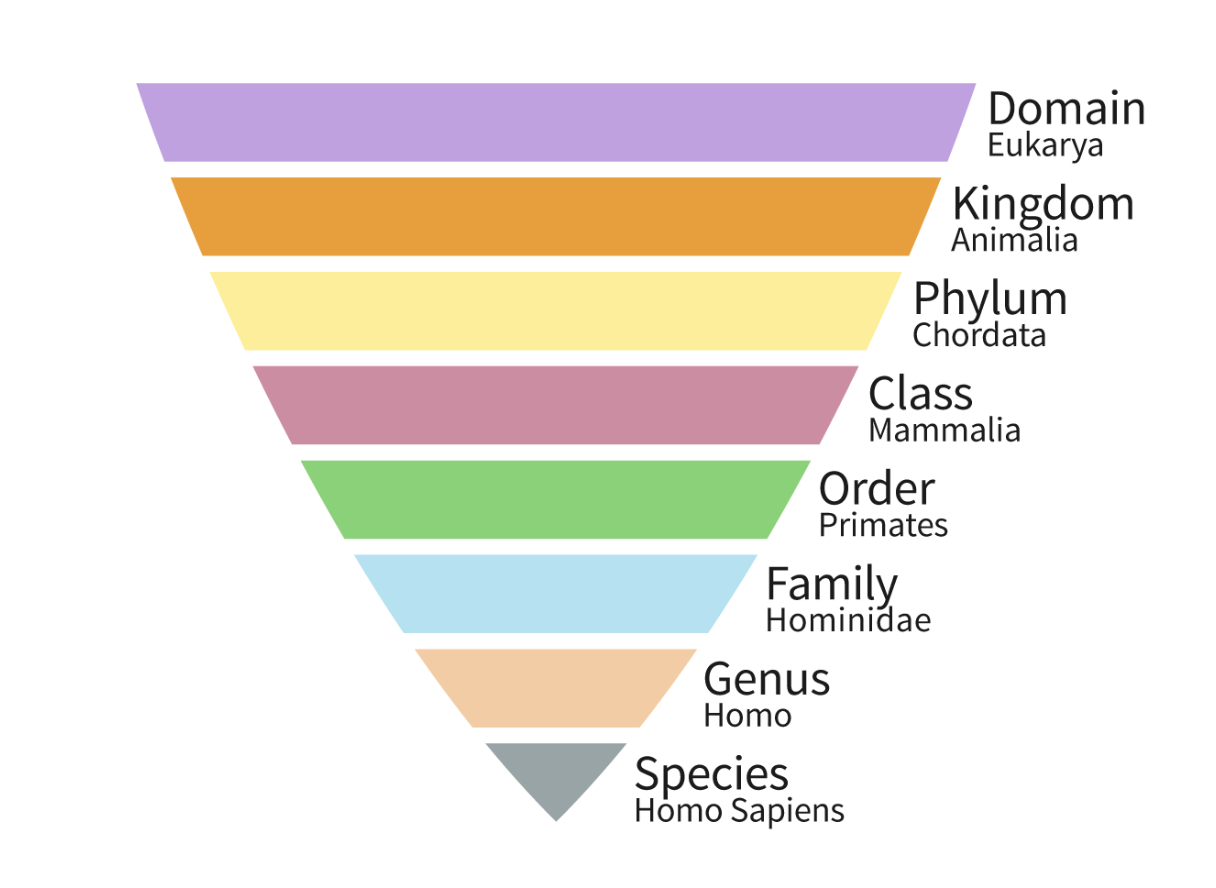
Classification of Homo sapiens
Domain
Eukarya
Kingdom
Animalia
Phylum
Chordata
Class
Mammalia
Order
Primates
Family
Hominidae
Genus
Homo
Species
Sapiens
Dichotomous keys
It is a serious of questions based on the physical characteristics (phenotype) of the organisms concerned.
Cladogram
Clades are the evolutionary relationships and a cladogram shows a hypothesis of the evolutionary relationships between members of a taxon.
Population
A group of organisms living in the same area at the same time, and which are capable of interbreeding.
Abiotic vs biotic factors
Abiotic factors are non living things such as PH, salinity and temperature that many influence an organism or ecosystem. Biotic factors are living things/biological factor that may impact an organism or ecosystem such as predation, parasitism and disease.
Niche
The ecological role of a species in an ecosystem and the range of conditions necessary for it’s survival. It depends not only on where it lives but also on what it does.
Fundamental niche vs realized niche
Fundamental niche is the set of all abiotic and biotic factors and resources in which a species or population could theoretically survive and reproduce. A realized niche is the actual conditions and resources a species or population could exist due to abiotic factors and competition.
Predation
It is when one organism acts as the predator and feeds on another organisms called the prey. This may not seem good for the prey, but it creates a negative feedback loop and ensures the stability of the ecosystem.
Commensalism
An interaction between two species where one benefits and the other is not harmed or benefited. Example: Remora fish and sharks.
Herbivory
It is when organisms, usually animals feed on plants. The organisms eating the plants are called herbivores.
Parasitism
It is a interaction between two organisms, where one organism gets resources it needs from the other organism, the host, but may harm the host in the process.
Mutualism
It is a interaction between organism where both benefits and neither suffers. One example when ants farm aphids to get the honeydew.
Disease
Disease is a departure from the normal state of functioning of any living organism and is marked by symptoms of illness.
Competition
It is when organisms compete for limited resources such as food, water, mates etc.
Carrying capacity
The maximum population size of species that can sustainably be supported.
Limiting factors
A resource in the environment that can significantly affect a population’s size if it becomes limited.
Plants - nutrients, food, water
Animals - space, food, mate, shelter
Density independent factors
Limiting factors that do not depend on the size of the population and affect every population in the ecosystem, they tend to be abiotic.
Examples:
Natural disaster: Flooding, fires
Density dependent factors
Limiting factors that are related to population density. They are usually biotic (like competition) that limit population growth.
There is usually an increase of predation and spread of pathogens in dense populations. Density dependent/independent factors are examples of negative feedback.
Population growth curve: J curve
First when there are no limiting factors the population or an activity grows extremely quickly, but as soon as the population reaches the carrying capacity, the population crashes. Example: bacteria and reindeer on St Matthew Island
Population growth curve: S curve (logistic growth)
Shows the population or an activity grow exponentially, but then slowing growth as the carrying capacity is reached.
R strategists vs K strategists
R strategists produce a large number of offspring with minimal parental care. They grow quickly and have a short lifespan. Examples include rabbits and insects. K strategists produce fewer offspring with more parental care and they tend to have a longer lifespan. Examples include mammals such as elephant and whales.
Quadrant sampling
Sampling for non motile or slow organisms. A square frame is used to describe the area, enabling the extrapolation to a bigger area. An area is chosen, length and width.
Estimated population size: Multiply the mean number of organisms in 1 quadrant by the number of quadrants that would fit into the field.
Capture mark release recapture
Capture: In your area of study, capture as many of the study animals as possible in a fixed time period. Record the number that you have caught.
Mark: Mark the captured organisms in a way that does not harm them or make them more or less prone to predation.
Release: Release the animals back into their environment and give them sufficient time to reintegrate into the population. Fast moving animals like mice will reintegrate more quickly than slow-moving animals like snails.
Recapture: Capture a second sample of the population using the same fixed time period used for the first capture. Record the total number of animals that you have caught in the second sample. Include the number of marked animals. You can now estimate the size of the population.
Lincoln index formula: (Number of animals capture on first day x number of animals recaptured in the second day) / number of marked animals in the sample recaptured on the same day.
Benefits:
Can be applied to a wide range of species
Can be used to collect long term data
Limitations:
May not be ethical
Can harm the animal
Community
A group of interacting populations of different species living within an ecosystem.
Habitat
It is the location in which a community, species, population or a organism lives.
Keystone species
A single species in an ecosystem that maintains its structure and function. Examples include sea otters, wolves, elephants and purple sea stars.
Tipping points and new equilibria
They lead to the collapse of the original ecosystem and the development of a new equilibrium. One example is the deforestation of the Amazon.
Zonation
The arrangement or pattering of communities or ecosystems in response to change, over a distance, in some environmental factor.
Example: Intertidal zone and barnacles. Some barnacles less air exposure while some like more.
Ecological succession
The long-term change in the composition of a community

Primary succession
Pioneer species: A piece of land without any living organisms (biotic factors), —> pioneer species —> lichens, —> small plants and lichens, grasses and perennials . Intermediate species: shrubs, grasses, pines

Secondary sucession
A fire or anything else destroys everything (natural phenomenon.) Then the same process as primary succession takes place. But pioneer species process is usually quicker because there may already be seeds in the soil.
Things threatening biodiversity
Habitat loss
Invasive species - example: Yellow crazy ant
Over harvesting and hunting
Pollution
Factors determining conservation size
Population size - low population size or reduced
# of matured individuals
Geographic range & degree of fragmentation
Quality of habitat
Probability of extinction
IUCN redlist
Determines how vulnerable a species is, global conservation status of species
Why biodiversity is crucial?
Direct service
Shelter
Food, genetic diversity
Medicine
Indirect service
Removal of chemicals, wetlands
Aesthetic and ethical
Value, what is left for the future
Types of conservation
Ex citu conservation
Botanic gardens
Zoo
Seed banks
Strategies outside natural habitat
In citu conservation
National parks
Reserves and sanctuaries
Strategies inside natural habitats
In citu conservation is conserving organisms in their natural habitat. Protects ecosystem and habitat. Whereas in ex situ conservation is conserving organisms in man made habitats. Protects individual species and genetic information.
Designing protected areas
Area
Edge effect
Shape
Corridor
Buffer zone
Large vs small protected areas
Large areas: Can be beneficial because some species can only survive in larger areas and it reduces the edge effect.
Smaller but multiple areas: Increases the edge effect. However, some species thrive better such as birds.
Biosphere
The thin outer layer of earth which is inhabited by living organisms. A biosphere represents the parts of the Earth where life exists.
Biome
A collection of ecosystems sharing similar climatic conditions.
Ecosystem
An area where a community of organisms live and interact with their environment.
Simpsons reciprocal index
Richness: diversity of species, number of unique species
Evenness: How evenly the individuals with each species are distributed

Types of biodiversity
Habitat diversity: Variety of different ecosystems or habitats within a specific area.
Species diversity: Number and variety of species within a given habitat or ecosystem.
Genetic diversity: The variety of genetic traits and characteristics within a population or species.
Resilience
It is an ecosystems ability to recover when disturbed. Biodiversity increases resilience because if one species disappears, then another species with a similar niche can replace it.
Biodiversity hotspots
1500 endemic plant species
More than 70 % of the habitat already lost
Distinct environmental conditions
Example: Galapagos islands
Biodiversity areas
Indigenous approachment to land management
Key biodiversity areas (KBAs)
Tensions: Conflict between exploitation, sustainable development and conservation.
Environmental justice
Kraeng Krachan National Park
Transect sampling
The sampling method in which you collect data (counting) along a transect (a line, path, or strip along a habitat). Can be used to record the change over time.
Invasive species
An invasive species is a non-native species that threatens its new ecosystem. Non-native species are usually brought to new ecosystems through human transport and trade.
Arguments for habitat and species preservation
Aesthetics: focuses on the beauty and visual appeal (from a human perspective)
Ecological: Focuses on the vital ecosystem services provided by diverse species
Ethical: Moral responsibility to protect and preserve the diversity of life on Earth.
Sociocultural: Importance of biodiversity in providing for human social wellbeing.
Conservation strategies from different perspectives
Ecocentrism: this assigns intrinsic value to biodiversity, treating ecosystems and species as inherently valuable components in sustaining all life on Earth. Low intervention and in situ conservation strategies
Anthropocentrism and technocentrism: viewed primarily through the instrumental value of biodiversity for humans. Strategies include eco tourism, gene banks and establishing zoos.
Benefits of rewilding
Benefits
Ecosystem resilience
Ecosystem services
Economic benefits
Socio cultural benefits
Limitations of rewilding
Limited scope and slow results
Uncertainty
Resources (can require a lot of resources)
Land use conflict with other people like farmers
Data logging
Capturing, storing, measurements, such as temperature, humidity, pressure, over time using sensors and electronic devices.
Ecosystem
The community and physical ecosystem with which it interacts. Tropical rain forests are examples of old ecosystems.
Human activities leading to tipping points
Tipping points can lead to collapse of the original ecosystem and development of new equilibrium. One example of this is deforestation of Amazon rainforest, reduces generation of water through transpiration, thus reduces cooling and precipitation necessary for the maintenance of the remaining forest.
Climate vs weather
Climate describes atmospheric conditions over relatively long periods of time, whereas weather describes the conditions in the atmosphere over a short period of time.
Gross productivity
Total amount rate at which producers/plant algae capture energy and convert it into chemical energy.
Net primary productivity,
Remaining energy stored as biomass after plants use that energy for respiration.
IUCN
Species that has become extinct: Dodo bird
Species that is critically endangered: Sumatran tiger
Species whose conservation status has been improved by intervention: Siberian tiger
Key biodiversity areas/hotspots
Sites that contribute significantly to the global persistence of biodiversity.
Tension between indigenous people and national parks
Examples: Maasai in Serengeti park and Karen people in Kaeng Krachan national park.
Examples of rewilding
Rewilding in Gorongosa national park, Mozambique. Reintroduction of wolves to Yellowstone national park.
Succession of conservation or regeneration measures needs to be assessed
Conservation measures have successfully protected biodiversity, and consider the impact of the measures on local communities.
Can be evaluated at three levels
Did the measures in the project succeed as planned
Was the project well received by the communities impacted?
Was this the best way to conserve nature
Case study: Wangari Maathai’s Kenyan Green Belt Movement
Established in Kenya. Focuses on empowering women. Facilitated the planting of over 51 million trees to combat deforestation, soil erosion and climate change. Focuses on establishing tree nurseries, plant trees on their farms, at schools, and in communities, promoting sustainable livelihoods.
Wildlife friends foundation
Example of rehabilitation and refuge for animals in need.
Positive feedback loop/negative feedback loop
An initial change in a system is amplified, causing the output to reinforce and amplify the original cause.
Self regulating biological and ecological process that counters a change to bring a system back to a stable point
Donut economics
Social needs inside and environmental outside. Focuses on sustainability and well being. Case study: Bangkok, Thailand. Has the biggest green roof. Has theater, meditation centers. There is park in Chulalongkorn University designed with incline so that all of the water is absorbed by the ground. Instead of concrete that is non permeable, soil allows water to be absorbed into ground, preventing flooding.
Conditions required for coral reef formation
Example of marine system. Factors include: water depth, pH, salinity, clarity and temperature.
Obligate anaerobes, facultative anaerobes and obligate aerobes
Obligate Aerobes: Require oxygen to survive
Facultative Anaerobes: Can grow with or without oxygen
Obligate anaerobes: Cannot live or grow in the presence of molecular oxygen
Archaea
One of the three domains of life. They are varied in how they obtain energy for ATP production.
Phototrophy: They capture sunlight without using chlorophyll.
Lithotrophy: Oxidising organic molecules.
Organotrophy: Break down ready made organic molecules.
Saprotrophs
Use external digestion, secretes enzymes that break down nutrients externally and then they absorb the nutrients.
It is heterotrophic nutrition and this mode can be referred to as decomposers.
Different types of troph
Photoautotroph
Saprotroph:
Autotroph:
Chemotroph: Obtains nutrients by breaking down chemical compounds
Heterotroph: Obtains nutrients by breaking down organic compounds.
Chemotrophic nutrition
Most archaea carry out chemotrophic nutrition and gain their energy and nutrients by breaking down or metaboliing molecules from their environment such as hydrogen sulfide and ammonia.
Keeling curve
Daily record of global atmospheric carbon dioxide concentration that tracks humanities impact on Earths climate. Carbon dioxide drops in summer as plants absorb carbon dioxide via photosynthesis, rises in fall and winter as plants decompose.
Ecosystem
A community of living organisms interacting with each other and their physical environment.
Bioaccumulation vs biomagnification
Bioaccumulation is the buildup of toxic substance in an single organism over time, while biomagnifcation is the increase in concentration of that substance as it moves up the food chain. One example of biomagnifcation is mercury and DDT.