Genetics
 Call Kai
 Learn
Learn Practice Test
 Spaced Repetition
 Match
Match Flashcards
 Knowt Play
1/92

There's no tags or description
Looks like no tags are added yet.
Name | Mastery | Learn | Test | Matching | Spaced | Call with Kai | Chat |
|---|
No analytics yet
Send a link to your students to track their progress
93 Terms
What must a molecule exhibit for it to be considered genetic material
genetic material must contain complex information; must be capable of storing large amounts of information, because all the instructions are carried by this
genetic material must replicate accurately; must be able to be passed on with high fidelity
genetic material must encode the phenotype (the stored information), to be expressed by the genotype
in an organism. It must also undergo mutations that allow for variation and evolution.
What are Nucleic Acids composed of, and how can they be categorized?
Nucleic acids are composed of a string of nucleotides, which can be categorized according to the base involved: Pyrimidine or Purines

How can you determine whether the nucleic acid is RNA or DNA
The type of sugar molecule in a nucleotide determines whether the nucleic acid is RNA or DNA. RNA has an OH group on Carbon2, DNA has an H on Carbon2

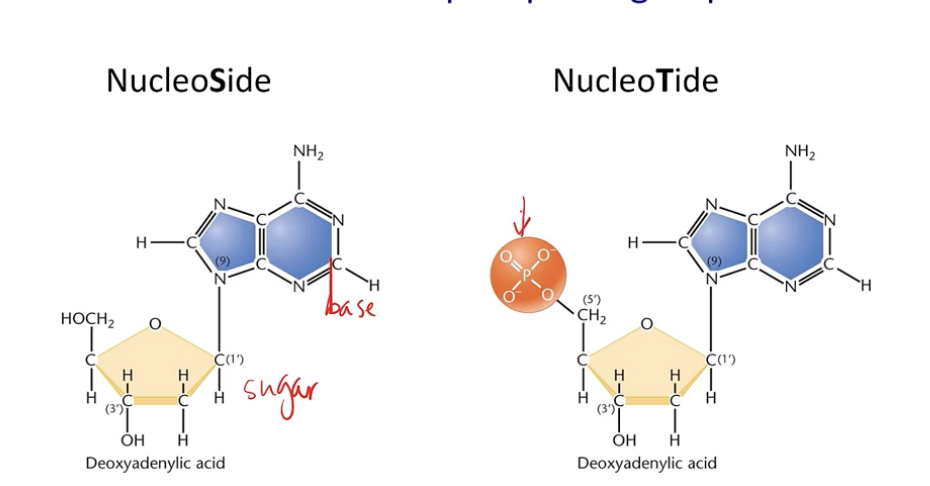
What is the difference between nucleotide and nucleoside
Nucleotides have a base, sugar, and a phosphate group; Nucleosides lack a phosphate group
What is the difference between a Polynucleotide vs. an Oligonucleotide?
A polynucleotide has many nucleotides (>20); an Oligonucleotide has few nucleotides (<20)
How are nucleotides joined together to form nucleic acids
they are joined by covalent phosphodiester bonds

what is the Nucleic Acids backbone made of; how does DNA carry an overall negative charge?
nucleic acids have a sugar-phosphate backbones; DNA carries an overall negative charge because of these phosphates

How is the structure of DNA composed?
secondary structure of DNA is the double helix, 2 antiparallel DNA strands. It has a 3’ end, and a 5’ end

What is the specificity to base pairing in nucleic acids? What is the nature of Hydrogen Bonds in base pairing? How many Hydrogen Bonds are in each?
Purines ( G, A) pair with Pyrimidines ( C, T); GCAT
The nature of Hydrogen bonds limits which bases compare; Thymine and Adenine share 2 hydrogen bonds, Cytosine and Guanine share 3 hydrogen bonds

What does Chargaff’s Rules tell us about base composition of the molecule of DNA
% A = % T
% G = % C
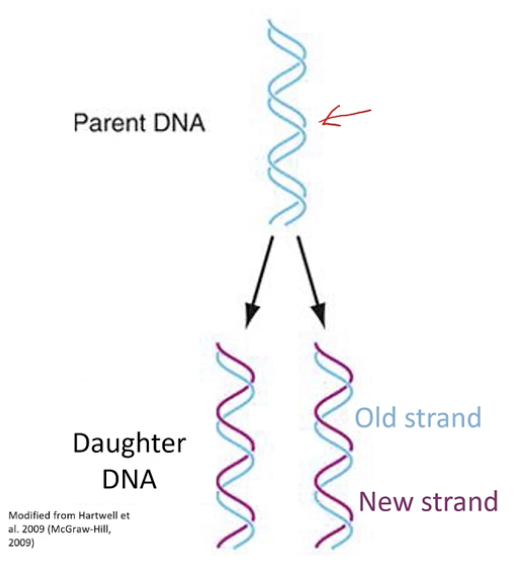
How does DNA structure facilitate replication?
Semiconservatively = each original parent strand acts as a template for the synthesis of a new strand of DNA. The 3rd generation has new DNA,

How does DNA begin synthesis/replication
DNA undergoes localized unwinding of the DNA double helix. Once it unwinds, it has a replication fork

How does DNA replication add new nucleotides?
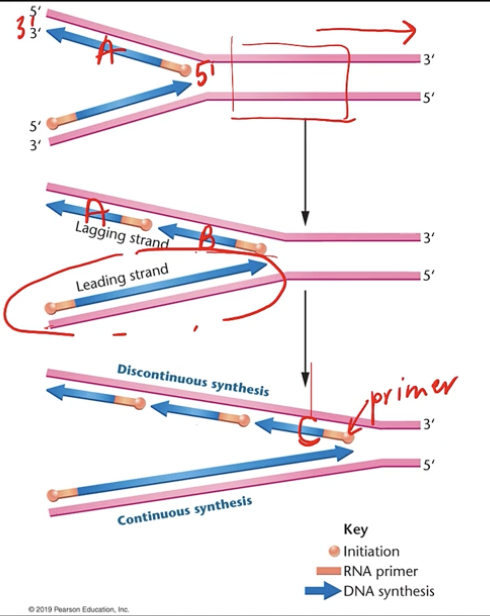
since DNA cannot create synthesis on a bare template, it requires a primer (RNA Polymerase) to provide a free 3’-OH group that can attach the new nucleotide to the 3’ end

What adds the new nucleotides? From which end?
DNA polymerase catalyzes the addition of new nucleotides/deoxyribose nucleotides triphosphates to from the 5’ end to the 3’ end of the growing strand

What are the directions of the leading and lagging strands? Why is lagging strand considered discontinuous synthesis? What pairs the okazaki fragments?
Leading: left - right
Lagging: right - left
Lagging strand is discontinuous creating okazaki fragments, due to it being cut off each time it waits for the replication fork to open up
DNA Ligase
What are the chances for DNA synthesis errors? What are the chances after proofreading?
1/100000; 1/1000000
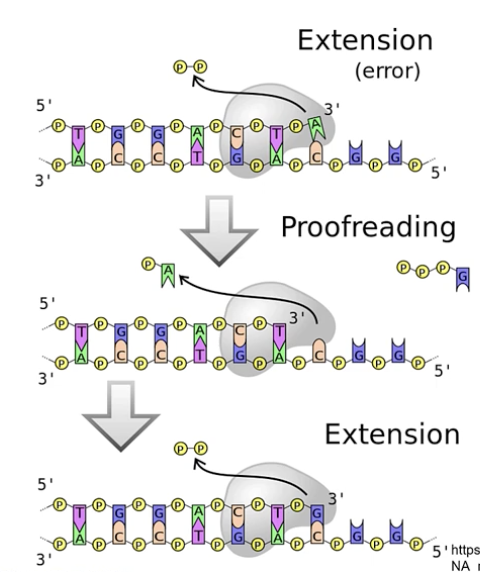
What happens when there is an error in DNA synthesis?
extension: DNA polymerase inserts an incorrect nucleotide into the growing strand, the 3’ end is incorrectly positioned which stalls the DNA polymerase
Proofreading: DNA Polymerase goes backwards with a 3’-5’ exonuclease azctivity, removes incorrect nucleotide
extension: DNA Polymerase inserts correct nucleotide
When does DNA Synthesis happen in the cell cycle?
In the S phase

How is the information stored in DNA expressed?
it is expressed as RNA via Transcription, then the mRNA is translated into protein
Identify the differences in the structure of RNA vs. DNA
The sugar Ribose replaces Deoxyribose, so there is an additional OH group on the 2nd Carbon
The Nitrogenous Base Uracil replaces Thymine, and binds with Adenine
RNA is single stranded, DNA is double stranded making it more stable
When does Transcription happen?
Interphase
When does Translation happen?
Interphase
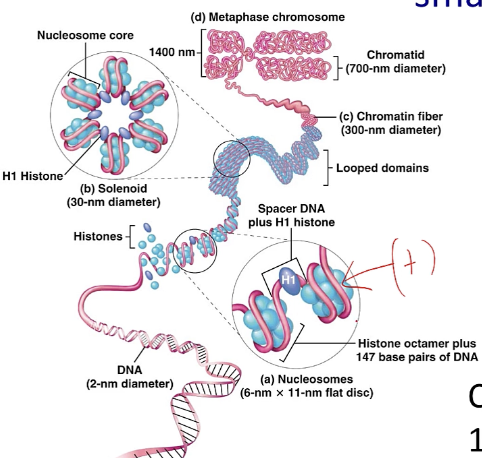
How are cells able to pack DNA? What is this called?
cells manage to pack two meters of DNA into nuclei that are about 10 microns large
that DNA and the associated proteins = chromatin
what is the name of the protein that holds the DNA together?
Histones, which are organized into nucleosomes
How do the nucleosomes pack the DNA?
Nucleosomes are positively charged, which means they can bind DNA electrostatically to the negatively charged phosphate groups of the nucleotides
What does Diploid mean?
The organisms have two full sets of their chromosomes (2n)
What is the Haploid?
the number of chromosomes in one full set (n)
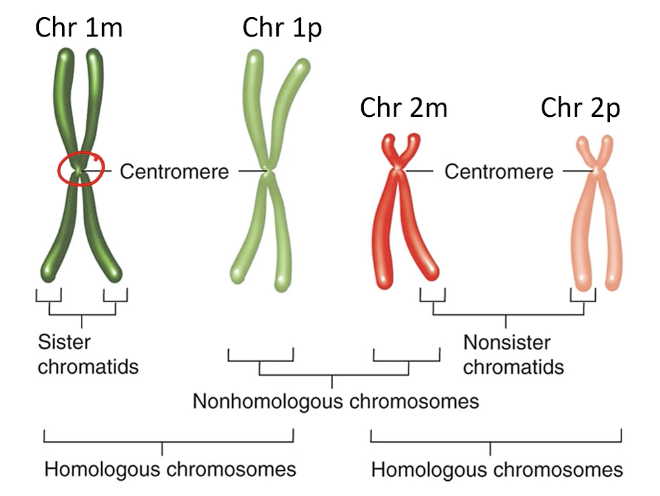
What does it mean for humans to be Diploids? What does it mean for it to be a homologous pair?
We have two copies of each chromosome, one from one parent, and the other copy from the other parent
chromosomes a,b are identical in size, have their centromere in the same location, and they CARRY the SAME GENES

what are the different locations of centromeres?
metacentric
sub-centric
acrocentric
telocentric

what is a centromere?
part of the DNA that makes up the chromosome
what are the parts of the chromosome? why is this important?
p = short arm
centromere
q = long arm
these parts represent the lengths of the chromosome which is important when pairing homologous chromosomes

How are the Daughter strand and Parent strand bonded together?
Hydrogen Bonds between the complementary bases, helping them form the double helix
Identify chromosomes properly
How much DNA can cells hold?
2 meters
How is DNA able to compact itself in Eukaryotes?
the 2m long DNA wraps around proteins called Histones like strings wrapping around a bead. the Histones are positively charged proteins that bind electrostatically to the negatively charged phosphate backbone on DNA
throughout most of the cell cycle, how will you find Chromatin?
in a diffused, uncondensed state

when does condensation happen during the cell cycle? what happens?
during prophase; the chromatin gets further compressed (10000-20000x)
what happens to DNA during the S phase?
synthesis, the cell makes more DNA
what happens to DNA during the G2 phase?
the cell continues growing for it to reach an optimal size before it divides
what happens to DNA during Mitosis/Meiosis?
the chromosomes are condensed into that sister chromatid structure

what are base analogues?
molecules that have structures similar, but not identical to certain bases and can be incorporated into DNA and/or RNA by Hydrogen bonding with other bases

How do Base Analogues get incorporated into DNA?
Cells must be actively dividing. As DNA is being made, cells will pick up the Base Analogue where the usual Base would go. Then, an antibody that detects unique molecules will recognize the Base Analogue to help us study it
what are the products of the information from DNA?
RNA and Proteins, which impact the structure of an organism
what is genotype? what is phenotype?
genetic makeup; the overall appearance of a trait in an organism
what is the process in which information from DNA is encoded to produce RNA?
gene expression
what is Spatial gene regulation?
genes expressed in different cells of the body produce different tissues = even though all cells carry identical genes, the different areas of the body only express certain ones

what is the process by which cells become more different from each other?
cell differentiation: the genes are expressed when activated by cell-type specific genes

what is Temporal Regulation?
when genes are expressed at different points/times during development
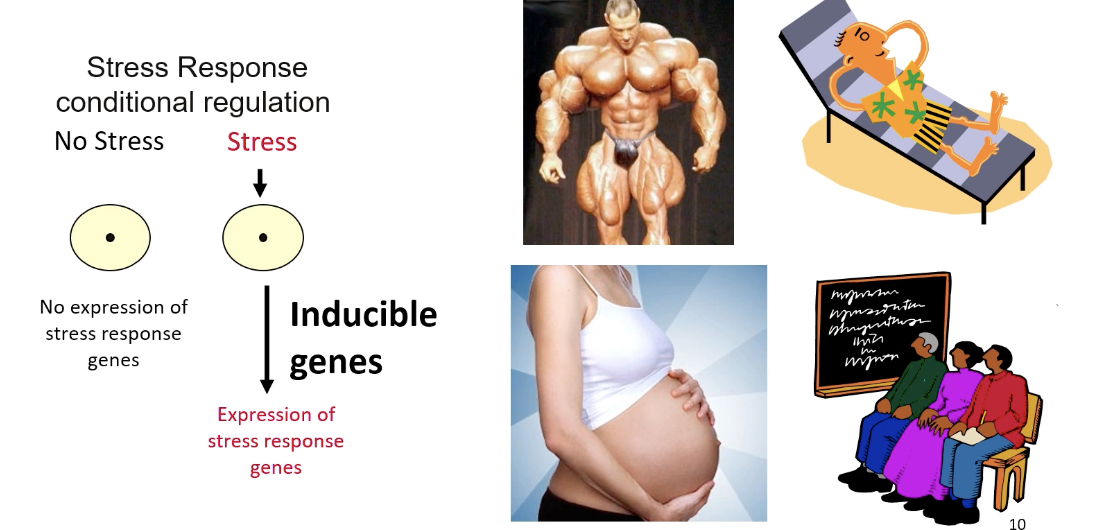
What is Conditional Regulation?
when genes are expressed in different types of conditions/environments - these are called Inducible Genes
What are Housekeeping Genes?
Genes that are always turned on - they are called Constitutive Genes, because they are required for the maintenance of basic cell function
what determines if a gene gets transcribed or not?
it depends on the protein in the cell - in particular, the Transcription Factors
WHat is the Genotype? WHat happens when a mutation occurs?
sequence of DNA; when a mutation occurs, we can sometimes see a change in phenotype
what is a phenotype? what can it also include?
ANY OBSERVABLE characteristic of an organism
eg. eye colour, hair colour, high tolerance to PH, susceptibility to disease, behaviour
it can also include banding patterns on gels
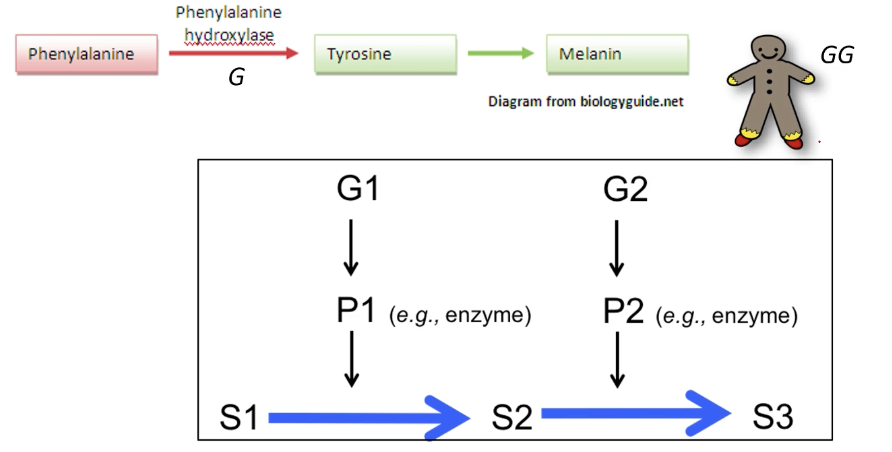
Do genes act alone? AS 1?
No,genes do not act alone. Phenotypes can be products of multiple genes interacting. They can be products of genes interacting sequentially in a biochemical pathway
what do you call the one gene that has a heavy influence on the trait(s) produced?
Pleiotropy
What are Conditional Mutations?
Genes that are always there, but are expressed/mutated into phenotypes depending on the environment of an organism
eg. temperature sensitive proteins = proteins unfold upon heating
what are Polygenic traits?
traits that require multiple genes to work together to produce
what kind of variation do Polygenic traits exihbit?
Quantitative/Continuous Variation - where it has multiple genes that each have a respective amount of alleles and produces a gradient of phenotypes

What kind of variation do traits produced by 1 or 2 genes typically exhibit?
Qualitative/Discrete Variation - traits have their own categories (a, OR b, OR c)

Do all genotypes produce the same phentoypes?
No they do not.
What is Penetrance? Incomplete vs Complete Penetrance?
measures the proportion of individuals in a population with a genotype who actually express the expected phenotype
complete: 100% of individuals with the genotype will express the phenotype
incomplete: only a certain percent of individuals will express the phenotype even if they have the genotype

what is variable expressivity?
the degree to which the phenotype is expressed

What can Incomplete Penetrance/Expressivity indicate about influencing phenotype?
mutations could be in different parts of the same gene - individuals may have the genes but do not express it to the full extent
variance/expressitivity could also be due to a Modifier Gene - the intensity (eg. number of extra toes) depends on the expression of genes in the tissues surrounding what will become the phenotype
environmental factors - eg. diet and extra added factors can produce certain phenotypes

How do we study mutations and mutant/new phenotypes?
via Forward Genetics - expose organisms to certain conditions and see if they express a phenotype you are interested in
How do we study known genes to determine what it does?
Reverse Genetics

How is something like, colour, determined in an organism?
It is determined by a pigment molecule (a protein)
What is a Null Mutation (Cw?
It means the gene is essentially ‘broken’ and no pigment molecule is made (colourless)
How is something like, Beak Size, determined?
Determined by the Size (S) gene - Size Large (SL), Size Tiny (ST)
What Happens to DNA in Mitosis?
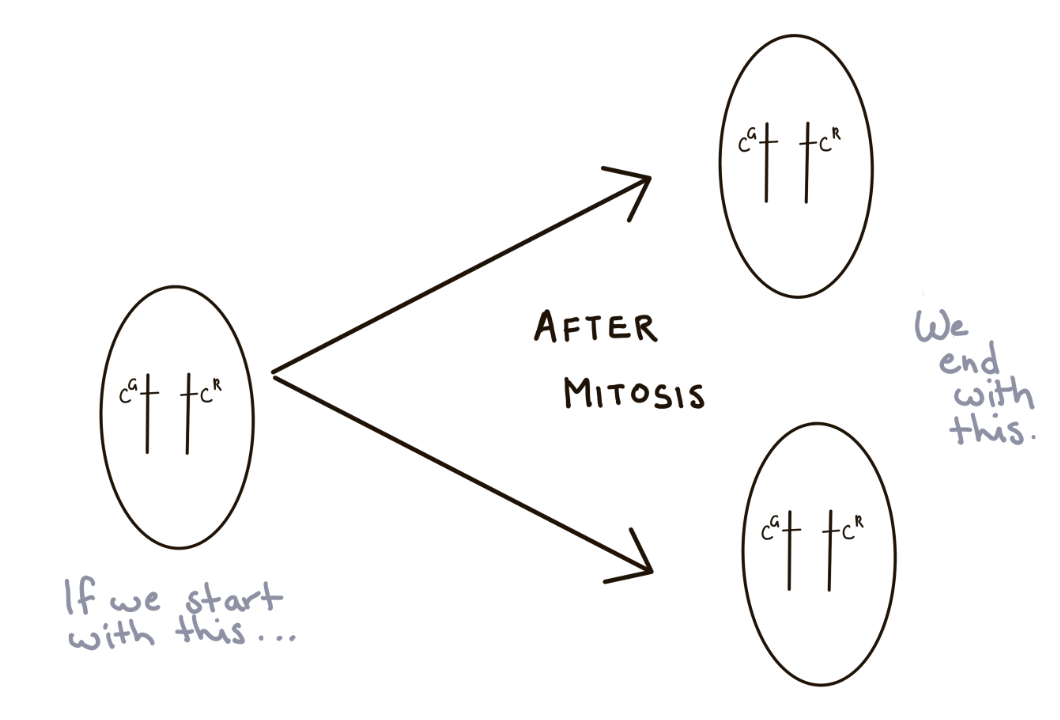
Mitosis is identical cell division. The DNA replicates and one parents cell (CGCR), splits into two identical (CGCR) daughter cells (2n)
Before mitosis: Interphase?
DNA is replicated in S phase
Each chromosome now = 2 sister chromatids
DNA is still loose chromatin
1. Prophase — “Pack & Prepare”?
Chromatin condenses → visible chromosomes
Each chromosome = 2 sister chromatids joined at centromere
Mitotic spindle forms
Centrosomes move toward opposite poles
Nucleolus disappears
Prometaphase — “Nucleus breaks, spindle grabs”
Nuclear envelope breaks down
Spindle microtubules attach to kinetochores on chromosomes
Chromosomes begin moving toward middle
Metaphase — “Middle”?
Chromosomes line up at metaphase plate
Sister chromatids are attached to spindle fibers from opposite poles
Metaphase checkpoint: confirms proper attachment before separation
Anaphase — “Apart”
Sister chromatids separate
Move toward opposite poles
Once separated, each chromatid is considered its own chromosome
Cell elongates
Telophase — “Two nuclei”
Chromosomes arrive at poles
Chromosomes decondense → chromatin
Nuclear envelopes reform
Spindle breaks down
Two nuclei form
Cytokinesis — “Cut the cell”
Cytoplasm divides → 2 daughter cells
Animal cells: cleavage furrow
Plant cells: cell plate
where does mitosis occur?
somatic/body cells
what does it mean to say that Meiosis is Reductional Division?
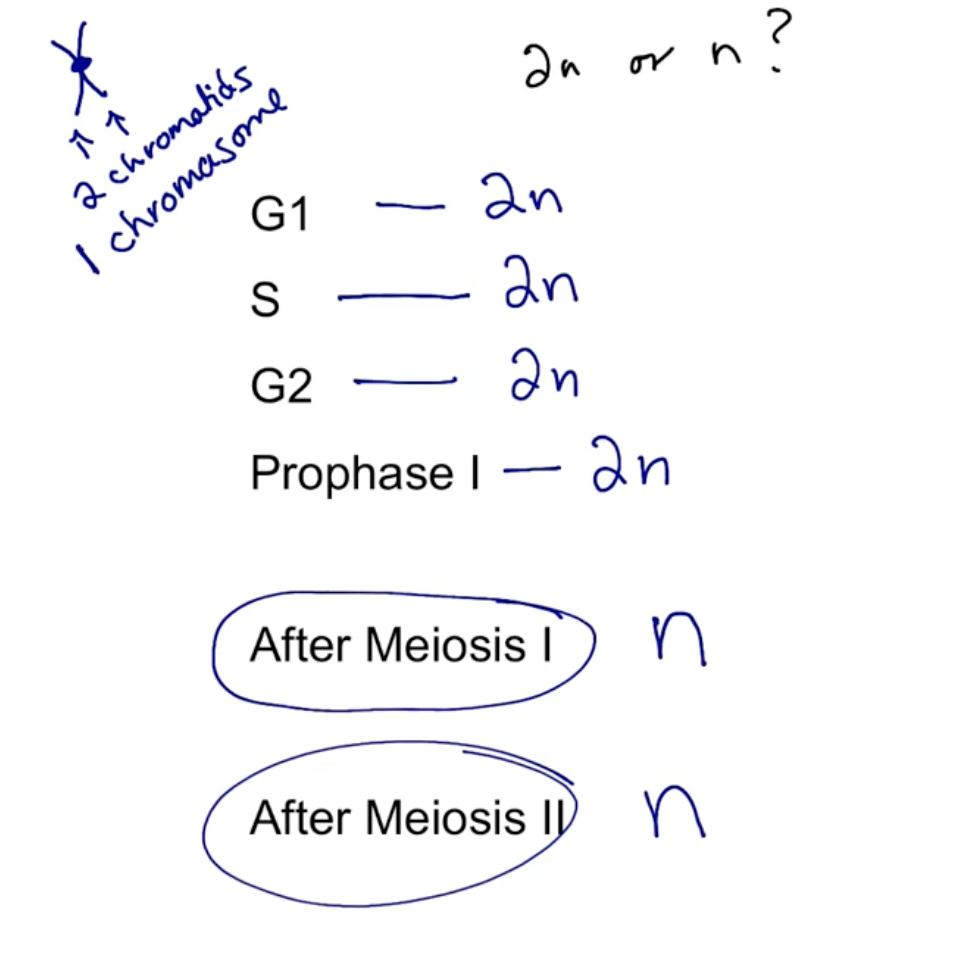
2n → n (Haploid Cells)
what happens in Meiosis? Where does Meiosis happen?
DNA replicates, then during Meiosis there are two rounds of division (meiosis 1 and meiosis 2) which produce four daughter cells; This happens in gametes to produce more gametic cells (sperm and egg)

Show the process for Meiosis 1

show the process for Meiosis 2
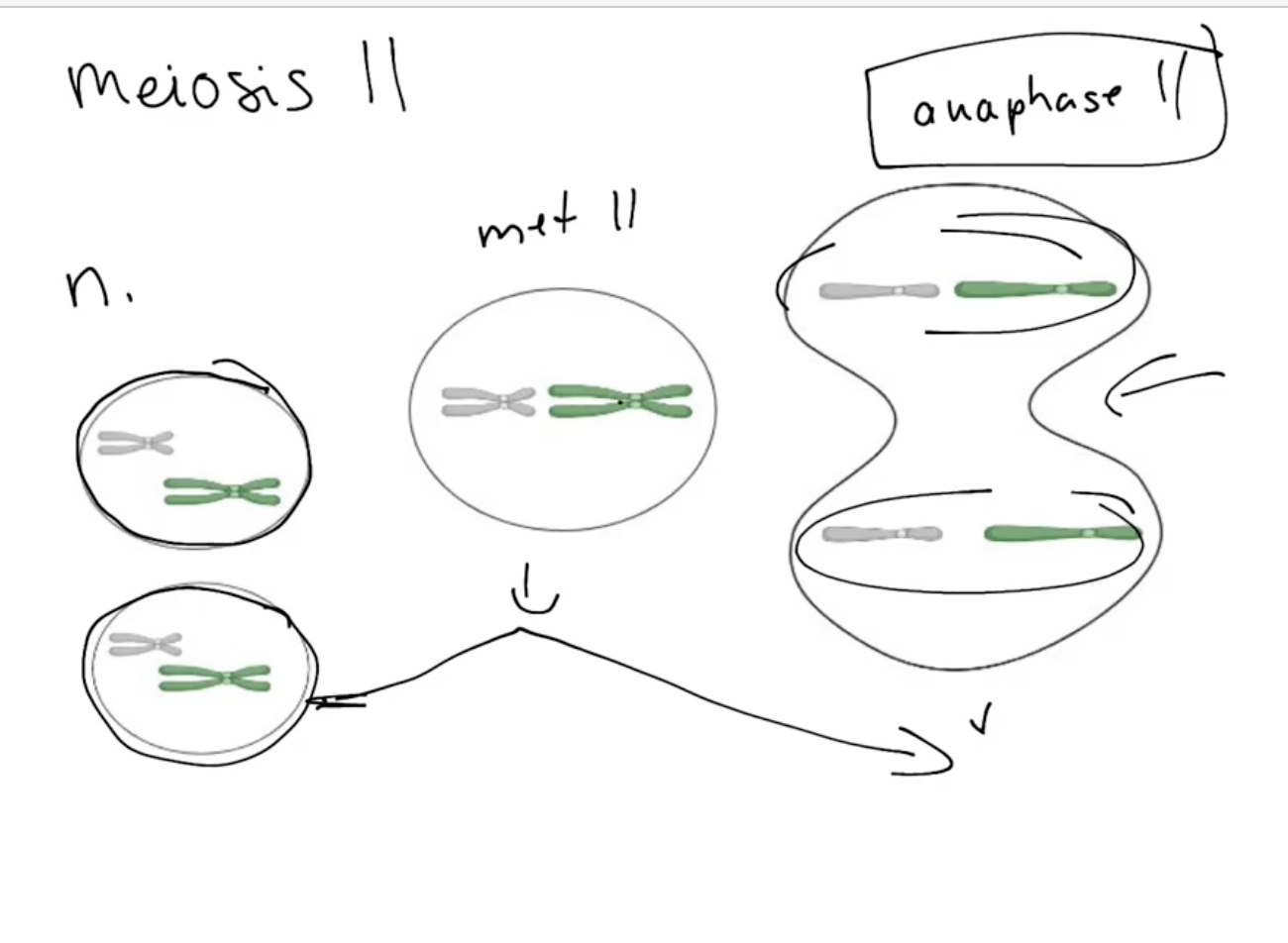
what is the chromosome count for each stage in Meiosis?
what are independent variables
when the outcome of one variable does not change/influence the probability of getting the second variable
what is the product rule
The product rule says that the probability of two independent genetic outcomes occurring together is found by multiplying the probability of each outcome.
Example: if there’s a 1/2 chance of getting allele A and a 1/2 chance of getting allele B, the chance of getting both A AND B is 1/2 × 1/2 = 1/4.
Is Recombination the only process for genetic variation?
No, Independent Assortment generates new allele combinations for genes that are on different chromosomes, while Recombination mixes up allele combinations of genes that are on the same chromosome
What is Independent Assortment?
not the same as Recombination, ‘crossing over’

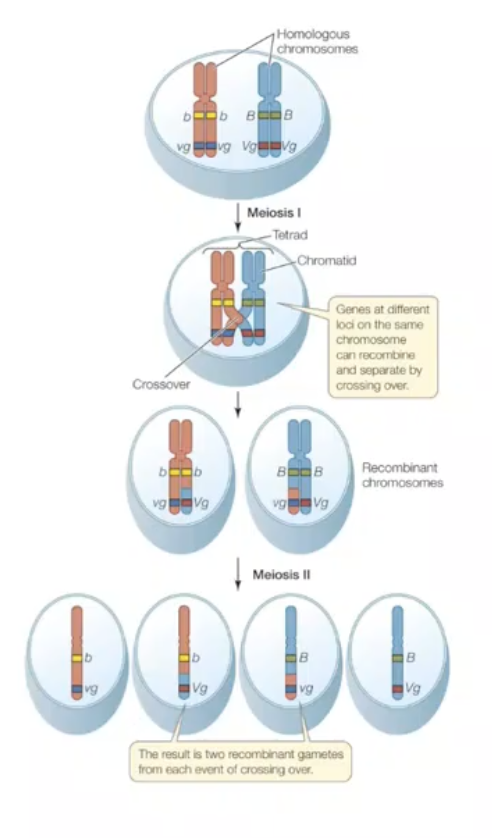
How does Crossing Over/Recombination work?
Crossing over creates new allele combinations for genes on the same chromosome.
Happens during Prophase I of meiosis.
Homologous chromosomes pair up closely to form a tetrad / bivalent.
Crossing over occurs between non-sister chromatids of homologous chromosomes.
The physical crossover point is called a chiasma.
DNA segments are exchanged, producing recombinant chromatids.
This can create new allele combinations not originally present on either homolog.
Usually, after one crossover between two genes:
2 chromatids stay parental
2 chromatids become recombinant
Crossing over increases genetic variation in gametes.
It is unique to meiosis I; homologous chromosomes do not form tetrads in mitosis.
what is a genetic marker?
Any difference in DNA whose pattern of transmission can be tracked. They are unique DNA sequences associated with specific location (locus), and they provide useful landmarks or reference points throughout the genome
what is the likelihood of seeing a recombination event on a chromosome?
the further apart two loci are on a chromosome, the more likely you’ll see a recombination event occur between them
what is gene mapping?
it uses the recombination frequency between your gene of interest and markers of known location to identify the approximate location your gene of interest
How do we indicate tthe genotype of two genes are on different chromosomes?
A1/A2; G1/G2
How do we indicate the genotype of genes A and G are on the same chromosome, but split into two sets of alleles found on each homologue?
A1G1 /A2G2
How do we indicate the genotype another gene of interest that is on a different chromosome?
A1G1 /A2G2 ; R1/R2