Micro Exam 2
 Call Kai
 Learn
Learn Practice Test
 Spaced Repetition
 Match
Match Flashcards
 Knowt Play
1/213

There's no tags or description
Looks like no tags are added yet.
Name | Mastery | Learn | Test | Matching | Spaced | Call with Kai | Chat |
|---|
No analytics yet
Send a link to your students to track their progress
214 Terms
Which of the following microbial systems are most commonly exploited to control the growth of microorganisms?
Microbial nutrition
Which of the following best defines biocides?
The term biocide describes all antimicrobials that can be used to control microbes
Which three of the following are microbial cell types that are especially recalcitrant to control agents?
Bacterial endospores, Protozoan cysts, & Mycobacterium spp
Which two of the following may be found on a properly disinfected object?
Small number of microbes & Viable spores
How do bacteristatic and bactericidal treatments differ?
Bacteristatic treatments prevent growth while bactericidal treatments kill
Which two of the following are effective ways to inhibit the growth of microorganisms?
Poisoning & Starvation
Choose three commonly used physical methods for sterilization
Filtration, Heat, & Radiation
The terminology used to describe different microbial control agents is important to understand because ___
some of the words are in common use with imprecise meanings & some treatments have different effects depending on the conditions
Which of the following statements regarding control of microbial cell types is false?
Bacterial endospores are challenging to control because they reside inside the mother cell
Filtration is an effective means of sterilization for liquid solutions. Its effect on microorganisms is to ___
remove them from the solution
How do sterilization and disinfection differ?
A sterile object has no living cells, spores, or viruses while a disinfected object may have small numbers of these
Boiling water is best described as which of the following?
Disinfectant
Growth of microbes will resume following the discontinuation of which type of treatment?
Fungistatic & Bacteriostatic
What temperature of moist heat will eliminate most bacterial endospores?
Temperatures above 100°C
Heat and radiation are examples of which type of method for the control of microbes?
Physical
Which of the following is a limitation on the use of ultraviolet radiation for sterilization?
It does not penetrate substances effectively
Which of the following best defines biocides?
The term biocide describes all antimicrobials that can be used to control microbes
Which two of the following chemical control agents are used to reliably control bacterial endospores?
Formaldehyde & Ethylene oxide
Filtration is an effective means of sterilization for which two of the following?
Chemical solutions & Gases
What are the primary mechanisms of action of phenolics as disinfectants?
Disrupt cell membranes & Denature proteins
Which of the following would not be killed by a treatment of boiling for 10 minutes?
Bacterial endospores
The primary mechanisms of action of alcohols on bacterial cells are to ___
dissolve membrane lipids & denature proteins
The device used for steam sterilization in a microbiology lab is the ___
autoclave
Which one of the following halogens is used as an antiseptic?
Iodine
Which items are best sterilized by exposure to UV radiation?
Laboratory work surfaces
What are the primary mechanisms of action of ethylene oxide gas as a sterilizing agent?
Alkylates nucleic acids & Alkylates proteins
Which of the following chemical control agents are safe for use on human skin?
Benzalkonium chloride
Which of the following statements is correct regarding the influence of population size on the effectiveness of an antimicrobial agent?
A larger population requires a longer treatment time to be killed than a smaller population
Which two of these are advantages of phenolics as disinfectants?
They are active in the presence of organic material & They are active long after application
Which is more effective at killing bacteria?
70% ethanol (in water)
Which of the following statements is correct about the use of alcohols as chemical control agents?
Ethanol and isopropanol are the most commonly used agents
What change in microbial population size is reasonable to achieve sterilization?
A million times fewer microbes
What is the primary mechanism of action of halogens against microbial cells?
Oxidizes cell constituents
Which of the following statements regarding biological control of microorganisms is correct?
Human application of biological control mechanisms is relatively new
Which two of the following terms describe the effects of sterilizing gases on microbial cells?
Sporicidal & Microbicidal
The first true antibiotic (a natural microbial product) to be used was ___
Penicillin
How is cell death related to the time of exposure to an antimicrobial agent?
An equal fraction of the population is killed in each time interval
A successful antimicrobial agent has the ability to kill or inhibit microbial pathogens with little or no damage to the host, a property called ___
Selective toxicity
Which of the following statements is correct regarding the influence of concentration on the effectiveness of an antimicrobial agent?
The effectiveness of an antimicrobial agent is not always related to its concentration
Drugs that are effective against a wide variety of pathogens are called ___
broad-spectrum
Which of the following statements is correct regarding the influence of contact time on the effectiveness of an antimicrobial agent?
A longer exposure results in more killing
Dilution susceptibility tests can be used to determine both minimal ___ concentration and minimal ___ concentration
inhibitory & lethal
Which two of the following may be considered types of biological control?
Virus infection & Bacterial predation
The most selective antibiotics in use target the bacterial ___
Cell wall
Penicillin is considered to be the first true antibiotic, meaning that it ___
is a natural microbial product
The therapeutic index of a protein synthesis inhibitor is less than the therapeutic index of a cell wall inhibitor because…
bacterial cells and host cells both use ribosomes for protein synthesis
The ability to kill or inhibit microbial pathogens while causing minimal damage to the host is called…
selective toxicity
A substance that blocks the functioning of a specific biochemical pathway is called a(n)
antimetabolite
The sulfonamides inhibit the growth of a wide variety of bacteria and are classified as ___ drugs
Broad-spectrum
Which two of the following are NOT targets of antibacterial drugs that inhibit nucleic acid synthesis?
Dihydrofolate reductase & DNA ligase
The dilution susceptibility test can be used to determine the ___ concentration
minimal inhibitory & minimal lethal
The most selective antibiotics target ___
cell wall synthesis
Which of the following statements concerning antivirals is false?
Antivirals are often referred to as antibiotics
The therapeutic index of a protein synthesis inhibitor is ___ the therapeutic index of a cell wall inhibitor
less than
Why are there fewer antifungal drugs than antibacterial drugs?
Fungal cells are more similar to human cells than bacterial cells
An antimicrobial substance that antagonizes or blocks the function of a specific biochemical pathway is a(n)
Antimetabolite
The side effects and toxicity of antiprotozoan drugs results from the fact that protozoans and humans are both members of Domain ___ and have similar enzymes, processes, and pathways
Eukarya
Which two of the following are targets of antibacterial drugs that inhibit nucleic acid synthesis?
RNA polymerase & Topoisomerase
Antiviral agents are ___ referred to as "antibiotics."
never
Regarding cell types and antimicrobial agents, which two of the following statements are true?
Currently there are fewer antifungal agents than antibacterial agents & Fungal cells are more similar to human cells than to bacterial cells
The side effects and toxicity of antiprotozoan drugs in humans is primarily due to ___
the drugs targeting protozoan enzymes and processes also present in human cells
The substantial reduction of the total population of microorganisms on inanimate objects and the destruction of potential pathogens is called ________.
disinfection
The destruction or removal of all viable organisms is called ________.
sterilization
Which of the following inhibits bacterial growth but does not kill bacteria?
Bacteriostatic agent
An agent that specifically kills fungi but not other kinds of microorganisms is also known as a ________.
fungicidal agent
Which of the following is MOST effective against resistant endospores?
Autoclaving
Which kind of sterilization procedure takes advantage of the size of microorganisms?
Filtration
Which of the following is not a method of heat sterilization?
Pasteurization
Ultraviolet radiation is an effective means of sterilizing surfaces
true
Match the following chemical control agent
Surfactants
Amphipathic organic molecules that serve as disinfectants by disrupting membranes
Match the following chemical control agent
Chlorine
The disinfectant of choice for municipal water supplies
Match the following chemical control agent
Isopropanol
An important alcohol germicide
Match the following chemical control agent
Iodine
An effective skin antiseptic that may cause skin damage, staining, and allergies
Which of the following influence(s) the efficiency of an antimicrobial agent?
All of the above
Bacterial pathogens may be controlled by ________, which are viruses that specifically infect and lyse the bacterial host.
Bacteriophages
The lowest concentration of an antibiotic that prevents growth is the ________.
minimal inhibitory concentration (MIC)
The most selectively toxic antibacterial agents are those that interfere with bacterial cell wall synthesis. This is because ________.
bacterial cell walls have a unique structure not found in eukaryotic host cells
The minimum lethal concentration (MLC) is the lowest concentration of drug from which organisms fail to recover when removed from the drug.
true
Which of the following does not inhibit protein synthesis?
Penicillin
Which of the following is normally treated by antifungal creams and solutions?
Superficial mycoses
Drugs chloroquine and qualaquin when used to treat malaria are examples of ________.
antiprotozoan drugs
Which of the following is the major reason why it has been difficult to treat viral infections with chemotherapeutic agents?
Viruses use the metabolic machinery of their hosts, which limits many of the potential points of attack
Sulfonamides and other drugs that inhibit folic acid synthesis are considered _______________.
metabolic antagonist
Treatment of fungal infections is more difficult than treatment of bacterial infections because the greater metabolic similarity between the fungi and their hosts limits the ability of a drug to have a selective toxicity.
true
The antiviral drugs currently approved for use in HIV disease include ________.
All of the above
Which of the following is normally treated by antifungal creams and solutions?
Superficial mycoses
Select statements representing features that are common to all types of metabolism
All of the above
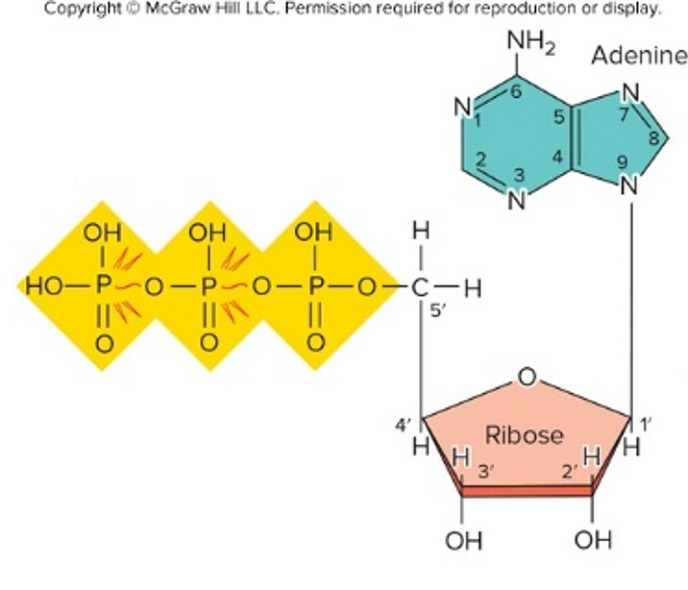
As shown, this molecule is called ___. If you removed a phosphate group from this compound, then you would be left with ___
ATP; ADP

The bracket indicates the presence of three ___ in the ATP molecule shown
phosphate groups
ATP is formed from energy made available in which of the following processes?
ADP + Pi → ATP
All of the above
Match the outcome of oxidation-reduction reactions with the correct description
Electron donor
Becomes less energy rich after a redox reaction
Match the outcome of oxidation-reduction reactions with the correct description
Electron acceptor
Becomes more energy rich after a redox reaction
Which of the following are features common to all types of metabolism?
Redox reactions play a critical role in energy conservation & Energy is most often conserved in molecules called ATP
Each redox reaction consists of two half-reactions. The acceptor and donor of a half reaction are referred to as a(n) ___ redox pair
conjugate

The common acronym for this compound is ___
ATP (Adenosine Triphosphate)
Standard reducing potentials generally couple reactions that have negative potentials with reactions that have ___ potentials.
positive
How many phosphate groups are present in ATP?
three
Carbon dioxide donates electrons to the electron transport chain.
false

When ATP is hydrolyzed to ADP and Pi, the energy released powers which of the following kinds of work?
Transport work
Mechanical work
Chemical work
Substrate level phosphorylation
1, 2, & 3
When NADH donates electrons to the first carrier in the electron transport chain, NADH becomes ___ and the first carrier becomes ___. The first carrier then donates electrons to the second carrier, becoming ___ and available to accept more electrons.
oxidized; reduced; oxidized