LRA 217 Final
 Call Kai
 Learn
 Practice Test
 Spaced Repetition
 Match
 Flashcards
 Knowt Play
1/78

There's no tags or description
Looks like no tags are added yet.
79 Terms
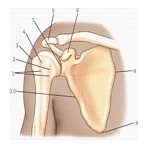
3 refers to:
greater tubercle
how many carpal bones are found in the wrist?
8
The joint found between the base of the 3rd metacarpal and carpal bone is the:
carpometacarpal
which of the following carpals articulates with the radius?
scaphoid
which of the carpal bones is considered to be the largest?
capitate
Which carpal articulates with both the fourth and fifth metacarpals?
hamate
Which is the most commonly fractured carpal bone?
Scaphoid
Which carpal bone is the smallest?
pisiform
what is the name of the joint found between the proximal and distal phalanges of the first digit?
interphalangeal
which of the following bony structures is found on the distal aspect of the ulna?
head
which of the following structures is NOT part of the ulna?
ulnar notch
which of the following structures is considered to be most proximal?
olecranon process
which of the following structures is considered the most lateral ?
capitulum
which of the following structures is considered to be most distal?
styloid process
which two structures primarily form the hinge-like structure and movement of the elbow joint?
trochlea and olecranon process
what is the name of the two small depressions found on the anterior aspect of the distal humerus?
radial and coronoid fossa
which two structures form the distal radioulnar joint?
ulnar notch and head of ulna
what two bony landmarks are palpated for positioning of the elbow?
humeral epicondyles
The smooth, depressed, center portion of the trochlea used for evaluating rotation on a lateral elbow is termed the trochlear:
sulcus
the interphalangeal joints have a(n) ____type of joint movement
ginglymus
The radiocarpal (wrist) joint possesses a(n) ____ type of joint movement.
ellipsoidal
the first metacarpophalangeal joint has a(n) ____type of joint movement
ellipsoidal
A ginglymus joint can also be referred to as a ____joint
hinge
the first carpometacarpal joint is classified as a ____joint.
sellar
which carpal bone is 5?
trapezium
which wrist ligament is attached to the styloid process of the ulna and continues to the triquetrum and pisiform?
ulnar collateral ligament
the bending or forcing of the hand laterally with the hand pronated in a posteroanterior PA projection is known as:
ulnar deviation
a nonvisible posterior fat pad on a well-exposed, correctly positioned lateral elbow radiograph generally suggests:
negative study for injury

part 8 refers to the vertebral border of the scapula.
true
transverse fracture through 5th metacarpal neck
boxers fracture
fracture and dislocation of posterior lip of distal radius
barton fracture
Fracture of the base of the first metacarpal
Bennett's fracture
carpal tunnel syndrome is more common in middle-aged women than in middle-aged men.
true
a skier's thumb is an injury of the:
ulnar collateral ligament
which of the following is the most common primary malignant bone tumor?
multiple myeloma
which of the following structures is not part of the proximal humerus?
glenoid process
which term describes the medial end of the clavicle?
sternal extremity
The female clavicle is usually shorter and less curved than that of the male.
true
the anterior surface of the scapula is referred to as the:
costal surface
what is the name of the large fossa found within the anterior surface of the scapula?
subscapular fossa
what is the name of the insertion point for the deltoid muscle located on the anterolateral surface of the humerus?
deltoid tuberosity

Part 5 refers to:
Acromion

Part 3 refers to the greater tubercle. TRUE or FALSE
true

G
superimposed epicondyles of humerus

I
trochlear sulcus

J
trochlear notch

K
double outer ridges of capitulum and trochlea

L
coronoid process of ulna

M
radial head

N
radial neck

A
head of humerus

B
greater tubercle

C
intertubercular groove

D
lesser tubercle

E
anatomic neck

F
surgical neck

G
body (shaft of Humerus)

A
Sternoclavicular joint

B
Sternal extremity

C
body of the clavical

D
acromial extremity
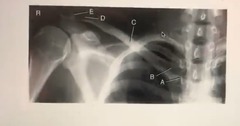
E
Acromioclavicular joint

A
Acromion

B
Neck of scapula
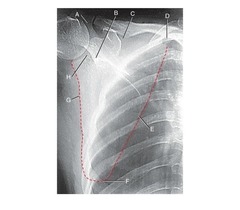
C
scapular notch

D
superior angle

E
medial (vertebral) border

F
inferior angle

G
lateral (axillary) boarder

H
glenoid cavity (fossa) or scapulohumeral joint

A
acromion

B
coracoid process

C
inferior angle

D
spine of scapula

E
body of scapula

A
coracoid process

B
glenoid cavity/lateral angle/ head

C
spine

D
Acromion