ME 021 Final Exam
 Call Kai
 Learn
 Practice Test
 Spaced Repetition
 Match
 Flashcards
 Knowt Play
1/75

There's no tags or description
Looks like no tags are added yet.
76 Terms
Sources of experimental errors
(i) Human error
(ii) Systematic error
(iii) Random error
Mean value

Standard deviation
A measure of the amount by which individual measurements differ from the mean value

Error in the volume (ΔV) of cuboid
ΔV = √[(wh)(Δb)² + (bh)(Δw)² + (wb)(Δh)²]
What is the quantity (optimality criterion) that the linear, least-squares fitting technique minimizes in order to determine the values of a and b?
Minimize D = Σ(ax_i + b - y_i)² for i=1 to n
What does the correlation coefficient r mean when you perform a linear regression?
Indicates how good the resulting fit is when performing linear regression (perfect fit: r = 1)
Linear Curve Fits
Y = aX + b
linear paper
Power Law Curve Fit
Y = cX^a
log-log paper
Exponential Law Curve Fits
Y = ce^aX
semi-log paper
transducer
a device that converts the quantity of interest, be it pressure, displacement, strain, temperature, or whatever, into an electrical voltage
Digital data acquisition system components
Computer, Software, Data acquisition board, Signal Conditioner, Transducers
If the output of the transducer v, expressed in millivolts, is linear in x
v = kx
the constant k
the sensitivity of the transducer
A/D converter
Conversion of the analog signal to digital form is done by this
Resolution of a converter
R = V/ 2^N
V = range of voltages
N = bits
LVDT
Linear Variable Differential Transformer
LVDT operates
by sensing the difference in voltage induced in two adjacent coils by a moving inner rod
Can LVDT output be used in raw form?
No- it must first be passed through a signal conditioner
Physical Quantity related to LVDT
Linear Displacement
What property of elastic bodies makes them useful as load cells?
Linear behavior if yield stress is not exceeded
Transducer glued to body to measure loads
Strain gage
Strain gages experience a change in _____________ _______________, and by measuring this change, we measure the _________ __________.
electrical resistance, applied strain
The change in resistance experienced by the gage is related to the strain by
the gage factor, F

Most common type of strain gage
foil gage
Another kind of strain gage
semiconductor gage
Why are dummy gages used
Because thermal strains due to changes in temperature may lead to a spurious contribution to the measured strain value
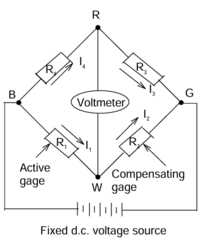
Electrical circuit used to convert small changes in strain gage resistance to voltage changes
Wheatstone Bridge
The reduction in yield stress experienced after a reversal of loading
Bauschinger effect
When the material begins to yield again and the yield stress in higher than that experienced on initial loading
cyclic hardening
When the stress-strain curve settles into a stable hysteresis loop
limit cycle
You had to measure the length of the tube specimen for the torsion experiment. Explain: (i) what measurement instruments were used and (ii) how the measurement was carried out
(i) Ruler
(ii) total length - clamped length
In the torsion experiment that was conducted we need to reverse the loading on the specimen. Why would we NOT want to perform tension and compression on the specimen instead?
* Tension and compression introduce different stress states (axial normal stress)
* Performing tension/compression could lead to different failure modes (like necking or buckling) and would not accurately represent material behavior under pure shear
Instability when and aluminum can is compressed
Buckling
A particular feature of the buckling of then-walled cylinders is that they tend to be
imperfection sensitive
How experiment is set up for can crushing
* Load cell which puts out a voltage signal proportional to the load
* LVDT which produces a signal proportional to crosshead motion
* Both fed into A/D converter
Numerical method for evaluating work W = ∫Fdx
Trapezoidal Rule
What the Wheatstone bridge consists of in Experiment 7 (Transverse Beam Bending)
R1, the active gage (the gage which will be strained), R2, the compensating gage, and two fixed resistances R3 and R4 (Typically, R3 = R4)
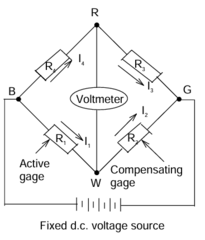
Compensating gage
A gage applied to an unstrained piece of the same material, to compensate for strains induced by changes in temperature
When is a Wheatstone bridge said to be balanced
when the voltage across the voltmeter, ER - EW = 0, or the ratio of resistances on both sides of the bridge are equal. This is usually done by making either R3 or R4 a variable resistor and adjusting its value until a zero-voltage reading is obtained on the voltmeter.
Each of the strain gage rosettes that we have been using is composed of how many individual strain gages
3 strain gages
What is the angle between adjacent gages in the rosettes that we have been using?
45°
Characteristic of strain gages
Respond only to a lengthening or shortening of the gage along the gage axis (they can measure only normal strain)
The three strain gage readings 𝜀1, 𝜀2, 𝜀3 give us the three in-plane strain components
𝜀𝑥 (strain in x axis), 𝜀𝑦 (strain in y axis), 𝛾𝑥𝑦 (shear strain)
Accelerometer
A transducer that measures acceleration.
Most common type of accelerometer, can measure extremely fast changes in accelerations
piezoelectric
What is the method used in numerically calculating the integral of the measured signal from the accelerometer
Trapezoidal Rule
When performing a calibration of an accelerometer, we are interested in determining the constant k. This constant relates _______ to _______
a, the voltage output of the accelerometer: e, the voltage output of the device
What does it mean when we say a piezoelectric accelerometer is a high frequency device
It has a higher sampling rate
What is a gage factor
It relates the change in resistance experienced by the gage to the strain
Name the instrument used in our lab experiments for measuring the depth of a hole
Caliper
How is the execution of a While loop within LabVIEW halted
The execution of a While loop in LabVIEW is halted when the Boolean value wired to the stop terminal becomes TRUE
How is a "bad wire" depicted on the LabVIEW diagram panel?
dashed line
The function causes the While loop to pause for 250 milliseconds during each iteration.

In a Waveform plot, LabVIEW plots the experimentally measured variable vs _________
time
There is an error in the block diagram, and the VI (Virtual Instrument) cannot run
Broken Arrow

Name two of the Palettes that you have used in LabVIEW
Control and Functions, and Tools.
What is the term given to programs written in LabVIEW?
Virtual Instruments
While loop

For loop

Name four different transducers that were used this semester, along with the physical quantity each was designed to measure
1) Accelerometer - acceleration
2) Strain Gage - Strain
3) Thermocouple - temperature
4) LVDT - displacement
A data acquisition system samples at 100kHz on 16 channels. What is the effective sampling rate for each channel?
100/16 = 6.25 kHz
What is the device, typically located on a plug-in board at the rear of the computer, which accepts data from one of more transducers and linearizes the signal?
DAQ board and signal conditioning
You want to measure the shear strain at a point in the structure (i) Name the sensor (transducer) that was used in one of the experiments and (ii) explain what it is
(i) strain gage rosette
(ii) a group of three strain gauges arranged 45° apart on a small backing. Used to measure strain in multiple directions, which allows for the calculation of shear strain and principal strains at a single point
Explain what a SubVI is in LabVIEW
It is the equivalent of a function. It is a VI that is used inside another VI to perform a specific task.
In a LabVIEW diagram, what is the main difference between a FOR loop and a WHILE loop?
For loop has a set number of iterations whereas a while loop runs until the condition is met
Button to run your VI in LabVIEW

If an A/D converter has 12 bits and the measurement voltage range is 0-5V, then the code width Vcw for this A/D converter is
Vcw = V/2^N
= 5/2^12
= 1.22 mV
When you performed measurements, such as determining the period of a spring-mass system, you take measurements of a large number of oscillations (say, 20) and then divide the total time by that number of oscillations. What is the reason for not taking just one oscillation?
An average value is more accurate because it reduces the effect of timing errors
First part of thermocouple experiment, equation and where constants fit in
T = aV + b
a is the slope multiplied by the voltage and added to the intercept, b
Second part of thermocouple experiment
Using T = aV + b and V = cT + d, the relation is inverted to obtain the constants a and b and then used to obtain T (T = (1/c)V + (-d/c))
The rate at which data is taken using a data acquisition system, is called the __________
sampling rate
For the type of strain gage that we have been using in the lab, the strain gages are described by a constant. The __________ this constant is, the more accurate it is to measure strain
larger
If the experimental values are distributed according to a Gaussian or normal distribution then, approximately _________% of the measured values will lie within the interval ( x - 3σ , x + 3σ)
99
In our beam bending experiment, the bending moment M at the strain gage in the diagram is given by the formula:
M= (L - a/L) * b * P
A micrometer can measure sizes to within
0.01 mm or 10^-6 m
The constant that describes a given strain gage is called
gage factor