soils 3210 preim
 Call Kai
 Learn
Learn Practice Test
 Spaced Repetition
 Match
Match Flashcards
 Knowt Play
1/136

There's no tags or description
Looks like no tags are added yet.
Name | Mastery | Learn | Test | Matching | Spaced | Call with Kai | Chat |
|---|
No analytics yet
Send a link to your students to track their progress
137 Terms
Definition of soil
The layer(s) of generally loose mineral and/or organic material that are affected by physical, chemical, and/or biological processes at or near the planetary surface and usually hold liquids, gases and biota, and support plants
Human reliance on soil
More direct
Nutrients
Plants
Animals that eat plants
Direct consumption (although rare)
Building and energy
Brick and tile
Wood
Oil, gas and peat
Although oil and gas are usually much deeper than soil, they are decomposed in soil at some point
Less direct
Natural water filter
Organisms that support other life forms (Worms, microbes, etc)
Climate moderation (C)
Soils are made of…
Pore space (water/air)
Mineral fraction
OM
Primary (abiotic) processes of soil building
Soil particles contain mineral nutrients
Particles allow for water retention (capillarity)
Dissolution of mineral nutrients (P, K, Ca, etc)
Mineral nutrients retained by soil
Secondary (biotic) processes of soil building
Invasion by plants and microorganisms. Capture of nitrogen and carbon, solar energy
Storage of organic carbon, nutrients and water
Decomposition of dead organic materials. Mineralization and release of nutrients and energy
Factors of soil formation CORPT
Climate
Organisms (grassland? forest?)
Relief (topography)
Parent Material (granitic, basalt)
Time
CORPT
Soil health/soil well-being
“The continued capacity of the soil to function as a vital living ecosystem that sustains plants, animals, and humans”
Function is a relative term
Some soils might not hit the peaks of others, not every soil can be Usain Bolt, but they can at least do their job decently well
Soil health effects
Humans affect soil health

Ancient civilizations and their staples
Fertile Crescent/Mesopotamia: wheat
Meso-America: maize
West South America: potatoes
North China Plain and Yangtze Delta: rice and soybean
First domestication of animals
Zagros mountains
Sheep, goat, cattle: easier to work with
Early soil management
Scratch plow + broadcast
Crop-livestock systems
Draft animals
Entire crop was removed
Used straw, less desirable parts of plants for roofs, bricks, bedding, animal feed, etc
However: draws nutrients out of soil without putting anything back
Why were chinampas effective
Water in canals absorbs sun’s radiation by day, radiates heat by night → helps protect against frost
Raised beds moistened by capillary suction
Nutrient rich sediment in canals becomes fertilizer
Canals also useful for transportation
Who made New Horse Husbandry
Jethro Tull (1674-1741) noticed that traditional sowing methods (broadcast) or in the furrow) provided low germination rates. He designed a drill with a rotating grooved cylinder that directed seeds to a furrow and subsequently covered them. Row seeding also allowed for mechanical cultivation
Row planting vs scattering seeds by hand: more opportunities for weed control, can cultivate weeds all in a row
Tull, believing that plants absorbed small soil particles for nutrition, promoted repeated and intensive tillage to pulverize the soil as a substitute for adding manure. He grew wheat for 13 consecutive years without adding manure. He published his book titled The New Horse Hoeing Husbandry in 1731, which still has an impact today
6 Grand challenges to ag sustainability
Population growth
Meat consumption
Declining Resources
Soil degradation
Climate change
Agricultural Pollution
Green revolution technologies
Transfer of improved crop varieties, irrigation, synthetic fertilizers, and pesticides to developing countries
High yielding varieties of wheat and rice
DIsease resistance
Semi-dwarf varieties reduced lodging from fertilizer
Heavy reliance on chemical inputs
Digital agriculture
Deployment of computational and information technologies to improve the profitability and sustainability of agriculture
Offers opportunities through the ubiquitous availability of highly interconnected and data-intensive technologies
Reflects a shift from generalized management of farm resources towards highly optimized, individualized, real-time, hyper-connected and data-driven management
Data analytics, smart machines, system dynamics and optimization, biological and physical science
Soil water cycle
Precipitation comes from above
Reaches surface, infiltrates soil OR intercepted by (tree) canopy (maybe 10%, relatively minor) OR runs offs
Very critical - does it infiltrate or run off?
Runoff can reach streams very quickly
Soil Water storage
Percolation
Relatively slow - water has to make its way through pores
To deep groundwater
To stream
Very slow when coming from percolation - maybe comes 3 months later
Evapotranspiration - losses
Soil water budget
Precipitation + irrigation = interception + infiltration + runoff
Infiltration = ET + ΔSoil storage + percolation
ΔSoil Storage - soil can dry out (water leaving soil through gravity like a saturated sponge, etc), plants can use water
Rain and ET effects on percolation
Lower evapotranspiration with high rains means good amount of percolation
Return periods
Planning for infrastructure development related to water requires an analysis of the recurrence of storms of different duration and intensity
T = 1 / P
Where T = return period in years
P = probability that an observed event in a given year is equal to or greater than a given event
Basically, a 100 year event has a 1/100 chance of happening every year
Design of such structures focuses on the prediction of runoff during major hydrologic events
Infrastructure may need to be built to deal with a 50 year event, or a 100 year event, etc
There is no memory: a 50 year event can happen twice in 2 weeks (November 2 and 16 2020, category 4 and 5 hurricanes)
Raindrop energy formula
Raindrop energy: E = ½ m v2
m = mass (4/3 pi r3)
v = velocity
Drought Indices - percent of the normal
It is calculated by dividing actual precipitation by normal precipitation – typically considered to be a 30-year mean – and multiplying by 100%. This can be calculated for a variety of time scales.
If normal is 750ml, and we get 500ml, percent of normal is 66.666%
Limitation to this index - If we say we got 60% of the normal, it doesn’t indicate WHEN it was dry - certain periods more important than others
Drought indices - standardized precipitation-evapotranspiration index
WIth a value for PET, the difference between the P (precipitation) and PET (potential ET) for month i is calculated:
Di = Pi - PETi
Provides measure of water surplus or deficit for the analyzed month.
The calculated Di values are aggregated at different time scales as it relates to different drought-related concerns
Precipitation vs demand for water (through ET)
The SPEI enables identification of different drought types and impacts in the context of global warming
Traits of areas prone to desertification (and examples)
Low precipitation, high evaporative demand
Extreme variation in rainfall (within and between years)
Poor soils with low inherent fertility and poor physical properties
Limited plant cover
Low carrying capacity
These factors result in highly fragile ecosystems. Land is susceptible to degradation from intensified land use, often as a result of inappropriate technological and social advances. Such land degradation results in an irreversible reduction in land productivity and ability to support vegetation. Use of groundwater is often unsustainable
Middle east/western Asia
Sahara
Australia
Central/Western US
Particle density ρp
Msolid / Vsolid
OM: <1 g/cm3
Quartz: 2.65 g/cm3
Bulk density ρb
Msolid / Vtotal
Normal soil bulk densities: 1.0-1.6 g/cm3
Affected by soil texture, mineralogy, organic matter content, and compaction level (aggregation)
Bulk density meanings (higher vs lower)
Lower bulk density - lower weight, more pore space
Higher bulk density - higher weight, less pore space
Forces acting on soil
Capillary forces - cohesion and adhesion
Gravity
Osmosis - across membranes
Capillary forces
Hold water between soil particles
Soil is negatively charged: bipolar water molecules can hold onto soil
Cohesive forces:
Hydrogen bonding
Van der Waals - London forces
Results in surface tension
Water tends to minimize the air-water interface because of cohesion. Water molecules at the surface experience a net inward force
Adhesion results from double-layer forces
Capillarity: combined effects of cohesion and adhesion
Consider the behavior of water drops on a glass plate. (glass and soil particles, particularly quartz, have similar chemical compositions)
Without gravity, and neglecting adhesion to the glass plate, a volume of water forms a sphere due to internal cohesion and surface tension
Gravity and adhesion distort the sphere into roughly a hemisphere
As the plate is tilted, cohesive forces resist distortion from the hemispherical shape (flow), and adhesion resists the downhill pull of gravity
As the plate is tilted further, gravity overcomes viscosity and the drop begins to flow. The “point” of the characteristic teardrop is due to adhesion (wetting)
Adsorbed/hygroscopic water properties
Capillary water coheres to adsorbed water and to itself. Surface tension produces the curved water-air interface. The smaller the radius of the curve, the more tightly the water is held in the pore (higher suction)
Smaller pores are water filled, which larger pores are partially drained
Capillary tube formula
h = 2γ / r
γ = surface tension constant
r = radius
h = height of water column
A simple rule, when all units are in mm:
h = 15/r or r = 15/h
Gravimetric water content
w = Mwater / Msolids
Volumetric water content
θ = Vwater / Vtotal
w and θ relation through bulk density formula
θ = w * ρb
Volumetric water content = gravimetric water content * bulk density
Soil water potential, energy status of water in soil
The total (net) potential in a soil region is composed of several component potentials:
Ψt = Ψg + Ψp + Ψo
Ψt = total soil water potential
Ψg = gravitational potential
Ψp = pressure (matric) potential
Ψo = osmotic potential
Water in soil profile: how does it drain? Matric potential above vs below water table
Sequentially smaller pores are drained as the soil dries out
Lower soil section is saturated (below the water table)
Under the water table - pressure equivalent to the water above you, Ψp > 0
Above water table - pressure becomes negative due to positive suction (capillarity) Ψp < 0
At water table: 0 pressure, Ψp = 0
Soil-atmosphere-plant continuum
ET dries out the soil and decreases Ψp

Field capacity
Theoretically: amount of water held by soil (due to capillarity) against gravity
Laboratory measurement: soil water content at -33kPa; for sand, -10kPa
Field capacity in the field depends on: soil texture (clay: 4-5 days, sand <1 day free drainage), type of clay, organic matter, depth to water table, depth of soil, surrounding topography, presence of layers in the soil, and time of measurement
Permanent wilting point
Soil water content at which the plants can no longer recover turgidity (they wilt)
PWP indicates the lower limit of water availability. Depends on plant properties, soil properties, meteorological conditions
Generally, PWP is assumed to be the soil water content at a suction of 150m (Ψo = -1.5MPa). In reality, plant water stress occurs at much lower (less negative) suctions and depends on meteorological conditions
Irrigation of crops is often initiated at much lower suctions, before water stress occurs: (Ψp = 0.05 - 0.07 Mpa)
Why is soil aggregation important
A well aggregated soil has a range of pore sizes that support multiple hydraulic functions
Small pore: long term moisture retention
Intermediate pore: Important for water retention and biological functions
Large pore: Important for drainage, aeration and rooting
STORAGE and DRAINAGE DEPENDS ON AGGREGATION
Poisseulle’s Law:
Flux through a pore is proportional to the fourth power of the radius of the tube
Flux through a pore is proportional to the pressure difference
Q = ΔΨp/L * πr4
Q = water flux (mm/s)
ΔΨp / L = pressure gradient
r = radius of the pore
Flux density (flux per unit area):
q = Q/area
Q~r2
Hydraulic conductivity
At the macroscopic level, a multitude of flow tubes in soil are represented by one value, the hydraulic conductivity, K, also referred to as permeability
Inverse of resistance, analogous to Ohm’s Law in electronics, I = V/R
Saturated hydraulic conductivity (Ks): the soil’s ability to conduct water under unit gradient when all pores are filled with water
K-values lower for compacted soils
Infiltration rate graph
Dry and well structured soils have better infiltration at first, but eventually converges with the slope of the wet, well structured soils
Dry, compacted soils have poor infiltration, quickly have infiltration rate fall under the rainfall rate
Wet compacted soils have infiltration rate under rainfall rate immediately
Surface pounding: when infiltration rate is lower than rainfall rate, ponding and runoff occurs

Philip’s equation
Infiltration rate: i = S*t-0.5 + A
Cumulative infiltration: i*t = l = S*t0.5 + A*t
i = infiltration
t = time
l = cumulative infiltration
A = transmissivity, final infiltration rate
Factors affecting infiltration
Soil type
Aggregation/crusting/sealing
Crusting - when pores on surface are not abundant, and soils fall apart with enough pressure (think of lawn demonstration)
Surface storage capacity
Water that collects on surface but doesn’t runoff or infiltrate quickly
Retained in basins of mulch
Plant canopies
Intercept energy from raindrops, and suction of water
Surface cover and mulch
Absorb force of rain hitting the ground
Soil freezing
Hydrophobicity
A tabletop is hydrophobic, doesn’t absorb water; in soils, typically refers to organic matter and surface tension
After fires, soil is very hydrophobic; more potential for runoff
Soil freezing
Moisture tied up as ice near surface and clogs pores
Water infiltration rate very low (or zero), high runoff risk
Soil under frozen layer dry (friable)
Surface ice supports heavy equipment; low compaction
Ice lenses break up compaction
Frost tillage: tilling soil with shallow frozen layer (3-7 cm)
Soil thawing
Soil thaws from surface down
Thaw water initially cannot enter the soil and creates supersaturated conditions
High potential for runoff and erosion (especially of concern with surface applied manure), and nitrous oxide losses
Water quickly enters into dry lower layers after frost disappears
Frost seeding: spreading seeds (e.g. clover) over frozen soil which subsequently mix with supersaturated soil (liquid consistency) during early soil thaw
Watershed (catchment)
a unit of land from which surface, subsurface, and groundwater runoff flow to a common outlet
Larger ones are called basins
Orders of streams/watersheds
When two of the same order combine, they will become a higher order
Defined by how many streams come together
1: first order stream, convergence of two flows
2: second order stream, convergence of two first order streams
3: third order stream, convergence of two second order streams
NYC drinking water supply watersheds
Croton watershed used since 1842
2 centuries of development with 25-50 year plans; some of the best-tasting and safest water of any urban area; no water treatment (saved $3-5B)
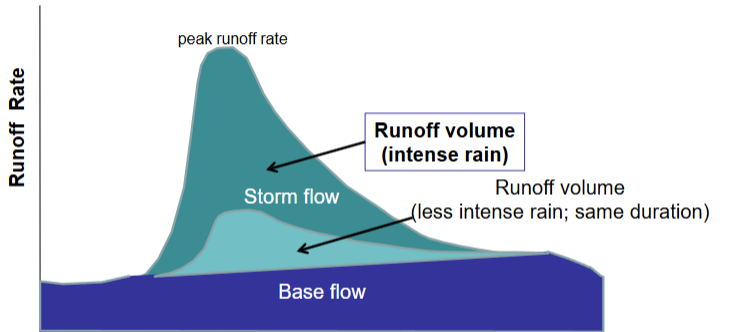
Runoff hydrograph
Typically: base flow without rain, then runoff volume can vary with rain intensity, then a peak runoff rate
Note: base flow may not be present
• In small ephemeral streams/waterways
• After long dry periods
Hydrologically sensitive areas for runoff surface losses
areas with great potential for transporting pollutants to surface or groundwater.
definition related to the transport mechanism:
For runoff surface losses these include:
flood plains
areas adjacent to flowing and standing water bodies
areas with low infiltration capacity (paved, compacted or bare surfaces)
saturated areas
Hydrologically sensitive areas for leaching
For subsurface recharge (leaching) these include:
• groundwater recharge areas near wells or springs
• saturated areas and wetlands
• areas with very permeable soils
Soil organic matter
Complex mixture of organic substances, including plant and animal residues at various stages of decomposition
All material in soils that contains (reduced) carbon is SOM
What % of SOM is SOC
50-65
Main ingredients of organic matter
CHNOPS
Living SOM
bacteria fungi nematodes earthworms mites springtails protozoa plant roots
ROles: make nutrients available, nutrient acquisition, suppress disease, aggregate soils
Dead SOM
Manure, winter-killed crops, partially decomposed fresh residue: stems, roots, and fungi
Roles:
Provide food (energy and nutrients) for soil organisms to live and function
Organic matter that microbes mineralize into available nutrients
Plant roots role in rhizosphere
Plant roots are carbon pumps in the rhizosphere
Plant rhizodeposition - fuels rhizosphere microbial activity (roots and carbon pumps)
Exudates and chemical signals
Mucilage
Root border/cap cells
C transfer to symbionts
Root turnover and cell lysis
Secretions
Purposeful compounds which plant signals to microbes to get nodules
Lysates (fluids with contents of cell)
Cell dies, contents are free
Stimulates microbes and predators
Mineralization definition
the overall process whereby organic materials are decomposed in simple inorganic products, like ammonium, nitrate, sulfate, or CO2
Immobilization definition
the overall process whereby simple inorganic products, such as ammonium, nitrate, sulfate, or carbon dioxide (CO2) are incorporated into organic forms during microbial uptake from soils
C:N ratios with net immobilization or mineralization
<15:1 - net mineralization
>35:1: net immobilization
Very dead SOM
Stable SOM
Humus - Ultimate stage in decomposition (historic view)
Mineral-associated organic matter and physical separation from microbes (new view)
Benefits:
Increases soil water holding capacity – through microporosity
Increases nutrient retention – surface areas hold electrical charges, that draw in and store cations
Stores/sequesters carbon
Less CO2 release, since carbon is being sequestered
How is OM stored in soil
Strong chemical bonds between organic matter and fine silt, clay, Fe-, Al-, Mn- oxides, Ca2+
Inside small aggregates (physically protected from decomposition)
Humification: produces stable/complex substances such as humic materials that are resistant to biological decomposition
Char produced by incomplete burning
Very recalcitrant, lasts for 100s of years
Labile SOM
Lasts 1-50 yrs
Lighter
More complex
Higher C to N than in stable SOM
Stable SOM
10-1000 yrs
Less complex
Heavier
More even C:N
What biome has highest SOM
Boreal, tundra, and peatlands (northern hemispheres)
Living: not particularly active in cold areas (and also need oxygen)
Tundra, peatlands can be waterlogged - less oxygen
Anaerobic decomposition - slower
What texture of soils holds most OM
Finer textured soils can store more OM than coarse textured soils
Greater surface area - more opportunity for SOM to attach
Feeding soil vs feeding plant
Natural systems:
High SOM inputs
Little disturbance - few losses
C and nutrients cycled
Decomposing OM “feeds the soil”
Mineralized inorganic nutrients then “feed the plants”
Onset of ag:
Lower SOM inputs
Intensive tillage
Accelerated OM mineralization and less recycling → net OM losses
OM losses through erosion
But still, feeding the soil and building fertility (manure, legume rotations, etc)
20th century ag, green revolution pros&cons
Use of chemical fertilizers to feed high-yielding varieties
Shortcut: feeding plants directly with mineral nutrients
Advantages
Chemical fertilizers more nutrient dense, (easy transport, more precise rates, and timing of application, increased yields)
Disadvantages
We stopped feeding the soil (replaced nutrients, but not carbon), combined with intensive tillage → soil health degradation
Managing OM to build healthy soils
Produce and cycle high amounts of biomass (crop type/use, residue; cover crop)
Perennialize cropping systems to increase active growing ground
Keep soil surface covered with living vegetation and/or residue
Import OM inputs (manure, compost, biochar…)
Reduce OM losses from decomposition and erosion
The SOM Dilemma - shall we hoard it or use it
Primary limiting factors to soil biota activity
Energy supply - phototrophs vs chemotrophs
Source of cell carbon - autotrophs vs heterotrophs
All types of organisms (trophs)
Light penetration for plants, algae
Phototrophs
Substrate quality/availability for soil organisms (dirt)
Chemotrophs
Carbon dioxide for plants
Autotrophs
Organic carbon for most soil organisms
Heterotrophs
Soil food chain
Primary producers (photosynthesizers)
Primary consumers
Decomposers
Mutualists
Pathogens
Secondary consumers
Shredders
Organisms which break up things into smaller pieces, increase surface area, colonize
Predators
Grazers
Bacteria along surface of a root: protozoa will “graze” it
Higher level consumers
Predators
What makes soil biota unique vs marine, lake biota?
More biodiversity
Slower growing organisms
Novel lifeforms
Significant percentage in unknown organisms
Soil bacteria roles
Decomposing OM
Releasing nutrients
Only after their own needs are met
Retaining nutrients in biomass
Controlling pathogens
Also are pathogens
Solubilizing phosphorus
Phosphorus tends to get stuck on soil exchange complex
Binds to things like clay: enzymes can release phosphorus
Aggregating soil
Mineral-associated organic matter MAOM
Forming soil organo-mineral associations
Base of the food web
Bacteria, including actinomycetes, form the base of the soil food web
Diverse nutrient requirements and temperature ranges
Population specialists
Actinomycetes
Filamentous growth
Earthy smell - geosmins, good sign
Nitrogen cycle - players and roles
Mediated by microbes
SOM also has key role
Original source of nitrogen is N2 from the atmosphere
Vast majority (>90%) of N is bound in soil organic matter
Most transformations in the N cycle are mediated by microbes: nitrogen fixation, mineralization, nitrification, denitrification
To predict state and fate of N we need to understand these microbes
Nitrogen cycle
Nitrogen fixation → mineralization to NH4+ (ammonium, positive, sticks around) → nitrification (nitrate, NO3-, leaches easily) → denitrification (N2 + N2O)
Composting info
Requires microbial action
Thermogenic compost
Windrow system: organic residues, microbes and mechanical turning
Vermicompost
Continuous flow through reactor system: OM, microbes, and epigeic earthworms (Eisenia fetida)
Give plenty of carbon to balance nitrogen
Approaches to bacterial control
Inoculations
Nitrogen fixing bacteria
P solubilizing microbes
Hormones analogues
Microbial soups (PGPR)
Compost teas
Cultural control
Add OM
Reduce toxins
Keep plants in system
Oxygenate the soil
Improve drainage
Lower bulk density
Fungi roles
Decomposing OM
Mobilizing P
Controlling pathogens
Promoting plant growth
Controlling insects
Aggregating and stabilizing soil
Fungi can grow on crappy substrates lacking in nitrogen
Arbuscular mycorrhizal fungi (AMF, used to be VAM)
Arbuscules - arbor, tree-like structure for exchange
Membrane supports integrity
Obligate, cannot complete life cycle without plants
Have to use spores to colonize roots
Fallow bad for AMF
Colonize most crops
Fungi management approaches
Inoculants
EMF and AMF
Trichoderma
Metarhizium
Beauvaria
Cultural control
Reduce tillage
Add higher C:N OM
Fungi do better on low N material
Reduce use of toxins
No bare fallows
C:N ratios of organisms
N mineralization at <20:1
Used to understand the ratios of C and N required to satisfy metabolic needs
Bacteria 3-5:1
Fungi 10-15:1
Protozoa 10:1
Earthworm activity
Turn over leaf litter too fast, expose bare soil
In agricultural systems:
Stimulate microbial activity
Mix and aggregate soil
Increase water infiltration and water holding capacity
Provide channels for roots
Shred and bury plant residues, increasing SOM
Earthworms are easily harmed - cultural controls to encourage them
Reducing tillage
Reducing use of chemicals, toxins
Increase OM inputs
Protists
“Turn over” microbial biomass
Need water
Ciliates (use cilia for locomotion, eating), flagellates, naked and testate (test = amoeba house) amoebae
Functional roles":
Primary consumers of bacteria in soil
Regulate population size and composition
Accelerate turnover of soil biomass/OM
Maintain plant available N
Bacteria very nitrogen rich (5:1), versus protozoa which is only 10:1
Prevent pathogen establishment
Food source for fungi, nematode, other
Can cause disease as animal parasites
Soil nematode roles
Abundant, small, water-dependent
Functional roles
Feeding on bacteria, fungi, protozoa
Controlling bacterial numbers and population structure
Releasing large amounts of N while feeding and upon death
Because they eat bacteria, and get more N than they need
Helping to maintain plant available N
Selective feeding influences
Soil structure
C utilization rates
Types of substrates present in soil
Plant and animal parasites
Nematode feeding
Diverse range of feeding strategies
Plant parasites
Bacterial feeders
Fungal feeders
Predators
Omnivores
Plant parasitic nematodes are a problem, but all the others are very important
Managing nematode populations
Inoculants
Enthomopathogens
Biocontrol
Bacteria, viruses, microsporidia
Cultural control
Encourage diverse saprophytic food web
What is required for mineral nutrient release?
A complex food web

Functional roles of soil fauna
Shred OM (mites, springtails (Collombela)
Stimulate microbial activity
Mix microbes with their food
Mineralize plant nutrients
Enhance soil aggregation
Burrow
Control pests
May be pests
Shredder examples
Sow bugs, dung beetles, mites, Collombela (springtails)
Herbivores
Mole cricket
Cabbage looper
Locust
White fly
Soil predators - crop pest control examples
Wolf spider
Harvester ants
Pseudoscorpions
Lady beetle
Drivers of microbial activity (biological, chemical, physical)
Biological factors
Competition
Predation
Allelopathy
Chemical factors
pH
Moisture
Oxygen
Oxygen is human’s ultimate electron acceptor, but not the case for some anaerobic bacteria
Carbon dioxide
Having an alternative chemistry (diff ultimate electron acceptor) very beneficial in the soil
Inorganic nutrients
More acidic - heavy metals more soluble, only tolerated by some organisms
Physical factors
Texture
Porosity
Most important - give organisms a home
Compaction
Bulk density
Temperature
Key biological processes in healthy soils
OM decomposition/accumulation
Nutrient transformations and availability
Organic fertilizer - feed soil
Synthetic fertilizer - feed plants, reducing SOM
With excess of N without carbon like in synthetic fertilizer, C:N ratio is skewed; organisms will take C in faster given so much N, making the ratio worse
Disease, disease suppression
Immobilization of toxins
Well-supported microbial community of beneficials producing plant growth promoting compounds
Why are roots a good indicator of soil health
Have clear symptoms to following problems:
Poor drainage
Poor nutrient availability
Severe compaction
Pathogen infections
Rhizoctonia
Pythium
Root-knot nematodes
6 Macronutrients and common forms
N - ammonium, nitrate
P - H2PO4-, HPO4-2
K - K+
S - SO4-2
Mg - Mg2+
Ca - Ca2+