Directional Terminology
 Call Kai
 Learn
 Practice Test
 Spaced Repetition
 Match
 Flashcards
 Knowt Play
1/37

There's no tags or description
Looks like no tags are added yet.
38 Terms
What is an anatomical plane?
A: An anatomical plane is a real or imaginary surface used to divide or describe portions of the body. 🔎 What this means: The major planes in this lecture are the median, sagittal, transverse, and dorsal planes. 💡 Think: A plane is an imaginary “slice” through the animal.
How do the median and sagittal planes differ?
A: The median plane divides the body longitudinally into equal right and left halves, whereas a sagittal plane runs parallel to the median plane and divides the body into right and left portions that are not necessarily equal. 🔎 What this means: The median plane is also called the midsagittal plane. A sagittal plane may also be called a paramedian plane. 💡 Think: Median = middle = equal halves.
What does the transverse plane divide?
A: The transverse plane crosses the body and divides it into cranial and caudal portions. 🔎 What this means: Cranial is the head-end portion and caudal is the tail-end portion. The portions do not have to be equal. 💡 Think: Transverse separates front from rear.
What does the dorsal plane divide?
A: The dorsal plane divides the body or head into dorsal and ventral portions. 🔎 What this means: Dorsal is toward the back or top, while ventral is toward the belly or bottom. The dorsal plane runs at right angles to the median or sagittal and transverse planes. 💡 Think: Dorsal plane separates top from bottom.
Why must veterinary directional terms be interpreted relative to a reference point?
A: Veterinary directional terms are relative, so their meaning depends on what structure or point is being used for comparison. 🔎 What this means: The elbow is proximal to the paw but distal to the shoulder. The same structure can therefore receive different directional descriptions depending on the reference point. 💡 Think: Always ask, “Compared with what?”
What do cranial and caudal mean, and where are they used?
A: Cranial means toward the head and caudal means toward the tail; these terms are used for the trunk and proximal portions of the limbs above the carpus and tarsus. 🔎 What this means: The terminology changes on the head and on the distal limbs. 💡 Think: Cranial = cranium/head; caudal = tail.
What do rostral and caudal mean when describing the head?
A: On the head, rostral means toward the nose and caudal means away from the nose. 🔎 What this means: Rostral is used on the head because “cranial” loses useful directional meaning there. 💡 Think: Rostral = rostrum = nose.
Which directional terms are used above and below the carpus and tarsus?
A: Above the carpus and tarsus, use cranial and caudal; below the carpus, use dorsal and palmar; below the tarsus, use dorsal and plantar. 🔎 What this means: The carpus is the wrist and the tarsus is the hock or ankle. Palmar applies to the distal forelimb, while plantar applies to the distal hindlimb. 💡 Think: PALMar = front limb; PLANtar = back limb.
What do dorsal and ventral mean as directional terms?
A: Dorsal means toward the back, whereas ventral means toward the belly. 🔎 What this means: These “top and bottom” directions are used for the head, neck, trunk, and tail. 💡 Think: A dorsal fin is on the back.
What do superior and inferior mean?
A: Superior means above or upper, whereas inferior means below or lower. 🔎 What this means: The lecture gives structures such as the eyelids and lips as examples where these above-and-below terms can be used.
What do proximal and distal mean?
A: Proximal means closer to the body or point of attachment, whereas distal means farther from the body or point of attachment. 🔎 What this means: These terms are especially useful along the limbs. For example, the elbow is proximal to the carpus, while the paw is distal to the elbow. 💡 Think: Proximal = proximity to the body.
What do medial and lateral mean?
A: Medial means toward the median plane, whereas lateral means away from the median plane. 🔎 What this means: Imagine a line running down the center of the animal. Closer to that line is medial and farther toward the outside is lateral. 💡 Think: Medial = middle.
How do superficial and deep relate to external and internal?
A: Superficial means toward the exterior and corresponds with external, whereas deep means toward the interior and corresponds with internal. 🔎 What this means: These terms describe how close a structure is to the body surface. 💡 Think: Superficial = surface.
What are dorsal, sternal, and lateral recumbency?
A: Dorsal recumbency means lying on the back, sternal or ventral recumbency means lying on the belly, and lateral recumbency means lying on a side. 🔎 What this means: Recumbency simply means lying down. Right and left lateral recumbency describe which side the animal is lying on. 💡 Think: Dorsal = back down; sternal = sternum down; lateral = side down.
What regional terms are used for the thorax and forelimb?
A: The thorax includes the thoracic, pulmonary, and cardiac regions, while the forelimb includes the shoulder, brachium, elbow, antebrachium, carpus, and manus. 🔎 What this means: Brachium refers to the upper forelimb region, antebrachium is between the elbow and carpus, the carpus is the wrist region, and manus refers to the distal forelimb or forefoot.
What regional terms are used for the abdomen, pelvis, and pelvic limb?
A: The lecture identifies lumbar and cranial, middle, and caudal abdominal regions; sacral and pelvic regions; and the pelvic-limb regions of the hip, stifle, tarsus, and pes. 🔎 What this means: The tarsus is the hock or ankle, pes is the distal hindlimb or hindfoot, and the pelvic region also includes perineal, perianal, and urogenital regions.
What are the major course goals of VM 515 Animals in Society?
A: VM 515 focuses on the veterinarian’s role in animal welfare and behavior, scientifically assessing welfare, recognizing normal and abnormal behavior, managing behavioral problems, applying behavioral knowledge to handling and examination, and understanding ethical principles related to animal welfare. 🔎 What this means: The course integrates welfare science, behavior, clinical handling, and ethics rather than treating them as completely separate topics.
Which four domestic species receive particular emphasis in VM 515?
A: VM 515 places particular emphasis on dogs, cats, cattle, and horses. 🔎 What this means: The course applies welfare, behavior, handling, and physical-examination principles repeatedly across these four key species.
How is VM 515 organized across the semester?
A: VM 515 progresses from Week 1 introductory material into animal-welfare foundations and applications, then animal-behavior foundations and species-specific applications, and finishes with animal-welfare ethics and values. 🔎 What this means: The course builds from basic terminology and welfare science toward applied behavior, handling, and ethical decision-making.
What major topics are covered in Week 1 of VM 515?
A: Week 1 covers course introduction, directional terminology, biosecurity, the large-animal models lab, and wellness. 🔎 What this means: Directional terminology supplies the anatomical language used later during handling and physical-examination activities.
What practical animal-handling experiences are included in VM 515?
A: VM 515 includes practical sessions involving large-animal models, canine and feline physical examinations, equine physical examinations, and bovine physical examinations. 🔎 What this means: The course connects lecture concepts about behavior and low-stress handling with hands-on clinical skills.
What principle does the course emphasize about animal-welfare evidence and opinions?
A: The course emphasizes that animal-welfare material should be evidence-based while recognizing that some questions cannot be answered by science alone or may not yet have definitive scientific answers. 🔎 What this means: Scientific evidence should inform welfare judgments, but values and ethical perspectives may still matter when science cannot determine a single answer.
How are the written exams weighted in VM 515?
A: The midterm written exam is worth 40% of the course grade and the final written exam is worth 60%. 🔎 What this means: The final carries the larger share of the course grade.

Label everything A through G
A. Anterior (cranial)
B. Transverse Plane
C. Ventral
D. Posterior (caudal)
E. Sagittal Plane
F. Dorsal
G. Frontal Plane


Label everything A through E
A. Proximal
B. Distal
C. Palmar
D. Transverse Planes
E. Plantar


What plane is this?
Transverse

What plane is this?
Dorsal

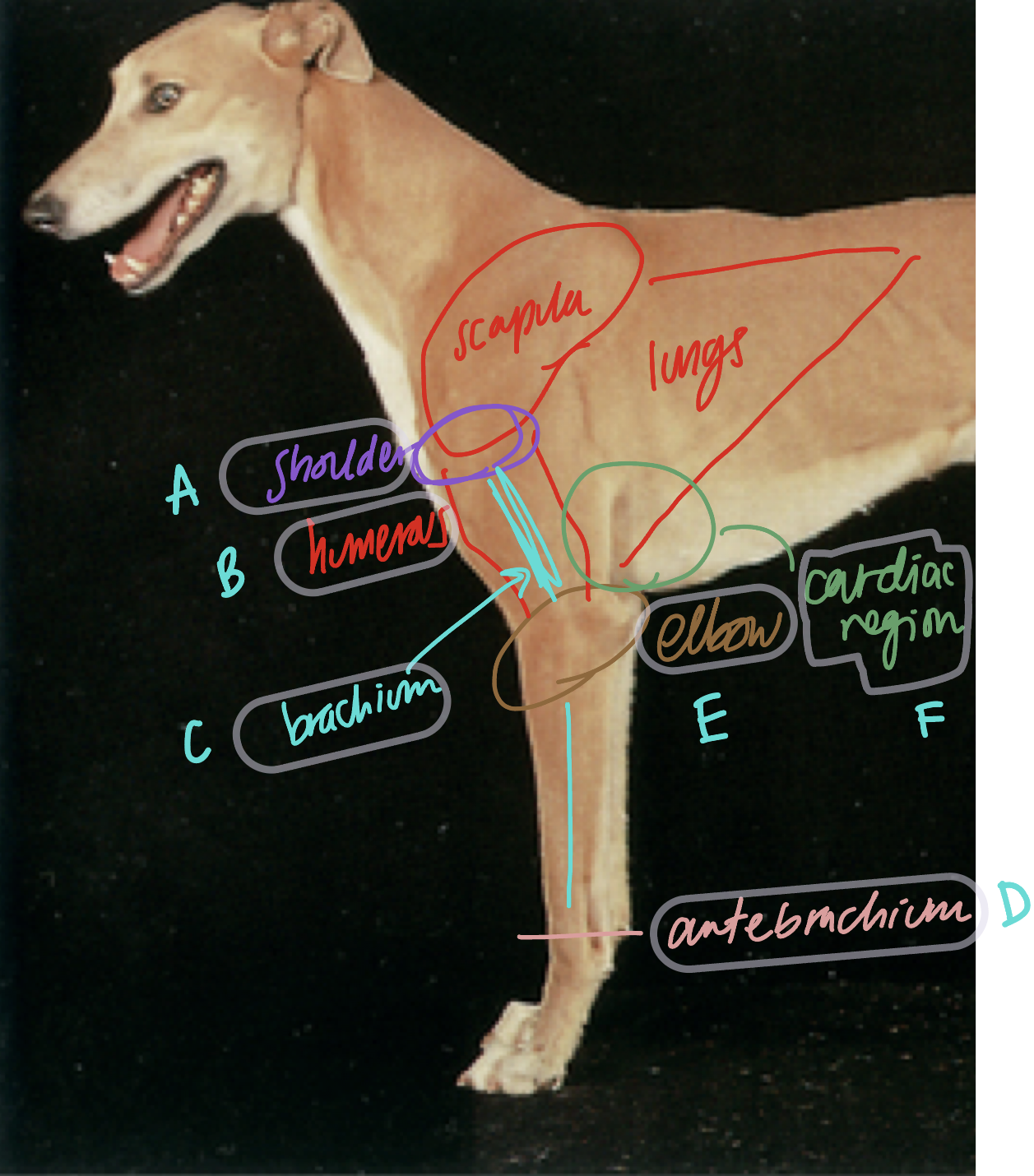

Where is the tarsus, manus, PES, and stifle of this dog?


Where is the anus, perineal, perianal, and urogenital areas on this dog?
Peri-anal is around the anus


where is the hock of a horse?


What aspect is the star placed on?
Plantar

where is the carpus on a horse?
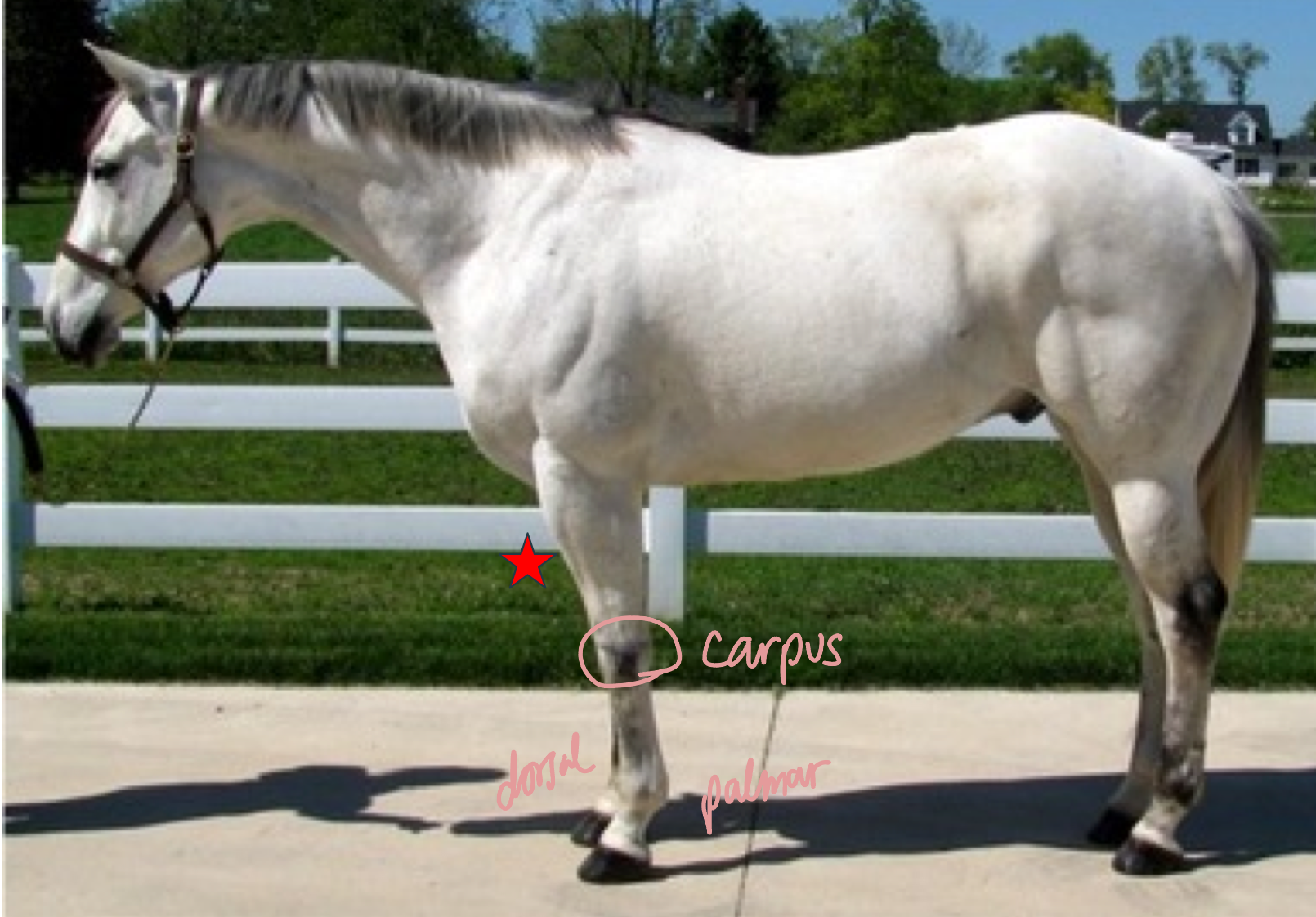

What aspect is the star placed on?
Cranial

What kind of recumbency is this?
Dorsal recumbency

What kind of recumbency is this?
Sternal recumbency