BIO107 A&P I: Bone and Skeletal Tissue Structure (Lecture 8)
 Call Kai
 Learn
 Practice Test
 Spaced Repetition
 Match
 Flashcards
 Knowt Play
1/26

Earn XP
Description and Tags
Lecture 8
27 Terms
What are the main components of skeletal cartilage?
Chondrocytes enclosed in lacunae, surrounded by a fiber-rich, jelly-like extracellular matrix (ECM).
What is the primary function of the perichondrium?
It provides the nearest blood supply and helps cartilage resist outward expansion when compressed.
List the seven functions of bone.
Support, protection, anchorage, mineral storage, triglyceride storage, blood cell formation, hormone production.
What are the two major regions of the skeleton?
Axial and appendicular skeletons.
How are bones classified by shape?
Into four groups: long, short, flat, and irregular bones.
What types of bone tissue do bones contain?
Compact and spongy bone tissue.
What is the diaphysis of a long bone?
The shaft of the long bone, surrounded by a thick layer of compact bone.

What is found in the medullary cavity of long bones?
Yellow (fat) bone marrow.

What is the epiphyseal line?
The border between the epiphysis and diaphysis, a remnant of the growth plate.
What are the two membranes associated with long bones?
Periosteum (outer surface) and endosteum (inner surface).
What are osteoprogenitor cells?
Stem cells located in the endosteum and osteogenic layer of periosteum that can develop into osteoblasts.
What is the role of osteoblasts?
Bone-forming cells that secrete osteoid, the bone's extracellular matrix.
What do osteocytes do?
Mature bone cells that maintain the bone's extracellular matrix and regulate bone remodeling.
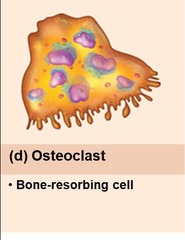
What is the function of osteoclasts?
Large, multi-nucleated cells that resorb bone through a process called bone resorption.
What is an osteon?
The structural unit of compact bone, organized in elongated cylinders parallel to the long axis of the bone.

What are central canals in compact bone?
Hollow cores of each osteon that contain blood vessels and nerve fibers.

What are lacunae in compact bone?
Small cavities between lamellae where osteocytes reside.
What is the significance of trabeculae in spongy bone?
They align along lines of stress to help bone resist physical stress.

What are the organic components of bone tissue?
Cells and osteoid, which includes ground substance, Ca2+-binding proteins, and collagen fibers.
What is hydroxyapatite?
A mineral salt made mostly of calcium phosphates that gives bone its hardness and resistance to compression.

What type of cartilage is found in articular, costal, nasal, and respiratory areas?
Hyaline cartilage.

How does the structure of a flat bone differ from a long bone?
Flat bones have two thin layers of compact bone with a thin plate of spongy bone in between, while long bones have a shaft and expanded ends.
How does compact bone differ from spongy bone?
Compact bone is organized into osteons, while spongy bone has trabeculae and lacks osteons.
Which connective tissue membrane attaches to the outer surface of bone?
Periosteum.
Which cell has a ruffled border and resorbs bone?
Osteoclast.
Which cell makes osteoid and helps drive the formation of hydroxyapatite?
Osteoblast.

Which cell is responsible for maintaining bone matrix?
Osteocyte.
