Unit 3- Ketone Bodies
 Call Kai
 Learn
 Practice Test
 Spaced Repetition
 Match
 Flashcards
 Knowt Play
1/27

There's no tags or description
Looks like no tags are added yet.
28 Terms
How is OAA made in the cell (i.e what are precursor molecules → OAA)
Glucose→ pyruvate (glycolysis)
glycerol→ DHAP → pyruvate
Odd chain FA→ propionyl → succinyl coA→ OAA at the top through TCA cycle
fermentation where lactate→ pyruvate
glycogenic aas (can be converted to glucose)→ TCA cycle
Under fasting/starvation conditions what occurs
TAGs broken down → glycerol + FAs
These products (via albumin) are transported by blood→ other tissues where they can be catabolized for fuel
BUT under starvation glycogen stores only provide day’s worth of energy
liver must make glucose to supply rest of body
In the liver what process occurs that converts glycerol to glucose?
GNG (gluconeogenesis) under starvation conditions or decrease [blood sugar]
Glycerol→ DHAP→ glucose
In the liver (fasting/starvation condtns) FAs will undergo
B-oxidation → acetyl coAs
BUT only a small amount of these acetyl coAs will enter the citric acid cycle in LIVER
Why do most of acetyl coAs gen in liver (under starv/fasting condtns) not enter the citric acid cycle (CAC)
under starvation/fasting (↓ [blood glucose]) there’s a lack of OAA in liver cells (bc its getting diverted and depleted to make glucose via GNG) so acetyl coA doesn’t enter TCA cycle in large amounts
since acetyl coA binds with OAA→ citrate
So we make KBs bc we have lots of acetyl coA
In liver cells what happens with OAA during starvation/untreated diabetes (why is there no net gain of OAA)
OAA removed from TCA cycle and used to make glucose via GNG
Can acetyl coA alone be used to make glucose?
NO
acetyl coA cannot be used to make a net gain of OAA or glucose
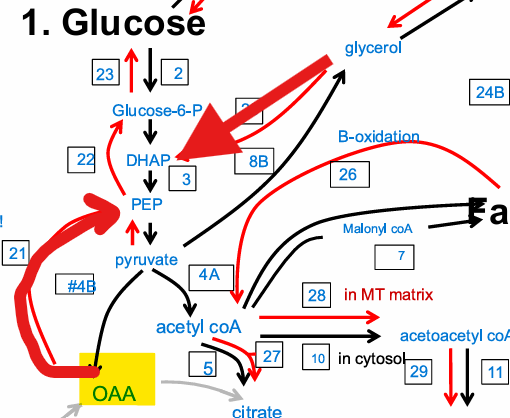
GNG in liver brief overview
Pyruvate→ PEP→ DHAP→Glucose
OAA feed back in → PEP→ DHAP→ glucose
Glycerol phosphorylated + oxidized → DHAP→ glucose
Where are ketone bodies produced and exported
produced in liver (from acetyl coA)( in MT matrix)
exported into bloodstream to other tissues that use KBs for fuel like
heart
renal cortex
brain
skeletal muscle
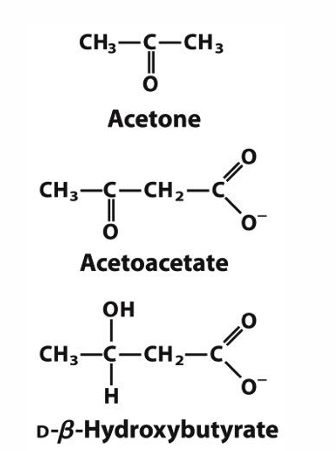
The ketone bodies that are formed are (know structures and names)
Acetone
Produced in smaller amounts and exhaled
Acetoacetate
D-B-hydroxybutyrate
both are transported to tissues other than the liver like skeletal and heart muscle, renal cortex, and brain
these are blood friendly versions of acetyl coA
Why can’t brain use free FAs for energy?
need to send KBs to brain if low on glucose (what we usually send) bc FAs too large to pass through BB barrier
Ketone body synthesis (liver)
What molecules combine to form acetoacetyl coA
2 acetyl coA combine→ acetoacetyl coA
this is reverse rxn of last step of B-ox (thiolysis)
Enzyme- thiolase

Ketone body synthesis (liver)
Acetoacetyl coA then ….
condenses w/ another acetyl coA→ HMG-coA
a coA produced in this step
Enzyme= HGM-CoA synthase

Ketone body synthesis (liver)
HMG-CoA is cleaved to form
The K.B acetoacetate
Acetyl coA also produced
enzyme= HMG-CoA lysase

Ketone Body Synthesis (liver)
the other 2 kbs (acetone and D-B-hydroxybutyrate) are produced from ..
Acetone: acetoacetate through decarboxylation
D-B-Hydroxybutyrate: using 1 NADH reducing equiv
Then ketone bodies exported→ extrahepatic tissues as fuel sources

Why is it important to regen coA in liver when KBs being made?
Need CoA to continue B-oxidation of FAs in liver
bc CoA needed in last step of B-oxidation (thiolysis)
What determines whether acetoacetate or D-B-hydroxybutyrate is made from HMG-CoA?
Ratio of NADH: NAD+ in cell (le chateliers principle)
if have high NADH then favors D-B-hydroybutyrate
if have high NAD+ then favors acetoacetate
Which KB is more oxidized, acetoacetate or D-B-hydroxybutyrate?
Acetoacetate more oxidized
has double bond to O

So summary of during sever starvation or untreated diabetes
liver performs GNG→ supply extrahepatic tissue w/ glucose
Liver also oxidized FAs(B-ox)→ acetyl coA→ Ketone bodies
all being stimulated by glucagon (lipolysis, B-ox of the FAs, then KB synthesis, and GNG)
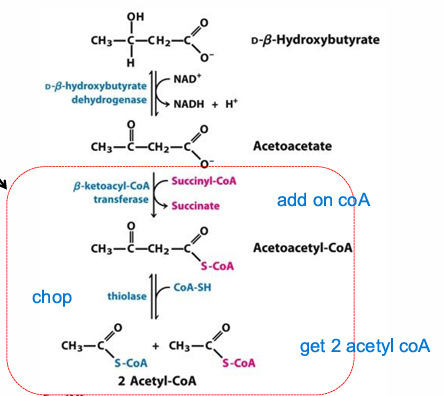
When the ketone body D β-hydroxybutyrate arrives at extrahepatic tissue (tissue outside liver) it is
oxidized (+1 NADH reducing equiv made) to form acetoacetate

If acetoacetate arrives at the extrahepatic tissue then it
doesnt need to be oxidized

Then after 2 enzymatic steps acetoacetate made into
2 acetyl coA molecules
the acetyl coA can enter CAC of extrahepatic tissues
Why do liver cells express very low levels of B-ketoacyl-coA transferase?
To prevent futile cycle in liver bc we dont wanna be synthesizing AND using ketone bodies at the same time
this enzyme is breaking down KBs for energy in extrahepatic tissues
Where do extrahepatic tissues get OAA during severe starvation?
extrahepatic tissues get enough glucose from liver (oprah)
convert glucose→ OAA therefore acetyl coA made from KBs can enter TCA cycle in extrahepatic tissues ONLY
Ketogenesis needs what in diet
Lots FAs, proteins
Low glucose, starch diet
pushes body into ketone body synthesis
Which of the following conditions/states would NOT promote ketogenesis (the production of ketone bodies)?
A. An individual performing a marathon run.
B. An individual consuming a high carbohydrate/low fat diet.
C. An individual consuming a low carbohydrate/high fat diet.
D. An individual who is fasting for more than 24 hours.
E. An individual suffering from untreated diabetes.
B→ have lots of stores then
Why do rats fed odd-chain fatty acids (heptanoic acid, C7:0) remain healthy and gain weight, while those fed even-chain fatty acids (octanoic acid, C8:0) lose muscle mass and weaken when used as their sole carbon source?
odd-Chain Fatty Acid (C7:0)→ propionyl-CoA during B-oxidation, which → to succinyl-CoA and yields net oxaloacetate for gluconeogenesis
The rats stay healthy because they can synthesize glucose from their diet.
Even-Chain Fatty Acid (C8:0)→ only acetyl-CoA, whose carbons are lost as Co2 in the citric acid cycle.
Mammals cannot convert acetyl-CoA into glucose.
Because brain and blood cells require glucose, the C8:0 group must break down muscle proteins for gluconeogenic amino acids, leading to severe muscle loss and weakness.
What’s ketoacidosis
if prolonged starvation or untrated diabetes continues acetyl coA will continue to accumulate (bc cant be oxidized in CAC as OAA being used for GNG)
this results in increased conc of KBs in blood which are acidic decreasing blood pH→ coma or death