Nerve supply + Key anatomical regions of LL
 Call Kai
 Learn
 Practice Test
 Spaced Repetition
 Match
 Flashcards
 Knowt Play
1/44

There's no tags or description
Looks like no tags are added yet.
45 Terms
Which two nerve plexuses supply the lower limb?
The lumbar plexus (L1–L4) and sacral plexus (L4–S4).
Which main nerves arise from the lumbar plexus, according to the lecture?
The femoral nerve and obturator nerve.
Which main nerves arise from the sacral plexus, according to the lecture?
The sciatic nerve and superior gluteal nerve.
What are the two main functions of nerves?
Motor: controls muscle contraction.
Sensory: carries information about skin sensation.
What are the six key lower-limb nerves covered in the lecture?
Femoral, obturator, sciatic, tibial, common fibular and superior gluteal nerves.
What are the nerve roots of the sciatic nerve?
L4–S4.

What is the largest and thickest nerve in the body?
The sciatic nerve.

Through which opening does the sciatic nerve leave the pelvis?
The greater sciatic foramen, usually inferior to piriformis.

Where does the sciatic nerve travel after leaving the pelvis?
It descends through the posterior thigh.

Into which two nerves does the sciatic nerve divide?
The tibial nerve and common fibular (peroneal) nerve.

What muscles does the sciatic nerve supply?
The hamstrings and, through its terminal branches, most muscles of the leg and foot.

What is another name for the common fibular nerve?
The common peroneal nerve. Both terms refer to the same nerve.

Which nerve supplies the anterior thigh, including the quadriceps?
The femoral nerve.
What are the main motor actions of the femoral nerve?
Knee extension and hip flexion.
Which nerve supplies the medial thigh, including the adductor muscles?
The obturator nerve.
What is the main motor action of the obturator nerve?
Hip adduction.
Which nerve supplies the posterior thigh, including the hamstrings?
The sciatic nerve.
What are the main motor actions of the sciatic nerve?
Knee flexion and hip extension.
Which nerve supplies the posterior leg, including gastrocnemius?
The tibial nerve.
What are the main motor actions of the tibial nerve?
Plantarflexion and inversion.
Which nerve supplies the anterior and lateral compartments of the leg?
The common fibular nerve.
What are the main motor actions of the common fibular nerve?
Dorsiflexion and eversion.
Which nerve supplies the gluteal region, including gluteus medius and minimus?
The superior gluteal nerve.
What are the main motor actions of the superior gluteal nerve?
Hip abduction and pelvic stabilisation.
Where is the common fibular nerve particularly vulnerable to injury?
Where it winds superficially around the neck of the fibula.

What can cause common fibular nerve injury?
Fracture of the fibula.
Compression of the nerve.
Prolonged leg crossing.

What is foot drop?
A condition in which weakness of the dorsiflexor muscles causes the foot to hang in a plantarflexed position.

Why does common fibular nerve injury cause foot drop?
The dorsiflexors become weak, while the plantarflexors remain active.

What muscles are weakened in foot drop caused by common fibular nerve injury?
The dorsiflexor muscles.

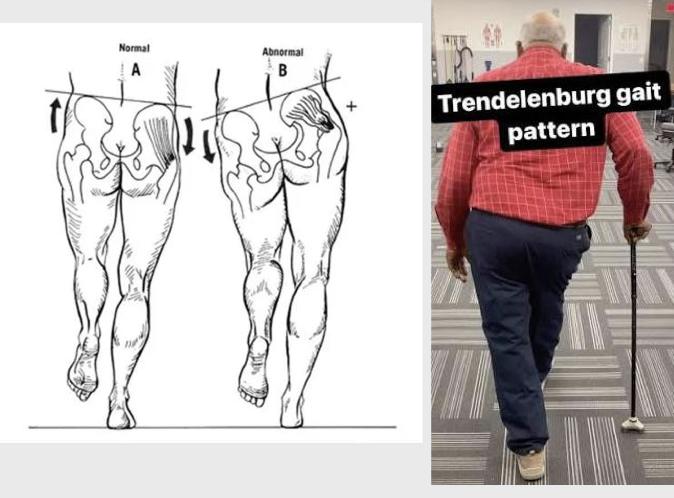
What causes Trendelenburg gait?
Weakness of gluteus medius and gluteus minimus.

Which nerve is affected in Trendelenburg gait?
The superior gluteal nerve.

What happens to the pelvis during Trendelenburg gait?
The pelvis drops on the opposite, unsupported side during single-leg stance.

How does a patient compensate for Trendelenburg gait?
They lean their trunk towards the affected, weight-bearing side.

In Trendelenburg gait, which side is actually weak if the pelvis drops on the opposite side?
The side of the weight-bearing leg. The weakness is in the hip abductors on that side.
What are the two key anatomical passageways of the lower limb covered in the lecture?
The femoral triangle and popliteal fossa.

What is the femoral triangle?
A triangular space in the upper anterior thigh, just inferior to the inguinal ligament.
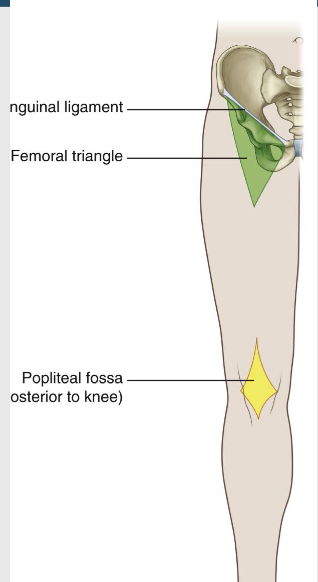
What forms the superior boundary of the femoral triangle?
The inguinal ligament.

What forms the lateral boundary of the femoral triangle?
The sartorius muscle.

What forms the medial boundary of the femoral triangle?
The adductor longus muscle.

What are the contents of the femoral triangle from lateral to medial?
Femoral nerve, femoral artery, femoral vein, femoral canal and lymphatics.

What mnemonic helps remember the contents of the femoral triangle?
NAVEL — Nerve, Artery, Vein, Empty space (femoral canal), Lymphatics.

What is the popliteal fossa?
A diamond-shaped anatomical space at the back of the knee.
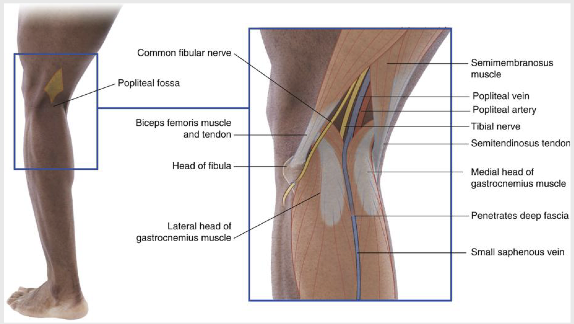
What forms the superior boundaries of the popliteal fossa?
The hamstrings.

What forms the inferior boundaries of the popliteal fossa?
The heads of gastrocnemius.

What are the contents of the popliteal fossa from superficial to deep?
Tibial nerve → popliteal vein → popliteal artery.
