chemistry unit 3 henry issaquah highschool
 Call Kai
 Learn
 Practice Test
 Spaced Repetition
 Match
 Flashcards
 Knowt Play
1/23

There's no tags or description
Looks like no tags are added yet.
24 Terms
what are the units for atomic radius
(PM) picometer
what is the trend in atomic radius as you go across a period left to right
the atomic radius gets smaller
how does the number of protons affect coulombic attraction
increases the force of attraction (coulombic attraction)
why does removing an electron (ionization) from an atom take energy?
it takes energy because removing an electron from its pull with a proton requires you to need energy / force to remove it (energy)
what is the trend in ionization energy as you go over a group
as you go down ionizations gets smaller because the atoms gain more valence electrons
in general what is the trend in ionization energy as you go across a period?
it gets stronger as you go left to right
how does ionization energy affect coulombic attraction
Ionization energy gets larger due to the number of protons increasing, so the coulombic attraction thats attracting the electrons, increases
would metals have high or low ionization energies?
they would have lower ionization energies because they hold their electrons loosely
would noble gases have have high or low ionization energies?
they would have higher ionization energies since they have a full valence electron shell
what is electronegativity’s trend on the periodic table
it goes up left to right

what is ionization energy’s trend on the periodic table?
goes up left to right

what is atomic radius’s trend on the periodic table?
does down right to left

Aufbau principle
electrons fill the lowest available energy levels and subshells before moving to higher ones ex: 1s fills before 2s and 2 s fills up before 2p
Pauli exclusion principle
each individual orbital can hold a maximum of two electrons and they must have opposite spins, those spins being represents as and upward arrow and a downward arrow; so no two electrons share an identical set of quantum numbers
atomic mass
the number under the element symbol
the weight of an atom when its at rest

atomic number
the number above the element symbol
the total number of protons in the nucleus of an atom
element symbol
a symbol that represents the element and is usually an abbreviation
isotope
a variant of a chemical element that has the same number of protons and electrons, but a different number of neutrons in its nucleus
what determines an elements element?
the number of protons in the nucleus
electron configuration
the distribution of an atom's electrons among its atomic orbitals in spatial shells

orbital notation
shows how electrons are distributed among the energy levels, subshells, and individual orbitals of an atom, including their spin direction.

orbital notation F sub level
the F sub level is in the metaloid’s and is usually not used by can be used in certain orbital notation equations
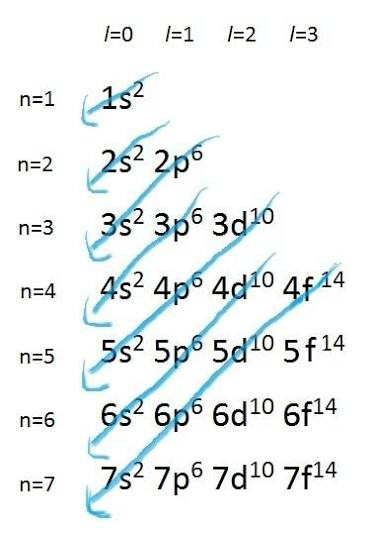
all orbital notation key rules
Hunds rule Aufbau principle Pauli exclusion principle

orbital notation rule of how you write it right
Ex: lithium is spin paired in the first orbital but only has one up arrow at the 2s underline since its shell isnt fully filled
*THIS IS CALLED HUNDS RULE*
