Energy Flow - Energetics and ATP
 Call Kai
 Learn
Learn Practice Test
 Spaced Repetition
 Match
Match Flashcards
 Knowt Play
1/38

There's no tags or description
Looks like no tags are added yet.
Name | Mastery | Learn | Test | Matching | Spaced | Call with Kai | Chat |
|---|
No analytics yet
Send a link to your students to track their progress
39 Terms
What are the 3 basic requirements of a cell?
A membrane separating the inside from the outside; a way to encode/transmit information; energy to perform cellular work.

What is intracellular homeostasis?
The ability of a cell to maintain stable internal conditions even when the extracellular environment changes.

What are 3 things cells need to maintain for homeostasis?
Glucose levels, ion levels, and pH.
What is metabolism?
The totality of an organism's chemical processes. Concerned with managing cellular resources

What is anabolism?
The building of larger molecules from smaller units; requires an input of energy.

What is catabolism?
The breakdown of molecules into smaller, less complex molecules; releases energy that can be captured as ATP.

What is energy?
The capacity to do work or cause change.
What is kinetic energy?
Energy associated with motion.
What is potential energy?
Stored energy due to an object's location or organization.
What does the First Law of Thermodynamics state?
Energy cannot be created or destroyed; it can only be transformed from one form to another.

What does the Second Law of Thermodynamics state?
Natural processes are accompanied by an increase in entropy or disorder.
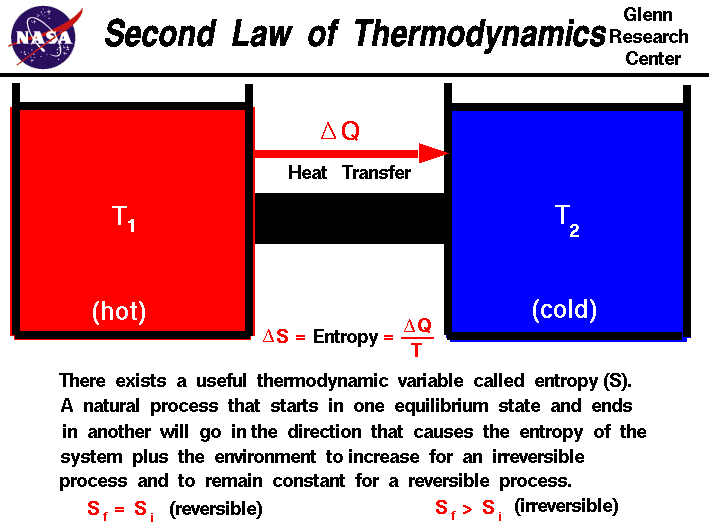
What is entropy?
The degree of randomness or disorder in a system.
Why does diffusion increase entropy?
Particles move from high concentration to low concentration, resulting in a more random distribution.
What is ATP?
Adenosine triphosphate; the main energy currency of the cell.
What is ATP made of?
Adenine, ribose, and three phosphate groups.
What is phosphorylation?
The transfer of a phosphate group from ATP to another molecule.
What does phosphorylation do?
It can change a molecule's charge and shape, changing its activity or making it more reactive.
What is a kinase?
An enzyme that adds a phosphate group to a molecule.
What is a phosphatase?
An enzyme that removes a phosphate group from a molecule.
What is dephosphorylation?
The removal of a phosphate group from a molecule.
How does ATP drive cellular work?
ATP transfers a phosphate to another molecule, creating an activated intermediate that can perform cellular work.
What are the 3 types of cellular work?
Mechanical work, transport work, and chemical work.

What powers primary active transport?
Direct energy from ATP.

What powers secondary active transport?
The energy stored in an ion concentration gradient.
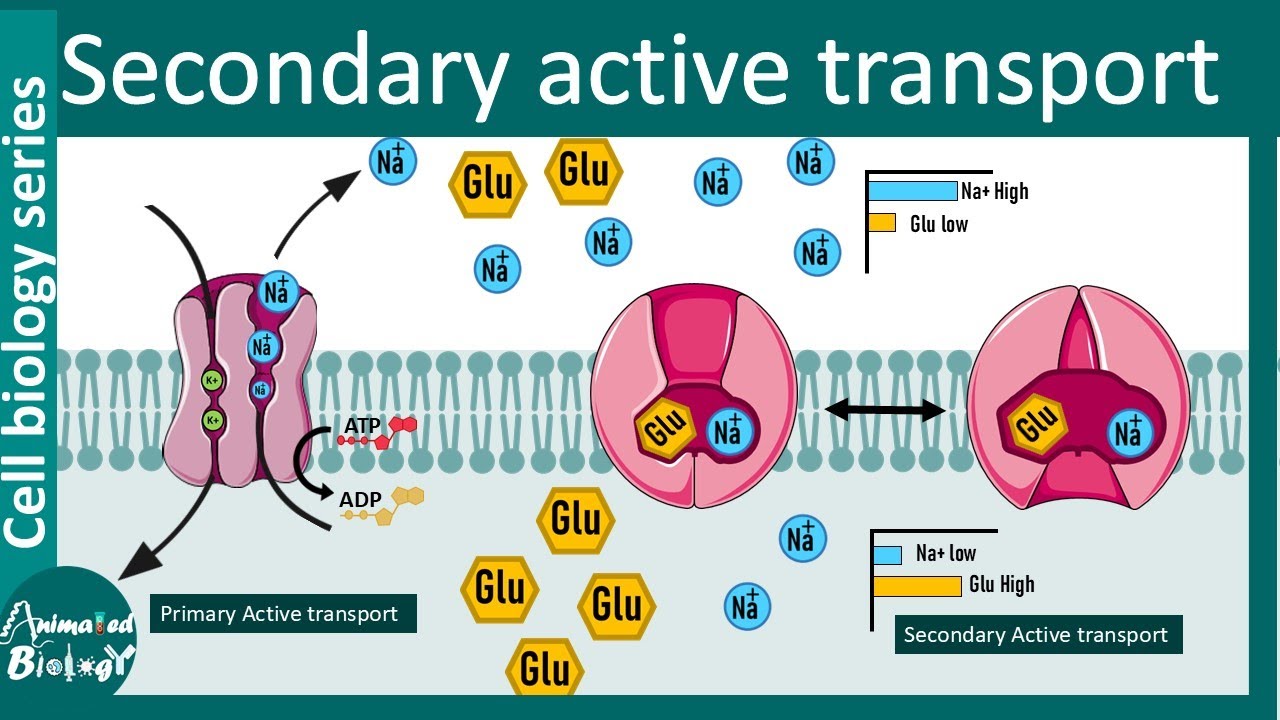
Where does the ion gradient for secondary active transport come from?
Primary active transport, which uses ATP.
A cell combines amino acids to make a protein. Is this anabolic or catabolic?
Anabolic because smaller molecules are being combined to form a larger, more complex molecule.

A large molecule is broken into smaller molecules and energy is captured as ATP. Is this anabolic or catabolic?
Catabolic because a complex molecule is being broken down and energy is released.
A cell uses ATP to move ions from low concentration to high concentration. What type of transport is this?
Primary active transport because ATP directly provides the energy.
A transporter moves glucose using the downhill movement of Na+ without directly using ATP. What type of transport is this?
Secondary active transport because it uses the energy stored in the Na+ gradient.
If the ATP-powered pump creating a Na+ gradient stops, what happens to secondary active transport?
The Na+ gradient eventually decreases, causing secondary active transport to decrease or stop.
If a cell cannot make ATP, why would it eventually die even if it has glucose?
It cannot perform essential energy-requiring processes such as active transport, biosynthesis, movement, and maintenance of ion gradients.
Why doesn't a cell run out of ATP immediately if ATP is constantly being used?
ATP is continuously regenerated from ADP and phosphate.
A kinase stops working. What would happen?
Phosphorylation of target molecules would decrease, disrupting processes that depend on phosphorylation.
A phosphatase becomes overactive. What would happen?
Target molecules would be dephosphorylated more frequently, potentially changing or reducing their activity.
How are catabolism and anabolism connected?
Catabolism releases energy that can be captured in ATP, and ATP provides energy for anabolic processes.
Does ATP hydrolysis power cellular work by releasing heat?
No. ATP hydrolysis is coupled to cellular work, often through phosphorylation.
A protein receives a phosphate from ATP and changes shape. What happened?
The protein was phosphorylated, causing a change in its charge and/or shape.
How do the First and Second Laws apply to cellular respiration?
The First Law means energy is transformed rather than destroyed; the Second Law means entropy increases during energy transformations.
Metabolic Map