Entrepreneurship and business planning - ch 6
 Call Kai
 Learn
 Practice Test
 Spaced Repetition
 Match
 Flashcards
 Knowt Play
1/25

There's no tags or description
Looks like no tags are added yet.
26 Terms
What is a business plan, what is its typical length, and what does it describe?
A business plan is a written narrative, typically 25–35 pages long, describing:
What a new business plans to accomplish.
How it intends to accomplish it.
It explains the business opportunity and the strategies for turning that opportunity into a viable venture.
What important facts should entrepreneurs know about writing a business plan?
Entrepreneurs should not start writing too early.
30–40% of successful new ventures had no formal business plan.
Preparing a business plan can be a good investment of time and money.
The slides state that a business plan has been legally required in Belgium since 2019 under the WVV (Belgian Companies and Associations Code).
Why is a business plan considered a dual-use document, and what are its internal and external purposes?
A business plan serves two purposes:
Internal: Forces the founding team to systematically think through every aspect of the new venture.
External: Communicates the merits of the business opportunity to investors and other stakeholders, such as bankers.
Who are the two primary audiences for a business plan, and what does each audience look for?
Internal audience — Employees: A roadmap for executing strategies and plans, helping employees work together consistently and purposefully.
External audience — Investors and other stakeholders: Evidence that the new venture represents a good use of their money, attention, or resources.
Why should entrepreneurs follow a conventional business plan structure, and what else should the plan communicate?
A conventional structure allows busy investors to locate critical information easily.
Departing from the conventional structure to demonstrate creativity is usually a mistake.
Alongside facts and figures, the plan should communicate a sense of anticipation and excitement about the venture's possibilities.
What are the main content guidelines for an effective business plan?
A business plan should:
Provide clear and concise information about every important aspect of the venture.
Be long enough to provide sufficient information.
Be short enough to maintain the reader's interest.
Combine factual information with enthusiasm about the opportunity.
What are the three types of business plans, their typical lengths, and their main purposes?
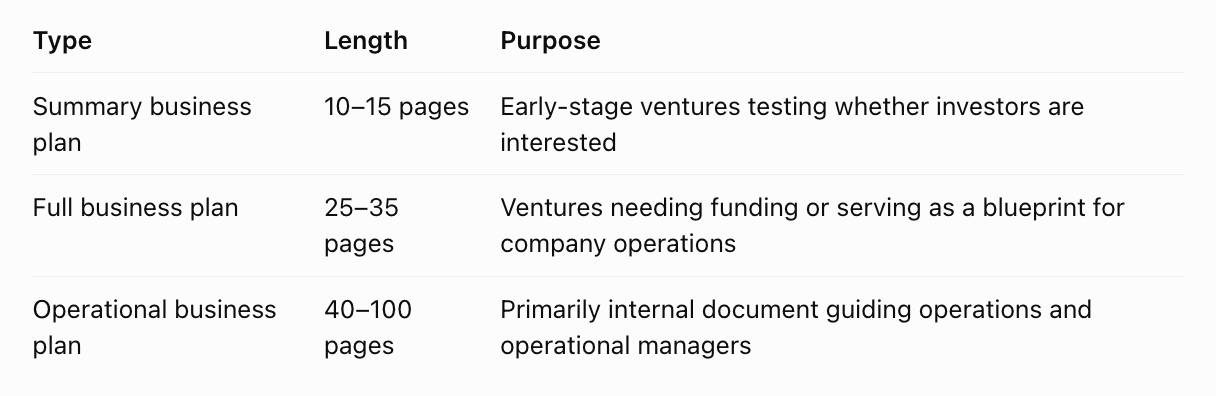
Why should entrepreneurs expect their business plan to change while writing it, and how does the lean start-up approach relate to this?
Business plans usually evolve during the writing process.
New insights emerge as entrepreneurs analyze their venture and receive feedback.
The lean start-up approach involves requesting feedback directly from prospective customers before settling on a business idea and the business model for executing it.
What is the recommended overall structure of a full business plan?
The plan begins with a cover page and table of contents, followed by 11 main sections:
Executive Summary
Industry Analysis
Company Description
Market Analysis
Economics of the Business
Marketing Plan
Design and Development Plan
Operations Plan
Management Team and Company Structure
Overall Schedule
Financial Projections
It ends with appendices. The slides also refer to the Barringer/Ireland Business Model.
What information is included in the Executive Summary, Industry Analysis, and Company Description sections?
Executive Summary: An overview of the business plan and venture.
Industry Analysis: Industry size, growth rate, sales projections, structure, participants, key success factors, industry trends, and long-term prospects.
Company Description: Company history, mission statement, products and services, current status, legal status and ownership, and key partnerships.
What information is included in the Market Analysis section of a business plan? 4
Market segmentation and target market selection
Buyer behavior
Competitor analysis
Estimates of annual sales and market share
It identifies the customers the venture intends to serve and evaluates its competitive market position.
What information is included in the Economics of the Business section? 5
Revenue drivers and profit margins
Fixed and variable costs
Operating leverage and its implications
Start-up costs
Break-even chart and calculation
This section examines how the venture will generate revenue, manage costs, and become profitable.
What information is included in the Marketing Plan section? 4
Overall marketing strategy
Product, price, promotions, and distribution
Sales process or sales cycle
Sales tactics
It explains how the venture plans to attract customers and generate sales.
What information is included in the Design and Development Plan (4) and the Operations Plan (3)?
Design and Development Plan:
Development status and tasks
Challenges and risks
Projected development costs
Proprietary issues: patents, trademarks, copyrights, licenses, and brand names
Operations Plan:
General approach to operations
Business location
Facilities and equipment
What information is included in the Management Team and Company Structure section (4) and the Overall Schedule?
Management Team and Company Structure:
Management team, including skills profiles
Board of directors
Board of advisors
Company structure
Overall Schedule: The planned timeline for implementing the business and reaching its important milestones.
What documents and analyses should be included in the Financial Projections section? 6
Sources and Uses of Funds Statement
Assumptions Sheet
Pro Forma Income Statements
Pro Forma Balance Sheets
Pro Forma Cash Flows
Ratio Analysis
The financial projections describe the venture's expected financial performance and funding requirements.
What additional elements accompany the full business plan outline?
Cover page: Identifies the business.
Table of contents: Organizes the document and makes important information easier to find.
Appendices: Provide supporting information.
Barringer/Ireland Business Model: Specifically referenced in the slides as an additional model included in the appendix/schedule.
How should entrepreneurs evaluate a completed business plan, and what are the ten key questions they should answer?
Entrepreneurs should put themselves in the reader's shoes and determine whether the plan answers the following questions:
Is the business merely an idea, or a genuine opportunity with potential?
Is the product or service viable, does it add significant customer value, and has a feasibility analysis been completed?
Is the industry attractive and growing, and has the firm found an attractive position?
Is there a well-defined target market?
Are the firm's points of differentiation genuine and sustainable?
Is the marketing plan sound?
Is the management team sufficiently experienced and skilled?
Is the operations plan appropriate and sound?
Are the assumptions underlying financial projections realistic?
Are the financial projections correct, and do they indicate a promising future?
What guidelines should entrepreneurs follow when orally presenting a business plan to investors?
Follow directions: Respect the allotted presentation time, e.g., do not exceed 15 minutes if given 15 minutes.
Deliver a smooth, well-rehearsed presentation.
Use sharp, clear, uncluttered slides.
Anticipate investor questions and prepare appropriate answers.
What are the 12 recommended slides for an investor presentation, in the correct order?
Title slide
Problem
Solution
Opportunity and target market
Technology
Competition
Marketing and sales
Management team
Financial projections
Current status
Financing sought
Summary
What should the first four slides of an investor presentation contain?
Title slide: Company name, founders' names, and company logo if available.
Problem: The problem to be solved or need to be fulfilled.
Solution: How the business solves the problem or satisfies the need.
Opportunity and target market: The specific target market and the business and environmental trends supporting its growth.
What should the Technology, Competition, and Marketing and Sales slides contain?
Technology: Technology or unusual product/service features, explained clearly without excessive technical detail. This slide is optional but normally included.
Competition: The firm's competitive advantage and how it will compete with established businesses.
Marketing and sales: Overall marketing strategy, sales process, and any primary research about customer attitudes toward the product.
What should the Management Team slide contain? 5
Existing management team members
How the team came together
Backgrounds and expertise relevant to the venture's success
Key board members or advisors, if applicable
Gaps in the management team and how and when those gaps will be filled
What should the Financial Projections, Current Status, and Financing Sought slides contain?
Financial projections: Expected profitability, amount of capital required, when cash flow will break even, and additional financial slides when needed. Avoid overwhelming investors.
Current status: Progress and milestones already achieved, without diminishing accomplishments.
Financing sought: Exactly how much funding the company seeks and how it will use the money.
What should the final Summary slide contain, and how should entrepreneurs prepare for investor feedback?
Summarize the strongest points of the venture and its team.
Bring the presentation to a clear close.
Invite questions and feedback from investors.
Anticipate likely investor questions and prepare thoughtful answers in advance.
What are the stages of developing a successful business idea before writing a business plan?
Recognizing opportunities and generating ideas — Chapter 2
Feasibility analysis — Chapter 3
Developing an effective business model — Chapter 4
Industry and competitor analysis — Chapter 5
Writing the business plan — Chapter 6 Important: Writing the business plan comes after the earlier opportunity-development and analysis stages.