Pharmacodynamics pt 2
 Call Kai
 Learn
Learn Practice Test
 Spaced Repetition
 Match
Match Flashcards
 Knowt Play
1/19

There's no tags or description
Looks like no tags are added yet.
Name | Mastery | Learn | Test | Matching | Spaced | Call with Kai | Chat |
|---|
No analytics yet
Send a link to your students to track their progress
20 Terms
🔄 UPDATED/REPLACEMENT 1. Q: How can a partial agonist act as a functional antagonist when a full agonist is also present?
A partial agonist can act as a functional antagonist by competing with a full agonist for the same receptors while producing less receptor activation, thereby decreasing the overall response.
The lecture also shows that buprenorphine can be more potent than morphine while still having lower efficacy, reinforcing that potency and efficacy are separate properties.
⭐ 2. Q: How do competitive, noncompetitive, and irreversible antagonism differ?
Competitive antagonists reversibly compete with agonists for the same receptor site,
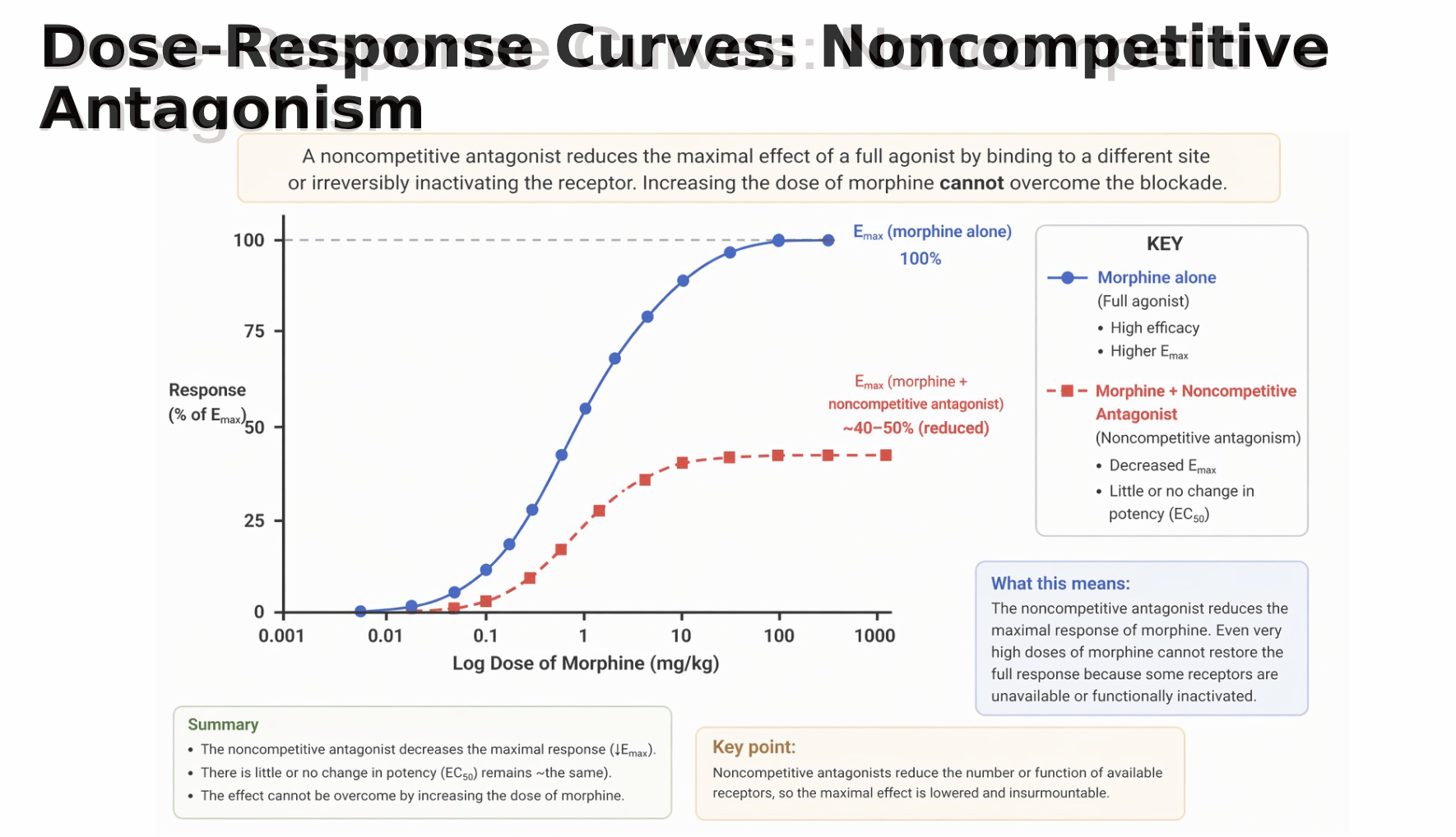
noncompetitive antagonists reduce receptor function in a way that cannot be overcome by more agonist,
and irreversible antagonists permanently bind receptors and reduce the number available.
🔎 What this means:
Competitive antagonism
The antagonist and agonist want the same receptor-binding site.
binding is reversible
increasing agonist concentration can overcome the antagonist
the agonist can still eventually produce the same maximum effect
This is called surmountable antagonism because enough agonist can overcome it.
Noncompetitive antagonism
The antagonist:
binds at a different site, or
otherwise alters receptor function
Increasing the agonist concentration cannot overcome the blockade.
The lecture associates this with:
decreased Emax
little or no change in EC50
Irreversible antagonism
The antagonist forms a permanent covalent bond with the receptor.
This:
reduces the number of receptors available
decreases Emax
cannot simply be overcome by adding more agonist
💡 Think:
Competitive = fighting for the same seat.
Noncompetitive = damaging/disabling the seat.
Irreversible = permanently taking the seat away.

⭐ 3. Q: How can competitive and noncompetitive antagonism be distinguished on a dose-response curve?
Competitive antagonism shifts the agonist dose-response curve to the right without lowering Emax,
whereas noncompetitive antagonism lowers Emax and cannot be overcome by increasing the agonist dose.
Competitive antagonist
The lecture's morphine + naloxone graph shows a rightward shift.
That means:
more morphine is needed for the same response
apparent potency decreases
Emax stays the same
Why?
Enough morphine can eventually outcompete naloxone.
Noncompetitive antagonist
The lecture's noncompetitive-antagonist graph shows a lower plateau.
That means:
Emax decreases
giving more morphine cannot restore the full response
EC50 has little or no change in the professor's example
So when looking at an exam graph:
Right shift + same Emax → competitive
Lower Emax → noncompetitive
💡 Think:
Competitive moves sideways.
Noncompetitive pushes the ceiling down.
4. Q: What is an inverse agonist, and how is it different from an agonist and a neutral antagonist?
An inverse agonist decreases receptor activity below its normal baseline,
whereas an agonist increases receptor activity above baseline
and a neutral antagonist binds without changing baseline activity.
🔎 What this means:
Some receptors have constitutive activity, meaning they produce some signaling even when no ligand is bound.
A full agonist: ex: Morphine
increases receptor activity above baseline
A neutral antagonist: ex: Naloxone
binds the receptor
does not activate it
does not change its baseline activity
An inverse agonist: ex: diphenhydramine
binds the same receptor
suppresses its constitutive activity
produces an effect in the opposite direction from an agonist
So an inverse agonist does more than simply “block” an agonist. It actively decreases receptor activity below baseline.
💡 Think:
Agonist = above baseline
Antagonist = baseline stays put
Inverse agonist = below baseline
5. Q: What are the therapeutic index and therapeutic window, and what do they tell you about drug safety?
The therapeutic index (TI) is the ratio that compares the toxic dose with the desired effect dose, while the therapeutic window is the range of doses that produces benefit without toxicity.
The formula and graph to TI is in the attached picture
TI = TD50/ED50 = (toxic dose) / (therapeutic dose)
Where:
ED50 = dose producing the desired effect in 50% of the population
TD50 = dose producing the defined toxic effect in 50% of the population
A large TI means the toxic dose is much higher than the effective dose.
That gives a wider safety margin.
A small TI means the effective and toxic doses are closer together.
That gives a narrower safety margin and greater toxicity risk.
The therapeutic window is the actual dose range where you can obtain the desired benefit without producing toxicity.
💡 Think: The farther toxicity is from the useful dose, the safer the drug.
The professor's next slide reinforces this with the idea that “the dose makes the poison.”

⭐ 6. Q: iClicker — A drug given with morphine causes a rightward shift in the dose-response curve without changing Emax. What type of antagonism is occurring?
A. Noncompetitive antagonism
B. Irreversible antagonism
C. Functional (physiologic) antagonism
D. Competitive antagonism
D. Competitive antagonism is occurring because the curve shifts to the right while the same Emax remains achievable.
A competitive antagonist competes with the agonist for the same receptor site.
The antagonist makes you need more agonist to obtain the same effect, which shifts the curve rightward.
🔄 UPDATED/REPLACEMENT 7. Q: What is the basic sequence of cellular signaling from drug binding to cellular response?
Cellular signaling begins when a ligand binds and activates a receptor, which initiates intracellular signal transduction, generates second messengers, activates downstream proteins, and ultimately changes cellular function.
⭐ 8. Q: What roles do receptors, second messengers, and effector proteins play in a cellular signaling pathway?
Receptors detect the initial signal, second messengers amplify and carry that signal inside the cell, and effector proteins execute the resulting cellular response.
💡 Think:
Receptor = receives
Second messenger = spreads/amplifies
Effector = does the work
⭐ 9. Q: How do G protein-coupled receptors (GPCRs) signal through Gs, Gi, and Gq proteins?
GPCRs convert extracellular ligand binding into intracellular signaling by activating G proteins;
Gs increases cAMP,
Gi inhibits cAMP, and
Gq increases IP₃/DAG and intracellular Ca²⁺.
🔎 What this means:
G protein-coupled receptors (GPCRs) are described in the lecture as the most common drug targets.
They have seven transmembrane domains, meaning the receptor crosses the cell membrane seven times.
💡 Think:
Gs = stimulate cAMP
Gi = inhibit cAMP
Gq = calcium pathway
10. Q: How do cell-surface GPCRs and intracellular nuclear receptors differ in how they produce drug effects?
GPCRs produce effects through intracellular signaling pathways after membrane-receptor activation, whereas intracellular nuclear receptors regulate gene expression and therefore tend to produce slower, longer-lasting effects.
An intracellular or nuclear receptor is located inside the cell.
The lecture gives the glucocorticoid receptor as an example.
Rather than mainly acting through rapid membrane signaling, nuclear receptors regulate gene expression.
The lecture therefore associates them with:
slower onset
longer-lasting effects
11. Q: How does μ-opioid receptor signaling produce opioid effects? What are the types of μ-opioid receptors?
μ-opioid receptors signal through Gi proteins, which decrease cAMP, increase K⁺ efflux, and reduce Ca²⁺ influx, ultimately decreasing neuronal excitability and neurotransmitter release.
🔎 What this means:
The μ-opioid receptor is a GPCR.
The lecture describes two receptor subtypes:
μ₁ receptors
primarily in the brain
associated with analgesia and euphoria
μ₂ receptors
found in the brainstem and GI tract
associated with respiratory depression
sedation
decreased GI motility
The receptor couples to Gi.
Its signaling produces:
decreased cAMP
increased K⁺ leaving the cell
reduced Ca²⁺ entering the cell
The end result is decreased neuronal activity and decreased neurotransmitter release.
Examples:
morphine = agonist
buprenorphine = partial agonist
naloxone = antagonist
12. Q: How does β-adrenergic receptor signaling produce sympathetic effects? What are the types of β-adrenergic receptors?
β-adrenergic receptors are GPCRs that activate Gs proteins, which increase cAMP and produce effects such as cardiac stimulation or smooth-muscle relaxation.
🔎 What this means:
This is an example of the general GPCR signaling framework, rather than a separate major learning objective.
β₁: primarily heart → increased heart rate and contractility
β₂: smooth muscle → effects such as bronchodilation
💡 Think: β receptor → Gs → more cAMP.
So I’d classify this as unstarred supporting/testable, while the Gs vs Gi vs Gq
I would know the broad association:
β-adrenergic receptor → GPCR → Gs → increased cAMP
And probably recognize:
β₁ → heart → increased heart rate/contractility
β₂ → smooth muscle → bronchodilation/relaxation
⭐ 13. Q: iClicker — What is the role of second messengers in cellular signaling?
A. They amplify signals from activated receptors to produce a cellular response.
B. They bind directly to extracellular ligands to initiate signaling.
C. They permanently activate receptors on the cell surface.
D. They degrade signaling proteins to terminate the response.
A. Second messengers amplify signals from activated receptors and help produce the cellular response.
⭐ 14. Q: Why can the same drug and dose produce different responses in different animals?
The same drug and dose can produce different responses because species, genetics, age, receptor expression, disease, and physiological state can alter the receptors or signaling pathways that determine drug response.
⭐ 16. Q: What is the difference between tachyphylaxis and tolerance?
Tachyphylaxis is a rapid decrease in drug responsiveness developing over minutes to hours, whereas tolerance is a longer-term decrease in response that usually develops over days to weeks with repeated or chronic exposure.
Tachyphylaxis may resolve after a drug free period
receptor desensitization
An example of tolerance is opiods
receptor downregulation
💡 Think:
Tachy = fast.
Tolerance = chronic.
⭐ 17. Q: How do receptor desensitization and receptor downregulation reduce drug responsiveness?
Receptor desensitization reduces responsiveness of receptors that are still present,
whereas receptor downregulation reduces responsiveness by decreasing the number of receptors available on the cell surface.
Receptor desensitization
The receptors are still present at the cell surface, but they stop responding as strongly aka it doesnt listen properly anymore
Receptor downregulation
The actual number of surface receptors decreases.
⭐ 18. Q: How does prolonged antagonist exposure cause receptor upregulation and withdrawal or rebound effects?
Prolonged antagonist exposure can cause receptor upregulation because reduced receptor stimulation leads cells to increase receptor number, making the cells unusually sensitive when the antagonist is suddenly withdrawn.
β-blocker example
Chronic β-receptor blockade can increase β-receptor number.
Chronic agonist exposure tends toward fewer receptors and tolerance.
Chronic antagonist exposure tends toward more receptors and withdrawal/rebound.
⭐ 19. Q: iClicker — A dog receiving chronic opioid therapy requires progressively higher doses to achieve the same analgesia. What best explains this phenomenon?
A. Increased drug metabolism leading to lower plasma concentrations
B. Tachyphylaxis due to rapid neurotransmitter depletion
C. Receptor desensitization and downregulation reducing drug response
D. Increased receptor affinity leading to enhanced drug binding
C. Receptor desensitization and downregulation reduce the response to chronic opioid exposure, producing tolerance.
The key word is chronic.
Tolerance develops over days to weeks with repeated drug exposure.
With chronic opioid stimulation:
receptors can become less responsive through desensitization
receptor number can decrease through downregulation