Innate Effector Mechanisms
 Call Kai
 Learn
Learn Practice Test
 Spaced Repetition
 Match
Match Flashcards
 Knowt Play
1/13

There's no tags or description
Looks like no tags are added yet.
Name | Mastery | Learn | Test | Matching | Spaced | Call with Kai | Chat |
|---|
No analytics yet
Send a link to your students to track their progress
14 Terms
Three main killing mechanisms
1) Intracellular killing, 2) Extracellular secretion of effectors, 3) Direct cell-mediated killing.
Phagocytic cells
Neutrophils, monocytes, macrophages, mast cells, and dendritic cells.
Four steps of phagocytosis
1) Find, 2) Adhere and signal, 3) Ingestion/Internalization, 4) Destruction.
Respiratory burst mechanism
NADPH-oxidase assembles upon bacterial binding to generate singlet oxygen, hydrogen peroxide, and hypochloride (reactive oxygen species). Mostly in neutrophils.
Respiratory Burst Pathway
PRR triggers NADPH-oxidase (NOX) assembly on phagosome
NOX transfers 2 electrons from NADPH to make superoxide (singlet oxygen)
Superoxide reacts with water to make hydrogen peroxide (superoxide dismutase) and chloride to make hypochloride (myeloperoxidase)

Chronic Granulomatous Disease
A primary immunodeficiency caused by an NADPH oxidase mutation, resulting in persistent infections and granulomas.
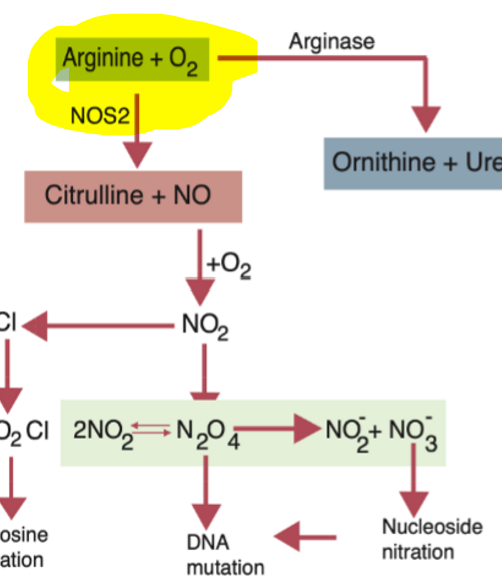
Nitric oxide (NO) production
Produced by the iNOS (NOS2) enzyme using L-arginine and molecular oxygen. Mostly in macrophages.
NO Pathway
PRR induce upregulation of transcription of NOS2
NOS2 active
Uses arginine and oxygen to make NO

Degranulation
Granulocytes (neutrophils, eosinophils, mast cells, basophils) release granules into extracellular environment
Neutrophil Extracellular Traps (NETs)
Sticky DNA networks containing antibacterial molecules released to trap and kill microorganisms extracellularly. Last resort mechanism
NK cell target recognition
Driven by a balance of activating and inhibiting receptors; engaging activating receptors without inhibitors triggers cytotoxicity.
Antibody-Dependent Cell Cytotoxicity (ADCC)
NK cell killing mechanism where antibodies bind target cells, triggering signal transduction and granule release.
Perforin function
Forms pores in the plasma membrane of target cells, similar to complement or defensins.
Granzyme function
Proteases that enter cells via perforin pores and cleave substrates to activate apoptosis.