CH 2010 Exam 3
 Call Kai
 Learn
 Practice Test
 Spaced Repetition
 Match
 Flashcards
 Knowt Play
1/37

There's no tags or description
Looks like no tags are added yet.
38 Terms
What do enantiomers have in common?
Solubility
Boiling point
Angle of rotation of plane-polarized light (only in opposite directions)
Racemic mixture
A mixture with a perfect 50:50 ratio of enantiomers
True of False: A carbon is always achiral if bonded to 2 CH2 groups
False (look past the immediate carbon [same goes for rings])
R configuration
Clockwise 1-2-3
S configuration
Counter-clockwise 1-2-3
Optically active
Rotates plane-polarized light
chiral molecules
Optically inactive
Does not rotate plane-polarized light (achiral), or the angles cancel each other out (racemic)
Z alkene
The highest priority substituents are on the same side of the double bond
E alkene
The highest priority substituents are on opposite sides of the double bond
Are E or Z alkenes more stable?
E alkenes (steric hindrance)
SN1 reactions
2 steps (Loss of LG, Nu- attack)
Rate = k[Rx]
Only 2 or 3 degree (3rd is better)
Weak Nu-
Good LG
Polar protic solvent
Not stereospecific
SN2 reactions
1 step (simultaneous loss of LG and Nu- attack)
rate = k[Nu][Rx]
Never 3rd degree (inc rate towards methyl Cs)
Strong Nu-
Good LG
inversion of configuration
Stereospecific
Prefers polar aprotic solvent
E1 reaction
Two steps (LG leaves, H+ off)
rate = k[Rx]
3 degree substrate
Poor Nu-
Polar protic solvent
Always gives Zaitsev
Bulky groups always trans to each other
E2 reaction
One step (H+ removal and loss of LG simultaneously)
rate = k[Rx][base]
Prefers strong bases and high temps
Never methyl carbon substrate (inc towards 3)
When does an E1 reaction have a third step?
When the carbocation rearranges (H2O or ROH is nucleophile)
Zaitsev product
Attacks beta carbon with less Hs (H+ removal)
DB forms between alpha and attacked beta
small base needed
Hofmann product
Attacks beta carbon with more Hs (H+ removal)
DB forms between alpha and attacked beta
Bulky base needed
inversion of configuration
S→R or R→S (happens in SN2 reactions)
Rules for Nu-s
Anions > neutral
Larger atoms > smaller atoms
Bulky anions are poor
Neutral molecules are poor (except S and P)
Other poor Nu-s
F-: too stingy
H2O and ROH: neutral O
HSO4-: too diffuse
Polar protic solvent vs apolar protic solvent effect on Nu- strength
Polar protic weakens nucleophile
Polar aprotic solvent makes nucleophile more reactive
Polar protic solvent
must have -OH or -NH
Polar aprotic solvent
must have an atom other than C or H
Nonpolar solvent
only made of C and H
When does a reaction occur quickly
Good leaving group
Good nucleophile
Solvent
written below the arrow
water is solvent if it is nucleophile and no other solvent is specified
Chiral molecule
no plane of symmetry
cannot be superimposed on mirror image
Rotates ppl
Achiral molecule
has a plane of symmetry
can be superimposed on mirror image
Meso compound
Has 2 or more chiral carbons
achiral due to plane of symmetry
R/S opposites


Why is this compound chiral?
The carbon ring prevents rotation which creates a lack of symmetry
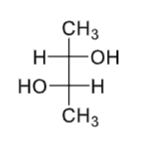
Why is this molecule chiral?
The OH groups are on opposite sides of the projection
Priority rules for R vs. S
Higher atomic number takes priority
High mass isotope wins
Look at next atoms if identical
DB and TB count as 2x and 3x
diastereomers
not mirror images
2 or more chiral carbons
not complete R/S opposites
# of stereoisomer possibilities formula
2n
n = # of chiral carbons
Enantiomers
non superimposable mirror image
comes in pairs
complete R/S opposites
1 or more chiral carbons
Is carbon or hydrogen more electronegative?
Carbon
DMSO
polar aprotic solvent
Rule for Fischer to zigzag projections
same side on Fischer = opposite side on zigzag