into to photosynthesis
 Call Kai
 Learn
 Practice Test
 Spaced Repetition
 Match
 Flashcards
 Knowt Play
1/16

There's no tags or description
Looks like no tags are added yet.
17 Terms
What is photosynthesis? what is the equation?
Photosynthesis is the conversion of light energy into chemical energy by living organisms.
Overall equation: 6 CO2(ag) + 6 H2O(l) + light energy + C6H12O6(aq) + 6 O2(g)
What is the primary function of the leaf? What is the structure of a leaf (+why)
photosynthesis
structure: THIN + BROAD
1) Broad → maximized surface area exposed to sunlight
2) Thin → reduces distance gases (CO2) need to travel
what controls the opening and closing of the stomata? What are the 2 environmental factors that open guard cells?
guard cells control the stomatal openings of the leaf
Two environmental factors that open guard cells:
i) light – exposure to sunlight or other light source (night = less open)
ii) low CO2 concentration in the leaf (if low co2 = more open)
**open = swollen (osmosis)
eg of prokaryotic autotrophs, what are its characteristics? when did it evolve
unlike plants
cyanobacteria do not have: A nucleus, Mitochondria, Chloroplasts
Instead, their DNA is found in a region called the nucleoid, and their photosynthetic machinery is located in internal membrane structures called thylakoids.
Other info:
no membrane bound organelles, unicellular or colonial
lives in many different environments (ocean, fresh water lakes, soil, rocks)
- form blooms when nutrients plentiful and may be toxic to animals
- evolved 2.5-3.4 billion years ago, probably first photosynthetic organism
how are cyanobacteria related to plants (3)
Cyanobacteria and chloroplasts share similarities:
Both contain chlorophyll a (a pigment that absorbs light energy).
Both perform photosynthesis.
Both have internal thylakoid membranes where the light-dependent reactions occur.
what is the endosymbiosis theory (2)
ancestor of cyanobacteria engulfed by ancestor of today’s eukaryotic cells
most likely cyanobacteria ancestor was protected from environment and eukaryotic ancestor obtained food
What are 3 photosynthesis eukaryotes? What are 2 characteristics about them?
algae, some protists, and plants
contain membrane bound organelles → including the chloroplast
chlorophyll is within the chloroplast membrane
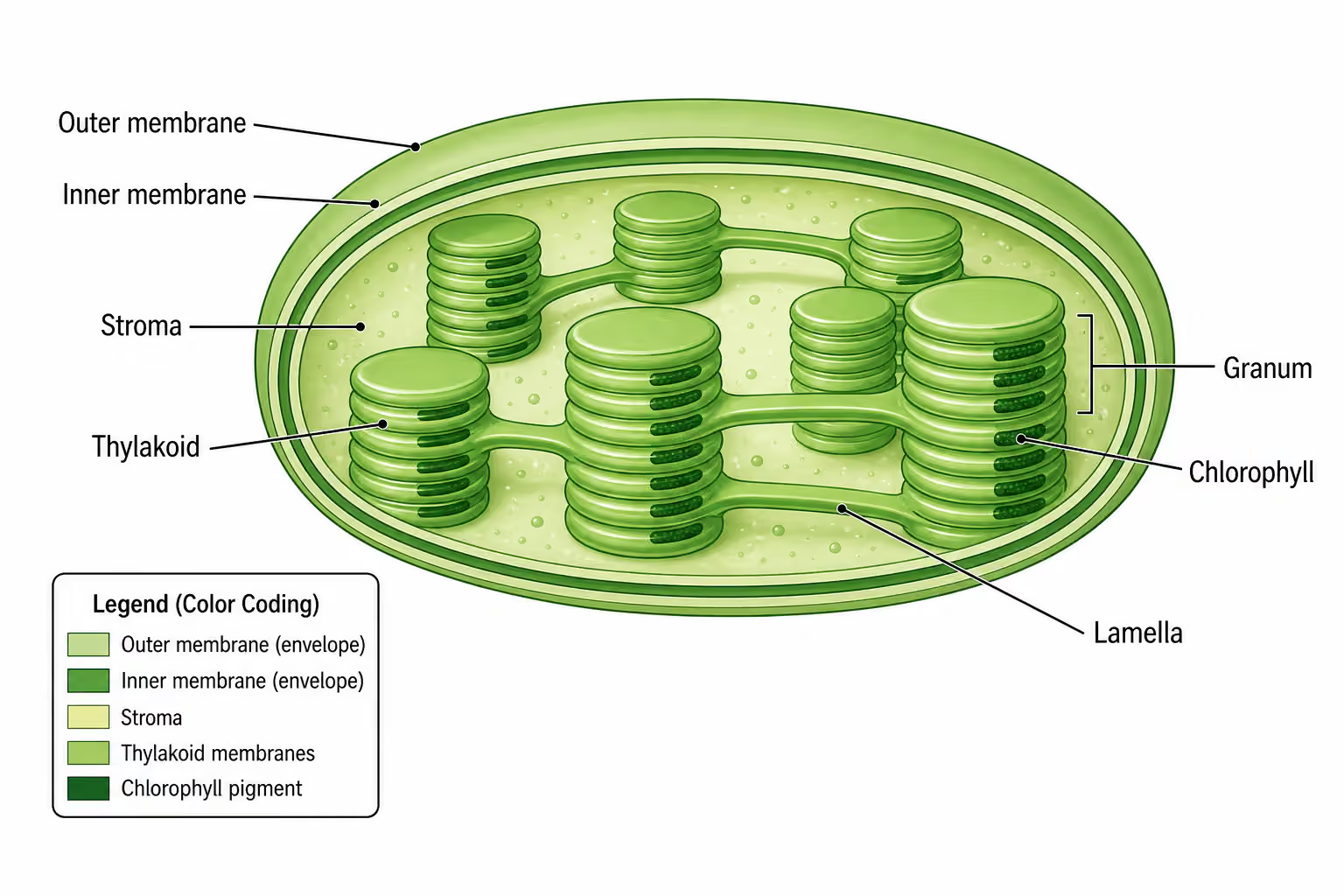
What are the 5 components of the chloroplast?
Stoma
protein rich liquid in the interior of the chloroplast
thylakoid
interconnected flattened membrane sacs forming compartments
thylakoid membrane
photosynthetic membrane (contains chlorophyll)
thylakoid lumen
fluid filled space inside a thylakoid
granum
a stack of thylakoid
lamella
unstacked thylakoids between grana
what are the 2 parts of chlorophyll and their purpose?
Porphyrin ring (head)
Contains a magnesium (Mg) atom in its centre.
Absorbs light energy from the sun.
This light energy excites electrons, helping initiate photosynthesis.
Phyto tail
A long, nonpolar (hydrophobic) tail.
Helps anchor chlorophyll into the thylakoid membrane.

Wat is light (electromagnetic EM) radiation? What are they characterized by? (explain)
is a form of energy that travels as photons
photons are wave packets characterized by their wavelength and energy
photons with short wavelengths (blue) have high energy and photons with long wavelengths (red) have low energy
what is sunlight? How do they form the electromagnetic spectrum?
mixture of photons of different energies
photons of different energies can be separated when passed through a transparent prism in a spectroscope forming the electromagnetic spectrum
When can humans see light
humans can see light between 380nm (violet)-750nm(red), but the rest is invisible
what allows thylakoid to absorb photons?
- thylakoid membranes have clusters of photosynthetic pigments, called photosystems, that absorb photons
What does chlorophyll do? what does chlorophyll a do?
absorb photons in the blue-violet and red regions of the spectrum
reflect photons in the green region of the spectrum
Chlorophyll a:
chlorophyll a is the only pigment that can transfer light energy to the carbon fixation
reactions
Chlorophyll b:
chlorophyll b acts as an accessory pigment, absorbing photons that chlorophyll a absorbs poorly or not at all
What do accessory pigments do?
transfer their energy to chlorophyll a
chlorophyll a and b combined with accessory pigments, absorb light within the entire visible spectrum

What are carotenoids? What do plant carotenoids do? (3)
able to absorb light energy in the range from 400nm to 500nm
plant carotenoids:
absorb light in the blue and green wavelengths, complementing chlorophyll be capturing energy that chlorophyll cannot (broadens the range of light that can be utilized by a plant)
- transfers that energy to chlorophyll
- can have a photoprotective effect by absorbing high intensity light and dissipate the
excess energy as heat

Where does the leaf color come from? Why do leaves appear in diff colors?
leaves appear green because of the high concentration of chlorophyll in the chloroplasts of leaf cells
Diff colors:
leaves appear in different colours in autumn as plants stop producing chlorophyll and
disassemble those already in the leaves; causes the yellow (xanthophylls), red (carotenoids) and orange pigments to become visible