Midterm 2 concepts
 Call Kai
 Learn
 Practice Test
 Spaced Repetition
 Match
 Flashcards
 Knowt Play
1/24

There's no tags or description
Looks like no tags are added yet.
25 Terms
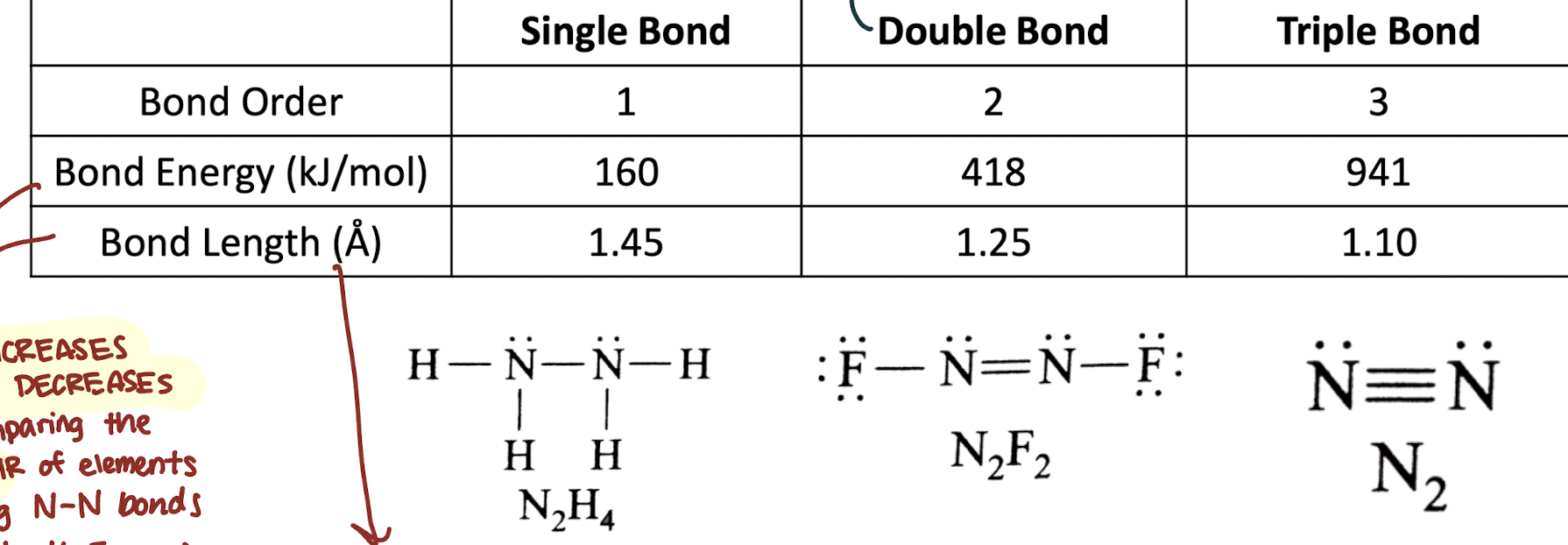
Bond order & trends (bond energy/length as bonds increase)
The number of bonds shared between two atoms
Bond energy increases as length decreases (ONLY when comparing the same pair of elements across different molecules)
Bond length decreases as bond order decreases
Covalent Nomenclature Rules and prefixes
more electropositive element goes first, more electronegative comes second and ends in “ide”
Greek prefixes are used for the number of atoms (but you don’t use mono on the first element)
ex: dinitrogen pentoxide

Acid definition and Acid Nomenclature
(and nomenclature without oxygen)
Acid: covalent molecules that have hydrogen attached, but when placed into water ionize
“-ate” becomes “-ic acid”
“-ite” becomes “-ous acid”
When theres no oxygen present = “hydro…-ic acid”
Duet rule
Hydrogen and Helium only need 2 electrons to fill their 1s orbital
A lone pair of electrons has ____ repulsion than bonded
Greater
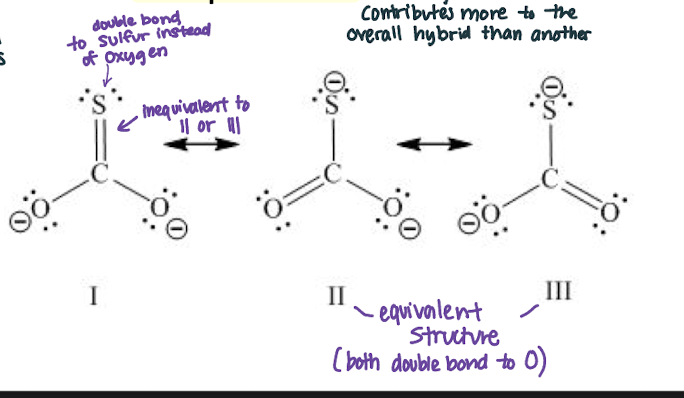
Resonance Forms
A true structure is a weighted average of 2+ Lewis dot structures
Valid resonance forms have the same # of electrons and full octets but are different due to interchanged multiple bonds/lone pairs
all atoms in exact same positions
resonance forms may be equivalent (identical in stability and formal charges) or inequivalent
Theoritical, Actual, Experimental yield
Theoretical yield - the amount of product expected
actual - real amount obtained
experimental % yield: (actual yield)/(Theoretical yield) * 100
Ion stabilization in solid/solvated states
Bare ionic charges are not electrically stable
in solid state, opposite charges stabilize one another
when solvated, the ions are stabilized with interactions with solvent dipoles (usually water) (hydration shells)

Strong electrolytes (behavior, conductivity, types)
completely ionize in solution (100% of compound splits into free-floating electrons)
high conductivity
Soluble salts (ionic compounds with low charges [+1/-1, +2/-1])
strong acids HCl, HBr, HI, HNO₃, HClO₄, HClO₃, & H₂SO₄
strong bases (group 1 and 2 hydroxides)
Weak electrolytes (behavior, conductivity, types)
partially ionize in solution (<5%)
weak conductivity due to presence of few ions
all acids that are not strong and all bases that are not hydroxide
Ionization
To ionize means a neutral molecule splits apart or reacts to produce charged ions (+ and - ) that can float freely in water.

Strong vs Weak electrolyte dipole/ion movement
for strong acids and bases, (and weak salts) the water's dipoles (positive hydrogen and negative oxygen) will surround the individual ions since the ions are really strong, completely splitting them apart into smaller charged ions.
for weak acids and bases, the acid/base molecules have to give or take an H+ ion to/from water, making either (OH-) or H_3O+ (aka H+), forming two seperate ions using water. The newly created ions are now swarmed by water!
identifying Strong bases Vs. Weak bases Vs. Soluble salts
Strong base:
Metal + Hydroxide (OH-), Group 1 and 2 metals
Weak base:
Covalent Nitrogen compounds (NH₃, NO₂⁻) or weak acid anions
Soluble salt:
Metal + nonmetal (with relatively low charges)
Acid Vs Base
Acids are proton donors, release/donate H+ into water to increase H+ (H₃O⁺)
Bases are proton acceptors, either drops OH- directly into solution or takes H+ from water to make OH-
Molecular Vs. Full Ionic Vs. Net Ionic Equations
Molecular: shows all species/everything present and does not seperate ions (with phase)
Full Ionic: shows all species & seperates everything aqueous in solution into soluble ions (know solubility rules
Net Ionic: Shows only reactive species (any ions on both sides of the full ionic equation cancel out- spectator ions)

Arrhenius Acid/BAse
Arrhenius acid- generates H+ in an aqueous solution
Arrhenius base- generates OH- in an aqueous solution
Bronstead Lowry acid/base
Bronstead Lowry acid: H+ donor
Bronstead Lowry base: H+ acceptor
Neutralization reaction
The combination of an acid and a base always generates a salt (ionic substance) and usually produces water as well.
Oxidation Number rules
Atoms in pure elements are 0
Atoms in ions have #s equal to their ionic charge
In binary compounds/polyatomic ions, the more electronegative atom has an oxidation number based on its common valence
all atoms of the element in a compound/ion have the same oxidation #
Group ½ atoms always have oxidation numbers +1/+2 respectively
Oxygen is always -2, unless its with a peroxide (having a single covalent bond connecting two oxygen atoms, eg H₂O₂)
Hydrogen is always +1 unless paired with a metal (then it’s -1)
When strong acids + bases meet in a solution, it results in what? what does it produce? With what?
A neutralization reaction, which always produces water and a salt.
the salt is made from the cation of the base and anions left over from the acid
Driving force in aqueous ionic reactions (or double displacement reactions)!
the removal of ions from aqueous
solution through the formation of a solid, liquid, or gas