Chapter 11.2: Prokaryotic Gene Regulation Occurs Primarily at the Level of Transcription
 Call Kai
 Learn
 Practice Test
 Spaced Repetition
 Match
 Flashcards
 Knowt Play
1/11

12 Terms
Sigma factors
Transcription factors present in prokaryotes, with expression changing with the environment
Enables multiple genes to be expressed simultaneously

Beta-galactoside
A disaccharide containing galactose linked to glucose
Includes the compound lactose
Induces beta-galactosidase and permease levels to increase following mRNA transcription
Permease
A carrier protein in the bacterial cell membrane that moves lactose into the cell
Beta-galactosidase
An enzyme that hydrolyzes lactose to glucose and galactose
Operon
A cluster of genes with a single promoter
Seen in prokaryotic responses to lactose producing three mRNA strands via one promoter, termed lac

Lac operon
The operon that encodes the three lactose-metabolizing proteins in prokaryotes
Has variable rates of efficiency depending on environment as an inducible operon
Contains an operator that controls transcription of the genes following promotion, with a repressor negatively regulating production
Activation occurs in the presence of allolactose, a lactose byproduct, which allosterically binds to the repressor
Also requires the absence of glucose
Operator
A transcription factor binding site that reduces transcription rates when bound to a repressor
Typically examples of negative regulation when the repressor is bound, only allowing activation following a change of conditions (such as the addition of allolactose in prokaryotes)
Regulatory gene
A gene that encodes a regulatory protein
One for the regulatory protein of the lac operon is located upstream of it
Structural gene
Any gene that encodes a protein that is not directly involved in gene regulation
Seen with the three lactose-metabolizing enzymes due to their lack of regulatory power

Trp operon
The operon that encodes five enzymes that catalyzes the synthesis of tryptophan from a precursor, as a repressible operon
Repression requires the presence of a co-repressor, which binds to the operon’s repressor to change shape and enable binding as a form of allosteric regulation
Here, tryptophan serves as the co-repressor, due to it always being needed until sufficient levels are reached
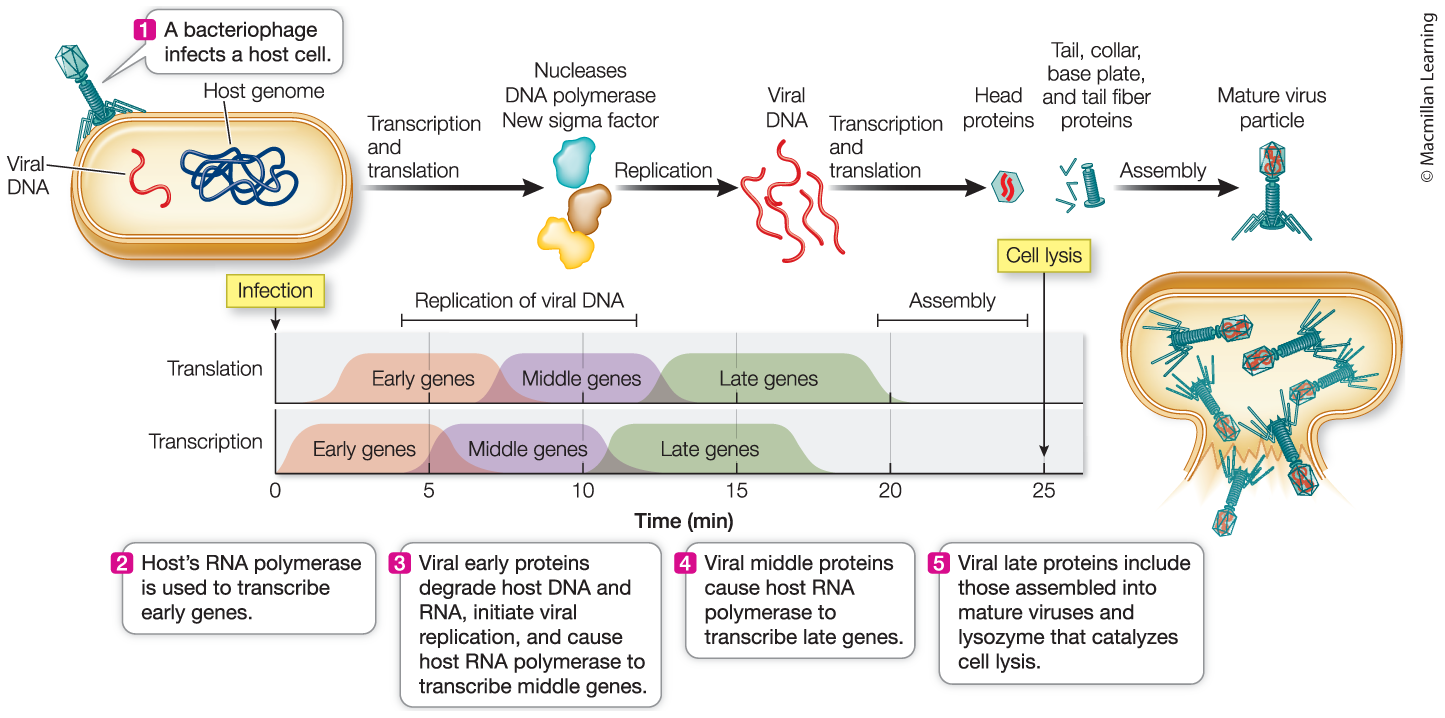
Lytic cycle
This is triggered following the injection of viral genetic material into a cell, where viral particles are immediately produced and the cell lyses
Lysogeny
A method of viral reproduction where the viral genome is incorporated into the host and replicated with the host genome, remaining dormant until an environmental signal triggers the lytic cycle