LS7A PCRQs - AOL 1 - Summation
 Call Kai
 Learn
 Practice Test
 Spaced Repetition
 Match
 Flashcards
 Knowt Play
1/36

There's no tags or description
Looks like no tags are added yet.
37 Terms
An ionic bond occurs due to:
an attraction of opposite charges
The structural formula for hydrogen gas (H2) is represented as H–H. The dash (–) represents a(n):
chemical bond
A molecule of water, or H2O, is the result of ______ bond forming between an Oxygen (O) atom and two Hydrogen (H) atoms.
a polar covalent
A woman's doctor tells her to gargle with salt water. She stirs a tablespoon of salt into a cup of warm water and watches the salt dissolve.
The partial positive charges on hydrogen atoms in water molecules are attracted to chlorine ions, and the partial negative charges on oxygen atoms in water molecules are attracted to sodium ions.
The unique properties of water are due to the ______ of water molecules and the ability of water to form ______ with other water molecules and with other polar molecules.
polarity; hydrogen bonds
Water is able to dissolve many compounds as a result of which fact?
the fact that water molecules are polar
Which of the statements is true regarding a polar molecule?
A polar molecule is hydrophilic and will dissolve in water.
T/F: Water is neither hydrophilic nor hydrophobic, because these terms only define the interaction of other molecules with water molecules.
False
The ability of atoms to attract electrons is referred to as:
electronegativity
Of the following types of bonds or interactions between atoms in aqueous solutions, which is the WEAKEST?
van der Waals forces
All cells have:
genetic information
The lipid components of cellular membranes often include:
phospholipids and cholesterol
The plasma membrane is composed of a phospholipid bilayer and associated proteins.
What else is commonly found in the plasma membranes of animal cells?
cholesterol
The interior region of a phospholipid bilayer is characterized as:
hydrophobic and non polar
If cells had single-layer membranes like micelles, how would the structures of transmembrane proteins be affected?
Transmembrane proteins would possess a hydrophobic region in the cell interior and a hydrophilic region in the extracellular space.
How do eukaryotic plant and animal cells differ from one another?
Animal cells do not have chloroplasts and cell walls, and plant cells do.
Which eukaryotic cell structure plays a role in generating energy for the cell?
mitochondria
A bacterial cell, a plant cell, and an animal cell have which component in common?
cytoplasm
Which eukaryotic organelle is associated with the storage of the cell's genetic material?
nucleus
Some plant cells create a high concentration of protons outside the cell to move solutes, such as sucrose, across the plasma membrane into the cell where the sucrose concentration is already relatively high. This type of transport is an example of:
secondary active transport
Which molecules can easily diffuse across a plasma membrane?
non-polar gases like O2 and CO2
The random movement of solute molecules within a solution is referred to as:
diffusion
Why does secondary active transport of molecules across a membrane require an electrochemical gradient?
An input of energy is needed to allow the movement of molecules from an area of low concentration to one of higher concentration
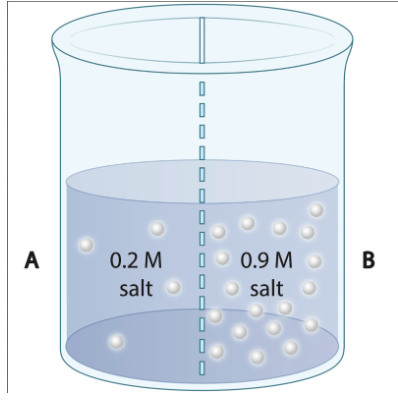
A beaker contains two solutions of salt dissolved in water. The two solutions have different concentrations of salt (measured by molarity, M) and are separated by a membrane that is permeable to water but not salt. Which statement is true about the diffusion of these solutions?
There will be a net movement of water from side A to side B and no movement of salt.
The plasma membranes of some plant cells use transport proteins to move protons out of the cell against their concentration gradient. This is an example of:
active transport
Anabolic pathways of metabolism are pathways that
build complex molecules from simple ones
Which of the processes requires net energy input in the form of ATP?
anabolism
A ball has potential energy when it is sitting still ______ of the stairs
All of these choices are correct.
Which of the choices is considered a form of kinetic energy?
All of these choices are correct.
A molecule of ATP has a great deal of ______ energy.
potential
Nonspontaneous reactions have a _____ ΔG
positive
Reactions in which there is a negative change in free energy (-ΔG) are:
spontaneous and exergonic.
Which statement is true about endergonic reactions?
The products of endergonic reactions have more free energy than the reactants.
Gibbs free energy is defined as:
the amount of energy available to do work.
What are the functions of an enzyme?
to increase the rate of a specific reaction & to lower the activation energy for the reaction
You notice that a the rate of chemical reaction catalyzed by an enzyme in your system is too high.
You want to slow down the reaction. What do you do?
add an inhibitor for the enzyme that catalyzes the reaction
Which of the statements is true of noncompetitive inhibitors of an enzyme?
Noncompetitive inhibitors do not prevent the substrate from binding the enzyme.