3.2.5 transition metals
 Call Kai
 Learn
 Practice Test
 Spaced Repetition
 Match
 Flashcards
 Knowt Play
1/40

There's no tags or description
Looks like no tags are added yet.
41 Terms
how can the efficiency of heterogenous catalysts be reduced
They can be poisoned by impurities, often present in the raw materials used. these bond very strongly to the catalyst surface and block it e.g. the activity of Fe in the haber process is blocked by sulfur
⭐️homogenous cannot be poisoned
what's used as a heterogenous catalyst in the manufacture of methanol from methane
Cr₂O₃
what's an example of an adaptation of a catalyst to have a large surface area
honeycomb structure
examples of heterogeneous catalysts and their equations
Fe catalyst in haber process
N₂(g) + 3H₂(g) ⇌ 2NH₃
2. V₂O₅ in the contact process
2SO₂(g) + O₂(g) ⇌ 2SO₃(g)
SO₂ oxidised to SO₃ by V₂O₅
SO₂ + V₂O₅ ---> SO₃ + V₂O₄
re-oxidation:
V₂O₄ + ½O₂ ---> V₂O₅
what are the problems with a heterogenous adsorbing too strongly or weakly, and what's the perfect ideal catalyst
if it adsorbs too weakly (e.g. silver), the reactant molecules don't spend enough time in contact with one another
it it adsorbs too strongly (like tungsten), the products don't leave the metal surface quickly enough and this slows the reaction down
the most useful catalysts are the ones that adsorb moderately (transition metals in the middle) as strength decreases across the periodic table
how do reactant molecules bind to the surface of a heterogenous catalyst
they bond to the surface of the metal by van der waals forces (physical adsorption)
they can sometimes form a covalent bond with the metal (chemisorption)
mechanism of a heterogenous catalyst reaction
the metal provides an active site
molecules bond to the surface of the metal (adsorption)
the product is formed and released (desorption)
what's auto-catalysis
catalysis of a reaction by one of its products
how does a catalyst work
lowers the Ea of a reaction by providing an alternative reaction pathway
what's a catalyst, and whats the 2 types
a chemical that can speed up the rate of a reaction without being chemically changed or used up
heterogenous= catalyst and reactants are in different phases, and the reaction occurs at the surface of the catalyst
homogenous= catalyst and reactants are in same phases
Why transition metals show variable oxidation states
The energy required to remove 3d electrons is sometimes recovered in bonding. Because 4s and 3d sub-levels are very close in energy, multiple electrons can be lost without requiring unfeasible amounts of energy.
Acidic vs. Alkaline conditions:
Acidic solution: Favours the reduction of high oxidation states to lower ones (oxidising agent).
Alkaline solution: Favours the oxidation of lower oxidation states to higher ones (reducing agent).
why is the titration acidified, and what's it acidified with
MnO₄⁻ only acts as an effective oxidizing agent in acidic conditions (sulfuric acid).
Never use HCL: Chloride ions are reducing agents and will be oxidized by MnO₄⁻ to Cl₂ which would ruin the titration volume and release toxic chlorine gas.
why is KMnO₄ put in the burette in the titration
1. Its intense colour makes it difficult to read the graduation marks if it's in the conical flask.
2. Putting it in the flask causes slow decolorisation issues; the burette allows dropwise addition with immediate color loss until the end-point.
starting and ending colours for standard transition metal titrations, and their overall equations:
MnO₄⁻
Cr₂O₇²⁻
intense purple MnO₄⁻ ---> colourless Mn²⁺
5e⁻ + 8H⁺ + MnO₄⁻ ---> Mn²⁺ + 4H₂O
5Fe²⁺ ---> 5Fe³⁺ + 5e⁻
5Fe²⁺ + 8H⁺ + MnO₄⁻ ---> 5Fe³⁺ + Mn²⁺ + 4H₂O
⭐️end point: faint pink colour- excess MnO₄⁻ when reducing agent runs out
2.
orange Cr₂O₇²⁻ ---> green Cr³⁺
Cr₂O₇²⁻ (aq) + 14H⁺ (aq) + 6e⁻ ---> 2Cr³⁺ (aq) + 7H₂O (l)
Vanadium Redox States & Colours
Oxidation state. ion formula. colour
+5 VO₂⁺ yellow
+4 VO²⁺ blue
+3 V³⁺ green
+2 V²⁺ violet
(yellow bees gather vines)
⭐️All vanadium(V) compounds can be reduced step-by-step down to +2 using excess zinc in acid
Colour sequence during reduction:
yellow --> blue --> green --> violet
What are the 2 uses of colourimetry?
finding the concentration of an unknown solution
(absorbance is proportional to concentration)
1. Prepare a range of known concentrations of the ion and add a suitable ligand in excess to intensify the colour.
2. Place a sample in a cuvetteinside a colorimeter and select the filter that gives the maximum absorbance.
3. Measure and record the absorbance for each solution.
4. Plot a calibration curve of absorbance against concentration.
5. Mix the unknown solutionwith an excess of the same ligand.
6. Measure its absorbance using the exact same filter.
7. Determine the concentration of the unknown solution using the calibration curve.
2. finding the formula of a transition metal complex
-use the ratio of the volume of the transition metal ion compared to the ligand, and then the point at which the absorbance stops changing is the formula.
why will different compounds of the same metal have different colours
in the presence of ligands, d-orbitals split by DIFFERENT amounts of energy
d-electron absorbs a different amount of energy/light, gets excited and moves to a higher d-orbital
a DIFFERENT absorbed light energy is missing from the transmitted light
how do you calculate the energy absorbed by a d-electron
ΔE = hv
E= energy absorbed
v= frequency of light absorbed
h= planks constant
why are transition metal solutions coloured
in an isolated transition metal ions/atom, all the d-orbitals have exactly the same energy
in the presence of ligands, the d-orbitals split in energy
d- electrons absorb light and get excited to higher energy d-orbitals
the absorbed light is missing from the light transmitted
what's an isomer
same structural formula, different arrangement of bonds in space
What are the shapes of ions with a coordination number of:
6
4
2
6= octahedral
4= tetrahedral (except for cisplatin which is square planar)
2= linear
Explain the poisonous effect of carbon monoxide in terms of Fe incorporating a porphyrin ring
The Fe²⁺ bond to O₂ is weak and oxygen is a bad ligand, meaning oxygen can easily be given up to cells. Better ligands than oxygen can bond irreversibly to the iron and destroy haemoglobins oxygen-carrying capacity. This explains the poisonous effect of carbon monoxide.
what's a bidente ligand
a species (ligand) which can donate lone pairs from 2 atoms to form 2 co-ordinate covalent bonds
why do chloride ions only have 4 ligands bonded to it rather than 6
chloride ions are large
chloride ions are negatively charged
what's the definition of the co-ordination number
the number of co-ordinate bonds to the central metal atom/ion
what 2 features must metal cations have to form complex ions
high charge density (small ion, high charge)
empty orbitals of low energy (so they can accept lone pair from ligands)
what's a ligand
an ion/molecule that donates a pair of electrons to a central transition metal ion to form a co-ordinate bond
what's a co-ordinate covalent bond
a shared pair of electrons in which both electrons come from 1 molecule/atom in a covalent bond
what's the 4 features of transition metals
complex formation
coloured ions
variable oxidation states
catalytic activity
why is zinc not a transition metal
it's d orbital is already full
example of autocatalysis , and why is this reaction slow at first
Mn²⁺ behaves as a catalyst and therefore the reaction is slow at first but is much faster after the products are formed. originally the 2 ions are negative and have mutual repulsion, meaning the Ea is very high. When the catalyst is formed its +ve meaning it can react with the -ve ions very easily.

equation for Fe²⁺ and Fe³⁺ catalysing the reaction between S₂O₈²⁻ and I⁻ (HOMOGENOUS CATALYST)


which one has E-isomerism and which one has Z-isomerism

examples of E and Z isomers in complex metal ions (cisplatin and transplatin)
cis= Z
trans= E
⭐️the anticancer drug is cisplatin, not transplatin

diagram of cisplatin, what's its shape and what's it used in

diagram of octahedral, tetrahedral, square planar and linear complex metal ion shape

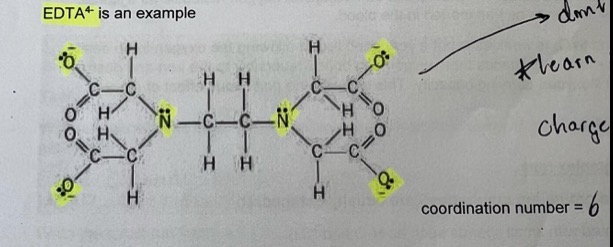
Structure of EDTA⁴⁻ (remember where the LP are located)
(multidente ligand- capable of forming more than 2 co-ordinate bonds with the central transition metal ion)
examples of complex ions:
(include charges and shapes)
Fe surrounded by H₂O
Co surrounded by Cl⁻
Ag surrounded by NH₃

2 examples of bidente ligands
ethandioate (C₂O₄²⁻)
2. 1,2-diaminoethane (H₂NCH₂CH₂NH₂)

Structure of Fe incorporating a porphyrin ring (remember where the LP are located)
(the porphyrin ring is a multidente ligand- capable of forming more than 2 co-ordinate bonds with the central transition metal ion)

what’s the meaning of the chelate effect
a bi/multi dente ligand replaces a monodentate ligand
the resulting complex is more stable as theres an increase in entropy