dental science - unit 3
 Call Kai
 Learn
 Practice Test
 Spaced Repetition
 Match
 Flashcards
 Knowt Play
1/38

Earn XP
Description and Tags
the oral cavity
39 Terms
Anterior
in front
Posterior
behind
Medial
toward the middle
Lateral
away from the middle
Superior
above
Inferior
below
Maxilla
where the top or maxillary teeth are are anchored
Mandible
where bottom or mandibular teeth are anchor
Labial
surface of max and man teeth closest to lip
Buccal
surface of max and man teeth closest to inner cheek
Lingual
surface of man and max teeth closest to the tongue
Facial
surface closest to face
Mucosa
moist tissue linings of the oral cavity, respiratory and digestive system
What are the landmarks of the lips?
philtrum
tubercule
labial commissures
labiomental groove
labial frenum
buccal frenum

Describe the boundaries of the oral cavity.
Starts at the lips, ends at the palatine
Bounded by the lips anteriorly
Cheeks laterally
Floor of the mouth inferiorly
Oropharynx posteriorly
Palate superiorly
Identify the landmarks associated with the vestibule
Space between the teeth and inner mucosal lining of lips and cheeks
Consisting of:
Vestibular fornix (includes mucobuccal fold and mucolabial fold)
Mucolabial fold - anterior segment of maxillary and mandibular arches where labial mucosa joins the alveolar mucosa
Mucobuccal fold - alveolar, buccal mucosa joins with cheek mucosa
Identify the landmarks associated with the oral cavity proper
Space on the tongue side within upper and lower dental arches
Consisting of:
Hard palate
Soft palate
Tongue
Floor of mouth
Hard & soft palate landmarks
Incisive papilla
Palatine rugae
Uvula
Palatine tonsil (tonsils)
Palatine fovea
Palatine raphe (median raphe)

Oral cavity diagram

Tongue diagram

Floor of tongue diagram

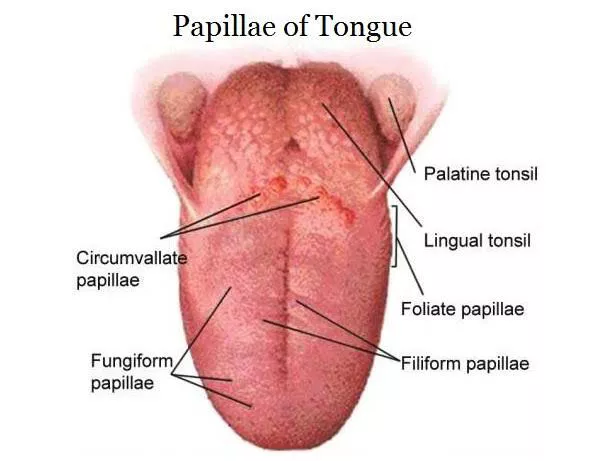
Define circumvallate papillae (part of the tongue)
Big, mushroom-shaped, arranged in a V-shape at the back of the tongue.
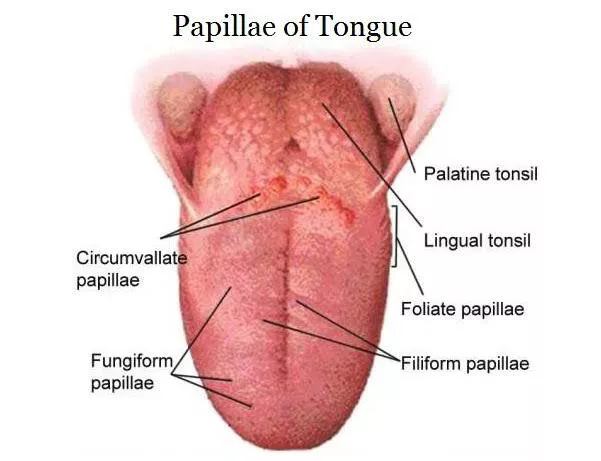
Review: Define foliate papillae (part of the tongue)
Low, parallel folds found on the sides/back of the tongue.
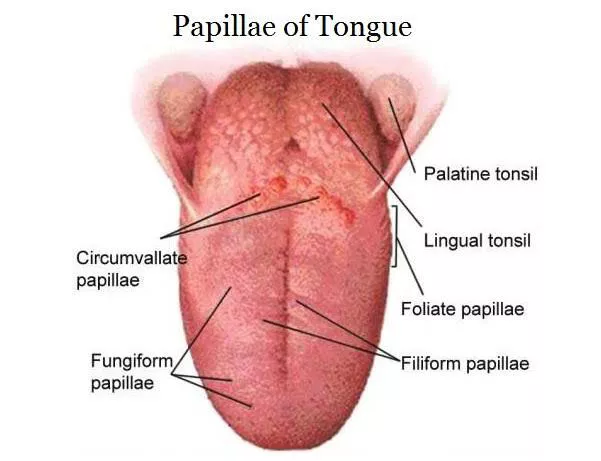
Define filiform papillae (part of the tongue)
Tiny, hair-like projections covering the front ⅔ of the tongue; give it a rough texture.
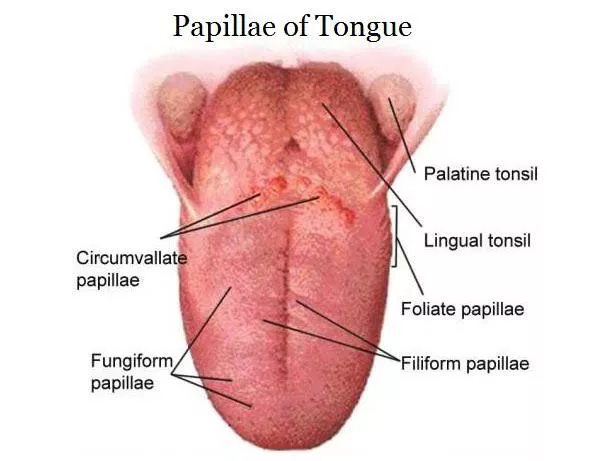
Define fungiform papillae (part of the tongue)
Mushroom-shaped, fewer in number, mainly toward the tip of the tongue; appear as small red dots.

Name & identify the location of major salivary glands
Parotid
the largest, and provides 25% the total volume of saliva
location: just below & in front of the ear
secretion exits from the buccal mucosa, through the parotid duct od Stenson’s duct
Submandibular
the second largest, & provides 60-65% of the total volume of saliva location
location: below & toward the posterior part of the body of the mandible
produces sereous & mucous fluid
Sublingual
the smallest, & provides 10% of the total volume of saliva
location: in the anterior floor of mouth next to the mandibular canines
function is mostly mucous secretion

Name & identify the location of minor salivary glands
Labial glands: Located in the upper and lower lips.
Buccal glands: Located in the inner lining of the cheeks.
Palatine glands: Located in the soft palate and hard palate.
Lingual glands: Located in and around the tongue (including the anterior, mixed, and serous Von Ebner's glands near the back papillae).
Molar glands: Located near the molar teeth in the back of the cheek

Commissural pits
bilateral or unilateral pits at corners of the mouth

Fordyce granules
misplaced collections of sebaceous glands

Macroglossia
enlarged tongue

Ankyloglossia
short lingual frenum allowing tongue minimal movement

Fissured tongue
numerous small furrows or grooves on dorsal of tongue

Geographic tongue
looks like different countries, round smooth, shiny, red areas scattered

Black hairy tongue
hairy appearance due to overgrowth of filiform papillae

Linea alba
white line along buccal mucosa (where we bite)

Diastema
space located between anterior teeth

Palatal tori
bony growths that form on the center of the hard palate
found in 20% of population often inherited

Mandibular tori
-found in 7% of the population found in linguinal surfaces around the premolar area (super white on radiograph b/c it’s dense)

Cleft lip and/or palate
genetics/ birth defect where union of lip and/or palate is incomplete