Chapter 8: Bacterial Genetics and Biotechnology pt 1
 Call Kai
 Learn
Learn Practice Test
 Spaced Repetition
 Match
Match Flashcards
 Knowt Play
1/30

There's no tags or description
Looks like no tags are added yet.
Name | Mastery | Learn | Test | Matching | Spaced | Call with Kai | Chat |
|---|
No analytics yet
Send a link to your students to track their progress
31 Terms
Describe the traits of bacterial DNA.
DNA organized in nucleoid throughout the cytoplasm
small genome
circular chromosome (usually), although may have multiple circular and linear chromosomes
chromosomes replicate and segregate during cell growth
Describe the traits of eukaryotic DNA.
DNA contained in nucleus, enclosed by nuclear membrane
wide range of genome size, including very large
linear chromosomes (in nucleus); mitochondria (derived from bacteria) have one circular chromosome
chromosomes segregate by mitosis and meiosis after replication during interphase
What are genome, chromosomes and plasmids?
genome - complete set of genetic info in a cell, double stranded DNA is the genetic material, can be structurally diverse
chromosomes - essential genes, circular, single copy
plasmids - extrachromosomal DNA in bacteria, non-essential but useful w/ antibiotic resistance, circular and copy number varies based on plasmid
What are the differences between the eukaryotic genome and the bacterial genomes?

Bacterial genomes
coding DNA blocked together
no nucleus
can replicate and divide/continuous growth and division
Eukaryotic Genomes
has non-coding btwn coding
in nucleus
has interphase replication and short time in mitosis
What is DNA/RNA made out of? What is the structure?
nucleotides - 5 carbon sugar, phosphate grp and nucleobase
DNA - encodes genetic information, AGCT
RNA - transfer of information from gene to protein, AGCU

antiparallel - chemical directionality (5’ and 3’) two strands have opposing directionality
complementary - specific base pairing btwn strand - H-bonds, T=A, C=G (triple bond), in RNA its U=A
helical - double stranded helix, RNA is often single stranded, but can also be double stranded
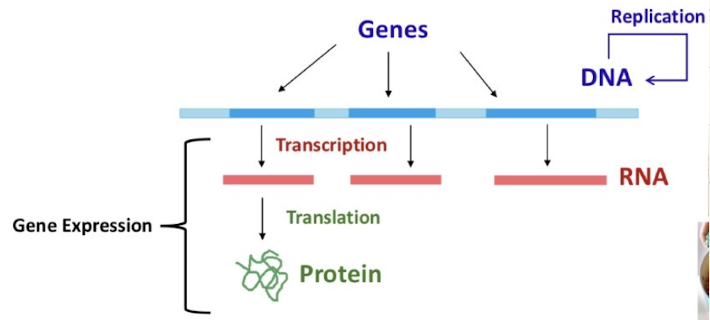
What is the central dogma?
the flow of genetic information is in 1 direction

DNA replication - process of copying the genome
Genes - functional units in the genome/chromosome used for gene expression (making RNAs and protein)
What happens in DNA replication?
before cellular division
duplicated DNA molecules - each daughter cell receives one copy
“vertical” gene transfer (parental to daughter)
plasmids replicated independently of the chromosome
Steps of DNA Replication: initiation, elongation, termination
DNA Replication: How is DNA made?
DNA polymerase - uses DNA as a template along w/primer to synthesize DNA
can only synthesize 5’ to 3’
very accurate w/ proofreading function
Primase - makes primer for NRA
Origin of Replication (Ori) - site in genomes where DNA polymerase and other replication proteins bind and begin replication (replicates in both direction)
Terminus (ter) - site where replication ends


DNA Replication: Initiation
unwind the helix at origin - creates replication bubble
add in RNA primer: primase
load the enzyme for synthesis: DNA polymerase (cannot start by itself needs primase)

DNA Replication: Elongation
adding base and reading template strand to put in complementary base using DNA polymerase
adding in dNTP (dATP, dTTP, dGTP or dCTP)
release pyrophosphate
form a phosphdiester linkage
goes in both direction so two new strands of DNA are replicated at each fork

DNA Replication: Termination

occurs at Ter sites, replication complete
Properties of DNA replication: Bidirectional
bidirectional - replication forks move in both directions form the origin - fixed sequence in the genome
two new strands of DNA are replicated, one at each fork
bacterial have circular genomes
replication forks meet at a terminus and process is completed

Properties of DNA replication: Semiconservative
semiconservative - each daughter cell receives DNA that is made up of old (conserved) strand and a newly synthesized DNA
DNA polymerase uses both strands of the DNA meaning both strands are copied
old strand is a template for new strand and uses complementary base pairing to make a complementary strand that is antiparallel: A=T and G=T

Properties of DNA replication: Semi-discontinuous
semi-discontinuous - a continuous portion (leading strand) and a discontinuous portion (lagging strand)
5’ to 3’
replication forks are moving bidirectional
leading strands: continuous so forks and replication are moving in the same direction
lagging strand: discontinuous short “Okazaki” fragments
DNA ligase joins the fragments

What happens in transcription?
RNA Polymerase: uses DNA as a template to make RNA
needs a DNA template strand
5’ to 3’
adds RNA bases so its complementary and antiparallel to DNA template
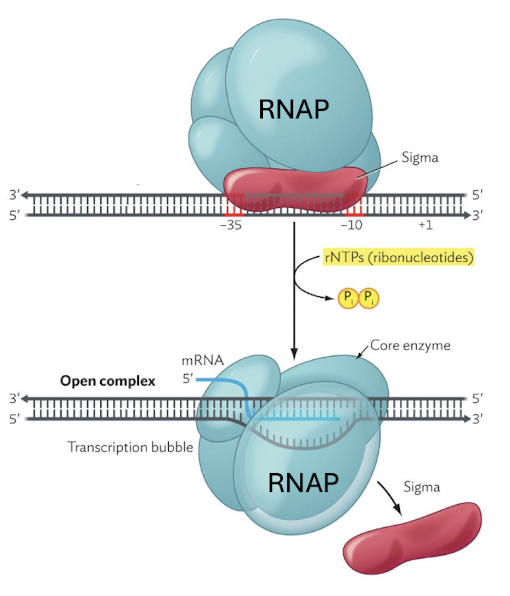
Promoters: sites in genomes where RNAP binds/ starts
Terminators: sites where RNAP is released/ end

What is the template strand and what is the coding strand?
template strand: used by the RNA polymerase to build the RNA transcript which is complimentary and antiparallel
coding strand (non-template): the exact same nucleotide sequence as the resulting RNA transcript, except that thymine (T) in the DNA is replaced by uracil (U) in the RNA and has ribose sugar
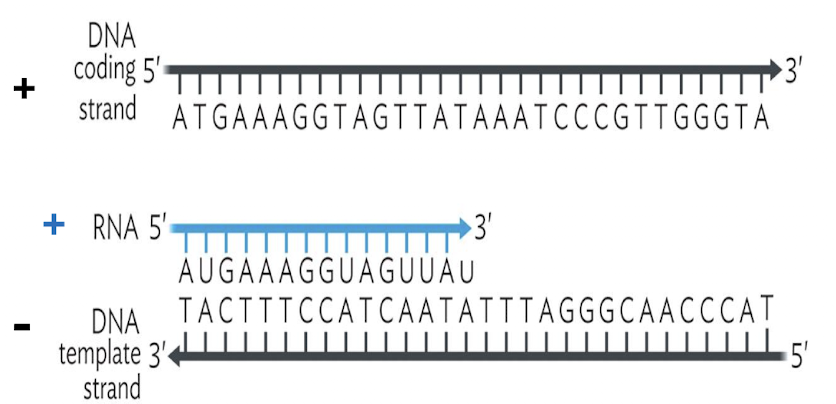
Transcription: Initiation requires RNAP holoenzyme - Sigma Factors
Sigma factors - part of RNA polymerase (RNAP)
recognizes promoter and bind the DNA
bacteria code for several different Sigma Factors
different sigma factors recognize different promoters, different genes are expressed/made into proteins
useful for global changes in gene expression such as large physiological changes across the cell

What do eukaryotes use instead of sigma factors?
transcription factors
TATA box recruits other transcription factors and brings RNA polymerase
need it help to find binding spots

How does RNA Polymerase know which strand to use as the template strand?
DNA strands are complementary, NOT identical
different info is encoded in each strand
either strand can be used as the template
location and orientation of the promoter sequence is important
DNA template strand read 3’ to 5’

Transcription: What is an operon? How is it different in eukaryotes?
collection of adjacent genes that are all transcribed into a single RNA and under the control of a single promoter
one promoter for 2 or more genes transcribed
mostly found in bacteria
eukaryotes are monocistronic one transcript, one gene transcribed

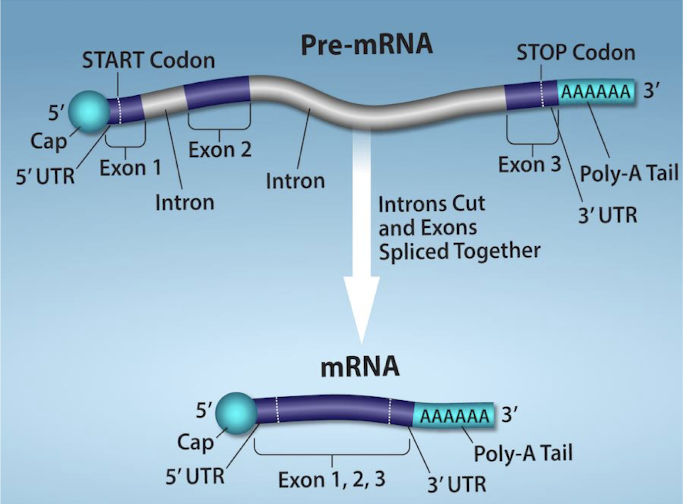
What is the post transcriptional processing in eukaryotes?
add 5’ cap
add poly A tail at 3; end
splicing - intron regions removed from the mRNA before the next step (e.g. translation)
one transcript per gene
Transcription: What are the types of RNA products?
mRNA messenger (yes protein)
rRNA ribosomal (no protein)
tRNA transfer (no protein)
sRNA small regulatory

What happens in translation?
synthesis of peptides (polypeptides) from a code found on an RNA template - translate nucleotides into amino acids
ribosomes: enzymes that catalyzes peptide bond formation btwn amino acids
large complex of proteins and ribosomal RNAs (rRNA)
enzymatic function done by rRNA: ribozyme
mRNA serves as the template 5’ to 3’
maintains the correct reading frame and aligns amino acids by aligning the tRNA

Translation: What is tRNAs role?
delivers correct amino acids to the ribosome
anticodon on tRNA recognizes codon on mRNA
anticodon is complementary to codon and antiparallel
code is triplet (3 nucleotides and 1 amino acids)

Translation: What are the 3 steps?
Initiation - ribosomal binding sites, initiation factors
elongation - elongation factor
termination - occurs at a STOP codon
no tRNA or amino acids for stop codons
termination factors
What is genetic code and how do you read it?
genetic code - codons in mRNA specify amino acids, triplet code
has 64 codons
4 base options at each of 3 codon positions
some amino acids have >1 codon: degenerate code
3 codons specify no amino acids: STOP codons

Translation: Reading Frame
one of 3 ways the code can be read

Open Reading Frame (ORF, coding region):
region on the mRNA btwn START and STOP codons
code for the correct peptide is in the ORF, in the correct reading frame
How is translation in prokaryotes and in eukaryotes different?
Bacterial
operons —> polycistronic mRNA
Ribosomal bind sites (RBS): special sequence of bases that help tell the ribosome where to align
can have multiple RBSs per transcript
puts the ribosome in the correct spot to start at an AUG codon
Eukaryotes — generally have monocistronic mRNA
ribosome recognize the 5’ cap structure and find the AUG from there
Compare and contrast gene expression in bact. and euks?
bacterias do not have nucleus
transcription and translation in bacteria are not separate compartments
translation begins before mRNA is fully made
eukaryotes
transcription and translation are in separate compartments
What would we need for DNA synthesis in vitro?
In vitro: the artificial, laboratory-based production of DNA molecules outside of a living organism using chemical or enzymatic methods such as polymerase chain reaction (PCR)
DNA templates
DNA primers
dNTPs
DNA polymerase
Buffer + Mg2+
What is polymerase chain reaction (PCR)?
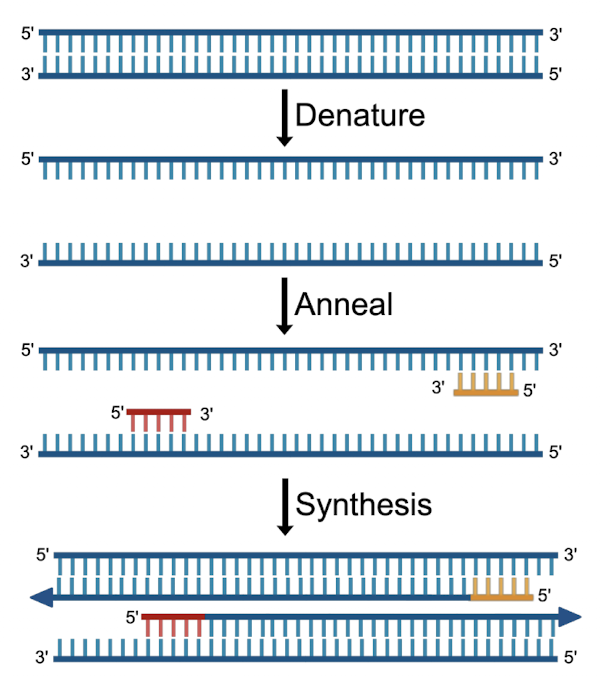
Denature - 95C for 30 secs to separate strands
Anneal - 55C for 30 sec primers hybridized
Synthesis - 72C for 60 sec tag polymerase replicates sequence