Neuro Final
 Call Kai
 Learn
 Practice Test
 Spaced Repetition
 Match
 Flashcards
 Knowt Play
1/267

There's no tags or description
Looks like no tags are added yet.
268 Terms
ABI
acquired brain injury
Acquired Brain Injury
injury to brain, that's not hereditary, congenital, or degenerative or by birth trauma
-brain injury occurred AFTER birth
-effects functionality of nerve cells in brain
-umbrella term for all brain injuries
two types of acquired brain injury
traumatic and non-traumatic
causes of ABI
trauma
seizures
tumors
aneurysm
infections
alcohol
hypoxia/anoxia
stroke
diseases
surgery
TBI (traumatic brain injury) etiology
blast injuries, gun shot wound, assault, Motor vehicle crash, falling
RHD (right hemisphere disorder)
inc right CVA, tumor (right side), degenerative processes affecting right hemisphere
Dementia (umbrella term)
alzeimers, frontotemporal dementia, primary progressive aphasia
Tumor considerations with therapy
depends on size, location, and lesion
-may be focal but can appear difficult becauase of growth pattern of tumor
Cognition areas
attention/info processing
memory
Exec function
social cog/pragmatics
Attention
-capacity to focus on participation stimuli over time and flexibly manipulate info
Attention Impairment
-disorientation (esp in early stages)
-internal and external inattention/distractibility
(ex: internal- distracted by pain, bathroom, external: noise)
-in early stage, touching them while talking could be distracting - think of all sense
-diff maintaining focus/concentration and shifting between task
Types of attention
focused
sustained
selective
alternating
divded
focused attention
attention to individual items
sustained attention
over time
ex: card sorting task- sort black/red (concentration)
selective attention
in competing noise
ex: listening for your name during roll call while other students are talking
alternating attention
shifting from one stimulus to another
ex: watching TV and switch to schoolwork during commercials
-safety concern, when they're trying to cook could get distracted by another task and abandon cooking
divided attention
to two stimuli at once
-ex: talking on the phone while driving
Ox4
person (who you are)
place (where you are)
time (yr, month, date, etc)
Situation (what happened to you, why are you here?)
information processing
how you take info in and take previously learned info and apply to new concepts
-efficency/speed of processing
-think about the amount of info (length of info) accuracy of processing (may be incomplete--> incorrect)
-simple info vs complex
-familar vs unfamiliar (the longer its been the more unfamiliar the more complex less likely they can process)
What is the foundation for memory
attention
-capacity for new learning decreased after TBI
memory
ability to attend to, process/encode, stores dn recall info
-if there is a breakdown anywhere in this continuum we're going to have a memory breakdown
long-term memory
holds info in permanent "store"
thought to have unlimited capacity
ex: childhood memories
short-term/working memory
what's "on your mind" at any moment- your mental workspace
-temporary stage - needs rehearsal to transfer to working memory or will extinguish
-short duration
LIMITED capacity
short term storage and active manipulation for storage or retrieval
working memory
type of short term memory
manipulation of info, occurs prior to storage in long term memory
ex: at restaurant and waiter tells you their name
internal strategies to compensate memory
rehearsal, visual imagery, verbal elaboration, associations, pneumonic
external strategies to compensate memory
calendars, day planners, clocks/alarms, sticky notes
storage of memory: left hemisphere
verbal
storage of memory: right hemisphere
visual
Declarative memory
conscious, intentional recollection of experiences (4 types)
episodic memory
storage of events that are tagged in time and place
ex: remembering your grad
semantic memory
storage of facts and concepts
-remembering names of CN
Metamemory
Awareness of your own memory function
-knowing when you need to study more for a test
prospective memory
remembering to intiate future decisions
-remembering to remember a doctors appointment
nondeclarative memory
doesn't require conscious awareness of learning; remember through repeated performance (3 types)
Procedural memory
acquisition of rules, sequences, and perceptual motor skills (last type of memory a person w alzeimers will lose)
-ex: brushing teeth, operating car
emotional associations
association we have with people and events
Priming
increased probability of producing a response because of having previously produced it
Executive Function
conscious control of thoughts, feelings emotions, and actions to accomplish goals or solve problems
-sense of time
-abstract thinking
-problem solving
-organization (planning)
initiation/motivation
inhibition/impulse control
self-monitoring/self correction
awareness of deficits
-have to be able to monitor yourself daily, "I would miss class if I sat outside, what's my priority"
problem solving
requires:
understanding cause and effect
considering alternatives
making appropriate choices
Steps in Problem Solving
-identify a problem
think of several solution
figure out the feasibility of each solution
choose best solution
apply it
evaluate results
ex: flat tire, do I drive to dealership or call AAA?
Reasoning
logical thinking
appreciation of relationships
practical judgement
ex: should I take medication even though I dont like the way it makes me feel- take it bc you recognize the consequence of not taking
Planning
ability to think ahead
-understand future consequence of present actions
ex: planning vacation - have to consider many things
metacognition
thinking about thinking
-ability to monitor own thoughts and use that info to improve our thinking and behavior
ex: recognizing you're stressed and making changes like taking a break
Executive functioning examples
having a sense of time - what was yday vs last year
-control of thoughts: starting, stopping, and shifting thinking and behavior
-abstract thinking- seeing big picture (ex need this for understanding jokes)
-they might find weird things funny
Theory of Mind
this is impaired for TBI
TBI --> they take the most literal version of what was said
- used to reason about beliefs, emotions, and mental states
-allows ppl to perceive social cues and predict others behavior
-(ex: trying to stand up and open the door to imply the session is over- they have difficulty with this)
-reading body language
how can cog impairments effect auditory comprehension
-increased lengt/complexity diff to comprehend
-reasoning and processing deficit
how can cog impairments effect: reading comprehension
deficits in inferencing
deficit in analyzing multiple details
how can cog impairments effect: writing
diff organizing information, spelling, grammar (disorganized formatting- not language issue)
-omit words bc of lapses in attention
-not a language issue but agrammatic - attn issue
how can cog impairments effect: misinterpreting information
processing !!!! may be slow or they dont get the whole thing making it incorrect
-give them more time to process !
language deficits
-injury is focal
-located in left hemisphere (language dominant hemisphere)
-communication impairments are primary deficits
-audit comprehension, reading, expressive lang, and writing
-communciation impairments range from mild to severe
cognition deficits
-injury is diffuse
communucation (whole brain) impairments are SECONDARY to cognitive impairments!!!
-attention/info processing, memory, exec function, social cog
-mild comm impairments in word retrieval
-they could have decreased performance in language task bc of decreased attn, memory, or info processing
-NOT A LANG ISSUE
assessment of cognitive impairment considerations
diagnosis
age
severity level
education
occupation
cultural background
English speaker/translator
-use baseline to help w treatment goals, identify strengths and weakness
Administration of Assessment
-preparation (practice)
-environment (quiet, comfortable- distractibility)
observations (watch for inattention, distractibility, perseveration behaviors)
-is the assessment after physical therapy? they could be tired etc
After Assessment considerations
dev treatment plan (individualized)
determine prognosis
-family might ask are they gonna get better (not back auto their level but may recover)
frequency and duration of service
-plan for fam education and counseling
-stress is greatest in first year
-need support (personality changes, role changes, finances, social isolation etc)
assessment considerations: individual
-whats their function level/medical status
-history
-dynamic assessment- ongoing eval
-multiple conditions- collaboration w families so they can learn to best serve their loved one
-fatigue!
-manner of test response (do they have to write? )
-note level of arousal
-family reports pre injury
initial eval question
-introduction
Ox4
-get a glimpse of their memory
-can they maintain a convo with you
-informal feel if they're oriented or not
Open ended - depending on cog status
-"can you tell me about why you are here?"
-motor speech
-pragmatics
-discourse skills (comprehension and production)
family interview
open ended questions: opens up to discussion "can you describe a typical day at home"
close ended: probe for spec info: "what rehab services do they receive?"
impressi
impression ?: clarify/expand on info shared
"am I correct to say you are most concerned with..."
-help w collaboration
- can help identify priorities and goals
- what pressure and frustration is the family having?
-what did they like/dislike about prev services, what is their daily role?
why is family collaboration important
-they are maintaining and generalizing recovery long term
-they spend the most time w them
-helpful input for setting realistic goals
-they need support too along w the client
Caregiver education
importance of structure, consistency, repetition
-visual cues, repetition and wait time
-redirection /feedback of pragmatics (diff to fix social behaviors, esp when no awareness of a shift)
review compensatory strategies
-written education on rancho levels, RHD, dementia, etc whatever their loved one has
SLP Professional Education
-we provide differential diagnosis of severity, stage, rancho
-strengths and weaknesses identify
-reccomend other professionals if the client needs supervision
-reccomedn medical staff with cueing
-outcome goals and prognosis
TBI definition
alternation in brain function, or other evidence of brain pathology caused by an external force
-may produce altered states of consciousness
-not degenerative or congenitall
-not a stroke (internal)
-not anoxia (internal)
Types of TBI PRIMARY Injury: Focal
-specific part of brain
-open or penetrating injury (ex: gunshot wound)
-skull fracture
-lacerations and contusions (hit in head w baseball bat)
Types of TBI PRIMARY Injury: Diffuse
all over brain!
-acceleration/deceleration
-shaking like if you shake an egg
-coup/contra coup (brain moving forward and back and forward and back)
-diffuse axonal injury/shearing
-axons are being injured and they are stretching and then they shear and break
tbi: primary injury
focal (spec part of brain-gunshot)
and diffuse (coup contra coup)
can co-occur
TBI secondary injury
-hematomas (pooling of blood)
-hemorrhages
-hydrocephalus
-infarct due to ischemia (stroke secondary to primary injury)
-seizure
hypoxia /anoxia
-herniation
-infections
Mildly impaired TBI
-concussion
-brief or no loss of consciousness
severely impaired TBI
-extended length of loss of consciousness
-coma
Memory Loss- post traumatic Amnesia (PTA)
-how long they are in this determines the severity
-predictive of outcome
-the longer it takes patient to clear PTA the worse the prognosis
pretraumatic memory loss
- aka retrograde amnesia
-wont remember events before the injury
post traumatic amnesia
anterograde amnesia
-inability to demonstrate conscious memory
cant store and retain new info after the injury
-not remembering info past the event
what marks the end of PTA
continuous memory
Glasgow Coma Scale
level of consciousness based on:
-eye opening
-verbal responses
-motor responses
-observed during immediate post injury period
-from 3-15
-anything below 8 is coma
-administerd by first responders not SLP
-up to 6 Hours after injury
Mild TBI
-glascow coma scale: 13-15
-brief loss of consciousness (20 min or less)
-may lose consciousness- confused period
-PTA (60 mins or less)
-often referred as concussion
Mild TBI Symptoms
-headache
-fatigue
-irritabiltiy
attn deficits
-depression
-sleep disturbance
-light/noise sensitive
-balance problems
-memory difficulties
-vision problems
-anxiety
Moderate TBI
Glascow 9-12
-loss of consciousness (less than 6 hours)
-PTA less than 24 hours
-period of confusion from days to week s
-physical, cog, comm, behavior problems - weeks to months
-can make good recovery
Severe TBI
GCS 8 OR LESS
PTA greater than 24 hours
Chronic vegetative state - 3 mo after non-traumatic brain injury , 12 mo after traumatic brain injury
-minimally responsive state
improvement may be there after they leave the state but permanent changes will be there
prog for full recovery less likely
Severe TBI Coma Symptoms
-unarousable state
-lack of sleep-wake cycle
-no evidence of eye-opening
-inability to follow commands, demonstrate volitional behavior and/or verbalize/mouth words
-may see a jerk, gag, cough or swallow reflex but that does mean brain is emerging (educate family on this)
-may see posture reflex
-rarely last more than 2-4 weeks- emerge into vegetative state or better
Coma
complete failure of arousal system
-not conscious
-no hearing
-no eyesight
-no communication
-no emotion
coma
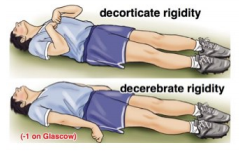
Decorticate rigitidity
in coma
flexion of arm at the elbow
adduction of should r
extension of leg and ankle

decerebrate rigidity
in coma
extension of arm at the elbow internal rotation of shoulder and forearm, leg extension
vegetative state
rudimentary arousal
-no purpose are response to stimuli
-sleep wake cycle
periods of eye opening
-may have spontaneous limb or trunk movements
no language
no coordinated chewing or swallow
may smile shed tears or grimace but not in contextually appropriate manner
Minimal Conscious state
follow simple commands
-gesture or verbal your name
-intelligible verbalization
-movement that is related to context
severely impaired bit not coma or vegetative
-inconsistent but clear evidence of consciousness
-one clear cut behavioral sign of processing and cog processing - needs to happen once
Therapy for Mild TBI
out patient
therapy for Mod-severe TBI
Inpatient then transitioned to outpatient or day program
therapy for vegetative state/mcs
may be transferred to inpatient for monitoring but then go to long term acute care
-disorders of consciousness program
TBI: attention cog function
-arousal/alertness --> first state of attention
-confusion
-disorientation
-attn extremely impaired in early stages
-persistent problems --> poor outcome
-as patient improves attn improves
TBI executive function: initiation
the frontal lobe is responsible for regulation of behavior (this is often injured)
-takes a long time for initiation to kick in- have trouble getting started
TBI executive function: inhibition
we filter and inhibit our communication
-I wouldn't say the same thing to Riya that I would say to Helen
-ex: we dont hit ppl when we are mad at them
-brain injury --> this diminishes
TBI: executive function: planning and organization
what must be done in the future
-how do I get from hospital room to therapy room
-deficit
TBI executive function: awareness of deficits/self monitoring
-they dont have honest assemsnet of how they're doing
ex: they say can do the laundry but they cant
-they can tell you how to change a tire/do the laundry but they can't execute
-they can sequence the steps but not execute
standardized tests and executive function
-they are not sensitive to executive dysfunction
-they will perform very well on test (ex the sequencing thing)
-ask family to observe how well they're doing at home
-observe your client in multiple settings/situations not just test
-having all of the steps in front of them can be helpful
Communication Impairment bc of Cog function
-lang of confusion (content doenst make sense- sounds like aphasia)
confabulations (committed to what they believe even if bizarre, ex: man killed his wife but she's alive
-perseverations (stuck on words)
- tangential responses (attn, pragmatics, responses unrelated)
-press for speech (disinhibition)
topic maintenance (hard to follow- do not ref what they're talking about)
-non-linguistic comm: unawre of person space, facial expression etc)
Behavior characteristics bc of cog communication dysfunction
-irritability
-restlessness
-childishness/egocentricity
-disinhibition --> not filtering
-dependency
-apathy (unmotivated, feeling down)
-emotional lability: something makes them cry and cant stop crying
-depression
Cog comm dis VS Aphasia
-interrelationship between cog and Lang (esp bc the damage can be diffuse)
-breakdown in cog can cause a comm breakdown
-asphasia = lang disorder
-cog-communication disorder = lang is typically unaffected, communicative competence can be altered BC OF COG DEFICITS
Rancho Level I
-No response: total assistance
-appears to be in deep sleep
-NO response to any stimuli
Rancho Level II
Generalized response: Total assistance
-inconsistent reaction to stimuli, vocalizations, delayed responses
Rancho Level III
Localized Response: Total Assistance
-reaction is specific but inconsistent, directly related to stim turns head to sound, respond to discomfort, follow simple commands inconsistently
Rancho Level IV
Confused/Agitated: Maximal Assistance
-4-6 are "middle phase" - all confused
-agitated: bounce leg, hit themselves, hurt others, swearing
Rancho Level V
Confused, Inappropriate: Non-Agitated - Maximal Assistance
-4-6 are "middle phase" - all confused
-agitation subsides, still confused, highly distractible, may perform previously over-learned tasks (hand washing), unable to learn new info
Rancho Level VI
Confused, Appropriate: Moderate Assistance
-4-6 are "middle phase" - all confused
-more alert, attn is much better, can engage in convo, decreased problem solving