ceutics aerosols
 Call Kai
 Learn
 Practice Test
 Spaced Repetition
 Match
 Flashcards
 Knowt Play
1/65

There's no tags or description
Looks like no tags are added yet.
66 Terms
aerosols are pressurized dosage forms that emit __(phases?)______ particles and contain one or more active ingredients in a ___(phase?)___ medium
emit: liquid or solid
medium: gaseous
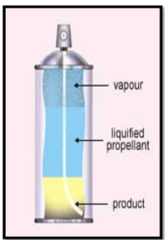
pressure is applied using one or more ___________ or _________ propellants
(which phase is the propellant?)
liquefied or gaseous

contents from an aerosol are expelled as...(6)
fine mist
coarse, wet, or dry spray
steady stream
stable, fast-breaking foam
aerosols are similar to dosage forms in which ways? different?
same: stability, formulation, efficacy
different: depend on container, valve assembly, propellant for function
t/f: if the product is packaged under aseptic conditions, the drug will be maintained sterile
true
advantages of aerosols (5)
1. easy to withdraw dose without contaminating remainder
2. container protects drug from O2, moisture, and light
3. topical drugs applied uniformly and thin, without friction from fingertip (+ cooling)
4. dosage is controlled via metered valves/particle size
5. clean process
(WPTMC: withdraw, protect, topical, metered, clean)
the effectiveness of an aerosol depends on the proper combination of what 3 things?
Formulation
Container
Valve assembly
the product concentrate in an aerosol is made up of
1. active ingredient
2. adjuncts: antioxidants, SAA, solvents
which adjuncts are often seen in aerosols?
antioxidants, SAA, solvents
what is the "heart" of the aerosol, acting as a solvent and diluent
propellant
what determines the characteristics of the product as it leaves the container, acting as a solvent and diluent
propellant
propellants can be classified as what 2 things
1. liquefied gases
2. compressed gases
examples of liquefied gases
ChloroFluoroCarbons (CFC)= ozone
HydroChloroFluoroCarbons (HCFC)
HydroFluoroCarbons (HFC)
HydroCarbons (HC)= flammable

which liquefied gas is the most used
CFC (chloroFluoroCarbon)
Cl and Fl carbons work to ____enhance or decrease?_____ fire
decrease
t/f: liquefied gases are highly flammable
false. they are nontoxic and nonflammable (except for HCs)
t/f: hydrocarbons are highly flammable
true
t/f: all liquefied gases are nontoxic
true
which gases are a major source of inorganic Cl, destroy the stratosphere and ozone layer?
CFCs (liquefied gases)
_________ are prohibited for nonessential use under federal regulations
CFCs
which rules allow for the use of CFCs
1. there is no alternative
2. drug is important to health and CFC is necessary for public health
3. benefit outweighs CFC release
the major advantage of liquefied propellants such as CFCs are (select)
1. non toxic
2. nonflammable
3. low cost and easily accessible
4. solubilize the drug
1,2
( 3 and 4 is HCs)
fluorinated hydrocarbons are _________ at room temp
gases
how are hydrocarbons liquefied
1. cooling to below their boiling point (liquefied)
= becomes gas upon release
2. compression at room temp (compressed)
what replaced CFCs for topical pharmaceutical aerosols?
hydrocarbon propellants (to reduce CFC output)
benefits of hydrocarbons over CFC
1. low order toxicity
2. greater range of solubility
3. lower cost
[BUT highly flammable]
downside of using hydrocarbons
highly flammable
examples of hydrocarbons as propellants
n-butane, propane, isobutane
examples of compressed gases
nitrogen, nitrous oxide, carbon dioxide
t/f: liquid nitrogen is an example of a compressed gas
false
the container and valve of an aerosol must be capable of withstanding what 2 things
1. pressure
2. corrosion
what metals are used for containers
steel and aluminum
t/f: glass aerosols are preferred over plastics
true. glass has less compatibility problems
problems with plastic aerosols
1. permeation of vapor through the container
2. drug-plastic interactions
which materials are the most used for aerosol containers
1. metals: steel and aluminum
2. glass w no plastic (better compatibility than metals)
-> plastic has problems: vapor permeation and drug-plastic intrxns
mounting cup of aerosol
holds valve in place; exposed to formulation
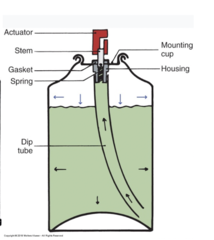
t/f: since the mounting cup is exposed to the formulation, it must be compatible just like the inner container
true
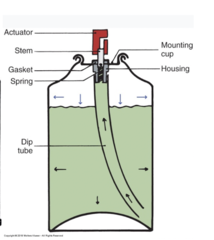
stem of aerosol
supports actuator and delivers formulation to actuator chamber

gasket of aerosol
prevents leakage when the valve is closed
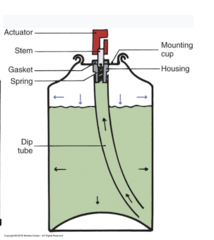
spring of aerosol
permits actuator to retract and close when pressure is released (returns valve to closed position)

housing/body
-links dip tube, stem, and actuator
-directly below mounting cup

dip tube of aerosol
brings formulation from container to the valve

the actuator of an aerosol is
- button pressed to activate the valve assembly for emission
- easy opening and closing of the valve

describe the actuator for foam/solid stream vs spray/mist
large orifice= less propellant= foams/solid streams
small orifice= more propellant= spray/mists
would a large or small actuator orifice have less pressure? more or less propellant?
large orifice= less propellant= less pressure
small orifice= more propellant= more pressure
a two phase system consists of
1. liquid phase (liquified propellant and drug)
2. vapor phase

a three phase system consists of
1. water-immiscible liquid propellant
2. highly aqueous product concentrate
3. vapor phase
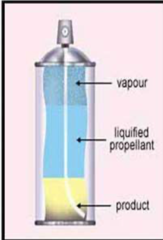
the difference between a 2 phase and a 3 phase system is
in 2 phase: propellant and drug are combined in liquid phase
in 3 phase: propellant (hydrophobic) and product(aqueous) are separated
both have vapor phase
does liquified propellant or aqueous layer have greater density? which is on top?
liquified propellant has greater density= resides at bottom
upon activation of the valve, the pressure of the ________ phase causes the _______ phase to rise in the dip tube and be expelled
vapor; liquid

what ensures that the liquified propellant is NOT expelled and the product IS
the dip tube extends only within the aqueous phase (top) and NOT down into the liquid propellant
which aerosols do NOT have a reservoir of propellant
compressed gas systems
(liquified gas propellants do)
higher gas pressures are required in which systems? why?
compressed gas systems. they do not have liquid propellant
in which system does the pressure diminish as the product is used
compressed gas systems
in which system does the pressure remain constant as the product is used
liquefied gas systems
how do metered dose inhalers provide consistent dosing
dose is regulated by an auxiliary valve chamber that emits same amount based on size

an effective inhaler medication delivery depends on
1. particle size of inhaled drug
2. breathing patterns and depth of respiration
3 purposes of a protective cap
1. protects valve against contamination
2. prevents accidental activation of valve
3. serves a decorative function
aerosol labels have which 3 warnings
1. do not puncture pressurized container
2. do not use or store them near heat or open flame
3. do not store at temps >49C
disadvantages of topical aerosols
hard to apply to small area, more expensive
vaginal foams are generally __________
o/w. water miscible and non-greasy
proper technique for inhalers
1. exhale completely
2. inhale while pressing down on inhaler
____________ are used for patients who cannot coordinate the release of medication with inhalation
spacers
spacers allow the patient to separate the activation of the inhaler and inhalation by _______ seconds
3-5 seconds
how do spacers increase efficacy
1. give pt 3-5 more seconds to inhale contents
2. reduce aerosol velocity
3. reduce droplet size (evaporation of propellant)
4. less medication deposited in oropharynx
how do spacers reduce droplet size
increase time of propellant to evaporate