USP 797 - Assigning Beyond-Use Dates to Compounded Sterile Preparatio
 Call Kai
 Learn
 Practice Test
 Spaced Repetition
 Match
 Flashcards
 Knowt Play
1/14

There's no tags or description
Looks like no tags are added yet.
15 Terms
BUDS and expiration dates
expiration date:
assigned by manufacturers of conventionally manufactured products and components such as active pharmaceutical ingredients (APIs)
expressed as either a specific month in a specific year or a specific day of the month in a specific year
the time during which a product can be expected to meet the requirements of the compendial monograph, or maintain expected quality provided it is kept under the specified storage conditions
limits the time during which the conventionally manufactured product, API, or added substance may be dispensed or used
assigned by manufacturers based on analytical and performance testing and packaging integrity of the product
specific for a particular formulation in its container and at stated exposure and storage conditions (i.e., illumination, temperature)
beyond-use date:
assigned to compounded preparations
the date, or the hour and date, beyond which the preparation must not be used and must be discarded
determined from the date/time that preparation is initiated
not intended to limit the time during which the CSP is administered
knowledge check
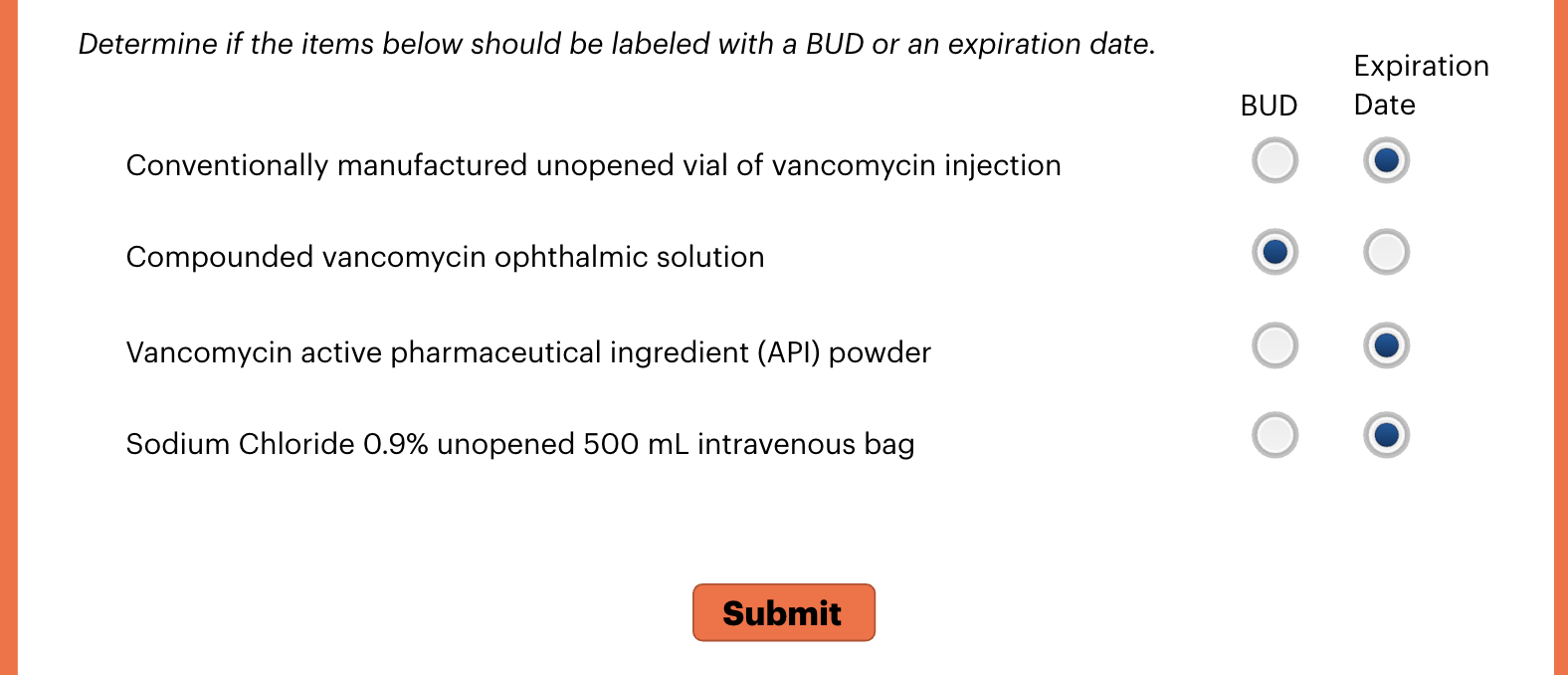
factors to consider when establishing a BUD
factors to consider when assigning BUDs to CSPs:
chemical and physical properties of the components and the container closure system
environment where the CSP is prepared
whether nonsterile ingredients have been used to prepare the CSP
sterilization method
whether or not sterility testing has been performed
intended storage temperature for the finished CSP
assigning BUDs—stability
oxidation and hydrolysis are reactions that can be identified by light, heat, or the presence of water, which can reflect the stability of medications
other factors to consider regarding stability when assigning BUDs:
physical and chemical stability of the active ingredients and added substances in a CSP
the effects of light, heat, and water on dehydration of the CSP
materials of composition of the container closure system and the compatibility of the container closure system that will be used for the final CSP to prevent leaching or sorption
the ability of the container closure system to withstand intended storage conditions (e.g., freezing)
assigning BUDs—sterility considerations
immediate use
environment: uncontrolled environment with no primary engineering control (PEC)
BUD limit: 4 hours at any storage condition
category 1
environment: ISO class 5 PEC placed in unclassified environment
BUD limit: 12 hours controlled room temperature, 24 hours refrigerated
category 2
environment: ISO class 5 PEC placed in an ISO class 7 buffer room
BUD limits: 1 to 45 days controlled room temperature, 4 to 60 days refrigerated, 45 to 90 days frozen
category 3
environment: ISO class 5 PEC placed in an ISO class 7 buffer room
additional facility and personnel requirements:
BUD limits: 60 to 90 days controlled room temperature, 90 to 120 days refrigerated, 120 to 180 days frozen
how factors impact length of assigned BUDs
nonsterile components
impact: shortens BUD for category 2 CSPs
nonsterile ingredients increase the risk of contamination or failure to achieve sterility
example:
BUDs for category 2 CSPs that (1) are aseptically processed. (2) are stored at controlled room temperature, and (3) have not undergone or passed sterility testing
terminal sterilization vs aseptic processing
impact: terminal sterilization lengthens BUD for category 2 and category 3 CSPs
using a verified method of terminal sterilization (e.g., auto-claving, dry heat sterilization) provides reasonable assurance that a CSP will be sterile. aseptic processing (e.g., filtration or using only conventionally manufactured sterile products as components) is more difficult to verify for
sterility testing
impact: lengthens BUD for category 2 CSPs
sterility testing provides reasonable assurance (but does not guarantee) sterility has been achieved
example
BUDs for category 2 CSPs that are (1) terminally sterilized and (2) stored at controlled room temperature:
did not undergo and pass sterility testing: 14 days
passed sterility testing: 45 days
storage conditions
impact: colder temperatures lengthen BUD for category 2 and category 3 CSPs
USP <659> packaging and storage requirements explains that colder temperatures slow the growth of most microorganisms refrigerated or frozen CSPs have longer BUDs than do those CSPs stored at room temperature — provided that the CSP and its container
knowledge check

establishing BUDs for different categories of CSPs
USP <797> lists three tables to enable compounding professionals to assign an appropriate BUD to CSPs and lists caveats for use of the tables. the assigned BUD for any CSP may not exceed:
the expiration date or remaining BUD of any of its individual components
the known duration for physical and chemical stability of the CSP
exception: some BUDs may exceed the BUD of the compounded components if the physical, chemical, and microbiological quality is not negatively affected (e.g., pH altering solutions)
table 12

table 13

table 14

establishing BUDs for category 3 CSPs
category 3 CSPs have additional requirements to address the additional risks from increasing storage times:
personal compounding category 3 CSPs must complete garbing competency and aseptic manipulation every 3 months, instead of every 6 months for category 2 CSPs
personnel must adhere to stricter garbing requirements, such as using sterile garb without any exposed skin
viable air sampling must be performed monthly and surface sampling performed weekly
additional surface sampling of the PEC must be performed after compounding a category 3 CSP
the use of sporicidal disinfectants in the PEC and work surfaces outside the PEC must be completed weekly
establishing BUDs for category 3 CSPs—addtional requirements
further requirements for category 3 CSPs to address additional risks:
require stability information using a stability indicating method that can distinguish the active ingredient from its degradants and impurities and quantify the amount of the active ingredient
may be performed by the compounder or obtained through third-party sources
must be the exact same formulation (bracketing acceptable)
CSP must be packaged and stored in a container closure of the same materials of composition as that used in the study
container closure system must be tested once per formulation
particulate testing must occur once per formulation for injectables and ophthlamics
release testing each time category 3 CSPs are prepared
sterility testing (see USP <71>)
endotoxin testing, if required based on dosage form
knowledge check part 1

knowledge check part 2

multiple-dose CSPs
compounded aqueous multiple-dose containers:
have more than one dose
are intended to be entered or penetrated multiple times
usually contain a preservative
if present, the preservative must be compatible with the CSP and route of administration
may be prepared only in a cleanroom suite
must be discarded on the assigned BUD or 28 days after initial puncture, whichever is shorter
must pass a container closure integrity test (USP <1207> package integrity evaluation—sterile products)
performed once initially for that volume of CSP in the specific container closure system to be dispensed
must demonstrate ability to pass USP <51> antimicrobial effectiveness testing
there is an exception for multiple-dose nonpreserved aqueous topical and topical ophthalmic CSPs
these CSPs do not require a USP <51> test if:
they are prepared as a category 2 or category 3
they are used by a single patient
they are labeled (in a label or labeling) to indicate that once opened, it must be discarded 24 hours after opening when stored at room temperature and/or that once opened, it must be discarded 72 hours after opening when stored under refrigeration
antimicrobial effectiveness testing
options for compounding professionals to obtain evidence to support antimicrobial effectiveness in multiple-dose CSPs:
perform or contract for testing once for each formulation in the particular container closure system in which it will be packaged
reference antimicrobial effectiveness testing results provided by an FDA-registered facility (e.g., contract testing laboratory) or published in peer-reviewed literature sources
CSP formulation, including any preservative, and container closure system are exactly the same as those tested
perform or reference a bracketing study on a low concentration and a high concentration of the active ingredient in the formulation to establish preservative effectiveness across various strengths of the same formulation
the concentration of all other ingredients, including preservatives, must be the same throughout the bracketing study
multiple-dose CSPs are different than compounded stock solutions, which do not undergo the aforementioned testing
knowledge check
