Actors & Factors
 Call Kai
 Learn
 Practice Test
 Spaced Repetition
 Match
 Flashcards
 Knowt Play
1/30

There's no tags or description
Looks like no tags are added yet.
31 Terms
type of factors
(F)actors that make new phase start (type 1)
(F)actors that determine the length of a phase (or how it evolves) (type 2)
Factors explaining stabilization phase
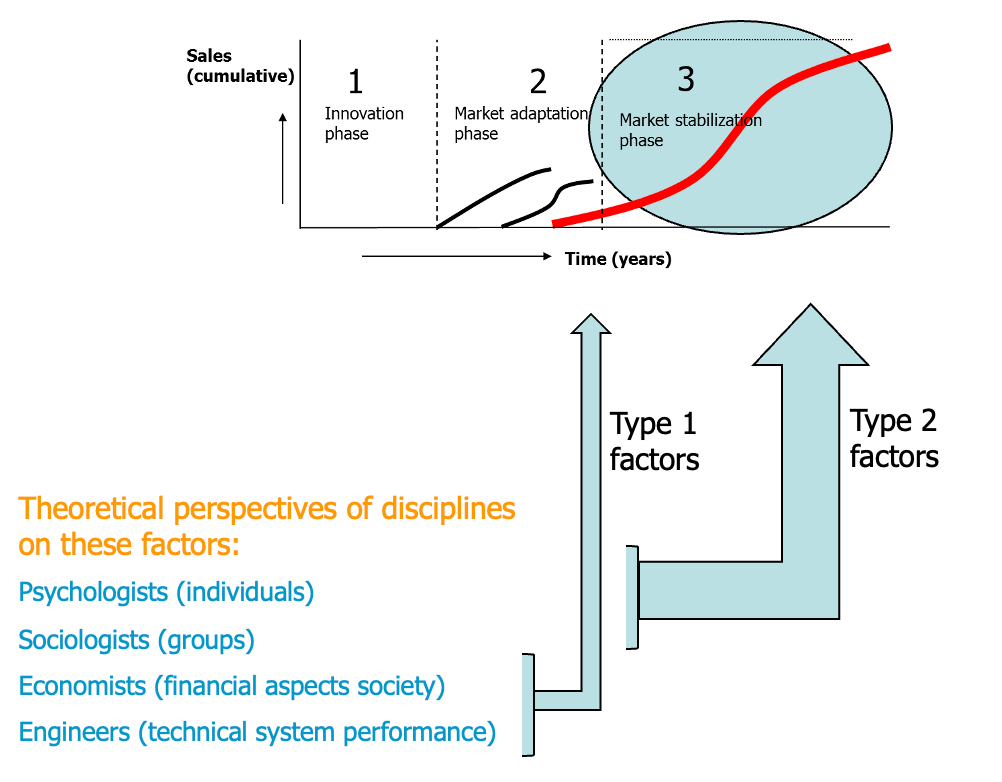
Theoretical perspectives of disciplines on these factors
Psychologists (individuals)
Sociologists (groups)
Economists (financial aspects markets)
Engineers (technical system performance)
Psychologists (individuals)
Focus on characteristics of individual adopters to explain adoption/rejection, time of adoption and type of adoption process for individual consumers.
Sociologists (groups)
Focus on typical characteristics of adopters in groups (how do people influence each other on the demand-side) to explain steepness/ceiling of curve. Describe how different subgroups perceive innovation (vision and closure among social groups)
Economists (society)
Focus on economic factors (supply and demand) to explain start, slow down or speed-up of diffusion curve (socio-economical system development)
Engineers
technical system development and relative performance
Mechanism driving stabilization phase according to psychologists and sociologists
Diffusion as macro communication-process between individuals (sociologists)
Diffusion as macro communication-process between individuals (sociologists)
Psychologists’ and sociologists’ perspective on diffusion
Subsequent adopter groups in stabilization phase
Subsequent adopter groups: innovators, early adopters, early majority, late majority, laggards
Basic idea: innovators have characteristics in common (as a group)
Why are these innovators important:
The first group to focus on when introducing an innovation
Their role in communicating the benefits of the innovation to subsequent groups
The early identification of innovators and early adopters is therefore important for businesses developing new products, “since it assists in the process of tailoring each element of the marketing mix to the requirements and behaviors of those buyers who initiate markets and without whom the social comparison that leads to diffusion would often not occur.”
Basic idea: innovators have characteristics in common (as a group)
Results after reviewing many studies on the characteristics of innovators
Some widely held notions about specific innovator characteristics do not hold (age, education, etc).
Characteristics are in general (very) weakly related to (relative timing of) adoption.
Product-related characteristics have stronger relationships than generic (e.g. socio-demo) characteristics.
Characteristics differ per product category.
Early rejecters are found to have similar characteristics as early adopters (Labay and Kinnear, 1982)
Innovators sometimes scare away subsequent adopters (instead of convincing, they discourage)
Many other variables determine the start of diffusion (supply side factors in the market)
Factors explaining adaptation phase
Problem: Endless number of factors and different categorizations + focus
Theoretical perspectives and the emergence of the adaptation phase
Psychologists:
Individuals that adopt and are deviant scare away subsequent adopters. (see Note
Sociologists:
Individuals that are fanatic opponents to adoption may also scare away adopters. Different groups hold different views and hence diffusion is constrained. Relatively closed segments of customers (constrain diffusion)
Economists:
Moore:Row of p/m combinations is required segments have different requirements
Marx : New production machine and its consequences in a factoryTushman Andersson Utterback: Market disturbed by new product, chaotic competition
Engineers: Performance competition between alternative technologies (see Note)

tentative model

Factors explaining stabilization and adaptation phase


Actors explaining innovation phase
Theoretical perspectives:
Psychologists:
The work of researchers and developers
Sociologists:
Vision-formation and communication within and across different subgroups of stakeholders
Economists:
Research and development funding (supply) and demand, barriers to market formation
Engineers:
Problems in turning principle in reliable product
Why does the innovation phase take so long?

What are the activities and barriers or problems in the innovation phase?

Activities in innovation phase
Basic research to improve principle (scientific development).
Basic research on subprinciples in the larger system (scientific development).
Applied research required to complete the system (technology development).
NPD-process (product/service, marketing-mix, production, organization).
Pilot/testing.
Formation of network of actors with complementary competences/resources.
Vision on the system (function, type of use, type of product type of users).
Choice product/market combination(s).
Competition with other new or incumbent (existing) systems.
Problems to tackle in innovation phase
Funding problem
Principle technology immaturity problem; uncertainty performance competitive systems
(Shared) vision is lacking
Network of actors willing to learn and build up vision is lacking or scattered
Why is the innovation phase not just a project?
The innovation phase lasts longer than a typical project
In contrast with a project activities can either involve many projects in parallel or no project activity for prolonged periods of time.
Instead of a coordinated program of activities the innovation often shows parallel unrelated sets of projects in different companies. Innovation phase is not a project because in this phase many actors tend to work in parallel in different projects.
Minnesota studies and not a project
Markam roles and problems during innovation phas
Model of relevant (F)actors innovation
necessary conditions for l-s diffusion
Product perform
Price
Production
Compl prod/serv
Network of supply
Customers
Institutions

market mechanisms
Market mechanism is a particular type of interaction between different market actors/factors
Innovation phase
Market for basic research (pre-competitive governmental sponsoring, corporate investment in R&D)
Uncertainty, different visions, interests, resistance, accidents, social rumour
Adaptation phase
The innovators dilemma
Competition & Substitution
Network effects: The critical mass or chicken and egg dilemma
Emergence of a dominant design
Learning points
Excellent companies do not become lazy
Competence destroying technologies are not always breakthrough but can be inferior at first sight.
Multiple reasons why smart managers would not invest
uncertainty about performance of old and new technology (see sailing boat/motor boat principle)
current clients do not like it
investment is too risky
organization is not designed to deal with the new market
Innovators dilemma
problem: interference innovation/standard operations.
Effect 1: performance technology (of incumbent company) increases faster than consumers want
Effect 2 : performance of new entrant increases faster than incumbent
Hype cycle
Interpreting technology hype
Gartner Hype Cycles provide a graphic representation of the maturity and adoption of technologies and applications, and how they are potentially relevant to solving real business problems and exploiting new opportunities.
Relevance
Tracking one technology over time (describing evolution)
Positioning multiple technologies at one point in time (benchmarking related technologies)
Previewing technology development over time (predicting evolution)
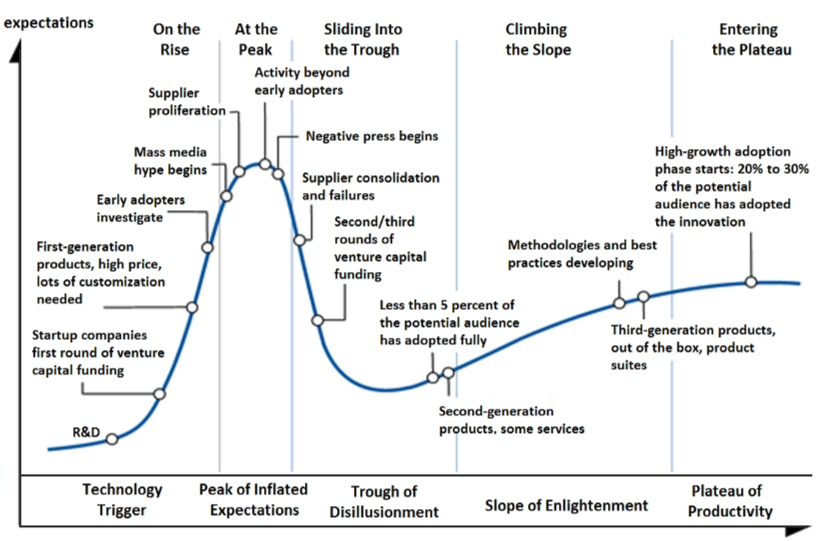
Assumptions of the hype cycle
Similar pattern of expectation for new technologies over time?
Similar expectations about a technology held by widely different stakeholders?
Positive expectations are first while negative expectations come later.
Hence the debate between different groups of stakeholders that hold opposing views regarding a technology are not taken into account.
Relationship between expectations and technology? (co-evolution, expectations cause technology development or reverse?)
Similar events and steps over time during the hype cycle?(are the events over the hype cycle (slide 4) illustrative or predictive?)
Defining and measuring of the hype cycle
Definition of the hype
Expectations or visibility on the y-axis?
Measurement of the hype cycle
What is the unit of analysis for which we measure expectations? How is that defined and measured? (technological innovation, technology/generic product, discipline?)
What are expectations? How are they defined and measured?(expectations about technical or economic performance or societal impact?) (expectations by whom?)
Can we find proxies to assess expectations (visibility)?
News-data
Scientific articles
Patents
Do proxies measure the same thing?
Expectations versus visibility
Difference in practice
Visibility = number of publications, patents, news.
Expectations = type of visibility (positive or negative) requiring content analysis
Explaining the hype cycle
As a combination of 2 cycles
PS: engineering and business maturity are very different
PS: how can curves with different Y-axis be combined in one curve?
Psychological mechanisms
Fenn and Raskino (2008) argue that three human nature phenomena are responsible for the curve's shape: attraction to novelty (and the love for sharing), social contagion, and heuristic attitude in decision-making. Together, these phenomena lead people to assess a new technology's potential with overenthusiasm. The media additionally tend to focus on potentially big stories and the resulting collective hypes the number of supporters over a critical mass. Once a technology begins to hype, decision makers in organizations may follow the trend rather than carefully assessing the technology's potential themselves. This is potentially a dangerous tactic as the sharp peak of enthusiasm of the new technology is often followed by disappointing early results of the first generation of applications, causing the hype to suddenly ebb and collapse into a trough.

Other possible causes for the hype cycle?
Underestimating the scope of the system.
Underestimating the problems with mundane issues like institutions.
Underestimating time/resources required to increase performance and lower price.
Underestimating competition with old technology and with alternative new technologies
Model of relevant (F)actors for the hype cycle
Product perform
Price
Production
Compl prod/serv
Network of supply
Customers
Institutions
Expectations and the start (at the time of invention)
the New York Daily Mirror 1930
Prediction (in 1930): in 5 years many American households will have a video-telephone
General predictions at the invention communication technology
Rogers (1986): two opposing views hyper enthusiastic and hyper pessimistic
Usually about the following topics
Effect on the economy
Effect on Urban structure
Effect on social organization
Effect on individuals (children)
Substitution effect
Consequences of the hype cycle
Synchronization of expectations and development/diffusion?
The role of expectations in funding
Assumptions 3 models
