Unit 1 Quiz - H. Chemistry
 Call Kai
 Learn
 Practice Test
 Spaced Repetition
 Match
 Flashcards
 Knowt Play
1/61

Earn XP
Description and Tags
Name | Mastery | Learn | Test | Matching | Spaced | Call with Kai | Chat |
|---|
No analytics yet
Send a link to your students to track their progress
62 Terms
John Dalton's Atomic Theory
All matter is made of tiny particles called atoms.All atoms of a given element are identical.Atoms of a given element are different from those of any other element.
Atoms of one element can combine with atoms of other elements to form compounds. A given compound always has the same relative number and type of atoms.
Atoms are neither created nor destroyed in chemical reactions.
JJ Thomson: Cathode Ray Tube Experiment
He put a stream of electrons into a electrified glass tube filled with gas where the left side was negatively charged and the right side was positively charged
Electrons in the tube were attracted to the positive side
This led to him discovering that electrons had a negative charge
led to plum pudding model

Thomson’s Plum Pudding Model
Thomson thought the atom was only electrons on a sphere of positive charge

Rutherford's Gold Foil Experiment
took a source of alpha particles and shot a beam of them at a piece of gold foil surrounded by a sheet of zinc sulfide
He found that most of the alpha particles went straight through but some bounced off of something and since electrons were too small to deflect the alpha particles he came to the conclusion that there was something else inside of the atom with a lot of mass
This led him to create the Nucleus Model of the atom where that something else was the nucleus

Rutherford: Nucleus Model
that something else in the atom was the nucleus
much later scientists discovered that the nucleus is made up of protons and neutrons
volume of the nucleus compared to the rest of the atom (the electron cloud) is actually quite small
electrons are more likely to be found closer to the nucleus than further away

Electron (e-)
Charge of -1
Found in the electron cloud
Proton (p+)
Charge of +1
Found in nucleus
Determines the element
Neutron
No Charge
Found in nucleus
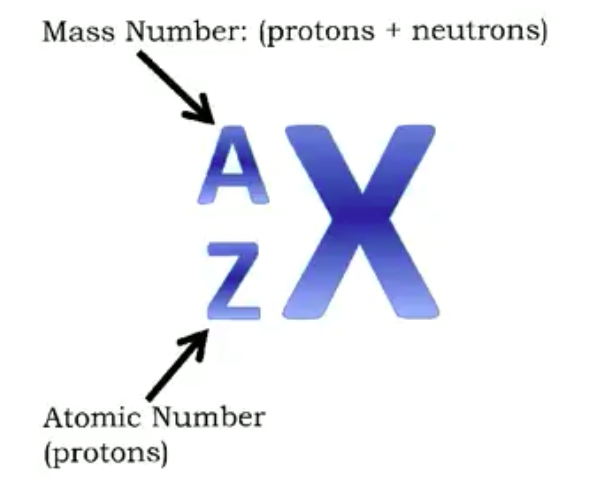
Nuclear Symbol Notation
X = Element Symbol
The one to two letter abbreviation for the chemical element.
Has a superscript with its charge if it is charged
A = Mass Number
The total number of protons + neutrons in the nucleus (written at the top left).
Z = Atomic Number
The number of protons in the nucleus (written at the bottom left), which defines the element.
Periodic Table Notation
X = Element Symbol
The one to two letter abbreviation for the chemical element.
Z = Atomic Number
The number of protons in the nucleus, which defines the element.
Atomic Mass
The weighted average mass of the element's atoms, usually measured in atomic mass units (amu).

Hyphen Notation
X = Element Symbol
The one to two letter abbreviation for the chemical element.
Has a superscript with its charge if it is charged
A = Mass Number
The total number of protons + neutrons in the nucleus (written at the top left).

Isotopes
Atoms with the same number of protons but different numbers of neutrons.

Average Atomic Mass (AAM)
The weighted average mass of all the different isotopes of a particular element
Weighted by how abundant each isotope is
(review how to calculate with the lecture video)
Ions
made by when a neutrally charged atom gains or loses electron(s)
an atom with a charge
Anion
Negatively charged ion
Neutrally charged atom has gained electron(s)
Nonmetals tend to gain one or more electrons to become anions.
(see notes of more info)
Cation
Positively charged ion
Neutrally charged atom has lost electron(s)
Metals tend to lose one or more electrons to become cations.
Half-Life (t1/2)
The time required for a quantity to fall to half its value as measured at the beginning of the time period
Used to describe a quantity undergoing exponential decay
Is constant over the lifetime of the decaying quantity
Radioactive atoms decay over time
man-made atoms typically have very short half-lives
Radioactive nuclei with a shorter half-life is called “hotter” than one with a longer half-life
(review how to calculate with the lecture video)
Metals
Physical properties:
Good conductors
Malleable
Ductile
Lustrous
All elements to the left and below the “stair-step” line are metals except for hydrogen (H)
Non-metals
Appear in the upper-right section of the periodic table
Generally lack the properties that characterize metals
More variation in properties than metals
Can be solids, liquids, or gases
Elements that border the staircase on the periodic table
Metalloids/Semisolids
Elements below the main section of the periodic table
Lanthanides and Actinides
Periodic table
an organized chart that shows all 118 known elements in order of increasing atomic number
Groups
Elements with similar chemical behavior because each group contains elements that share the same number of valence electrons
vertical columns
18 groups
Group 1
Alkali Metals
Group 2
Alkaline Earth Metals
Groups 3-12
Transition Metals
Group 17
Halogens
Group 18
Noble Gases
Period
Each period represents a new principal energy level (electron shell) being filled with electrons.
horizontal rows
7 periods
Electromagnetic radiation
It is a form of energy that acts like a particle and a wave, and its energy is defined by its wavelength and frequency.
wavelength (𝜆)
the distance over which a wave's shape repeats, measured from one peak (crest) to the next peak, or from one low point (trough) to the next low point
measured in units for length
Frequency (𝜈)
number of waves that pass through a given point in a second
measured in s-1
Relationship between wavelength, frequency, and energy
shorter wavelength, lower frequency, lower energy
longer wavelength, higher frequency, higher energy
Visible Light
The part of the electromagnetic spectrum that ranges from 400 nm to 700 nm.
Violet = 400 nm
Red = 700
photon
packet of energy
moves in streams
Emission of Energy by Atoms
Steps:
Atom absorbs energy
Electrons are promoted to excited state (electrons jump energy levels)
Atom is unstable
Atom releases energy in the form of a photon (energy absorbed = energy released)
Electrons return to ground state (electrons return to original energy levels)
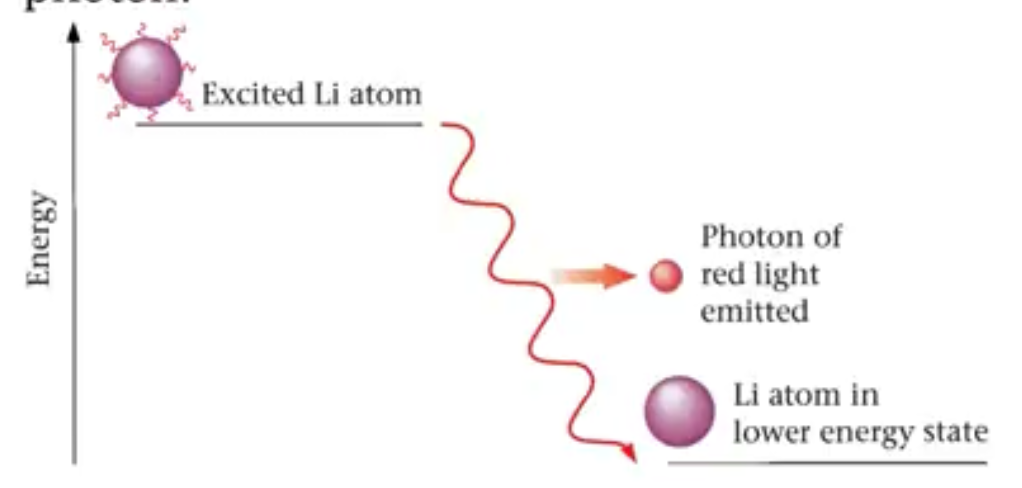
Excited State
Higher energy state
Ground State
Lower energy state
Emission Spectra
the colors that are emitted when atoms release energy
different electron transitions (movement of an electron between energy levels) within an atom produce different colors (wavelengths) of light.
(Principal) Energy Levels/Shells
Energy of shells increase the further they are from the nucleus
Discrete energy levels = certain energy states that electrons can be at
First shell: n=1, Second shell: n=2, etc.
The jumps between energy levels are unique to the element because each element has a different number of protons in its nucleus, which affects how attracted the electrons are to the nucleus
Ex: Subshells with an energy level of n=4
4s, 4p, 4d, 4f
Each energy level (or shell) can hold as many electrons as defined by 2n2
Bohr Model
Very incorrect
Electrons do not actually move in orbits the way planets move around the sum
But easy to draw

The Wave Mechanical Model
A "probability map" of finding the electron within a certain area; regions of space where the electron is "likely" to be found
Electrons are more likely to be found closer to the nucleus
Orbitals
Each orbital can hold 2 electrons
Schrödinger

Subshells/Sublevels
Within a given energy level, there are sublevels (called subshells) (ex: s, p, d, f) which contain multiple orbitals of different shapes.
In the energy level n=1 there is 1 subshell (1s), in the energy level n=2 there are 2 subshells (2s and 2p), in the energy level n=3 there are 3 subshells (3s, 3p, and 3d), etc.

s subshell
Spherical subshell
Each s subshell consists of 1 orbital
So each s subshell can contain up to 2 electrons
first subshell
Coefficient = period #

p subshell
Dumbbell shaped
Each p subshell consists of 3 orbitals
So each p subshell can contain up to 6 electrons
second subshell
Coefficient = period #
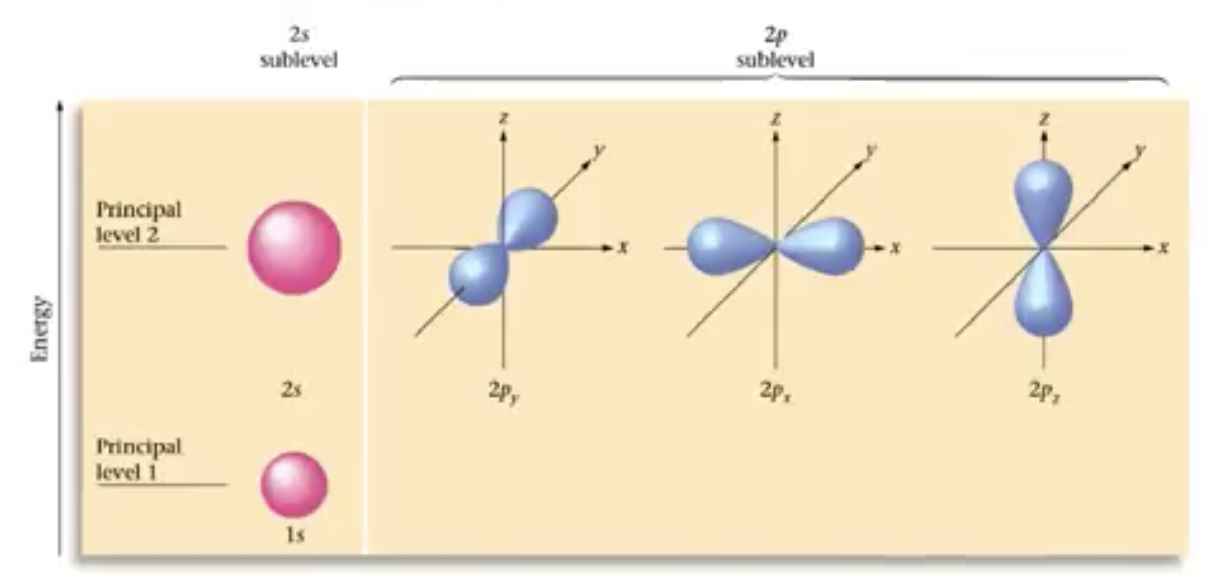
d subshell
double dumbbell-shaped or cloverleaf-shaped (do not have to know this)
Each d subshell consists of 5 orbitals
So each d subshell can contain up to 10 electrons
third subshell
Coefficient = period # - 1

f subshell
Each f subshell consists of 7 orbitals
So each f subshell can contain up to 14 electrons
fourth subshell
Coefficient = period # - 2

Orbitals
Subshells contain orbitals of different shapes
Each orbital can contain 2 electrons
The number of orbitals that each subshell are increasing odd numbers
the s subshell has 1 orbital, the p subshell has 3 orbitals, the d subshell has 5 orbitals, and the f subshell has 7 orbitals
How they are filled follows 3 rules
Aufbau Principle, Pauli Exclusion Principle, and Hund’s Rule

Nodes
areas in which electrons are not found

Orbital Notation
A graphical representation of exactly where electrons of an atom are placed.
Tells you which shell, subshell and orbital the electrons are in
Uses arrows to represent electrons and lines to represent orbitals.
Up arrow represents clockwise spinning electron and down arrow represents counter-clockwise spinning electron

Aufbau Principle
Electrons fill orbitals in order of increasing energy (1s, 2s, 2p, 3s, 3p, 4s, 3d, etc.)
because that is their most stable, lowest-energy state
Pauli Exclusion Principle
No two electrons can have the same location and spin
Reduces repulsion between the electrons

Hund’s Rule
All orbitals of a given subshell must contain one electron before pairing begins
This is because electrons are negatively charged so they repel each other so as a result they will be a far from each other as possible

Electron Configuration
Shorter and easier way to represent the placement of electrons in the atom
No arrows, no orbital lines
Does not show spin or the orbitals
Superscripts are used to represent electrons
Less specific than orbital notation
Electron Configuration of Anions
Electrons need to be added to the last subshell or the next subshell if the previous shell fills
Ex:
S : 1s22s22p63s23p4
S2- : 1s22s22p63s23p6
S3- : 1s22s22p63s23p64s1
Isoelectronic
2+ atoms/ions that have the same number of electrons and the exact same electron configuration, even though they belong to different elements
Ex:
Ne : 1s22s22p6
F- : 1s22s22p6
O2- : 1s22s22p6
Electron Configuration of Cations
Electrons need to be removed from the valence shell (the subshell with the highest coefficient)
Ex:
Sc : 1s22s22p63s23p64s23d1
Sc1+ : 1s22s22p63s23p64s13d1
Sc2+ : 1s22s22p63s23p63d1
Sc3+ : 1s22s22p63s23p6
Noble Gas Electron Configuration
Shorter than Electron Configuration
Put the previous noble gas in brackets and then list the rest of the electron configuration.
Ex:
As: [Ar]4s23d104p3
U: [Rn]7s25f4
Chemical Periodicity/Periodic Trends
Trends that exist in the periodic table
Atomic Size/Atomic Radius
Ionization Energy
Reactivity
Electronegativity
Reactivity
As you go down each group they increase in reactivity
because outer valence electrons become easier to lose in larger atoms the outer valence electrons are further away from the positive charge of the nucleus so the experience a weaker nuclear attraction force
Atomic Radius
Distance from the nucleus to the valence shell
Vertical: going down each group, atomic radius increases
More energy levels/shells so the atom takes up more space
Horizontal: going left to right in each period the atomic radius decreases
The number of protons increases from left to right in each period so the valence electrons experience a greater nuclear force from the protons in the nucleus, pulling in the electron cloud and shrinking the size of the atom
Ionization Energy
The amount of energy needed to remove an electron. (Energy needed to turn a neutral atom into a cation)
Vertical: going down each group, ionization energy decreases
More energy levels/shells so the electrons in the valence shell are further from the nucleus so they experience a weaker nuclear attraction force from the nucleus so they require less energy to be removed
Horizontal: going left to right in each period the ionization energy increases
The number of protons increases from left to right in each period so the valence electrons experience a greater nuclear force from the protons in the nucleus so they require more energy to be removed