Central Nervous System Tumors and Radiotherapy Techniques
 Call Kai
 Learn
 Practice Test
 Spaced Repetition
 Match
 Flashcards
 Knowt Play
1/28

Earn XP
Description and Tags
Comprehensive practice flashcards covering primary spinal tumors, craniospinal irradiation beam matching, pediatric CNS radiation delivery, glioma management, and meningioma radiation therapy.
29 Terms
Feathering the Junction
The radiation planning technique of shifting the field junction or gap positions several times during a treatment course to disperse dose hot spots and cold spots across adjacent fields and minimize cord toxicity.

Geometric Skin Gap Formula

Gliadel Wafer
A biodegradable carmustine-impregnated polymer implant placed surgically into the resection cavity lining (up to 8 wafers) following maximal surgical removal of a malignant glioma to deliver local adjuvant chemotherapy.


Dural Tail Sign
A radiological imaging sign characterized by smooth thickening and contrast enhancement of the dura mater tapering away from an extra-axial mass, classically seen in intracranial meningiomas.
Approximately ___ %of all brain tumors are benign (non-malignant)
70
meningiomas grow on
the surface of the brain
why do meningiomas need special consideration when planning?
since meningiomas are mostly
benign tumors, and therefore the risk of serious late toxicities needs
to be minimized
High Grade gliomas

low grade gliomas

approximately ___% of GBM patients recur within 2 cm of the
primary site
80-90
anaplastic astrocytomas survival
36 months
which glioma typically affects children ages 5-7
diffuse
intrinsic pontine gliomas (DIPGs)
DIPG tx
Definitive RT. Hypofractionated RT may be considered
• surgical resection is not possible, radiation is the primary treatment modality
Optic glioma tx
surgery but RT if progressive disease or neurological symptoms
how to tx leukemia and lymphoma
CSI
CSI pts are ideally treated in what position
supine
medulloblastoma RX
Primary: 23.4Gy / 13 fx or 36Gy / 20 fx
• Boost: primary tumor bed (posterior fossa): 54 Gy or 55.8Gy
• 1.8Gy / fx
beam arrangement for 3D csi
Beams: lat brain ports; PA spine fields
• FiF
• Gap on skin between spine fields
• Feather the junction to remove cold and hot spots (brain
and spine fields)
disadvantages of 3D CSI
often result in dose inhomogeneity and inaccuracy at the field junction
areas
considerations for pediatric CSI
Anesthesia and airway
• Cover entire vertebral body = growing
• Avoid sharp dose gradients in the vertebral bodies in patients whose skeletons
were still maturing.
asymmetric or independant jaws allow for
beam splitting, half-beam blocking
CSI plans should only have which type of shifts
in and out
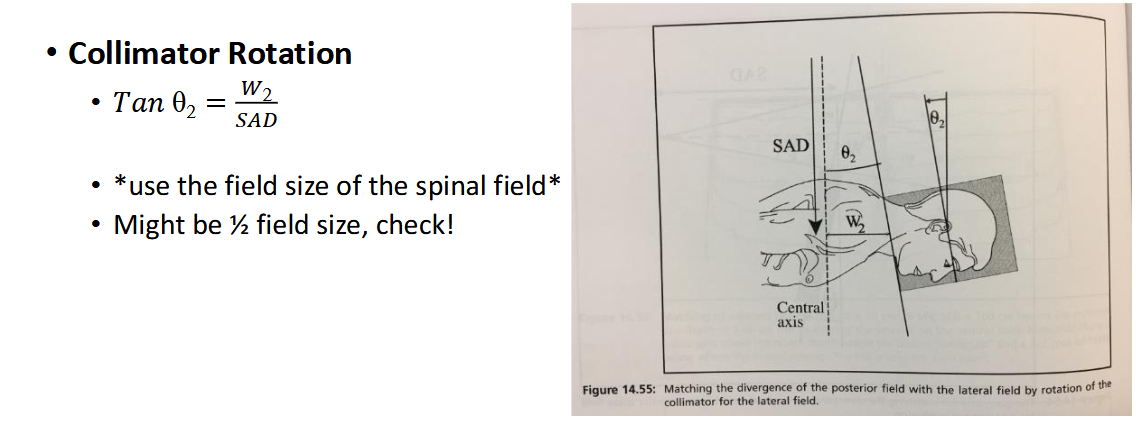
collimator rotation for CSI
designed to eliminate divergence between
the inferior border of the brain field and the
superior border of the upper spine field
couch rotation formula
𝑇𝑎𝑛 θ1 = 𝑊1/𝑆𝐴𝐷
collimator rotation formula for CSI
ex slide 9 of 3d beam arrangements ppt
what percent of primary CNS tumors are brain tumors
85-90
the
most frequent symptom of both benign and malignant spinal tumors
non mechanical back pain
cornerstone of treatment for primary spinal tumors
surgery, “en bloc resection”