Tissue 1 & 2
 Call Kai
 Learn
Learn Practice Test
 Spaced Repetition
 Match
Match Flashcards
 Knowt Play
1/50

There's no tags or description
Looks like no tags are added yet.
Name | Mastery | Learn | Test | Matching | Spaced | Call with Kai | Chat |
|---|
No analytics yet
Send a link to your students to track their progress
51 Terms
Name of the membrane that a connective tissue supporting the Epethial tissue
Basement Memebrane
What is an important special feature of cancerous epithelial cells
Fail to respect the boundaries of Basement membrane
What is basement membrane made of?
Basal Lamina that sits on top of reticular lamina
What is basal lamina and reticular lamina made of?
Basal lamina- supportive underlying sheet of glycoproteins
Reticular - Collagen fibres
What are
two important functions of the basement membrane?
????
Whta is the 4th structural characteristic of epethelia tissue?
Innervated but avascular?
name all 5 special characteristics and its explaination
- Polarity
- Specialized contacts: tight junctions & desmosome
- Supported by connective tissue: Basement membrane is composed of a basal lamina siting on top of a reticular lamina.
- Innervated but avascular
- Regeneration
What is innervated but avascular and HOW are they NOURISHED?
????
What does REGENRATION characteristic do?
Why is it NECESSARY?
???
Define the epithelial tissue
Sheet of cells COVERING body surface/ LINES body cavity
Epethelial tissue - 2 types
Covering and lining epithelial
Glandular epithelium
Name 6 functions of epithelia
?????
How many criteria to classify epithelia cells? What are they? Define each’s shape and charcteristics
2
(1) Cells shape → Squamos, Columnar
(2) Number of layers —→ Simple epithelia (thin basement membrane, has both laminas. membrane has single rods)
—> Stratified epithelia (long basement with many cell shapes)
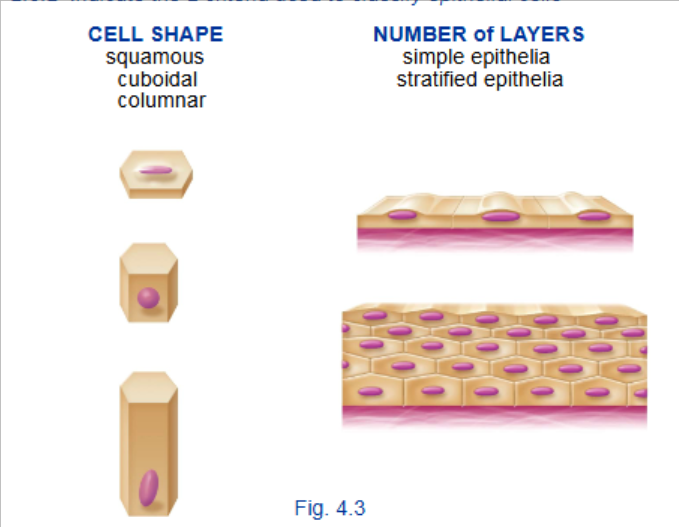
List the 4 types of simple epithelia
1) Simple squamous epithelium
2) Simple cuboidal epithelium
3) Simple columnar epithelium
4) Pseudostratified (ciliated) columnar epithelium
Name the 1st simple epithelium and definition, function
1) Simple squamous epithelium
Thin & permeable—→ allows FILTRATION + DIFFUSION
Sample body location of Simple squamous? Why??
Name 2nd simple epithelium and definition, function, body location- why?
Simple cuboidal epithelium: more cubicol and together
- for SECRETION + ABSORPTION
Kidney tubules, small glands
Name 3rd simple epithelium and definition, function, Sample body location?- why here only?
Simple columnar epithelium: vast
- SECRETION + ABSORPTION
In the GI TRACT
Last sample epithelia? (check hint)
Pseudostratified (ciliated) columnar epithelia
What is Pseudostratified (ciliated) columnar epithelia?, sample body location? What is the appearance like?
Single layer with cilia + mucus secretion such as in the respiratory tract
STRATIFIED epithelium APPEARANCE

State which is which type of simple epithelia tissue

What is a STRATIFIED squamous epithelium, what do they do? Why? give location
Basal cuboidal cells
Protective role
-Undergo MITSOS for regenerating layers from below
Where???

What is the most widespread example of
stratified squamous epithelium?
What happens to the apical layers of cells
?????
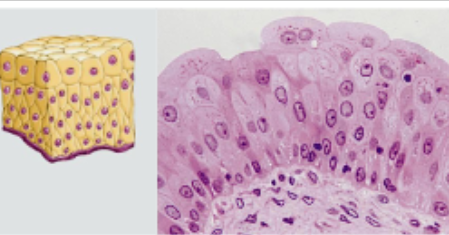
what is Transitional epithelium? Function- How?
A stratified epithelium with MIX of columnar and squamous cell
Line bladder. How?
-Has basal layer in CUBOIDAL shape + atypical layers = allows flattened and squamous fulling happen

Define gland, give examples
1 or more cells that make & secrete a particular products
Endocrine, exocrine, unicellular/ multicellular
What is an endocrine Gland?
Ductless
From HORMONES
What is an Exocrine Glands
Mucouse/ sweat/ oil. salivary Gland/ LIVER/ PANCREAS
Are Exocrine glands unicellular exocrine gland / multicellular exocrine glands?
Both
Relation between ducts and glands?
Ducts offer physical framework of support to carry SECRETION.
Certain glands in EXOCIRNE glands don’t need ducts
Difference between unicellular exocrine glands and multicellular. How does CT help here?
Unicellular exocrine:
Mucus cells + Goblet cells (1 body)
- found in Digestive + respiratory tracts
1 cell with no duct
Explanation: 1 body that secretes onto surface
Multicellular exocrine glands:
Epithelium derived duct + secretory cells
- surrounded by CT (connective tissue)—→ brings BLOOD VESSELS & nerves
Explaination: (Gland itself is epithelium with ducts supported by CT the framework hold GLAND and physically support transport of blood supply + nerves.
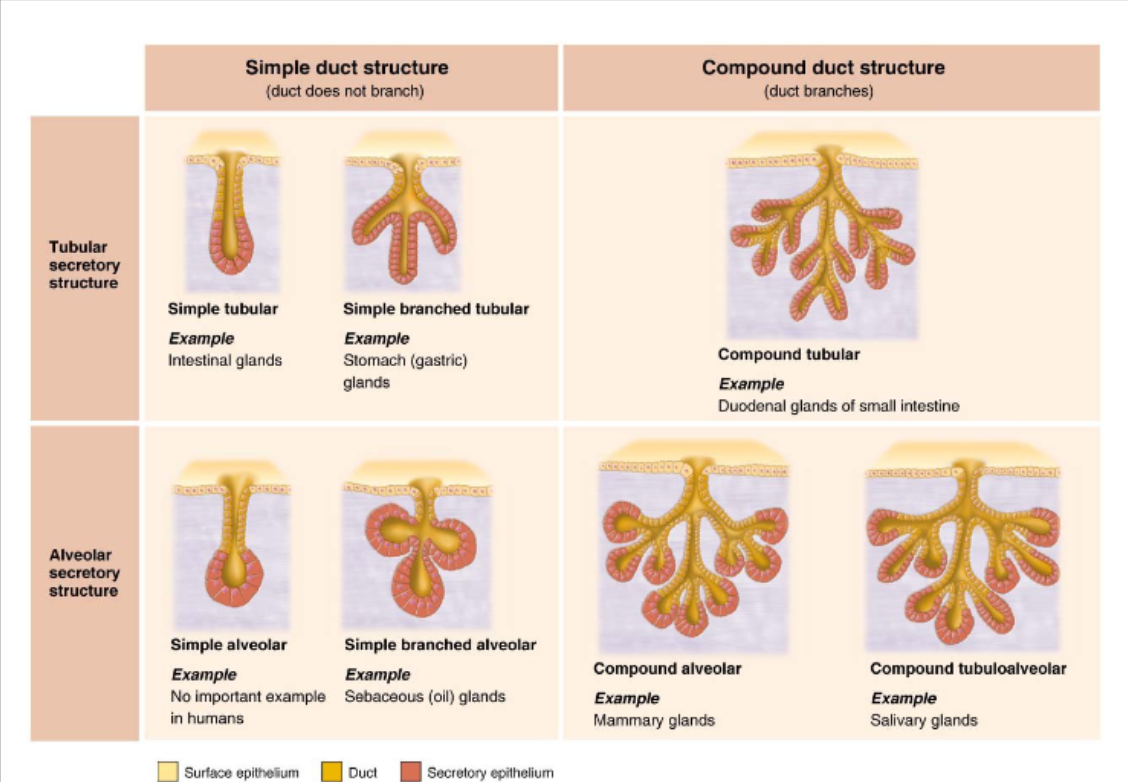
types of multicellular exocrine glands, branched duct or not? where?
Tubular secretory structure = no duct branching
Simple tubular: Eg Intestinal glands
Simple branched tubular - Eg: Stomach gastric glands
Tubular secretory structure= Duct branching
Compound tubular- Eg: Duodenal glands of SI (small intestine)
Alveolar secretory structure
Simple alveolar (no example in human)
Simple branched alveolar (Sebaceous= oil glands)
Compound alveolar- Eg: Mammary glands
How many secretory methods?
3
most common ty of secretory methods?
Merocrine exocytosis secretion