Hepatobiliary Disorders & End-Stage Disease
 Call Kai
 Learn
 Practice Test
 Spaced Repetition
 Match
 Flashcards
 Knowt Play
1/66

Earn XP
Description and Tags
67
67 Terms
liver structure
Weight: 1,200–1,600 g
Right lobe (caudate and quadrate), left lobe
Produces bile for fat digestion and absorption.
Metabolizes nutrients from small intestine.
liver anatomical structures
Hepatic artery, hepatic vein, portal vein
Common bile duct (CBD)
Ampulla of Vater
Sphincter of Oddi
Kupffer cells: PAC-MAN cells of liver
Specialized liver macrophages
Remove bacteria, viruses, foreign particles, damaged RBCs and fats.
Assist tissue repair and regeneration.
Release cytokines and chemokines.
organ weights
Organ | Weight | Age-related change per lecture |
|---|---|---|
Liver | 1,200–1,600 g | Increases |
Heart | 250–350 g | Slightly increases |
Kidney | 135–150 g | Slightly decreases |
liver functions (8)
Secretes alkaline bile/bile salts.
Metabolizes bilirubin.
Stores blood for release during hemorrhage.
Produces clotting factors.
Processes vitamins A, D, K.
Metabolizes fats, proteins and carbohydrates.
Regulates blood glucose.
Detoxifies toxins, drugs, hormones and alcohol.
gallbladder (structure and fxn)
Concentrates and stores bile between meals.
Receives bile through cystic duct.
Holds 90 mL.
Bile contains water, electrolytes, bile salts, pigments and cholesterol.
Bile salts emulsify fats.
pancreas (structure)
20 cm long
Head behind stomach; tail touches spleen.
pancreas (fxn)
Liver + gallbladder + exocrine pancreas: provide substances necessary for digestion of chyme.
exocrine: secretes alkaline digestive fluid to neutralize acidic chyme
endocrine: secretes hormones that regulate blood and glucose and other functions
insulin: ↓ BG by moving glucose into cell
glucagon: ↑ BG during hypoglycemia (fat metabolism)
somatostatin: inhibits growth hormone release from anterior pituitary
produced by hypothalamus, pancrease, GI tract
pancreatic polypeptide: elevated levels may suggest diabetes or a tumor
progression of liver disease
Healthy liver → fibrosis → cirrhosis → possible carcinoma.
Fibrosis: scarring, hardening, ↓ metabolic function.
Cirrhosis: permanent, extensive scarring.
ESLD: irreversible organ failure.
Hepatocellular carcinoma: liver cancer (lecture: 6th most common, 3rd deadliest).
Older adults: ↑ insulin resistance → hyperglycemia.
acute liver failure def + causes
rapid loss of liver fxn over days to weeks
causes:
Acetaminophen (Tylenol) overdose
Viral hepatitis
Prescription medications
Autoimmune disorders
Heat stroke, toxins, cancer
Hepatotoxic herbs/supplements
Herbs mentioned: St. John's wort, aloe vera, black cohosh, cascara, chaparral, comfrey, ephedra, kava.
liver disease sxs
N/V, anorexia, abdominal pain, diarrhea
Jaundice, pruritus, metallic odor
Fatigue, malaise, sleepiness
Headache, disorientation, tremors
Ascites
asterixis: flapping hand tremors associated with hepatic dysfunction and encephalopathy
diagnostic labs
↑ Liver enzymes (AST/ALT)
↑ Bilirubin
↑ PT/INR
↑ Ammonia
waste product of protein metabolism (liver dysfunction allows ammonia to accumlate → affect neurological fxn)
MAJOR COMPLICATIONS
CBIO → cerebral edema, bleeding, infection, organ failure
Complication | Explanation |
|---|---|
Cerebral edema | Toxin accumulation → brain swelling and altered LOC |
Bleeding | ↓ clotting factor production |
Infection | Impaired ability to fight infection |
Organ failure | Liver and kidney failure |
viral hepatitis
Type | Transmission | Progression |
|---|---|---|
A | Fecal-oral; contaminated food/water | Acute |
B | Blood, body fluids, needles, sex, mother to child | Acute → chronic |
C | Blood, transfusions, dialysis, tattoos, sex, mother to child | Acute → chronic |
D | Requires hepatitis B infection | Coinfection |
E | Fecal-oral; associated with Asia in lecture | Acute |
hepatitis A
Prevention: handwashing, vaccination, clean food/water.
Management: rest, hydration, nutrition, avoid alcohol.
hepatitis B
Prevention: vaccination, safe sex, no shared needles.
Management: antivirals (lamivudine), monitor liver function.
hepatitis C
Prevention: no shared needles, safe sex.
Management: antivirals.
other viruses associated w/ hepatitis
Epstein-Barr virus (EBV): mononucleosis and acute hepatitis.
Cytomegalovirus (CMV): especially in immunocompromised patients.
portal hypertension
Abnormally high pressure in the portal venous system D/T increased resistance to blood flow.
Normal: 3 mmHg
Portal hypertension: greater than 10 mmHg
portal HTN patho
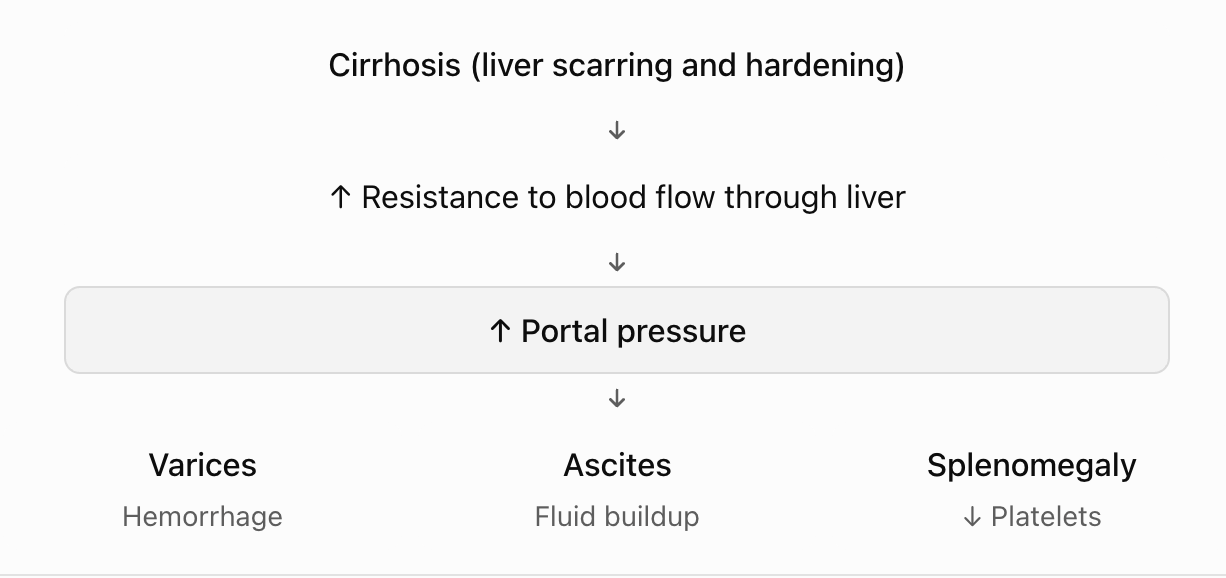
Cirrhosis → liver hardens → ↑ resistance to blood flow → ↑ portal pressure → collateral veins enlarge.
portal HTN sxs
ABCDE
ascites
bleeding (hematemesis, hemorrhoids)
colossal liver (hepatomegaly)
distended epigastric veins
enlarged spleen (splenomegaly)
varices
Distended, tortuous collateral veins.
Rupture → bright red hematemesis.
Bleeding esophageal varices = EMERGENCY.
splenomegaly
↑ Splenic venous pressure → enlarged spleen → thrombocytopenia.
Assess abdominal pain and organ enlargement.
portal HTN medical and surgical management
Intervention | Purpose |
|---|---|
Beta-blockers | Reduce portal pressure |
IV vasopressin | Temporarily lowers portal pressure |
Sclerotherapy | Treats bleeding varices |
Variceal ligation | Bands varices |
Sengstaken-Blakemore tube | Balloon tamponade to control bleeding |
Shunt procedures | Redirect blood flow to relieve portal hypertension (portacaval, splenorenal, transjugular) |
Liver transplantation | Treats underlying severe liver failure |
transjugular intrahepatic portosystemic shunt: connects the portal vein to the hepatic vein → redirects blood flow → decreases portal hypertension.
ascites def and causes
accumulation of fluid in peritoneal cavity
causes
Cirrhosis (most common)
HF, constrictive pericarditis
Abdominal malignancies
Nephrotic syndrome, malnutrition
ascites main mechanisms
Portal hypertension
↓ Albumin
Renal sodium/water retention
Changes in capillary hydrostatic pressure
Albumin: Maintains oncotic pressure → keeps fluid inside blood vessels.
↓ Albumin → fluid leaks out of vessels → ascites.
Nephrotic syndrome: ↑ protein in urine, ↓ protein in blood, ↑ cholesterol/triglycerides.

jaundice
Yellow discoloration D/T hyperbilirubinemia (↑ bilirubin) → sxs not condition
types
obstructive: Blockage of common bile duct → impaired bile drainage
hemolytic: excessive RBC destruction → increased bilirubin production
causes: ABO incompatibility, sickle cell disease, certain infections
causes: cirrhosis, hepatitis, gallbladder obstruction, cancer
sxs: clay-colored stool, dark urine, pruritus
hepatorenal syndrome (def + patho)
functional renal failure d/t advanced liver dz
patho: Cirrhosis → vasodilation → ↓ effective circulating blood volume → ↑ RAAS → renal vasoconstriction → ↓ renal perfusion → sodium/water retention
hepatorenal syndrome sxs
Oliguria (UO below 30 mL/hr)
Sodium/water retention
Hypotension (SBP below 100 mmHg)
Anorexia, weakness, fatigue, pruritus
hepatorenal syndrome (diagnostic labs)
↑ BUN, creatinine
↓ Creatinine clearance, GFR
Urine specific gravity >1.015
↑ Urine osmolality
↓ Urinary sodium
BUN: helps assess hydration and renal function. May increase with dehydration.
Creatinine: helps assess kidney filtration/function.
hepatorenal syndrome (management)
Confirm liver disease and AKI.
Priority: support renal blood flow.
IV albumin 20–25% (1 g/kg/day × 2 days, lecture regimen).
Correct electrolyte imbalances.
Antibiotics for infection.
Paracentesis
Hemodialysis/CRRT until transplantation when indicated.
Evaluate for liver/kidney transplantation.
MELD score mentioned in lecture: 38–40 in patients with severe disease requiring transplant evaluation.
hepatic encephalopathy (def + patho)
( aka portal-systemic encephalopathy )
Impaired behavioral, cognitive and motor function D/T accumulation of toxins that the liver cannot adequately remove.
May develop rapidly with acute liver failure.
May develop gradually with cirrhosis.
toxins involved: ammonia (most important), cytokines, serotonin, tryptophan
patho: Liver cannot detoxify wastes → accumulation of ammonia → impaired behavioral, cognitive and motor function.
hepatic encephalopathy stages
Stage | Manifestations |
|---|---|
0 | No abnormalities |
1 | Behavioral changes, mild confusion, disturbed sleep |
2 | Lethargy, moderate confusion, asterixis |
3 | Somnolent but arousable |
4 | Coma |
hepatic encephalopathy (diagnostics and tx)
Diagnostic Lab ★: ↑ Ammonia
Treatment — Lactulose ★
Lactulose | |
|---|---|
Purpose | Reduce ammonia |
Action | Traps ammonia in GI tract for elimination |
Excretion | Through stool |
Expected therapeutic effect | Improved mental status and reduced ammonia burden |
cirrhosis (def + patho)
Definition: Irreversible inflammatory, fibrotic liver disease.
Pathophysiology: Cellular injury → leukocyte infiltration → inflammatory mediators → fibrosis → ↓ perfusion and liver function.
Chronic alcohol consumption causes toxin accumulation.
Alcohol-related liver injury is emphasized as a greater vulnerability in women.
Removing toxins can slow progression and enhance regeneration.
cirrhosis (risk factors)
Major risk factors:
Chronic alcohol use
Overweight/obesity
Viral hepatitis
Other risk factors:
Primary sclerosing cholangitis: scarring of bile ducts
Hemochromatosis: excess iron accumulation
Wilson's disease: excess copper accumulation
Autoimmune hepatitis: immune-mediated liver injury
clinical types of cirrhosis
Type | Cause/characteristics |
|---|---|
Laennec's | Chronic alcoholism and malnutrition; fibrosis around portal/central veins |
Biliary | Bile duct injury or prolonged obstruction |
Postnecrotic | Hepatitis |
Pigment | Hemochromatosis (excess iron) |
Idiopathic | Unknown cause |
Noncirrhotic fibrosis | Schistosomiasis, congenital hepatic fibrosis or idiopathic disease |
cirrhosis (goals of tx)
Slow progression, relieve symptoms, prevent complications.
Treat underlying cause.
Alcohol cessation, weight loss, antivirals.
Manage comorbidities.
Liver transplantation
alcoholic fatty liver disease
Progression: Alcohol → steatosis → steatohepatitis → fibrosis → cirrhosis → possible liver cancer.
Steatohepatitis (precursor to cirrhosis)
↑ Hepatic fat storage
Inflammation
Hepatocyte degeneration/necrosis
Neutrophil and lymphocyte infiltration
Cirrhosis: Enzyme/protein alterations → hormone and ammonia buildup.
Complications: Ascites, splenomegaly, hepatomegaly, GI bleeding, encephalopathy, esophageal varices, renal failure.
nonalcoholic fatty liver disease (NAFLD → cause/associated)
Cause: Triglyceride accumulation in hepatocytes without significant alcohol consumption.
Associated conditions
High cholesterol
Metabolic syndrome
DM
Obesity
NAFLD (characteristics, progression, tx)
Characteristics
Most common chronic liver disease in U.S., per lecture.
Lecture estimate: 20 million unaware they have it.
Can progress to ESLD.
Progression (slide diagram): Simple steatosis → NASH → fibrosis/cirrhosis → hepatocellular carcinoma.
Treatment
Behavioral modification
Dietary counseling
Regular exercise
Meds: resmetirom (Rezdiffra) and semaglutide (GLP1)
primary biliary cirrhosis/cholangitis
Damage and inflammation begin in bile ducts.
Type | Cause |
|---|---|
Primary | Chronic autoimmune cholestatic liver disease |
Secondary | Partial/complete CBD obstruction → strictures, necrosis, edema, fibrosis, cirrhosis |
shortened life expectancy of 5-10 years
cirrhosis (assessment findings)
Area | S/S |
|---|---|
Abdomen | Hepatomegaly, pain, distention, bulging flanks, shifting dullness |
Nutrition | Anorexia, weight loss, muscle wasting |
General | Fatigue |
Skin | Jaundice, spider angiomas, telangiectasia, palmar erythema |
Nails | White nails, absent lunulae, finger clubbing |
Neuro | Confusion |
cirrhosis (nursing management)
Problem | Intervention |
|---|---|
Breathing | Sit patient upright |
Liver function | Monitor LFTs |
Portal HTN | Beta-blockers, monitor GI bleeding |
Ascites | Daily weights, low sodium, fluid restriction, diuretics, paracentesis |
Confusion | Monitor mental status/ammonia, safety |
Nutrition | Dietary modifications, nutritional balance |
Lifestyle | No alcohol, avoid hepatotoxic meds, vaccinations |
Other | Skin integrity, quality of life, address stigma |
Professor's emphasis:
Manage portal hypertension.
Prevent bleeding.
Use diuretics cautiously to avoid kidney damage.
paracentesis (purpose)
Purpose: Passive drainage of peritoneal fluid.
Relieves pressure on diaphragm → improves breathing.
Increasing frequency may indicate worsening disease.
paracentesis (pre-procedure)
Explain procedure, obtain consent.
Assemble equipment.
Baseline VS, weight, assess ascites.
Assess bleeding/coagulation.
Pain medication, empty bladder.
Position supine with pillows (not completely flat).
Spiritual support.
paracentesis (post-procedure)
Monitor VS and fluid balance.
Assess ascites, bleeding and infection.
acute pancreatitis (cause)
Cause: CBD/pancreatic duct obstruction (gallstones) → blocked digestive enzyme outflow.
Usually resolves spontaneously.
Lecture: 20% require hospitalization.
acute pancreatitis (sxs and complications)
Constant epigastric/mid-abdominal pain
Abdominal distention, ascites
Hypovolemia
Fluid leaks into abdominal cavity → risk of hypovolemic shock.
hypotension, tachycardia
Myocardial insufficiency
Renal failure
Hypocalcemia → tetany
Free fatty acids bind calcium → ↓ available calcium.
Hyperglycemia
Multisystem organ failure (MSOF)
acute pancreatitis (nursing priorities)
Restore blood volume — HYDRATION!
Monitor blood glucose — HYPERGLYCEMIA!
Monitor for excessive thirst and weight loss.
Professor's reminder: Pancreatitis → always think of diabetes.
chronic pancreatitis (def, causes, effects)
Definition: Progressive fibrotic destruction of pancreas.
Causes/associated factors: Smoking, gallstones, islet cell destruction.
Effects
Enzyme deficiency → malabsorption.
DM
Severe chronic pain
cause: ↑ Intraductal pressure, ischemia, neuritis, intra-abdominal HTN, compartment syndrome, ongoing injury.
↑ Risk of pancreatic cancer
chronic pancreatitis (management, pain meds)
Management
Pancreatic enzymes → prevent malabsorption.
Vitamins A, D, K
Nutrition
Manage DM.
Surgical intervention
Pain management
Pain medications listed in lecture
Mild/moderate: acetaminophen, NSAIDs.
Severe: tramadol, codeine.
primary liver cancer (risk factors, dx, management, prevention)
Risk factors
Toxins in spoiled corn, peanuts, grains
Alcohol abuse
Obesity
Chronic liver disease
Hepatitis B
Diagnosis
Difficult to determine.
CT, MRI, bone scans
Biopsy concern: tumor seeding.
Management: Surgery, transplant, radiation, chemotherapy, targeted therapy.
Primary prevention: HBV vaccination.
pancreatic cancer (sxs, diagnosis)
S/S
Weight loss
Vague upper abdominal pain
Hyperglycemia
Jaundice
Clay-colored stool
Dark urine
Diagnosis: CT, CT-guided needle biopsy, MRI, symptoms.
pancreatic cancer (management)
High-calorie, bland, low-fat diet.
Small frequent meals.
Avoid alcohol.
Anticholinergics
Chemotherapy, radiation
Stent for blocked CBD
Whipple procedure
whipple procedure (pancreaticoduodenectomy)
Indications: Cancer, trauma, tumors, chronic inflammation.
Structures removed
Head of pancreas
Duodenum
Gallbladder
Distal CBD
Part of stomach
whipple procedure (post op complications)
Bleeding, infection
Delayed gastric emptying
Duct leakage
Peritonitis
Intestinal obstruction
Hypotension
Steatorrhea
Short-/long-term DM
whipple procedure (nursing management)
Hydration, pain management, education.
Pancreatic enzymes
Monitor BG.
NG tube for gastric decompression.
Assist first ambulation (risk of syncope).
IV morphine mentioned in speaker notes.
Low-fat diet after gallbladder removal.
liver transplantation (post op assessment, sxs of rejection)
MELD: Model for End-Stage Liver Disease
Post-transplant assessment
VS, temperature
Fluid and nutritional intake
Weight
Labs
Signs of rejection
Fever
Graft tenderness
Pain over incision
N/V, malaise
Organ dysfunction
liver transplant (patient education)
Immunosuppressants prevent rejection.
Infection-prevention medications and vitamins.
Take medications at same time daily.
No live vaccines.
Report infection/rejection immediately.
Regular clinic visits and labs.
best practices for care!!
Prevent bleeding/hemorrhage.
Reduce ascites and balance fluids.
Maintain adequate nutrition.
Maintain skin integrity/manage pruritus.
Administer medications.
Monitor labs: AST, ALT, bilirubin, PT/INR, glucose.
Rest periods and activity progression.
Psychosocial, spiritual, palliative/hospice support.
liver dz diet
Early stages | Advanced stages |
|---|---|
High protein | Protein, fiber, fat and sodium restrictions |
High carbohydrates | Dietary modifications |
Six small frequent meals
Gastric decompression when indicated
liver dz coag
Damaged liver → ↓ clotting factors → bleeding.
PT/INR: extrinsic pathway (emphasized).
PTT: intrinsic pathway.
general meds (5)
Medication | Purpose |
|---|---|
Lactulose | ↓ Ammonia |
Diuretics | ↓ Ascites/fluid overload |
Antipruritics | Relieve itching |
Vitamin K | Clotting |
Lamivudine | Hepatitis B |
immunosuppressants
Generic | Brand |
|---|---|
Tacrolimus | Prograf (gold standard per professor) |
Azathioprine | Imuran |
Sirolimus | Rapamycin |
Cyclophosphamide | Cytoxan |
Cyclosporine | Sandimmune/Neoral |
Prednisone | Deltasone |
Cyclosporine: monitor kidney function.
Prednisone: corticosteroid, prevents inflammation/rejection.
Corticosteroid S/E: hyperglycemia, weight gain, moon face.
antivirals
Generic | Brand |
|---|---|
Acyclovir | Zovirax |
Ganciclovir | Cytovene (CMV) |
Lamivudine | Epivir (Hep B) |
Infection prevention
Nystatin (Mycostatin): antifungal.
Pentamidine nebulizer
Bactrim DS
other meds
Docusate
Nifedipine (BP control)
Ferrous sulfate
Magnesium
normal lab values!!
Lab | Normal range |
|---|---|
Glucose | 70–100 mg/dL |
Potassium | 3.5–5.0 mEq/L |
Sodium | 135–145 mEq/L |
Bilirubin | 0.3–1.0 mg/dL |
Albumin | 3.5–5.0 g/dL |
BUN | 6–20 mg/dL |