3- Surgical Management of Oral Pathologic Lesions (Dr. Oreadi)
 Call Kai
 Learn
 Practice Test
 Spaced Repetition
 Match
 Flashcards
 Knowt Play
1/75

There's no tags or description
Looks like no tags are added yet.
76 Terms
Define the following:
An abnormal mass of tissue, benign or malignant
Tumor
Define the following:
Closed sac-like structures within a tissue that contains a liquid, caseous or semisolid substance
Cyst
What are the two types of cyst and cyst-like lesions?
1) arising from odontogenic epithelium
2) from oral epithelium that is trapped between fusing processes during embryogenesis
Why do we call some cysts tumors?
- Aggressive biologic behavior
- Recurrence rate
T/F: Cysts and cyst-like lesions usually present with pain
False
T/F: Cysts and cyst-like lesions may be fluctuant on palpation if the cyst has eroded through the cortical plate
True
Define the following:
A dysmorphic proliferation of native tissue which will gain a certain size, then cease growth
Hamartoma
Define the following:
A dysmorphic proliferation of non-native tissue which will gain a certain size, then cease growth
Choristoma
Define the following:
A dysmorphic continual proliferation of native tissue which lacks the elaboration of proteins necessary for metastasis
Benign Neoplasm
Define the following:
A dysmorphic proliferation of native tissue which also possess the ability to elaborate the proteins necessary for metastasis
Malignant Neoplasm
All of the following are basic principles of what?
- Remove entire tumor en-bloc
- Respect anatomic barriers
- Avoid tumor seeding
- Clear radiographic margins
- Clear soft tissue margins
- Functional and aesthetic rehabilitation
Tumor surgery
What are all of the following?
- Mucosa
- Bone cortex
- Periosteum
- Muscle
- Skin
- Periodontal membrane
Anatomic barriers
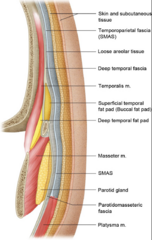
What are the basic goals of tumor surgery?
- Eradication of the Pathologic Condition
- Functional Rehabilitation of the Patient
- "Cure with quality of life in mind"
What are the two types of cyst and cyst-like lesions?
1) Those arising from odontogenic epithelium
2) Those from the oral epithelium that is trapped between fusing processes during embryogenesis
What has the following characteristics?
- Usually asymptomatic unless secondarily infected
- May be fluctuant on palpation if the cyst has eroded through the cortical plate
Cyst and cyst-like lesions
What type of tumors are all of the following?
- Ameloblastoma
- - Unicystic
- - Solid or Multicystic
- - Peripheral
- - Malignant ameloblastoma
- - - Ameloblastic Carcinoma
Odontogenic tumors
What type of tumors are all of the following?
- Clear Cell Odontogenic Carcinoma
- AOT
- CEOT
- Squamous Odontogenic Tumor
Odontogenic tumors
What type of tumors are all of the following?
- Ameloblastic Fibroma
- Ameloblastic Fibro-Odontoma
- Ameloblastic Fibrosarcoma
- Odontoameloblastoma
- Odontoma
Mixed odontogenic tumors
What type of tumors are all of the following?
- Central Odontogenic Fibroma
- Peripheral Odontogenic Fibroma
- Granular Cell Odontogenic Tumor
- Odontogenic Myxoma
- Cementoblastoma
Odontogenic Ectomesenchyme tumors
What type of surgical management?
- The process by which the total removal of a cystic lesion is achieved
- A shelling-out of the entire cystic lesion without rupture
- Attempt to remove the cyst in one piece without fragmentation, which reduces the chance of recurrence
Enucleation

ID the procedure:
Enucleation
What is the treatment of choice for removal of cysts of the jaws and should be used with any cyst that can be safely removed without unduly sacrificing adjacent structures?
Enucleation
The following are advantages of what treatment?
- Simultaneous diagnosis and treatment
Enucleation
The following are disadvantages of what treatment?
- Disease control
- May require additional surgery
- Specimen integrity
Enucleation
ID the surgical procedure:
Technique:
- Osseous window
- Thin-bladed curette with concave surface kept facing the bony cavity
- Avoid vital structures
- If obvious devitalization of teeth RCT may be necessary
Enucleation
After enucleation, radiographic evidence of bone fill will take___-___ months
6-12 months
What is the only entity that would require Marsupialization?
A) Ameloblastoma
B) Odontoameloblastoma
C) Odontogenic Myxoma
D) Odontogenic Keratocyst (OKC)
D) Odontogenic Keratocyst (OKC) - due to thin lining and difficulty removing in one piece
What type of surgical management?
- Creating a surgical window in the wall of the cyst, evacuating the contents of the cyst, and maintaining continuity between the cyst and the oral cavity (maxillary sinus, or nasal cavity)
- The only portion of the cyst that is removed is the segment excised to create the window
- The remaining cystic lining is left intact
- The process decreases intracystic pressure and promotes shrinkage of the cyst and bone fill
Marsupialization
T/F: The main goal of marsupialization is to decrease intracystic pressure and promote shrinkage of the cyst and bone fill
True
The following are indications for what surgery?
A) Cannot remove entire cyst in one unit
B) Extent of defect could result in pathologic fracture
C) Anatomic structures are at risk with more invasive surgery
D) Compliant patient
E) Enucleation could result in loss of multiple teeth
Marsupialization
The following are advantages of what treatment?
- Simple procedure to perform.
- It may also spare vital structures from damage during enucleation
Marsupialization
The following are disadvantages of what treatment?
- The pathological tissue is left in situ, without thorough histological examination until enucleation
- Requires absolute follow-up
- Requires a cooperative patient
- May require additional (repeat) procedure
- May allow development of infection
- Slower healing process
Marsupialization
ID the surgical procedure:
Technique:
- LA, aspirate
- Bony window
- Cyst is then incised to remove a window of lining, which is submitted for pathological evaluation. The contents of the cyst are evacuated
- Placement of tube or suture lining with oral mucosa
Marsupialization
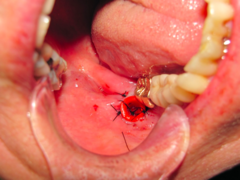
ID the procedure:
Marsupialization
Is marsupialization used as sole form of treatment of cyst?
No, in most cases, enucleation is done after
What has the following main advantage?
- The development of a thickened cystic lining, which makes the secondary enucleation an easier procedure
Enucleation after marsupialization
Main advantage of marsupialization is ________, which makes the secondary enucleation an easier procedure
The development of a thickened cystic lining
T/F: You should graft immediately after surgical removal of a pathology
False
T/F: The complete removal of OKC in one piece is difficult
True
What is the recurrence rate of OKC?
30-40%
(Can recur up to 10 years later; May invade skull base)
What is the typical treatment for an OKC?
Curettage with close follow-up
After you Marsupialize a newly diagnosed OKC, gone through enucleation and curettage, when would you resect (2)
- Large multilocular ones
- Multiple recurrent ones
OKC is associated with what Syndrome?
Nevoid basal cell carcinoma syndrome (Gorlin syndrome)
T/F: The orthokeratinized odontogenic cyst does not have the same clinical pathologic importance as the OKC
True
Nevoid Basal Cell Carcinoma Syndrome is a hereditary condition resulting from mutations in the _______ gene
PTCH1 gene
What are signs/symptoms that the doc listed for nevoid basal cell carcinoma syndrome aka Gorlin syndrome pts?
- Frontal bossing
- Calcified falx cerebri
- Multiple OKCs
- Perioral pitting
- Bifid ribs

What condition?
- Comprising the principal triad of multiple basal cell nevi, jaw keratocysts and skeletal anomalies
- May appear very early in life (2 years of age
- Odontogenic keratocysts (OKCs), palmar and/or plantar pitts and ectopic calcifications of the falx cerebri.
- Other clinical manifestations include congenital skeletal abnormalities (macrocephaly with frontal bossing, cleft lip and/or palate, rib and vertebral abnormalities)
- Also the presence of neoplasms or hamartomas such as medulloblastomas, meningiomas, lymphomesenteric cysts, fetal rhabdomyomas and ovarian and cardiac fibromas have also been reported
Nevoid Basal Cell Carcinoma Syndrome

When we treat OKC curettage, what must do all of the following EXCEPT:
A) Narrow access
B) Curette entire cyst in one piece
C) Preserve inferior alveolar nerve
D) Teeth regain response
E) Close mucosa, no packing
A) Need WIDE access!!
What technique?
Local removal of tumor by instrumentation in direct contact with the lesion
Enucleation and curettage

What technique?
In addition to mechanical removal of at least 2mm of peripheral bone
Enucleation and peripheral ostectomy
What are the types of resection for the maxilla:
- Partial
- Total
What technique?
Resection of the tumor by removing a full-thickness portion of the maxilla
Partial resection of maxilla
What technique?
Resection of a tumor by removal of the entire involved area
Total resection of maxilla
What are the types of resection for the mandible:
- Marginal
- Segmental
- Composite
What technique?
Removal of a tumor without disruption of the continuity of the bone
Marginal Resection

What technique?
Removal of a tumor by incising through uninvolved tissues around it creating a discontinuity defect
Segmental Resection
What technique?
Resection of a tumor with bone, adjacent soft tissues, and contiguous lymph node channels
Composite
When doing a marginal resection of the mandible, which will decrease the risk of mandibular fracture round angles or right angles?
Round angles
__________ positively identifies the pathologic condition and therefore directs the treatment of the lesion
Histological diagnosis
The prognosis is related more to the _________, which indicates the biologic behavior of the lesion, it positively identifies the pathologic condition and therefore directs the treatment of the lesion
Histological diagnosis
Is there a poorer prognosis associated with the maxilla or mandible?
Maxilla (bc symptoms occur late)
T/F: An aggressive oral lesion confined to the interior of the jaw (intraosseous), without perforation of the cortical plates, offers a better prognosis than one that has invaded surrounding soft tissues (extraosseous)
True
Slower growing lesions seem to follow a _______ course
Benign
Faster growing lesions seem to follow a _______ course
Malignant
What are the aggressive lesions that when resected should include the lesion and ~1 cm of uninvolved bony margins around the radiographic boundaries of the lesion (5)
- Ameloblastoma
- Myxoma
- Calcifying epithelial odontogenic tumor
- Squamous odontogenic tumor
- Ameloblastic odontoma
when performing marginal or partial resections on aggressive lesions, it is important to include the lesion and ____ cm of uninvolved bony margins around the radiographic boundaries of the lesion
1 cm
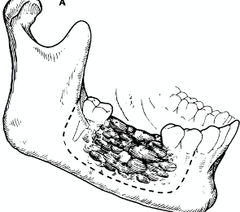
What type of resection is this?
Marginal resection
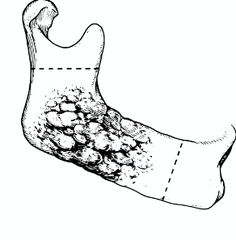
What type of resection is this>
Segmental resection
Reconstruction procedures should be planned and anticipated _______ initial surgery is performed
Before
Define the following:
Refers to assessing the extent of the disease before undertaking treatment
- Has two purposes:
1) Selection of the best treatment
2) Meaningful comparison of the end results reported from different sources
Clinical staging
What are four treatment modalities for malignancies?
- Surgery
- Radiotherapy
- Chemotherapy
- Combination of the above
The treatment of malignancies depend on what five factors?
- Histopathological diagnosis
- Location of the tumor and size
- Presence and degree of metastasis
- Age and general physical condition of patient
- Radiosensitivity or chemosensitivity of tumor
After the removal of oral tumors, how can you reconstruct soft tissue? (3)
- Primary closure
- Regional flaps
- Free flaps
After the removal of oral tumors, how can you reconstruct bone? (4)
- Bone Grafts
- Immediate
- Delayed
- Maxillofacial prostheses
Following a segmental mandibulectomy for oral cancer, which donor site is commonly used for a vascularized bone graft?
Fibula
A patient requires a non-vascularized bone graft following surgical removal of a jaw lesion. Which donor site is an option?
Posterior ilium