Surficial Exam 2
 Call Kai
 Learn
 Practice Test
 Spaced Repetition
 Match
 Flashcards
 Knowt Play
1/70

There's no tags or description
Looks like no tags are added yet.
71 Terms
What major processes control the chemical composition of natural waters?
Interaction with atmosphere, biological activity, mineral dissolution and precipitation, and human activities
What are the three major types of chemical weathering?
Hydrolysis, dissolution, and oxidation.
What are the main agents of chemical weathering?
Water, acids, dissolved oxygen
What are key effects of chemical weathering?
Weakens rock —> more vulnerable to mechanical weathering/erosion, affects landforms, controls soil formation/fertility, changes water/soil chemistry, regulates climate over time
Atoms
Basic building blocks of matter
Molecules
Two or more atoms bonded together
Ions
Charged atoms/molecules
Chemical Elements
Pure substances of one type of atom
Isotopes
Atoms of the same element with different numbers of neutrons
What gives a charge to an atom or molecule?
An imbalance between the number of protons (+) and electrons (-).
Why do atoms bond?
To reach a more stable, lower energy state, typically by filling their outermost valence electron shells.
Atomic Weight
The weighted average mass of an atom of an element, based on the relative abundance of its isotopes.
How do we calculate the molecular weight of a chemical compound?
By summing the atomic weights of all the individual atoms in the molecule's chemical formula.
How do you calculate the number of moles from a given mass?
Divide the mass in grams by the molecular or atomic weight in g/mol.
Thermodynamics
Study of energy and its transformation
What type of information does Thermodynamics provide?
Describes physical and chemical state of matter. Predicts energy changes for a given transformation.
What is a system
Part of the universe being studied.
How do you define a phase in a system?
A physically distinctive, chemically homogeneous, and mechanically separable part of a system.

Phase Diagram
As we cross the lines or curves on the phase diagram, a phase change occurs. 2 states of the substances coexist in equilibrium
Internal Energy (U)
Total kinetic/potential energy
Enthalpy (H)
U + PV; total heat of a system
Entropy (S)
Measure of disorder
Gibbs Free Energy (G)
Determines reaction spontaneity.
1st Law of Thermodynamics
Energy can be neither created nor destroyed, it can only be transferred from a system to its surroundings
2nd Law of Thermodynamics
In an isolated system, natural processes are spontaneous when they lead to an increase of entropy.
Evaluate if a reaction will lead to an increase or decrease in entropy.
Entropy increases when solids become liquids/gases, or dissolved particles increase.
What are conditions for spontaneous reactions?
Constant temperature, pressure, and Gibbs free energy is negative
What is a chemical reaction?
Process transforming reactant substances into different product substances.
What are common types of reactions?
Acid-base, solubility/precipitation, hydrolysis, redox, ion exchange
How do you write a chemical equation?
Reactants on the left, products on the right, separated by an arrow with stoichiometric coefficients.
What are the rules to balance a chemical equation?
Conserve mass and conserve electric balance

Equilibrium Constant
How is equilibrium related to thermodynamics?

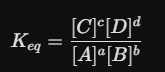
Write equilibrium constant of reactions using concentrations.
Right side divided by left side (except solids and liquids)
How can you measure disequilibrium?
Compare Activity Product to Keq. AP/Keq < 1 favors dissolution; AP/Keq > 1 favors precipitation.
What influences the composition of rainwater? Surface water? Groundwater?
Rainwater: atmospheric gases/aerosols. Surface water: weathering/runoff. Groundwater: prolonged rock-water interactions.
What are common water quality parameters?
Color, turbidity, total dissolved solid (TDS), hardness, electrical conductivity (EC), pH, Alkalinity, dissolved oxygen
What is included in a standard water chemical analysis?
Temperature, pH, EC, and major cations/anions.
Major Cations in Natural Waters
Ca2+, Mg2+, Na+, K+
Major Anions in Natural Waters
HCO3-, SO4 2-, Cl-

What are expected relative abundance of ions in the different types of water?
Ca-Mg-SO4 waters - gypsum groundwater, CA-HCO3 waters - shallow fresh groundwater, Na-Cl waters - seawater - rainwater, Na-K,HCO3 waters
What can impact the quality of a water analysis?
Sampling errors, contamination, delayed analysis, and instrumental limits.
How can you check error in analysis?
Perform a charge balance calculation in meq/L.
Convert concentrations to meq/L.
meq/L = (mg/L / Molar Mass) * Charge magnitude.

Piper Diagram
Acid
Substance that can donate a proton
Base
Substance that can accept a proton
Common Acids
Nitric Acid (HNO), Sulfuric Acid (H2SO4). Carbonic Acid (H2CO3), Formic Acid (CH2O2)
Common Bases
Lime (CaO), Portlandite (CA(OH)2), Brucite (Mg(OH)2, Limestone (CaCO3)
Recognize that a reaction is an acid or base dissociation reaction.
Look for a molecule splitting to release H+ or reacting with water to produce OH-.
Write the expression of the equilibrium constant (dissociation constant) for acid or base dissociation reactions.

Definition of pH

What is buffering.
When the pH is held steady because of the presence of a conjugate acid/base pair
What is hydrolysis?
H+ ions displace other ions to form a different mineral
What are some examples of hydrolysis reactions in geology?
Weathering of K-feldspar into kaolinite
How does a weathering profile develop?
1.) Solid bedrock (with original minerals like plagioclase)
2.) Water seeps in (percolation)
3.) Dissolves weak minerals (saprolite)
4.) Top layer builds (kaolinite and iron oxides)

Weathering profile graph.

Activity Diagram
Display the stability fields of a silicate mineral and its possible weathering products
What are key factors controlling silicate weathering?
Minerology, fluid flow, temperature, source of acid, open/closed system, composition of water
What are direct effects of silicate weathering on the environment?
Production of soils, 45% if total dissolved load of world’s rivers, mos pH-buffering mechanism, CO2 sink
Ionic Bonding
Electrostatic attraction between oppositely charged ions
Covalent Bonding
Sharing of valence electrons
Metallic Bonding
Metal cations sharing a 'sea' of electrons
Hydrogen Bonds
Weak electrostatic dipole-dipole interactions.
Open System
Exchange of both energy and matter
Closed System
No transfer of matter but possibilities for energy transfer
Isolated System
No transfer of energy and matter across the boundaries of the system
Intensive Properties
“Bulk” properties that can be specified at a particular point in the system. DON’T DEPEND on amount or size of system
Extensive Properties
Constitute a property of the whole system body. They are additive. DEPEND on amount or size of system
Examples of Intensive Properties
Temperature, pressure, density, concentration
Examples of Extensive Properties
Volume, mass, heat capacity, energy