Nervous System
 Call Kai
 Learn
 Practice Test
 Spaced Repetition
 Match
 Flashcards
 Knowt Play
1/34

There's no tags or description
Looks like no tags are added yet.
35 Terms

What does the nervous system do
Stimulus → Sensory input → CNS Processing → Motor output → Response

2 parts of the Nervous system
CNS = Brain + Spinal cord
PNS = nerves connecting body to CNS

Cerebral cortex
White matter → Communication (myelinated axons)
Grey matter → processing (nerve cell bodies)
Decides body movement
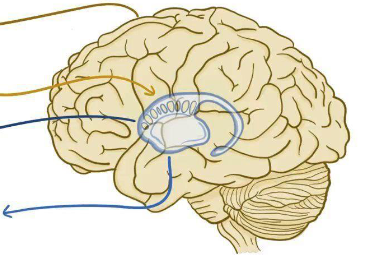
Basal ganglia/nuclei
Execute smooth movement
Millions of nerve cell bodies

Diencephalon
Thalamus
Epithalamus
Hypothalamus

Pituitary gland
Master gland
Produces hormones

Vertebral column
Cervical
Thoracic
Lumbar
Sacral
Coccygeal
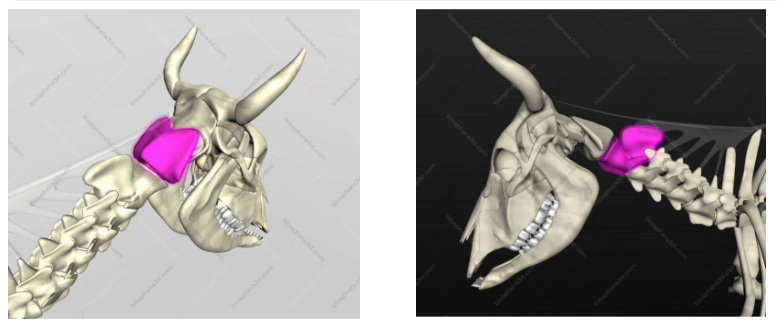
Atlas and Axis
First two vertebrae
Support the head

Flexibility of vertebrae
Intervertebral discs
Muscles and ligaments
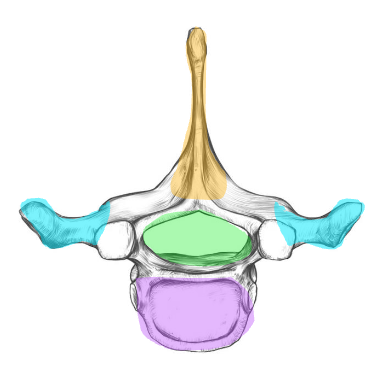
Parts of an individual vertebra
Dorsal → Spinous process
Middle → Vertebral canal
Ventral → Vertebral body
Sides → Transverse process

Intervertebral foramen
Opening between adjacent vertebrae

Spinal cord
Outer → White matter
Inner → Gray matter
Dorsal root → Sensory neuron
Ventral root → Motor neuron
Afferent
Arrives to CNS
Efferent
Exists CNS

How is CNS protected
Bones
Meninges
Cerebral spinal fluid

Meninges
Dura mater
Arachnoid
Sub arachnoid
Pia mater
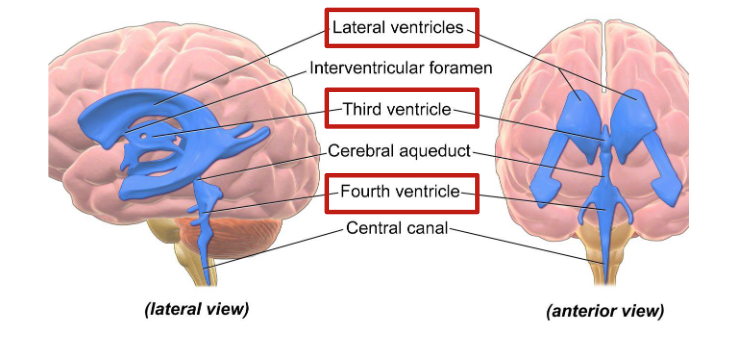
Ventricles
Lateral ventricles
Third ventricle
Fourth ventricle

Cerebrospinal fluid
Made in choroid plexus
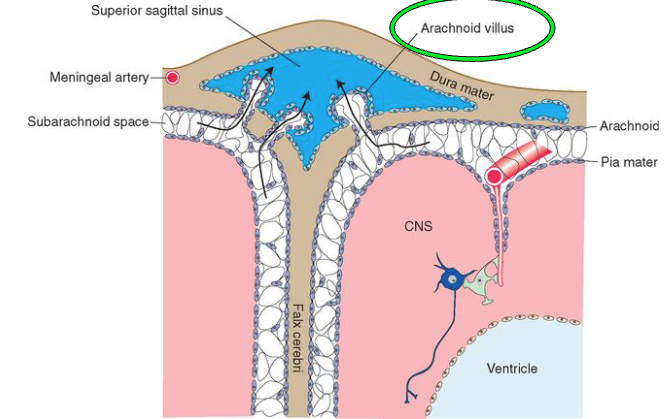
Arachnoid villi
Drain CSF from sub-arachnoid space into venus blood

Epidural injection
Needle injected into epidural space
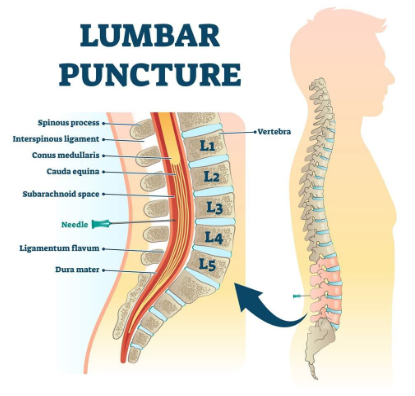
Spinal tap diagnoses
Meningitis
Subarachnoid hemorrages
Encephalitis
Guillain-Barre syndrome
Multiple sclerosis

Resting membrane potential is maintained by
Selective premeability
Ion pumps
Large anions trapped on inner surface of membrane

Selective permeability
Passive diffusion
Permeable to K
Barely permeable to Ca, Na, Cl

Ion Pumps
3 Na out
2 K in
Requires lots of energy

Large anions trapped on inner surface of membrane
Things trapped in the phosphomembrane of cell
Excitable cells
Skeletal muscle cells
Smooth muscle cells
Cardiac muscle cells
Neurons
Non-excitable cells
Red blood cells
Epithelial cells

Generation of Action Potentials (AP) in neurons
Depolarization
Repolarization
Hyperpolarization
Refractory period
Depolarization
Initial depolarization (stimulation) reaches threshold provoking opening of Na voltage gated channels
Influx if Na and rapidly close
Repolarization
K voltage gated channels open
Outflow of K
Hyperpolarization
K voltage gated channels close
Excess outflow of K
Refractory period
RMP restored through diffusion of Na/K pump
Neurons cant be restimulated until restored

Synaptic transmission
Presynaptic neuron releases neurotransmitters from axon terminal
Neurotransmitters in synaptic gap
Neurotransmitters attach to receptors on postsynaptic neuron to transfer nerve impulse
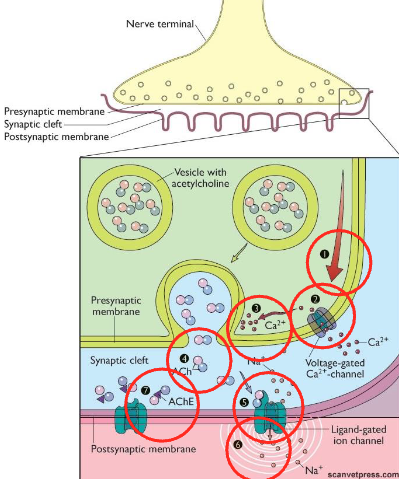
General mechanism of action in neuromuscular synapse
AP from pre-synaptic neuron
AP opens Ca voltage gated channels → Ca influx into presynaptic neuron
Ca triggers ACh exocytosis
ACh binds to specific receptors
Depolarization of post-synaptic neuron → Na channels open and Na flows in
Neurotransmitter inactivated
How the nervous system transduce a response
Stimulus → Sensory neuron → Dorsal root → Spinal cord → Brain → Motor neuron → Ventral root → Neuromuscular junction → Muscle contraction