Tests for ions, Gases, and Organic Functional Groups
 Call Kai
 Learn
 Practice Test
 Spaced Repetition
 Match
 Flashcards
 Knowt Play
1/9

There's no tags or description
Looks like no tags are added yet.
10 Terms
Describe the test for Ammonium Ion (NH4+)
Add sodium hydroxide solution and gently warm
the gas evolved turns damp red litmus paper → blue (ammonia gas)
Add HCl and white smoke is produced
Water test:
Add anhydrous copper (II) sulphate
which turns from white to blue (in presence of water
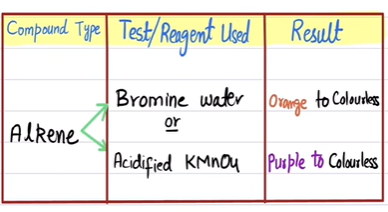
test for alkenes
[2 marks]
add bromine water
bromine water goes from orange to colorless
OR
add acidified KMno4
goes from purple to colorless
test for alcohol
[2 marks]
add PCl5
misty fumes (of HCl) produced
[Hold glass rod with conc. ammonia solution which gives white smoke of NH4Cl (g) ]
OR
add sodium
white solid forms and sodium disappears
state the functional group of ketones
ketones functional group = R2–C=O–R1
A ketone has a carbonyl group (C=O) bonded to two other carbon atoms
The smallest ketone is propanone (aka acetone)

Explain how a student can know if a test tube sample has ethanol or ethanoic acid or none of the above? [4marks]
- add PCl5, misty fumes are produced and if no misty fumes none are present
(indicating OH group, so it can be alchohol OH carboxylic acid COOH)
- add sodium carbonate solution
[NaCO3 is used to distinguish between alcohol and carboxylic acid]
- if there is no efferevescence ethanol is present
- if there is efferevescence of a gas that turns limewater milky, ethanoic acid is present
Give the test for primary alcohol [5marks]
add acidfied K2Cr2O7 and heat under distillation
color changes from orange to green
then add Tollens reagent to the product formed, which is aldehyde
if silvery mirror is produced then it was primary alcohol
NOTE:
heat under Distillation = incomplete combustion so aldehyde obtained
it is done to prevent further oxidation of the aldehyde to a carboxylic acid
heat under reflux = complete combustion so a carboxylic acid or ketone is obtained]
![<p></p><ul><li><p>add<mark data-color="yellow" style="background-color: yellow; color: inherit;"> acidfied K2Cr2O7</mark> and heat under<mark data-color="yellow" style="background-color: yellow; color: inherit;"> distillation</mark><br></p></li><li><p><mark data-color="yellow" style="background-color: yellow; color: inherit;">color changes from orange to green</mark><br></p></li></ul><ul><li><p>then add <strong><u><mark data-color="yellow" style="background-color: yellow; color: inherit;">Tollens reagent</mark></u></strong> to the product formed, which is <strong><u>aldehyde</u></strong><br></p></li><li><p>if<strong><u><mark data-color="yellow" style="background-color: yellow; color: inherit;"> silvery mirror</mark></u></strong> is produced then it was primary alcohol<br><br><br>NOTE:<br>heat under<strong><u> Distillation</u></strong> = incomplete combustion so <strong><u>aldehyde obtained</u></strong><br><br>it is done to prevent further oxidation of the aldehyde to a carboxylic acid<br><br>heat under<strong> <u>reflux</u></strong> = complete combustion so a<u> carboxylic acid or ketone</u> is obtained]</p></li></ul><p></p>](https://assets.knowt.com/user-attachments/e317992b-a5c7-4847-b291-fadc26291c00.png)
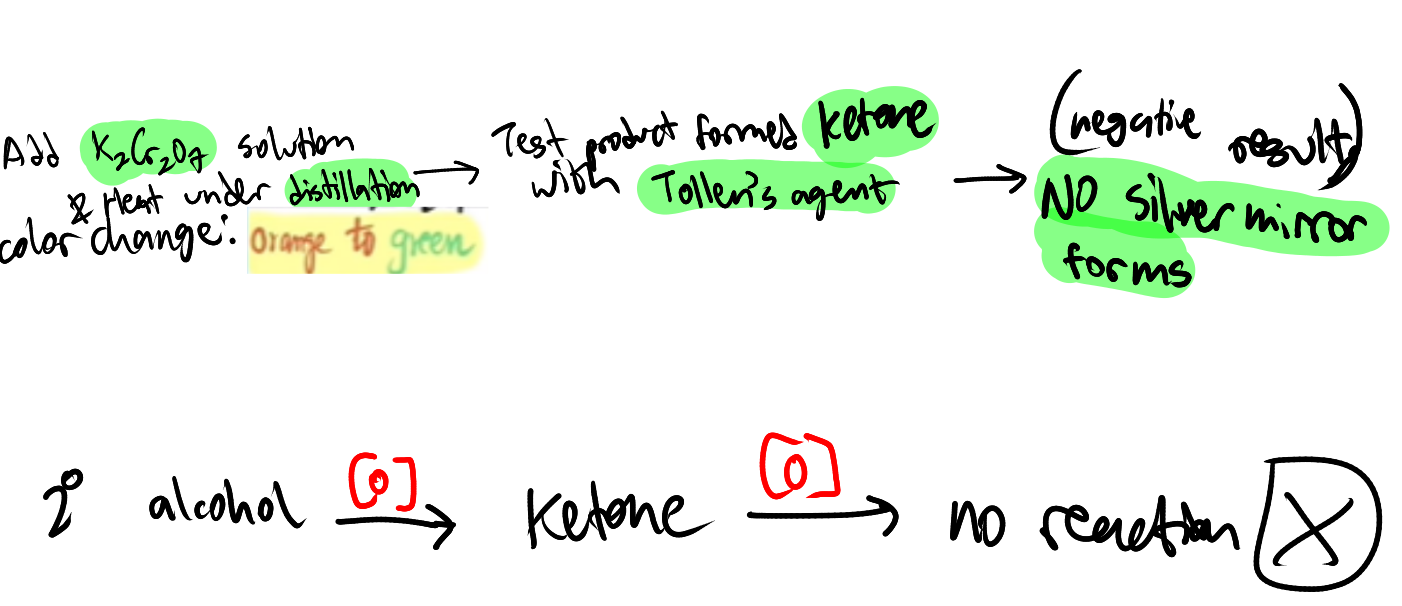
Give the test for secondary alcohol
[5 marks]
Give test for tertiary alcohol
[2marks]
add acidfied K2Cr2O7
solution remains orange as tertiary alcohol can't be oxidised
(no color change)
Test for aldehyde
[2marks]
add Tollen’s reagent and warm the mixture
silver mirror forms
OR
add Benedict’s/ Fehling’s solution
red precipitate produced
NOTE:
for ketone Tollen or Fehling, none gives any change