AI 2 (Beyond MLE)
 Call Kai
 Learn
 Practice Test
 Spaced Repetition
 Match
 Flashcards
 Knowt Play
1/17

There's no tags or description
Looks like no tags are added yet.
18 Terms
What are the two ways represent what we do not know?
Frequentist viewpoint
Bayesian viewpoint
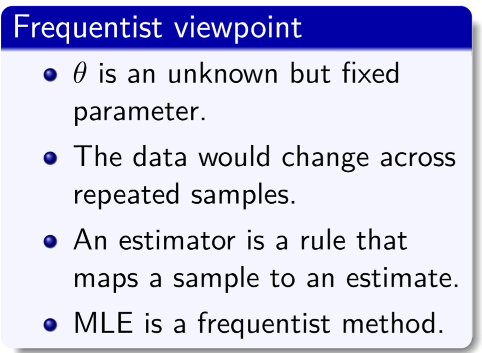
What is frequentist viewpoint?
What is Bayesian viewpoint?

What does posterior probability mean?
The revised probability after taking into account new data
What does a point estimate leave out?
→ Which other values of θ are available
→ Say θ MLE is 0.7, how strongly the data distinguishes 0.65 from 0.75
→ How prior information should affect the estimate
→ How to average over uncertainty when making an estimate
What are two Bayesian estimators to distinguish?

What does a Bayesian analysis do?

What is bayes rule for a parameter?

What is the formula for MAP?

What distinguishes MAP from MLE?
MLE uses the Likelihood, MAP use Likelihood multiplied by the prior.
How do you set up the MAP optimisation?

Derive the MAP optimisation ( g(θ)) to get θ̂MAP?

Why is the stationary point of MAP a maximum?
→ The log posterior is strictly concave therefore its interior stationary point is the unique maximum
Take the negative Logarithm of MAP.

What is Bayesian Interference?
Instead of returning the posterior mode like MAP, it keeps the Posterior Distribution.
What can the posterior distribution help with?
→Where is its peak?
→What is its mean or median?
→What probability does it assign to an interval?
→What is the predictive probability of a future observation?
What are the two types of uncertainty and what do they mean?
Aleatoric: randomness in outcomes
→ Even if the coins bias were known the next flip could still be heads or tails
Epistemic: Uncertainty about the bias
→ With only 10 flips we do not know the value of θ exactly. The posterior represents this uncertainty