Neuro Exam 3
 Call Kai
 Learn
 Practice Test
 Spaced Repetition
 Match
 Flashcards
 Knowt Play
1/75

There's no tags or description
Looks like no tags are added yet.
76 Terms
Phantom Limb
any non-painful sensation/stimulation that occurs in the amputated limb
T or F: phantom limb phenomenon can occur in the breasts, teeth, and genitals
true
Phantom Pain
cortically-generated pain that seems to occur in the peripheral limb
Phantom Limb Phenomenon is a (CNS/PNS) phenomenon
CNS
Why does phantom limb phenomenon occur?
the brain’s cortical map of the perceived body does not change despite the loss of the limb. neurons in the somatosensory area that previously responded to signals from the missing limb begin to respond to signals from other nearby neurons, causing the brain to perceive sensation in the missing limb
Stump Pain
painful sensations experienced in the stump of an amputated limb
mediated by peripheral nerve signals
T or F: Stump pain is mediated by peripheral nerve signals
true
What areas have the largest area in the sensory and motor homunculi?
hand and motor

When a limb is lost, damaged neurons often attempt to repeair themselves by growing new extensions. Why is this problematic?
the new extensions have nowhere to go and instead form a “neuroma”
Describes what a Transcranial Magnetic Stimulation shows after a limb is amputated.
initially, there is no changes in cortical map area, but eventually other areas of the cortical map will appropriate the cortical region that once mediated sensation/movement of the amputated limb reducing phantom sensations.
Who might experience phantom limb phenomenon?
amputees, stroke, injured limbs, SCI
Phantom limb seems to resolve quicker in those with SCI compared to amputees. Why?
in SCI cases, no peripheral stimulation can continue, as it might in an amputee who still retains a portion of the limb
Phantom Limb Treatment
difficult and often ineffective
transcutaneous electrical nerve stimulation/vibration to the stump
pain control and analgesics
neuro re-education
mirror therapy
What is the only way to successfully treat phantom limb phenomenon?
neuro re-education
Mirror Therapy
treats phantom limb by tricking the brain into thinking the limb is still intact
Sometimes patients with hand amputations report that if their amputated limb is touched, they experience the sensation that their face is being touched. Why is this?
the face and hands are mapped next to each other on the sensory homunculus
tone
continuous state of muscle contraction at rest that helps maintain a balance of opposing muscle groups around joints, and postural control
completely unconscious phenomenon
T or F: Tone is a completely unconscious phenomenon.
true
T or F: Our muscles are in a continuous state of contraction whether we are engaging in activity or not
true
List the primary mechanisms that mediate tone
extrapyramidal structures of the UMN
basal ganglia
pyramidal structures
cerebellum
motor neurons of the ventral horn (LMN)
peripheral nerves that innervate skeletal muscle (LMN)
3 Types of LMN
Somatic Motor Neurons: control mvmt and muscle tone
Special Visceral / Branchial Motor Neurons: supply muscles in the head and neck
General Visceral Motor Neurons: involved in the ANS
Hypotonicty
abnormally low muscle tone; weakness/flaccidity
low tone babies, SCI, etc.
cause: LMN lesions or lesions within the posterior cerebellar lobe due to its role in posture/position
What causes hypotonicity?
LMN lesions (damage to motor neurons in the ventral horn or spinal nerves in the periphery) or lesions to the posterior cerebellar lobe

hypotonia
Hypertonicity
abnormal increased tone; muscle group present with resistance to active and passive movement
caused by lesions to UMNs or anterior cerebellar lobe
What causes hypertonicity?
lesions to UMNs or the anterior cerebellar lobe
Forms of Hypertonicity
spasticity
rigidity
A patient’s muscle presents with resistance to active and passive movement. What does this indicate?
hypertonicity
spasticity
form of hypertonicity involving difficulty actively or passively moving the spastic muscle group on one side of the joint (either the flexor OR extensor)
associated with SCI T12 and above, TBI, CVA, cerebral palsy
velocity dependent
Spasticity is velocity (dependent/independent)
dependent
Spasticity is velocity dependent. What does this mean?
it can be elicited by passively moving an affected limb quickly through ROM
Spasticity is associated with SCIs at what level?
T12 and above
Clasp Knife Phenomenon
severe spasticity at a joint that is relieved by a sustained stretch
Rigidity
form of hypertonicity involving difficulty actively and passively moving muscle groups on BOTH sides of the joint (extensors and flexors)
velocity independent
Rigidity is velocity (dependent/independent)
independent
Rigidity is velocity independent. What does this mean?
rigidity is present whether the joint is moved slowly or quickly
Cogwheel Rigidity
jerky, alternating resistance to passive movement due to increased muscle tone
common in Parkinson’s
Lead Pipe Rigidity
continuous and sustained resistance to passive movement through a limb’s entire ROM in all planes
Clonus
uncontrolled oscillation of a spastic muscle group
indicates UMN damage
What does assessing muscle tone involve?
clinical observation
muscle body inspection
PROM and AROM
comparison of unaffected side and affected side
Modified Ashworth Scale
evaluates tone based on the performance of the muscle during ROM

How do we influence tone?
sustained stretch on agonist muscle
quick stretch on agonist muscle
placing pressure on the tendon of the agonist muscle
splinting
serial casting
How does a sustained stretch on an agonist muscle influence tone?
activates GTOs. GTOs inhibit spasticity of the agonist and facilitates the antagonist, resulting in reduced tone
Golgi Tendon Organs (GTOs)
proprioceptors that inhibit spasticity of agonist muscle body; activated by sustained stretch
If the biceps are spastic, how can you reduce tone?
place elbow joint in a sustained stretch (extension)
How does a quick stretch on an agonist muscle influence tone?
activates muscle spindles. muscle spindles send messages to alpha motor neurons in the ventral horn to continue innervating the agonist, resulting in increased tone
Performing sustained stretch on an agonist (increases/decreases) tone
decreases
Performing a quick stretch on an agonist (increases/decreases) tone
increases
How can you increase tone in a low-tone baby to increase UE?
perform a quick stretch on the biceps
How does placing pressure on the tendon of an agonist muscle influence tone?
activates GTOs. GTOs inhibit spasticity of the agonist and facilitates the antagonist, resulting in reduced tone
Placing pressure on the tendon of the agonist muscle (increases/decreases) tone
decreases
Splinting
method of putting a agonist in a sustained stretch to reduce tone
serial casting
method of putting a agonist in a sustained stretch to reduce tone
Synergy Patterns
stereotyped set of movements that occur in response to a stimulus or voluntary set of movements; groups of muscles working together to execute a certain skill/task
How might neurological damage that affects joint position (TBIs, CVAs, etc.) affect synergy patterns?
neurological damage can lead to impaired synergy patterns
T or F: Synergy patterns can change as the patient goes through stages of recovery.
true

scapula—elevation and retraction
shoulder—abduction and ext. rotation
elbow—flexion
forearm—supination
wrist—flexion and ulnar deviation
fingers—flexion and adduction
hip—flexion, abduction, ext rotation
knee—flexion
ankles—dorsiflexion and inversion
toes—dorsiflexion
flexor synergy pattern

flexor synergy pattern
scapula—elevation and retraction
shoulder—abduction and ext. rotation
elbow—flexion
forearm—supination
wrist—flexion and ulnar deviation
fingers—flexion and adduction
hip—flexion, abduction, ext rotation
knee—flexion
ankles—dorsiflexion and inversion
toes—dorsiflexion

flexor synergy pattern

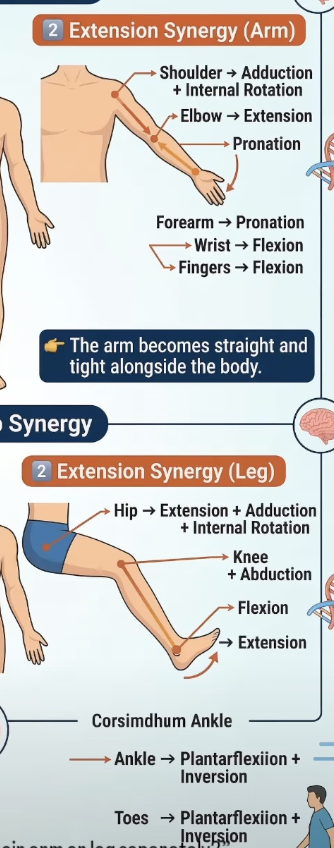
extensor synergy pattern
Extensor Synergy Pattern
scapula—depression and protraction
shoulder—horizontal adduction and int. rotation
elbow—extension and pronation
forearm—pronation
wrist—extension
fingers—flexion and adduction
hip—extension, adduction, int. rotation
knee—extension
ankles—planterflexion and inversion
toes—planterflexion
Possible Etiology of Spasticity
hyperactive reflex arcs (arc fires without modification from cortex/brainstem)
reduced reciprocal inhibition of the antagonist and synergy muscles (reduction in the ability of the alpha motor neurons to inhibit the activity of antagonist and synergy muscle groups, the agonist fires without modification, resulting in spasticity)
loss of cortical / subcortical modification of the alpha and gamma motor neurons in the ventral horn (lesions to the cerebral cortex or brainstem cause loss of cortical/subcortical modification of alpha motor neurons, causing alpha and gamma motor neurons to fire from the cerebral cortex or brainstem, resulting in increased muscle tone)
damage to M1 (damages corticospinal tracts, causing loss of cortical modification and spared hyperactive reflex arcs)
damage to brainstem regions that contain supraspinal motor centers
Hyperactive reflex arcs are a possible cause of spasticity. Describe this etiology
corticospinal tracts and extrapyramidal tracts are lost, but the reflex arc remains intact below the level of lesion, firing without cortical modification
UMN SCI