Nervous System Unit 1
 Call Kai
 Learn
 Practice Test
 Spaced Repetition
 Match
 Flashcards
 Knowt Play
1/47

There's no tags or description
Looks like no tags are added yet.
48 Terms
Nervous system
Master controlling and communicating system of body
Sensory input
Information gathered by sensory receptors about internal and external changes
Integration
Processing and interpretation of sensory input
Motor output
Activation of effector organs (muscles and glands) produces a response
Central nervous system (CNS)
Brain + spinal cord
Integration and control center
Peripheral nervous system (PNS)
Nervous system outside CNS
Consists mainly of nerves that extend from brain to spinal cord
Spinal nerves
to and from spinal cord
Cranial nerves
to and from brain
Somatic sensory fibers
Convey impulses from skin skeletal muscles, and joints to CNS
Visceral sensory fibers
Convey impulses from visceral organs to CNS
Sensory (afferent) division
Collects sensory information and sends it towards the CNS
Motor (efferent) division
Transmits impulses from CNS to effector organs (muscles and glands)
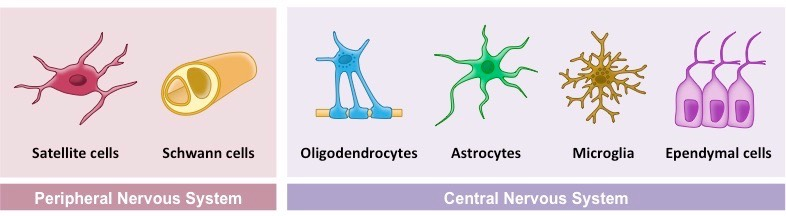
Neuroglia (glial cells)
Small cells that surround and wrap delicate neurons
Neurons (nerve cells)
Excitable cells that transmit electrical signals

Astrocytes
Most abundant, versatile, and highly ranched of gial cells
Cling to neurons, synaptic endings, and capillaries
Support and brace neurons
Play role in exchanges between capillaries and neurons
Guide migration of young neurons
Control chemical environment

Microglial cells
specialized resident immune cells (macrophages) of the central nervous system (CNS)
Small, ovoid cells with thorny processes that touch and monitor neurons
Migrate toward injured neurons
Can transform to phagocytize microorganisms and neuronal debris

Ependymal cells
May be ciliated
Lines the central cavities of the brain and spinal cord

Oligodendrocytes
Branched cells
Processes wrap CNS nerve fibers, forming insulating myelin sheaths in thicker nerve fibers

Satellite cells
Surround neuron cell bodies in PNS
Function similar to astrocytes of CNS

Schwann cells
Surround all peripheral nerve fibers and form myelin sheaths in thicker nerve fibers
Similar function as oligodendrocytes
Vital to regeneration of damaged peripheral nerve fibers
Cell body (soma)
Every neuron has __.
Nuclei
Clusters of neuron cell bodies in CNS
Ganglia
Clusters of neuron cell bodies in PNS
Tracts
Bundles of neuron processes in CNS
Nerves
Bundles of neuron processes in PNS
Dendrites and Axon
Two types of neuron processes
Dendrites
Motor neurons can contain 100s of these short, tapering, diffusely branched processes
Receptive (input) region of neuron
Dendritic spines
Appendages with bulbous or spiky ends
Axon
Can number as many as 10000 terminal branches
Can be over 1 meter long
Can excite or inhibit neurons it contacts
Carries on many convos with different neurons at the same time
Rely on cell bodies to renew proteins and membranes
Quickly decay if cut or damaged
Axon hillock
Most neurons have one axon that starts at cone-shaped area called __.
Nerve fibers
Long axons are called __.
Axon terminals
Distal endings are called __.
Axolemma
Neuron cell membrane
Generates nerve impulses and transmits them along __ to axon terminal
Axon terminal
Region that secretes neurotransmitters
Neurotransmitters
Released into extracellular space
Anterograde
Away from cell body
Ex: Mitochondria, cytoskeletal elements, membrane components, enzymes
Retrograde
Toward cell body
Ex: Organelles to be egraded, signal molecules, viruses, and bacterial toxins
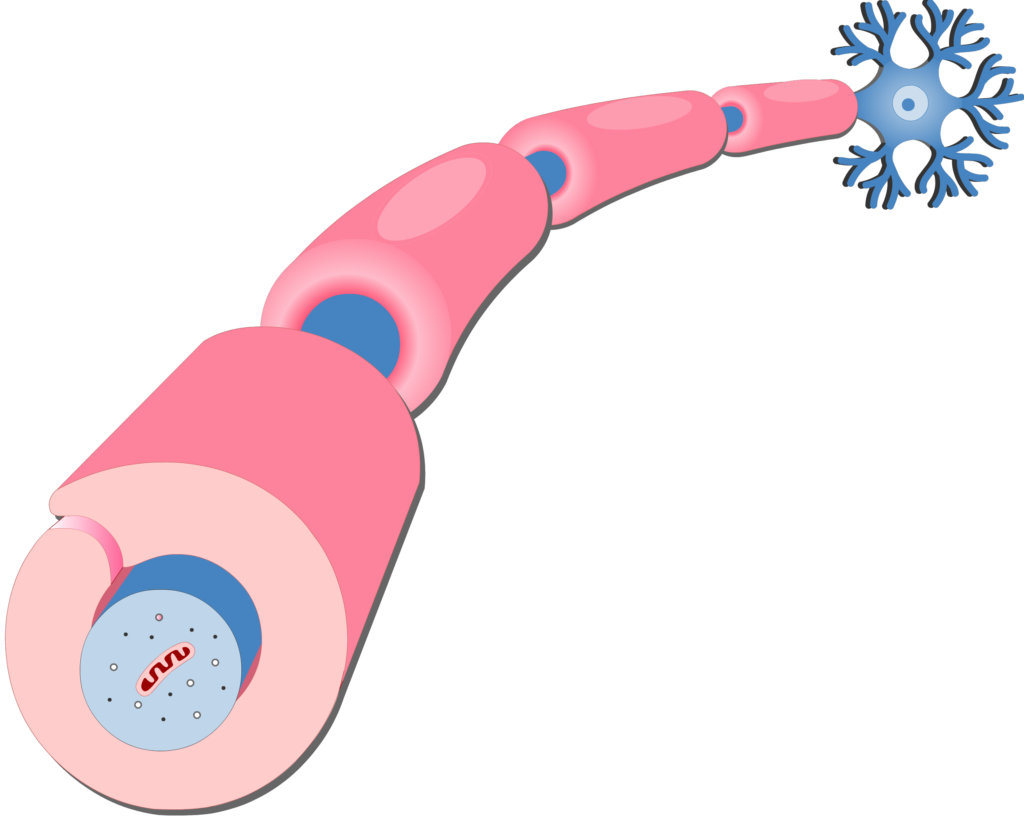
Myelin sheath
Composed of myelin, a whitish, protein-lipid substance
Protects and electrically insulate axon
Increase speed of nerve impulse transmission
Myelinated fibers
Segmented sheath surrounds most long or large-diameter axons
Nonmyelinated fibers
Do not contain a myelin sheath
Conduct impulses more slowly
Myelination in the PNS
Formed by Schwann cells
Wraps around axon in jelly roll fashion
One cell forms one segment of myelin sheath
Myelin sheath gaps
Gaps between adjacent Schwann cells
Also called nodes of Ranvier
Nonmyelinated fibers
Thin fibers not wrapped in myelin; surrounded by Schwann cells but no coiling; one cell may surround 15 diff fibers
White matter
Regions of brain and spinal cord with dense collections of myelinated fibers
Gray matter
Mostly neuron cell bodies and nonmyelinated fibers
Myelin sheaths in the CNS
Formed by processes of oligodendrocytes, not whole cells
Each cell can wrap up to 60 axons at once
Myelin sheath gap is present
No outer collar of perinuclear cytoplasm
Thinnest fibers are unmyelinated, but covered by long extensions of adjacent neuroglia
White matter
Regions of brain and spinal cord with dense collections of myelinated fibers
Gray matter
Mostly neuron cell bodies and nomyelinated fibers