Bio 1350 Prelim 3
 Call Kai
 Learn
 Practice Test
 Spaced Repetition
 Match
 Flashcards
 Knowt Play
1/125

There's no tags or description
Looks like no tags are added yet.
126 Terms
Which of the following shows the correct order of major events during vertebrate embryogenesis?
A. Fertilization, Gastrulation, Cleavage, Organogenesis
B. Fertilization, Cleavage, Gastrulation, Organogenesis
C. Fertilization, Cleavage, Gastrulation, Neurulation, Organogenesis
D. Fertilization, Cleavage, Gastrulation, Neurulation, Organogenesis, Morphogenesis
C. Fertilization, Cleavage, Gastrulation, Neurulation, Organogenesis
Without looking at your lecture notes, work with your group to list and describe the major events of vertebrate embryonic development.
Fertilization: Haploid genomes from the oocyte (egg) and sperm unite and form diploid zygote. Maternal components, materials deposited in the egg by the mother, control and drive very early stages of embryonic development.
Cleavage: Many rounds of rapid cell division without growth (cell division cycles lack G1 and G2 phases). Cells generated by cleavage division are called blastomeres. At the end of cleavage divisions, the embryo is called a blastula, a large number of blastomeres organized as a hollow ball.
Gastrulation: Cells of the blastula undergo an organized and well-orchestrated cell movement to form the three germ layers: ectoderm, endoderm, and mesoderm. Differences along the three major body axes (anterior-posterior, dorsal-ventral, and left-right) are apparent at the end of gastrulation.
Neurulation: formation of the neural tube, or central nervous system in vertebrates.
Organogenesis: formation of organs such as lungs, stomach, eye, or limbs.
hat is the first major morphogenetic event of embryonic development?
Important follow-up #1: what is morphogenesis?
Important follow-up #2: which stages of embryonic development are major morphogenetic events?
A. fertilization
B. cleavage
C. gastrulation
D. neurulation
E. organogenesis
C. gastrulation
#1: morphogenesis refers to the formation of organized tissue
#2 Gastrulation, neurulation, and organogenesis are major morphogenetic events in embryogenesis
What drives embryonic development immediately after a sperm fertilizes an egg?
a. zygotic gene products
b. the force of the sperm entering the egg
c. maternal components in the egg
d. extracellular components that are imported into the fertilized egg
C. maternal componets in the egg
For most organisms, an oocyte contains which of the following? Choose ALL correct answers (you can select multiple answer options).
Important follow-up #1: what are maternal components and what role do they play in early embryonic development?
Important follow-up #2: what do sperm contribute to early embryonic development?
A. mitochondria
B. ribosomes, tRNAs, metabolic enzymes
C. mRNAs and proteins
D. centrosome
E. lipids, yolk, structural proteins
F. haploid nucleus
G. diploid nucleus
A,B,C,E,F are in oocyte
1. maternal components drive embryonic development synth rather than relying on the synth of molecules in zygotic genome
2. sperm contribute a haploid genome and centrosome (microtubule organizing center), allowing the first mitotic spindle to form. Sperm are compact and stripped of most of its cytoplasm - facilitating travel to the egg. Sperm activates development once the egg is fertilized!
Cells undergoing cleavage divisions go through which stage(s) of the cell cycle?
A. G1
B. S
C. G2
D. M
E. More than one of the above
F. None of the above
E. more than one of the above.
Cleavage is a type of cell division w/out cell growth (S phase and M phase) bit skip G1 and G2
How do cleavage divisions result in progressively smaller cells?
A. Cleaving cells slow down the rate of growth.
B. Cleaving cells repeatedly go through M phase and skip the other cell cycle phases.
C. Cleaving cells skip the G1 and G2 phases.
D. Cleaving cells rely on exocytosis to reduce their size.
C. cleaving cells skip G1 and G2
Which of these terms refers to the "generation of organized forms?"
A. Developmental biology
B. Embryogenesis
C. Morphogenesis
D. Gastrulation
C. Morphogenesis
Identify A-E
A
B
C
D
E
A.Blastula
B. Gastrula
C. Ectoderm
D. Mesoderm
E. Endoderm

Use the dropdown menus to choose whether each of the following organs or tissues arise from ectoderm, mesoderm, or endoderm.
A. Blood
B. Stomach
C. Brain
D. Bone and cartilage
E. Lung
A. mesoderm
B. endoderm
C. ectoderm
D. mesoderm
E. endoderm
Create a diagram or describe the three major body axes. When do differences along the axes become apparent during embryonic development?
1. Anterior-posterior axis: head (anterior) and tail (posterior)
2. Dorsal-ventral axis: back (dorsal) and belly (ventral)
3. Lateral axis: left-right
Which of the following form during organogenesis? Choose ALL correct answers (you can select multiple answer options).
A. internal organs (heart, kidney, lung, liver)
B. endoderm, mesoderm, and ectoderm
C. limbs (fins, arms, legs)
D. sensory organs (eyes, ears)
E. blastomeres
F. dorsal-ventral body axis
G. anterior-posterior body axis
H. lateral body axis
I. germ layers
A internal organs (heart, liver, lung)
C limbs (fins, arms, legs)
D Sensory organs
Choose whether each of the following statements is TRUE or FALSE. If false, briefly explain why. Note: more than one statement may be false.
A. Embryonic development begins immediately after the sperm fertilizes the oocyte.
B. A sperm is much larger than an oocyte.
C. Sperm and oocytes are haploid.
True
False
True
Explain the significance of "conserved mechanisms" in the use of model organisms to study development.
The basic animal body plan arises from evolutionarily conserved mechanisms (similar mechanisms establish the basic body plan in all animals, including both vertebrates and invertebrates). As a result, these related genes are often functionally interchangeable between different species. This conservation enables us to use model organisms to understand common mechanisms underlying animal development.
Descriptive embryology, experimental embryology, developmental genetics, and comparative embryology are different approaches used to study development. While researchers typically use a combination of these approaches, a certain approach may be better suited for different experimental goals. For each experimental goal described below, choose an experimental approach or experimental approaches that you would want to use. Explain why.
A. Identify a gene influencing body plan development.
B. Trace a cell through each cell division during development.
C. Test the function of a specific group of cells during development.
D. Examine the evolution of a particular developmental process.
A. Developmental genetics would be best suited to identify a gene influencing body plan development because you could identify mutant individuals with alterations in their body plan (abnormal phenotype). You could then compare the DNA of mutant individuals to non-mutants (wild-type) to infer potential genes contributing to the abnormal body plan. In addition, you could also use CRISPR to experimentally manipulate DNA and then compare abnormal phenotype to wild-type individuals.
Model organism characteristics: large enough for you to easily observe body plan mutations, small enough to be easily bred in a lab and possess short generation times (you will want to be able to maintain a large population in the lab through multiple generations to compare mutant and nonmutant genomes). Alternatively, you could manipulate the genome using CRISPR, so you would not be dependent on naturally occurring mutations.
B. Descriptive embryology would be best suited to trace a cell from early development into what it later becomes. This could be done through fate mapping (lineage tracing), where a cell or group of cells in early development are labeled with a dye and then tracked through cell divisions using observation.
Model organism characteristics: you will want organisms with a relatively small number of cells and invariant cell lineage (cells always divide into the same cells, cell fate predetermined early on). While cells in a transparent embryo could be tracked under a microscope without dye (ex: C. elegans, a nematode worm), a fluorescent dye would facilitate cell lineage tracing in non-transparent embryos.
C. Experimental embryology would be best suited to experimentally test the function of a cell or group of cells as the approach involves experimentally manipulating embryos through removing, rearranging, or transplanting cells or growing cells in isolation.
Model organism characteristics: you will want a model organism whose embryos are big and external embryonic development (readily accessible by microsurgery.) Animals that have external embryonic development, such as birds (chicks) and amphibians (frogs).
D. Comparative embryology would be best suited as it involves comparison of similar developmental processes among different organisms to infer shared ancestral relationships.
Model organism characteristics: a set of organisms sharing a similar developmental process or body structure.
Which of the following is a model plant used by scientists?Choose one:A. Caenorhabditis elegansB. Saccharomyces cerevisiaeC. Homo sapiensD. Homo floresiensisE. Arabidopsis thaliana
Arabidopsis thaliana
Why do cell biologists study yeast?Choose one or more:A.Yeast lacks a nucleus, so it is easy to genetically manipulate.B.Yeast carries out all the basic tasks that a eukaryotic cell must perform.C.Yeast is as closely related to animals as it is to plants.D.Yeast is a bacterium and therefore very easy to grow.
B,C
A segment of DNA in the genome that is not a protein-coding geneChoose one
:is completely unimportant to the cell
.must encode a functional RNA
.can be used to regulate gene activity.
is junk DNA left over from mistakes in evolution.
.can be used to regulate gene activity.
The genome of the bacterium E. coli contains 4.6 million (4.6 ×× 106) nucleotide pairs, whereas the human genome contains some 3200 ×× 106 nucleotide pairs. What can be concluded based on these numbers?Choose one:
A. E. coli are unicellular, whereas humans are multicellular.
B. Human cells are larger than E. coli cells.
C. Human cells have 700 times more genes than E. coli.
D. Humans are a more complex life-form than
E. coli.E. All of the above conclusions are drawn correctly.
F. None of the above conclusions are drawn correctly.
F. None of the above conclusions are drawn correctly.
Identify the component that associates with the Cas9 protein. Drag the correct RNA label to the target.
Aguide RNA
Bmessenger RNA
Ctransfer RNA
Dribosomal RNA
A. guide RNA

The CRISPR-Cas9 system was discovered in bacteria, which use it as a defense mechanism against viral infections. Scientists have experimentally modified this system to work in other organisms. Which of the following statements correctly describe an application of the CRISPR system?Choose one or more:
A.activation of transcription of a specific gene
B.repression of transcription of a specific gene
C.gene editing of a specific gene
D.editing of the mRNA of a specific gene
A,B,C
Scientists are working to develop the CRISPR-Cas9 system to treat human disease. One of the first clinical trials in humans will use CRISPR to treat β thalassemia. People with β thalassemia have low levels of hemoglobin and cannot get enough oxygen to all their tissues. The treatment is designed to cleave the gene BCL11A that is important for repressing fetal hemoglobin, which is usually only produced in infancy. Cleaving this gene will prevent expression of the inhibitor BCL11A so that fetal hemoglobin can be produced even in adults, alleviating the symptoms. Which of the following are important components added to cells from β thalassemia patients in order to treat the disorder?Choose one or more:
A.a guide RNA that recognizes the BCL11A gene
B.the BCL11A protein
C.a guide RNA that recognizes the Cas9 gene
D.the Cas9 enzyme
A, D
In Hans Spemann's cutting experiment, he separated frog blastomeres at the two-cell stage and found that each cell developed into a normal tadpole. This experiment suggests that ____
there are no asymmetric cell divisions during frog embryo development
None of the answers are true
there was lateral inhibition between the two blastomeres
More than one answer is true
the first cell division is not an asymmetric cell division
the first cell division is not an asymmetric cell division
A mesodermal cell is ____
A terminally differentiated cells from the muscle
None of the answers are correct
A cell from the middle layer of the gastrula
A totipotent cell
A germ layer cell fated to become epidermis
Correct! A cell from the middle layer of the gastrula
Two adjacent cells found in cell-cell contact, we will name cell A and cell B, employ lateral inhibition via a cell membrane molecule X that is produced equally by the two cells to inhibit neuronal fate in the adjacent cell. Thus, the two cells compete with each other for neuronal fate. Injecting an inhibitor of X in cell A will result in____
The answer cannot be determined from the information provided
Cell A becomes neuronal
Cell B becomes neuronal
Both cells become neuronal
None of the cells become neuronal
Correct! Cell B becomes neuronal
An experimenter isolates blocks of tissue from two different regions of a blastula-stage embryo (tissue block A and tissue block B). She places them in separate dishes (this is called an explant experiment). Tissue block A gives rise to skin; Tissue block B gives rise to endodermal type tissue. She then isolates the same two tissue blocks from another embryo. This time she puts them next to each other in the same dish. Tissue Block A now gives rise to muscle and connective tissue (we call this tissue C), but tissue block B gives rise to endodermal type tissue.
Which of the following statements is consistent with these experimental results?
Tissue C was determined at the time of the explant.
Tissue A was determined at the time of explant
More than one answer is true
Tissues B and C were both fated to become endoderm
Tissue B induced tissue A to change its fate
Correct Answer Tissue B induced tissue A to change its fate
Asymmetric cell division is___
A cell non-autonomous way to generate diversity in the daughter cells
Driven by cell-extrinsic inductive signaling
A cell autonomous mechanism to generate diversity in the daughter cells
Controlled by lateral inhibition
Ensuring equal distribution of fate determinants between two daughter cells
Correct! A cell autonomous mechanism to generate diversity in the daughter cells
Commitment to a particular terminally differentiated cell fate is progressive, and each step of commitment is irreversible. Which of the following related statements is true:
Gene expression changes at each step of commitment
A committed endodermal cells cannot become mesoderm
Cells have memory of each commitment step they passed
All answers are correct
One cell lineage can experience both cell-autonomous and cell non-autonomous mechanisms of cell diversification
Correct! All answers are correct
TRUE or FALSE: Early animal development progresses through distinct stages: first the production of the zygote through fertilization, then cleavage, then the formation of the gastrula, and then the formation of the blastula.
False
Which of the following most directly leads to the development of the three embryonic tissue layers (ectoderm, mesoderm, and endoderm)?
A. Fertilization
B. Cleavage divisions
C. Gastrulation
D. Neurulation
E. Organogenesis
C. Gastrulation
Which one of the processes listed below does the figure illustrate?
A. Morphogenesis
B. Gastrulation
C. Differentiation
D. Cleavage divisions
C. Differentiation
What happens to a cell during the process of differentiation?
A. It undergoes rapid cell divisions to produce identical daughter cells
B. It progressively loses a particular set of genes
C. It progressively acquires particular genes
D. It undergoes a change toward a more specialized form or function.
D. It undergoes a change toward a more specialized form or function.
In your own words, what is different among different types of cells? Name and outline the major tenets of the relevant theory.
Cells are different due to differential gene expression. The control of gene expression is central to development as the genes that a cell expresses determine the proteins that it makes.
Differentiated cells express different subsets of genes and therefore make different proteins that enable them to carry out their specialized functions.
*Genes that are not expressed by a particular cell are not lost but are still present in the genome and they have the potential to be expressed.
Differential gene expression theory:
the genome is constant
only a portion of the genome is expressed in any given cell type
unused genes are not destroyed or mutated, but retain potential to be expressed
Use the dropdown menus to complete the statements below.
A. A cell that does not adopt its normal fate after it has been cultured in a neutral environment is not specified .
B. A cell that adopts its normal fate after it has been transplanted from its normal position to a new position in the embryo determined .
C. A cell that adopts its normal fate after it has been cultured in a neutral environment but which adopts a different fate when transplanted to a new position in the embryo is specified but not determined .
1. not specified
2. determined
3. specified but not determined
You extract a mesoderm cell from a gastrula stage embryo and isolate it in a neutral environment, like a petri dish. The cell develops into a muscle cell, indicating the mesoderm cells are ___________ to be muscle.
A. not committed
B. determined
C. specified
D. specified, but not determined
E. determined, but not specified
Correct Answer C. specified
An investigator conducts two experiments with cells from gastrula stage frog embryos. In the first experiment, she places mesoderm cells into a petri dish and the cells develop into muscle. In the second experiment, she places the mesoderm cells in a petri dish with ectoderm cells and the mesoderm cells develop into neurons. What do the results of these experiments indicate?
A. At the gastrula stage, the mesoderm cells are specified to develop into neurons.
B. At the gastrula stage, the mesoderm cells are determined to develop into neurons.
C. At the gastrula stage, the mesoderm cells are specified to develop into muscle.
D. At the gastrula stage, the mesoderm cells are determined to develop into muscle.
E. None of the above.
Correct Answer C. At the gastrula stage, the mesoderm cells are specified to develop into muscle.
The investigator conducts the same two experiments as described in the previous question. However, now assume the mesoderm cells are determined to be muscle. What would the mesoderm cells develop into in experiment 1 and experiment 2?
A. Exp. 1 = muscle, Exp. 2 = neuron
B. Exp. 1 = muscle, Exp. 2 = muscle
C. Exp. 1 = neuron, Exp. 2 = muscle
D. Exp. 1 = neuron, Exp. 2 = neuron
Correct! B. Exp. 1 = muscle, Exp. 2 = muscle
During the mid-1990s, scientists at the Roslin Institute in Edinburgh removed the nucleus from an unfertilized egg from a sheep and replaced it with the nucleus from an adult mammary cell. This egg with the transplanted nucleus was put back into a pregnant sheep. After more than 270 failed or partly successful attempts, a lamb named Dolly was born in 1996. Dolly grew to be an adult and produced six offspring (by breeding with a ram) of her own.
What scientific conclusion(s) can you draw from the birth of a healthy animal using a fully differentiated somatic cell from an adult animal? Choose ALL correct answer options (you can select more than one).
A. Nuclei from fully differentiated somatic cells that are injected into an egg have the potential to express any gene.
B. Unused genes that are not transcribed retain the potential to be expressed.
C. The genome is constant in all somatic cells.
D. Mammary cells in adults are not committed to a developmental fate.
E. None of the above
A,B,C
Differential gene expression theory:
the genome is constant
only a portion of the genome is expressed in any given cell type
unused genes are not destroyed or mutated, but retain potential to be expressed
D. is incorrect. The adult mammary cells are fully differentiated and have adopted their developmental fate to become mammary cells. The experiment is demonstrating that fully differentiated cells still contain all of the genetic material.
One cell can influence a neighbouring cell's development through ________.
A. specification
B. determination
C. gastrulation
D. inductive signaling
D. Inductive signaling
Without looking at your lecture notes, work with your group to actively recall the two general types of mechanisms by which cells become different (express different genes). Describe key differences between the mechanisms and any details or examples that you remember. For help getting started, see the list of terms below.
Cells become different (express different genes) by two general types of mechanisms:
1. Cell intrinsic mechanisms (cell autonomous): cytoplasmic determinants (molecules in the cytoplasm that influence the fate of cells that receive them) are asymmetrically localized in the mother cell before cell division. Asymmetric cell division: cell division produces one daughter cell containing the cytoplasmic determinants (adopts the particular fate) and one daughter cell that does not contain the cytoplasmic determinants (does not adopt the particular fate).
2. Cell extrinsic mechanisms (cell non-autonomous): cells produced by symmetric cell division adopt different fates due to influences acting on them after birth.
Cell-cell signaling (communication)!
Types of signaling:Inductive signaling: can act in an all-or-none manner or concentration-dependent manner (morphogens)Lateral inhibition
how a signaling molecule can function as a morphogen.
Important follow-up #1: describe how inductive signaling causes cells to become different.
Important follow-up #2: Do all inductive signaling molecules function as morphogens?
Morphogens are a certain type of signaling molecule that acts in a concentration-dependent manner (their effects vary with concentration; concentration decreases with distance from the signaling cell (morphogen gradient) - so cells close to the signaling cell will receive a higher concentration which may have a certain effect, while cells farther away may receive a lower concentration that has a different effect, etc.).
Example: mirror-image duplication of digits: Sonic Hedgehog
Important follow-up #1: Inductive signaling: a signal produced by one cell or a group of cells can cause the cells receiving the signal to adopt a particular fate. *Occurs in a field of cells where there are already differences (a cell/group of cells is different in that they signal/induce other cells to adopt a certain fate).
Important follow-up #2: No, not all inductive signals act as morphogens (in a concentration-dependent manner). Inductive signals can act in an all-or-none manner.
Even if there is no clear asymmetry, a regular pattern can arise spontaneously within a set of cells that are initially all alike. This can happen through the process known as lateral inhibition (see the figure).
Which of the following processes contribute to lateral inhibition?
Random fluctuations in key components within adjacent cells
Positive feedback loops to amplify transient differences
Asymmetric cell division to distribute key molecules unevenly
A. I and II
B. I and III
C. II and III
D. II
C.II and III

A. Cell 1 and Cell 2 are initially identical to each other in the top frame. Given that this question involves lateral inhibition, what do you know about the distance between these two cells? Describe the interaction between the two cells.
B. Describe how Cell 1 and Cell 2 and the interaction between the cells changes in the middle and bottom frames. What causes these changes?
C. Cell 1 and Cell 2 end up as different colors with different amounts of X. What does this color difference indicate? Explain how the amount of X leads to this difference.
D. What type of pattern would be produced by lateral inhibition in a large field of cells?
A. Lateral inhibition only occurs between two neighboring cells that are in direct contact with each other (i.e., directly adjacent neighboring cells). The signaling molecule X produced by each cell inhibits the production of X in the other cell. The cells contain equal amounts of X and therefore equally inhibit the production of X in the other cell.
B. A random stochastic event causes Cell 1 to transiently produce slightly more X than Cell 2. As a result, Cell 1 contains slightly more X and has a slightly stronger inhibitory effect than Cell 2 (middle frame). This initially slight difference is amplified by positive feedback: after Cell 1 produces slightly more X, increasing its inhibitory effect on the production of X in Cell 2, Cell 2 then has less X and a weaker inhibitory effect on Cell 1, enabling Cell 1 to further strengthen its inhibitory effect.
C. The colors indicate the different developmental fates of the two cells. The amount of signaling molecule X likely influences cell fate by altering the expression of certain genes (this mechanism is not represented in this figure).
D. Lateral-inhibition creates fine, regular repeating patterns in a field of cells.
Lateral inhibition: in an initially identical field of cells, transient differences in signaling strength between two directly adjacent neighbor cells cause groups of cells to become different, generating fine-scale patterns. *Cells are initially identical and compete for a certain fate.
You conduct an experiment to experimentally test the mechanisms underlying how cell A and cell B become different. From fate-mapping, you know that cell A normally develops into muscle and pharynx while cell B normally develops into skin and nerves.
You physically destroy cell A and observe that cell B fails to develop into skin and nerves.
You physically destroy cell B and observe that cell A develops into muscle, but not pharynx.
Choose ALL statements that could be true given these results (you can select multiple answer options).
A. the skin and nerve fates of cell B are specificed autonomously.
B. the skin and nerve fates of cell B are dependent upon cell-cell signaling.
C. for cell B, some fates are specified autonomously and some depend on cell-cell signaling.
D. the muscle and pharynx fates of cell A are specified autonomously
E.the muscle and pharynx fates of cell A are dependent upon cell-cell signaling
F. for cell A, some fates are specified autonomously and some depend on cell-cell signaling.
B,F
Choose ALL statements that are FALSE regarding the mechanisms by which cells become different (you can select multiple answer choices).
A. The asymmetric division of cytoplasmic determinants can cause daughter cells to adopt different fates.
B. Inductive signaling relies on cell-cell signaling, while lateral inhibition does not.
C. Lateral inhibition only occurs between two neighboring cells that are directly adjacent to each other.
D. Mirror image duplication of limb digits is caused by asmymmetric segregation of the cytoplasmic determinant Sonic hedgehog
E. Inductive signaling and lateral inhibition are examples of cell autonomous (cell extrinsic) mechanisms by which cells become different.
B,D,E are all False
How can one particular inductive signal lead to a diversity of different cell types? Choose ALL that apply (you can choose more than one).
A. Cell may receive different sets of additional signals
B. Cells may have received different signals at an earlier stage in development
C. An inductive signal may cause a terminally differentiated cell to revert to an earlier stage in its development.
D. The particular inductive signal may have concentration-dependent effects
A,B,D is correct
How does sequential induction lead to a diversity of cell types
A series of local induction events add successive levels of cell differences.
In a field of cells that initially has two cell types (type A and type B), type B produces a signal that induces a subset of type A cells to adopt the fate for type C.
Cell type C then produces a signal that induces subsets of type A and type B to adopt fates for type D and E, respectively (cell memory).
Which of the following statements is FALSE?
A. As development progresses, individual cells become more and more restricted in the range of cell types they can give rise to.
B. At different stages of embryonic development, the same signals are used over and over again by different cells, but with different biological outcomes.
C. While all cells have the same DNA sequence, they only express some fraction of that sequence. The specific sequences being transcribed and translated give rise to the specific differences between cells, tissues, and organs.
D. All of the above are false.
E. None of the above are false.
E. None of these are false
Morphogens are a certain type of signaling molecule that acts in a concentration-dependent manner to induce cell fate. Assume the simple patterns represented by the flags in the figure below were present in a field of cells.
A. Which could be created by a gradient of a single morphogen? Explain how.
B. Which would require gradients of two morphogens? Explain how.
C. Explain how the pattern in the flag of France could be created through sequential induction.
A. The patterns in the flags of Japan and France could be created by a gradient of a single morphogen.
The pattern in Japan's flag could be created by a group of cells in the center of the red circle which secrete a morphogen. As the morphogen diffused away, its concentration would decrease in a circular pattern. Cells closest to the source cells would receive the morphogen above a certain concentration threshold and turn red, while cells receiving a concentration of the morphogen below the threshold would turn white, with red and white indicating different developmental fates.
The pattern in France's flag could be created by a line of cells located at one end of the flag which would secrete a morphogen that had different effects on cells receiving high, intermediate and low concentrations.
B. The pattern in the flag of Norway could be created by gradients of two morphogens secreted by lines of cells at right angles to each other.
C. The pattern in the flag of France could be created if the blue and red stripes indicated different cell types. The blue cell type could then released an inductive signal that acted on the red cell type, producing a white cell type. To take it another step: if the white cell type then released another inductive signal that acted on the blue and red stripes, it would produce 2 more cell types, located as a stripe between the blue and white stripes and a stripe between the white and red strip.
A neuron and a white blood cell have very different functions. For example, a neuron can receive and respond to electrical signals, while a white blood cell defends the body against infection. This is because __________.
A. the neuron and the white blood cell within an individual have different genomes.
B. the neuron expresses some genes that the white blood cell does not.
C. neurons and white blood cells are differentiated cells and thus no longer need to transcribe and translate genes.
D. All of the above.
B. the neuron expresses some genes that the white blood cell does not.
Which is the major control point used to regulate gene expression in development?
Follow-up: identify the types of control at A-E in the diagram below. Compare and contrast the benefits of control points A and F.
A.

Use the dropdown menus to indicate whether each of the following statements about prokaryotic transcriptional regulation is TRUE or FALSE. If a statement is false, make sure that you are able to explain why.
A. A promoter is a DNA sequence located upstream of the transcription start site. TRUE
B. RNA polymerase recognizes and binds a DNA sequence in the promoter. TRUE
C. A terminator is a DNA sequence that tells RNA polymerase where to stop transcription. TRUE
D. Transcriptional activators and repressors (i.e., transcriptional regulators) are short sequences of DNA. FALSE
E. Promoter activity is inhibited by transcriptional repressors and enhanced by transcriptional activators. TRUE
F. DNA binding domains are specific sequences of DNA found in promoters. FALSE
1. True
2. True
3. True
4. False
5. True
6. False
Regulation of the lac operon by lactose involves a(n) _______ that inhibits transcription, while regulation by glucose involves a(n) _______ that stimulates transcription.
A. activator; repressor
B. repressor; activator
C. promoter; promoter
D. operator; operator
B. repressor; activator
Which of the following statements about the Lac operon is FALSE?
A. Even when the CAP activator is bound to DNA, if lactose is not present, the Lac operon will not be transcribed.
B. The CAP activator can only bind DNA when it is bound to cAMP.
C. The Lac operon only produces RNA when lactose is present and glucose is absent.
D. The Lac repressor binds when lactose is present in the cell.
D. The Lac repressor binds when lactose is present in the cell.
A. Describe how glucose influences transcriptional regulation of the Lac operon. For example: when it is present, does it prevent a repressor or an activator from binding to DNA? How?
B. Describe how lactose influences transcriptional regulation of the Lac operon.
C. Fill in the following table to indicate how the presence of glucose and/or lactose influences the activity of the Lac repressor (repressing or not repressing) and CAP activator (activating or not activating). In the final column, indicate whether the expression of Lac genes is on or off.
A. When glucose is absent (or at low levels), cAMP is produced by the cell and binds to the CAP activator, allowing the CAP activator to bind to the CAP-binding site, activating transcription. When glucose is present, the CAP activator cannot bind to the CAP-binding site and thus cannot activate expression of Lac genes.
B. When lactose is absent, the Lac repressor represses expression of Lac genes. When lactose is present, allolactose (a metabolite of lactose) inhibits the Lac repressor (but inhibiting the repressor is not enough to turn on gene expression - still need activator).

The CAP activator protein and the Lac repressor both control the Lac operon. You create cells that are mutant in the gene coding for the Lac repressor so that these cells lack the Lac repressor under all conditions. For these mutant cells, state whether the Lac operon will be switched on or off in the following situations, and explain why.
A. in the presence of glucose and lactose
B. in the presence of glucose and the absence of lactose
C. in the absence of glucose and the absence of lactose
D. in the absence of glucose and the presence of lactose
A. Operon off. CAP will not bind in the presence of glucose.
B. Operon off. Although normally the Lac repressor would bind in the absence of lactose, the lack of the Lac repressor, in this case, does not matter because the presence of glucose means that the CAP protein will not bind and activate transcription.
C. Operon on. Normally in the absence of both glucose and lactose, the operon would be off. However, because the cells lack the Lac repressor, the cells cannot sense the absence of lactose. Because the CAP protein will bind and activate transcription, the operon will be on.
D. Operon on. The CAP protein will bind and activate transcription because of the presence of glucose. It does not matter whether the Lac repressor gene is mutant because there is lactose available.
dentify the structures involved in eukaryotic gene expression shown in the figure below.
A. transcription regulator protein
B. Mediator protein complex
C RNA polymerase
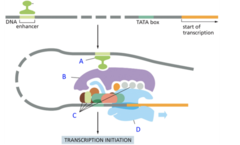
describe the roles of the following in eukaryotic gene expression: promoters, the TATA box, TATA box binding protein (TBP), general transcription factors (GTFs), enhancers, transcription activators, transcription repressors, Mediator, and RNA polymerase I
Each gene has a promoter, a DNA sequence located directly upstream of the transcriptional start site.
The promoter contains a DNA sequence called the TATA box where the TATA box binding protein (TBP) binds. TBP then recruits general transcription factors and RNA polymerase II.
Eukaryotes have different types of RNA polymerases and RNA polymerase II transcribes protein-coding genes.
RNA polymerase II does not directly bind to the promoter and requires the TATA binding protein (TBP) and general transcription factors (GTFs).
Enhancers are regulatory DNA sequences that can be located far upstream or downstream from the gene. Transcription activators and transcription repressors are DNA-binding proteins that bind to enhancer sequences. Looping of the DNA and the Mediator, a large protein complex, allows transcriptional regulators to interact with the RNA polymerase II transcriptional machinery over long distances.
RNA polymerase II recruitment to the promoter opens up the DNA double helix in preparation for transcription.
Important: All genes have a TATA box in their promoter region and the same set of general transcription factors. The enhancer sequences and transcription activators/repressors are specific for individual genes. This confers specificity in regulating the expression of individual genes.
The regulation of eukaryotic transcription is complex. The promoter is a region of DNA typically located approximately 30 nucleotides upstream from the transcription start site. Within this region is a DNA sequence called the [ Select ] ["enhancer", "TATA box", "TATA box binding protein (TBP)", "Mediator"] where [ Select ] ["RNA polymerase II", "general transcription factors (GTFs)", "TATA box binding protein (TBP)", "transcription activators", "the Mediator"] binds, helping to recruit [ Select ] ["RNA polymerase II", "general transcription factors (GTFs)", "TATA box binding proteins (TBP)", "transcription activators", "the Mediator"] , which then recruit [ Select ] ["RNA polymerase II", "general transcription factors (GTFs)", "TATA box binding protein (TBP)", "transcription activators", "the Mediator"] . However, this is still not enough to start transcription! The initiation of transcription by RNA polymerase II requires the binding of [ Select ] ["enhancers", "general transcription factors (GTFs)", "transcription activators", "promoters"] to [ Select ] ["enhancer", "promoter", "TATA box", "Mediator"] regions of DNA located thousands of nucleotides away from the promoter. The Mediator is a complex of proteins that links distantly bound transcription activators or repressors with the RNA polymerase transcriptional machinery through DNA looping.
promoter
TATA box
tata box binding protein
general transcription factors (GTF)
RNA polymerase II
transcriptional activators
enhancer
Which of the following statements about transcription regulators is TRUE?
A. Transcription regulators generally recognize specific sequences in the DNA.
B. Different DNA-binding motifs bind to different DNA sequences.
C. Both statements are true.
C. Both statements are true
In eukaryotes, one way that an enhancer differs from a promoter is that it _______.
A. is not a sequence of DNA.
B. does not bind a transcription factor.
C. may be located far away from the gene it regulates.
D. directly binds to RNA polymerase II
C- may be located far away from the gene it regulates
Enhancers are regulatory sequences of DNA that can be located far from the gene of interest, while promoters are sequences of DNA located near the transcription start site.
How are most eukaryotic transcriptional regulators able to affect transcription when their binding sites are far from the promoter?
A. by binding to their binding site and sliding to the site of RNA polymerase assembly
B. by looping out the intervening DNA between their binding site and the promoter
C. by unwinding the DNA between their binding site and the promoter
D. by attracting RNA polymerase and modifying it before it can bind to the promoter
B. by looping out the intervening DNA between their binding site and the promoter
Use the dropdown menus to select whether each of the following statements is TRUE or FALSE.
A. For each protein-coding gene, there is one promoter and one enhancer that act as regulatory elements for that gene.
["TRUE", "FALSE"]
B. TATA boxes are found in both enhancers and promoters.
["TRUE", "FALSE"]
C. In the figure below, gene A and gene B can be transcribed at different rates, producing different amounts of RNA within the same cell. ["TRUE", "FALSE"]
False. Multiple enhancers can regulate the expression of a gene (combined actions of multiple transcriptional regulators (activators and repressors) ensure precise regulation of gene expression).
False: TATA boxes are found only in promoters
True
Two bacterial populations were prepared in a laboratory. Population A expresses the wild-type transcription regulator protein that controls the transcription of gene X. Population B contains a mutation in the gene for this transcription regulator protein and does not express any form of the protein. Which statement provides a possible hypothesis to explain the gene X expression data shown in the table below?
A. The transcription regulator protein is an activator that is required for stimulating RNA polymerase to transcribe gene X.
B. The transcription regulator protein binds to RNA polymerase to prevent it from binding to the promoter site and transcribing gene X.
C. The transcription regulator protein is a repressor that binds to an operator site and blocks RNA polymerase from carrying out transcription.
D. The transcription regulator protein is an inhibitor that binds to RNA polymerase and prevents it from binding to the promoter site.
A>

You are interested in examining the regulation of the gene that encodes an enzyme, Tre-ase, important in metabolizing trehalose into glucose in bacteria. Trehalose is a disaccharide formed of two glucose units. It is known that two DNA-binding proteins, TreA and TreB, are important for binding to the promoter of the Tre-ase gene and are involved in regulating the transcription of the Tre-ase gene: TreA binds to the "A" site in the promoter region, and TreB binds to the "B" site. You make mutations in the TreA and TreB genes to create cells lacking these genes, observe what happens to transcription of the Tre-ase gene, and obtain the results in the table below.
A. What is the role for TreA in controlling Tre-ase expression? Explain.
B. What is the role for TreB in controlling Tre-ase expression? Explain.
C. From these data, what do you predict will happen to Tre-ase transcription (compared with that in normal cells) in the presence of trehalose if you were to create a version of the TreA protein that will constitutively bind to the "A" site in the Tre-ase promoter?
A. TreA is a gene repressor involved in turning off the Tre-ase gene when glucose is present. In cells lacking TreA, the Tre-ase gene can be expressed even when both glucose and trehalose are present in the growth medium.
B. TreB is a gene activator involved in turning on the Tre-ase gene when trehalose is present. In cells lacking TreB, the Tre-ase gene is not transcribed.
C. If TreA is constitutively bound to the "A" site, no transcription of the Tre-ase gene will occur. TreA is a gene repressor involved in turning off the Tre-ase gene when glucose is present. Transcription of the Tre-ase gene is seen inappropriately in cells lacking TreA when both glucose and trehalose are present in the growth medium, suggesting that the TreB gene activator can activate transcription of the Tre-ase gene in those circumstances and normally does not do so because of the repression mediated by TreA. Thus, if TreA were always bound, it would overcome the activation normally due to TreB, and the Tre-ase gene would not be transcribed.

If E. coli is in an environment that is rich in lactose, a metabolite of lactose binds to _______.
A. a transcription repressor, releasing it from the operator site.
B. RNA polymerase, activating it to transcribe the genes involved in lactose breakdown.
C. a transcription activator protein, which binds to RNA polymerase and stimulates transcription of the genes involved in lactose breakdown.
D. the operator site of the lac operon, stimulating transcription of the genes involved in lactose breakdown.
A. a transcription repressor, releasing it from the operator site.
Which of the following events occur when TATA-binding protein binds to the DNA?Choose one or more:
A.Binding leads to assembly of the rest of the transcription complex at the initiation site
.B.The DNA backbone is kinked nearly 90 degrees.
C.Four α helices separate the two strands of DNA.
D.An eight-stranded β-sheet domain of the TATA-binding protein lies on the DNA helix.
A,B,D
Which of the following describes the Lac operon in E. coli when lactose, but not glucose, is present in the culture medium?Choose one:
A. CAP and the Lac repressor are both bound to the Lac operon's regulatory DNA, and the Lac operon is not expressed.
B. Neither CAP nor the Lac repressor is bound to the Lac operon's regulatory DNA, and the Lac operon is not expressed.
C. Neither CAP nor the Lac repressor is bound to the Lac operon's regulatory DNA, and the Lac operon is expressed.
D. The Lac repressor, but not CAP, is bound to the Lac operon's regulatory DNA, and the Lac operon is not expressed.
E. CAP, but not the Lac repressor, is bound to the Lac operon's regulatory DNA, and the Lac operon is expressed.
E
Which of the following describes the Lac operon in E. coli when both lactose and glucose are present in the culture medium?Choose one:
A. CAP and the Lac repressor are both bound to the Lac operon's regulatory DNA, and the Lac operon is not expressed.
B. CAP, but not the Lac repressor, is bound to the Lac operon's regulatory DNA, and the Lac operon is expressed.
C. The Lac repressor, but not CAP, is bound to the Lac operon's regulatory DNA, and the Lac operon is not expressed.
D. CAP binds to the Lac repressor, preventing it from binding to the Lac operon's regulatory DNA, and the Lac operon is expressed.
E. Neither CAP nor the Lac repressor is bound to the Lac operon's regulatory DNA, and the Lac operon is not expressed.
E,
What must many activator proteins do before they can interact with DNA?Choose one:
A. bind to an enhancer sequence
B. hydrolyze ATP
C. bind to ATP
D. bind to a metabolite or other small moleculeE. bind to another activator protein
D
The transcription initiation site of a eukaryotic gene is found at which location?Choose one:
where RNA polymerase first binds
where transcription regulators bind
where general transcription factors bind
where RNA synthesis begins
where RNA synthesis begins
If lactose and glucose are both available to a bacterial cell, which carbon source(s) will be used?Choose one:
A. lactose
B. cyclic AMP
C. glucose
D. both lactose and glucose
C. glucose
Eukaryotic repressor proteins can decrease transcription using which of the following mechanisms?Choose one:
A. attracting a chromatin remodeling complex to open chromatin at the site
B. recruiting a histone acetyltransferase complex to modify histones
C. binding an operon and preventing polymerase binding
D. preventing the assembly of the transcription initiation complex
D. preventing the assembly of transcription initiiation complexes
What makes it possible for a combination of signal molecules to evoke a response that differs from the sum of the effects that each signal could trigger on its own?Choose one:
A.the ability of different intracellular relay systems to interactthe ability of the same signal molecule to bind to different receptors
B.the ability of different signal molecules to bind to the same receptort
C. he tendency of different cells to display different receptors
D.the ability of different receptors to activate different intracellular relay systems
A.the ability of different intracellular relay systems to interactthe ability of the same signal molecule to bind to different receptors
What are small intracellular signaling molecules often called?Choose one:extracellular signaling molecules
intracellular signaling proteins
first messengers
transmitter-gated ion channels
second messengers
second messengers
Which is true of signal integration?Choose one:
It might involve a kinase in one signaling pathway inactivating a kinase in another pathway.
It can only take place between receptors of the same class.
It relies on positive and negative feedback amplifying and dampening a signal.
It requires the generation of small intracellular messenger molecules.
It takes place when a single, activated target protein delivers a signal to many downstream effectors.
A.
Steroid hormones trigger transcription of target genes byChoose one:
binding to nuclear receptors that act as transcription factors for specific genes.
activating a kinase cascade that results in the activation of a transcription factor for a set of genes.
binding directly to DNA and stimulating transcription.
activating the release of Ca+2 ions that bind to and activate transcription factors.
binding to nuclear receptors that act as transcription factors for specific genes.
A skin cell and a muscle cell taken from a single mouse differ in appearance and metabolism. If you were to examine the DNA in these two cells, how would they compare?
A. The DNA sequences are arranged in different orders in the two cells.
B. DNA sequences differ in various parts of the genomes of the two cells.
C. The cells contain the same DNA sequences but have different promoters and enhancers.
D. The same DNA sequences are present but different regions of chromatin are modified.
Correct Answer D. The same DNA sequences are present but different regions of chromatin are modified.
A. Without looking at your lecture notes, work with your group to create a labeled diagram illustrating how eukaryotic DNA is packaged into chromatin during interphase. Important terms beads-on-a-string, nucleosome, linker DNA, histone octamer (2 of each of the following: H2A, H2B, H3, H4), histone tails, 30-nm chromatin fiber.
B. How does the degree of chromatin packing influence gene expression?
A. Short regions of the DNA double helix form a "beads-on-a-string" structure, with beads representing nucleosomes and the string representing linker DNA.
Nucleosomes consist of a 147-nucleotide-pair stretch of DNA wrapped approximately twice around a histone octamer (2 copies of each of the histone proteins H2A, H2B, H3, and H4).
Histone tails extend out of the nucleosome core.
Short stretches of linker DNA lie between adjacent nucleosomes.
Histone H1 associates with linker DNA, coiling up a string of nucleosomes to form the 30-nm chromatin fiber.
B. The degree of chromatin packing influences the ability of the transcriptional machinery (RNA polymerase, transcription factors) to access a gene, thus influencing the expression of the gene.
Tighter packing of chromatin (condensed chromatin) generally inhibits transcription.
Less tightly packed chromatin (decondensed chromatin) generally facilitates transcription.
is sometimes compact and can become transcriptionally active under specific cues.
is always compact, relatively devoid of genes, and includes telomeres and centromeres.
Facultative heterochromatin
Constitutive heterochromatin
three mechanisms that regulate chromatin structure, thus influencing gene expression.
Chromatin remodeling complexes are protein complexes that use energy from ATP hydrolysis to slide nucleosomes relative to DNA, creating either decondensed chromatin (facilitating transcription) or condensed chromatin (inhibiting transcription) in localized regions.
Histone modification enzymes methylate, acetylate, or phosphorylate certain amino acids in histone tails extending from the nucleosome core. These modifications can alter the affinity of tails on adjacent nucleosomes for each other or recruit chromatin remodeling complex proteins. Histone modifications are reversible.
DNA methylation: DNA can be methylated on the cytosine in a CpG site (i.e., the " 5'—C—phosphate—G—3' " sequence of nucleotides on one DNA strand). Methylated CpG islands recruit proteins that condense chromatin (repress gene expression). CpG islands in mammals are typically 300-3000 bases in length and >50% CpG. Important: DNA methylation does not affect normal base-pairing and does not involve a change in the actual nucleotide sequence of the DNA.
Although the chromatin structure of interphase chromosomes is very compact, DNA-binding proteins and protein complexes must be able to gain access to the DNA molecule. Chromatin-remodeling complexes provide this access by _______.
A. recruiting other enzymes
B. modifying the N-terminal tails of core histones
C. using the energy of ATP hydrolysis to move nucleosomes
D. methylating DNA on the cytosine of CG dinucleotides
C. using the energy of ATP hydrolysis to move nucleosomes
Which statement regarding the tails of core histone proteins is FALSE?
A. They can help DNA pack tightly
B. They are completely covered by the DNA that wraps around the core histone of the nucleosome
C. They are subject to covalent modifications
D. Their affinity for adjacent nucleosomes influences chromatin structure
B. They are completely covered by the DNA that wraps around the core histone of the nucleosome
How do histone tail modifications lead to changes in chromatin structure? Choose ALL correct answers (you can select more than one answer option).
A. They attract transcription factors and chromatin remodeling complexes.
B. They change the affinity between the histone octamer and the DNA.
C. They change the affinity of tails for adjacent nucleosomes.
D. They directly lead to changes in the positions of the core histones.
A
C
Which of the following is a mechanism by which transcription activators in eukaryotic cells facilitate transcriptional activation of the genes they regulate? Choose ALL correct statements (you can select multiple answer options).
A. interacting with transcriptional machinery
B. recruitment of chromatin-remodeling complexes
C. recruitment of histone-modifying enzymes
All are correct
Which statement about master regulators, such as eyeless, is FALSE?
A. A mutation in a master regulator gene can lead to the loss of an entire organ.
B. Expression of a master regulator gene in an inappropriate location can lead to formation of an entire organ in that location.
C. Master regulator genes code for all of the proteins required to assemble an entire organ
D. Certain master regulators are evolutionarily conserved and expression of a master regulator homolog from another organism can lead to formation of an ectopic organ.
C. because master regulators are transcription factors
Which of the following is a general mechanism that cells use to maintain stable patterns of gene expression as cells divide?
A. faithful propagation of parental patterns of histone tail modifications in daughter cells
B. inheritance of DNA methylation patterns when cells divide
C. a positive feedback loop, mediated by a transcriptional regulator that activates transcription of its own gene in addition to other cell-type-specific genes
D. all of the above
E. none of the above
All of the above
Which statement about epigenetic changes is TRUE?
Important follow-up: describe two mechanisms of epigenetic inheritance.
A. They alter the base sequences within genes.
B. They cannot be passed from one generation to the next.
C. They always lead to activation of gene expression.
D. All of the above statements are FALSE.
D
You have engineered the X chromosomes in female mice such that one X chromosome expresses green fluorescent protein when active, while the other expresses red fluorescent protein. You have used these mice to study cancer in females. You know that each tumor is a clonal cellular proliferation, meaning all of its proliferating cells are descendants of a single original cancer-causing cell.
It follows that, unless X-chromosome inactivation is perturbed in tumors, _______.
A. all tumor cells in one mouse should express the same fluorescent protein (either red or green), but tumor cells from different mice can show either red or green fluorescence.
B. the cells in any tumor should all express the same fluorescent protein (either red or green), but independently derived tumors in the same mouse can show either green or red fluorescence.
C. different cells within each tumor can express different fluorescent proteins, and the tumors would therefore show a mosaic of red and green fluorescent cells.
D. each cell can express both fluorescent proteins and would therefore emit yellow fluorescence, and the tumors would glow in yellow as well.
B. the cells in any tumor should all express the same fluorescent protein (either red or green), but independently derived tumors in the same mouse can show either green or red fluorescence.
Use the dropdown menus to choose whether each statement is TRUE or FALSE.
A. Interphase chromosomes represent a physical state of the chromatin with the highest order of packaging. [ Select ] ["TRUE", "FALSE"]
B. Chromatin remodeling factors are responsible for shuffling and rearranging DNA sequences in chromatin to make them either more or less accessible for transcription. [ Select ] ["True", "False"]
C. In eukaryotic cells, genes with methylated CpG islands near their promoter tend to be more transcriptionally active than those with unmethylated CpG islands near their promoter. [ Select ] ["True", "False"]
D. Transmission of information that is not contained within the sequence of DNA to daughter cells at cell division is called epigenetic inheritance. [ Select ] ["True", "False"]
E. DNA methylation recruits proteins that decondense chromatin, activating gene expression.
FALSE
False
False
True
FALSE
How can epigenetic changes explain why identical twins develop different physical characteristics later in life?
A. Epigenetic changes are mutations that change the primary structures of proteins.
B. Epigenetic changes are changes that occur to proteins after they have been synthesized in cells.
C. Epigenetic changes are modifications of DNA and histones that change which genes are expressed.
D. Epigenetic changes are additions and deletions of DNA by the action of viruses that infect cells.
C. Epigenetic changes are modifications of DNA and histones that change which genes are expressed.
The MyoD transcriptional regulator is normally found in differentiating muscle cells and participates in the transcription of genes that produce muscle-specific proteins, such as those needed in contractile tissue. Amazingly, expression of MyoD in fibroblasts causes these cells derived from skin connective tissue to produce proteins normally only seen in muscles. However, some other cell types do not transcribe muscle-specific genes when MyoD is expressed in them. Which of the following statements below is the best explanation of why MyoD can cause fibroblasts to express muscle-specific genes?
A. Unlike some other cell types, fibroblasts have not lost the muscle-specific genes from their genome.
B. The muscle-specific genes must be in heterochromatin in fibroblasts.
C. During their developmental history, fibroblasts have accumulated some transcriptional regulators in common with differentiating muscle cells.
D. The presence of MyoD is sufficient to activate the transcription of muscle-specific genes in all cell types.
C. During their developmental history, fibroblasts have accumulated some transcriptional regulators in common with differentiating muscle cells.
Which of the following is NOT a way in which transcription repressors decrease gene expression?
A. recruitment of histone acetyltransferases
B. recruitment of histone deacetylases
C. direct interaction with general transcription factors that prevents transcription activator binding
D. recruitment of chromatin remodeling complexes
E. more than one of the above
A. recruitment of histone acetyltransferases
In your own words, briefly describe cell signaling and its importance.
Cell signaling is how cells communicate with each other or their environment. To function properly, cells need to interpret and respond to signals from their environment, including signals from other cells. This allows cells to coordinate their activity or alter their behavior in response to the environment.
Identify the category of cell signaling described in the examples below.
A. A cell expresses a transmembrane protein that is cleaved at the plasma membrane to release an extracellular fragment. The fragment binds to receptor proteins on nearby cells and activates signaling pathways resulting in altered gene expression patterns in the cells. This is an example of _________ .
B. During nervous-system development in Drosophila, the membrane-bound protein Delta acts as an inhibitory signal to prevent neighboring cells from developing into neuronal cells. Delta is involved in neuronal signaling .__________
paracrine signaling
contact-dependent signaling
Explain how a particular signal could induce different responses in different target cells.
1. Target cells may have different receptors for a particular signaling molecule.
2. Different types of target cells may have the same type of receptor, but the receptor activates different intracellular signaling pathways.
Remember: Signaling molecules only elicit responses in target cells that have a matching receptor for the signal - cells without that receptor are unaffected.
Follow-up: The information conveyed by a particular signal depends on the cell's developmental history and current state. Earlier in development, the hindlimb (giving rise to the legs and feet) and the forelimb (giving rise to the arms and hands) were specified differently because of their location along the anterior-posterior axis. Because they are already different (one anterior--forelimb) and one posterior--hindlimb) when they both receive Sonic Hedgehog (Shh) signaling later during development, Shh signaling leads to the development of different structures--hand vs feet.
What determines whether a signal will bind to a cell-surface receptor or a nuclear hormone receptor? In the figure below, how is signal molecule A different from signal molecule B?
Small/hydrophobic signal molecules which are able to pass through the plasma membrane, will bind to intracellular receptors called nuclear hormone receptors in the cytosol or nucleus, which then act as DNA-binding proteins, influencing gene expression (transcription factors).
Large/hydrophilic signal molecules that are unable to pass through the plasma membrane by themselves will bind cell surface receptors.
Choose ALL of the following statements about signals and their receptors that are FALSE (you can select multiple answer options). Make sure that you can explain why any false statements are false.
A. To receive an incoming signal, target cells must possess the appropriate receptor.
B. An extracellular signaling molecule will have the same effect on different types of target cells.
C. Small, hydrophobic signaling molecules c can diffuse across the plasma membrane and bind directly to DNA, regulating gene expression.
D. Cell surface receptors act as membrane transport proteins, transporting hydrophilic signaling molecules across the plasma membrane.
C. Small, hydrophobic signaling molecules c can diffuse across the plasma membrane and bind directly to DNA, regulating gene expression.
D. Cell surface receptors act as membrane transport proteins, transporting hydrophilic signaling molecules across the plasma membrane.
Which of the following statements best explains why testosterone, a lipid-soluble signaling molecule that crosses the membranes of all cells, affects only target cells?
A. Only target cells retain the appropriate genes regulated by testosterone.
B. Only target cells contain the intracellular receptors for testosterone.
C. Only target cells possess the cytosolic enzymes that transduce the signal from testosterone to a GTP-binding protein.
D. Testosterone initiates a phosphorylation cascade only in target cells.
B. Only target cells contain the intracellular receptors for testosterone.
Intracellular signali
Relay: adaptor molecules relay signals between receptors and downstream signaling molecules in an intracellular signaling pathway.
Transduce and Amplify: second messengers (cAMP, Ca2+) are small molecules that transduce and amplify signals (a single signaling molecule may lead to many second messenger molecules)
Integrate: combine signals from more than one pathway. Example: target protein that has to be phosphorylated in two places to be active.
Distribute: create branches, allowing a single signal to elicit multiple responses. Example: a kinase that phosphorylates proteins in different pathways.
Feedback regulation: a downstream component may influence the activity of an upstream component through positive or negative feedback.